Human Resources has always been a people-first function — yet ironically, HR professionals spend a significant chunk of their time on tasks that have little to do with people. Answering the same policy questions repeatedly, processing leave requests, scheduling interviews, onboarding new hires, and chasing down documents are all necessary but time-consuming. This is where AI HR agents are changing the game.
An AI HR agent is an intelligent software system that can autonomously handle a wide range of HR tasks — from answering employee questions to screening candidates — with minimal or no human intervention. Powered by large language models (LLMs) and integrated with HR systems, these agents act as always-on, highly capable HR assistants that free up your human HR team to focus on what truly matters: strategy, culture, and people development.
TL;DR
- An AI HR agent is an intelligent system that autonomously handles HR tasks — from answering policy questions to managing onboarding and leave — with little to no human involvement.
- It’s not a chatbot. Unlike rule-based bots, AI HR agents reason, take multi-step actions, and integrate with your existing HR systems.
- Key capabilities include employee self-service, recruitment screening, onboarding automation, leave management, performance support, and HR analytics.
- The business case is strong: faster response times, reduced admin burden, consistent policy application, and HR insights on demand — all without proportional headcount growth.
- Watch out for: data privacy risks, potential bias in hiring, and the need for human escalation on sensitive matters.
- Bottom line: AI HR agents augment human HR teams — they don’t replace them. Used well, they free up HR professionals to focus on strategy, culture, and people.
Beyond Chatbots: What Makes an AI HR Agent Different
It’s easy to confuse an AI HR agent with a simple HR chatbot. The difference is significant.
A chatbot is reactive and rule-based. It answers questions from a predefined script and fails the moment someone asks something outside its programmed responses. An AI HR agent, by contrast, is dynamic and reasoning-capable. It can understand nuanced, open-ended queries, take multi-step actions across systems, remember context within a conversation, and even proactively surface information an employee didn’t know to ask for.
Think of it this way: a chatbot is a FAQ page that talks. An AI HR agent is closer to a knowledgeable colleague who happens to be available 24/7.
Core Capabilities of an AI HR Agent
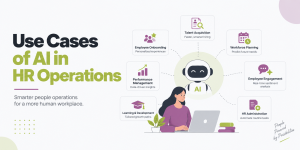
Modern AI HR agents can handle a surprisingly broad range of functions across the employee lifecycle. Here’s what they’re capable of:
Core capabilities of an AI HR agent
What an AI HR agent can do across the employee lifecycle
Employee self-service
Answers policy, benefits, and payroll questions instantly — 24/7, without an HR rep in the loop.
Recruitment support
Screens resumes, ranks candidates, schedules interviews, and sends follow-up messages automatically.
Onboarding automation
Guides new hires through checklists, document reminders, and orientation questions step by step.
Leave management
Handles leave requests conversationally — checks balances, notifies managers, and updates records in real time.
Performance support
Manages review cycles, sends reminders, aggregates feedback, and helps managers write balanced evaluations.
HR analytics
Surfaces workforce insights on demand — attrition rates, headcount trends, and DEI metrics — from a simple question.
Powering it all: LLMs + integrations + RAG
AI HR agents combine large language models for reasoning, tool integrations with your HRIS & calendar, and retrieval-augmented generation to ground answers in your actual company policies.
1. Employee Self-Service and Policy Assistance
One of the most immediate use cases is fielding employee questions. “How many sick days do I have left?” “What’s the process for requesting parental leave?” “When does open enrollment close?” These questions flood HR inboxes daily. An AI HR agent can answer them instantly, accurately, and at any hour — pulling from your company’s HR documentation, policy manuals, and live data from your HRIS.
2. Recruitment and Talent Acquisition Support
AI HR agents can significantly accelerate hiring. They can screen resumes against job requirements, rank candidates based on fit, schedule interviews automatically by syncing with calendars, and send personalized follow-up communications to applicants. Some agents can even conduct initial screening conversations, asking structured questions and evaluating responses before passing shortlisted candidates to a human recruiter.
3. Onboarding Automation
The first few weeks of a new hire’s experience can be chaotic. An AI HR agent can guide employees through onboarding checklists, send reminders for pending documents, answer orientation questions, introduce them to company tools and policies, and ensure nothing falls through the cracks — all without placing an extra burden on the HR team.
4. Leave and Absence Management
Requesting and approving leave involves multiple steps: checking balances, submitting forms, notifying managers, and updating records. An AI HR agent can manage this entire workflow, handling requests conversationally and updating systems in real time.
5. Performance Management Support
AI HR agents can assist with structuring review cycles, sending reminders for self-assessments and manager reviews, aggregating feedback, and even helping managers write more balanced and constructive performance summaries.
6. HR Analytics and Reporting
Rather than waiting for an HR analyst to pull a report, managers and HR leaders can ask an AI agent questions like “What’s our 90-day attrition rate for the engineering team?” and receive an instant, data-driven answer — provided the agent is integrated with the relevant HR systems.
How AI HR Agents Work
Under the hood, an AI HR agent typically combines several technologies:
- A large language model (LLM) — the reasoning engine that understands natural language, generates responses, and carries on coherent conversations.
- Tool use and integrations — connections to HR platforms (Workday, BambooHR, SAP SuccessFactors), calendars, document storage, and communication tools that allow the agent to take real actions, not just provide information.
- Retrieval-Augmented Generation (RAG) — a technique that lets the agent pull from your specific HR documents and knowledge base, ensuring responses are grounded in your company’s actual policies rather than generic information.
- Workflow orchestration — the ability to execute multi-step processes, such as receiving a leave request, checking balances, notifying a manager, and updating the HR system in a single seamless flow.
The Business Case: Why It Matters
The adoption of AI HR agents isn’t just a technology trend — it addresses real pain points with measurable outcomes.
Scale without headcount. A growing company’s HR queries grow with it. An AI agent handles volume elastically, whether you have 50 employees or 50,000, without adding proportional HR staff.
Faster response times. Employees no longer wait days for HR to respond to routine questions. Instant answers improve satisfaction and reduce frustration.
Reduced administrative burden. Studies suggest HR professionals spend 40–60% of their time on administrative tasks. Automating these frees them for higher-value work: talent strategy, culture building, and complex employee relations.
Consistency and compliance. Human beings make mistakes, especially when answering the same policy question for the hundredth time. An AI agent delivers consistent, policy-aligned responses every time, reducing compliance risk.
Data-driven HR decisions. With an AI agent aggregating and surfacing HR data, leaders gain faster access to workforce insights that were previously locked inside spreadsheets.
Challenges and Considerations
Implementing an AI HR agent isn’t without its challenges. Organizations should be thoughtful about:
Data privacy and security. HR data is among the most sensitive information a company holds. Any AI agent deployed in this space must meet strict data governance standards and comply with applicable regulations (GDPR, for instance).
Bias and fairness. AI systems trained on historical data can inadvertently perpetuate biases, particularly in recruitment. Regular auditing and human oversight of AI-assisted hiring decisions is essential.
Employee trust. Some employees may feel uncomfortable interacting with an AI for sensitive HR matters — especially around mental health, performance concerns, or harassment. Clear communication about when a human HR professional will step in is critical.
Integration complexity. Connecting an AI agent to existing HRIS, payroll, and communication platforms requires technical investment and careful planning.
The human-in-the-loop. The most effective implementations treat AI agents as force multipliers for human HR teams, not replacements. Complex, sensitive, or ambiguous situations should always escalate to a human.
The Future of AI in HR
The AI HR agent market is evolving rapidly. Early deployments focused on simple Q&A; next-generation agents are handling end-to-end workflows, proactively identifying issues like flight-risk employees or DEI gaps, and serving as a continuous intelligence layer across the entire people function.
What’s becoming clear is that organizations that deploy AI HR agents thoughtfully — with strong data governance, a human-centered design philosophy, and genuine integration into HR workflows — are positioning themselves to build more responsive, efficient, and employee-friendly HR functions.
In Summary
An AI HR agent is an intelligent, autonomous system that handles a wide spectrum of HR tasks — from answering employee questions to supporting recruitment, onboarding, leave management, and analytics. Unlike basic chatbots, these agents reason, take action, and integrate with your existing HR stack.
They are not a replacement for human HR professionals. They are, however, a powerful tool for eliminating the administrative overhead that keeps HR teams from doing their most important work: supporting the people who make an organization run.
As AI capabilities continue to advance, the question for HR leaders is no longer whether to adopt AI agents — but how to do so in a way that genuinely serves both the business and its people.
FAQs-
Will an AI HR agent replace human HR professionals?
No. AI HR agents are designed to handle repetitive, high-volume administrative tasks — not to replace the judgment, empathy, and strategic thinking that human HR professionals bring. In fact, by taking routine work off their plate, AI agents free HR teams to spend more time on complex employee relations, culture building, and workforce strategy. Think of it as augmentation, not replacement.
Is employee data safe with an AI HR agent?
Data security depends heavily on the platform and how it’s implemented. Reputable AI HR solutions are built with enterprise-grade security — encryption, role-based access controls, and compliance with regulations like GDPR and HIPAA where applicable. Before deploying any AI agent, organizations should conduct thorough vendor due diligence, review data handling policies, and ensure the system meets their internal security standards.
Can an AI HR agent handle sensitive issues like harassment complaints or mental health concerns?
Not on its own — and it shouldn’t try to. AI HR agents are well-suited for informational and transactional tasks. For sensitive, emotionally complex, or legally delicate matters such as harassment complaints, mental health disclosures, or disciplinary issues, the agent should immediately escalate to a human HR professional. A well-designed AI HR agent knows its limits and creates a clear handoff path.
How long does it take to implement an AI HR agent?
At Stello, it takes us two weeks or less to implement an AI Agent.
Do employees actually use AI HR agents, or do they prefer talking to a person?
Adoption rates are generally high for routine, transactional queries — employees appreciate getting an instant answer at 11pm rather than waiting until the next business day. However, preference for human interaction increases with the sensitivity and complexity of the issue. The most successful deployments make it easy for employees to reach a human whenever they want, positioning the AI agent as a first point of contact rather than a gatekeeper.