Compensation teams sit on some of the richest data in any organization. Pay history, market benchmarks, equity schedules, performance ratings, organizational hierarchies. And yet most spend their days buried in reactive work. Fielding manager questions about offer ranges. Reconciling survey data across spreadsheets. Building analyses that take days and get presented in minutes.
According to Pave’s AI Pulse Survey, over half of compensation teams now face moderate to extreme pressure from leadership to adopt AI tools. Yet only 16% report using compensation-specific AI tools today.
The gap between leadership expectations and on-the-ground reality is not a technology problem. It is a trust and readiness problem. AI agents are a distinct category from the chatbots and copilots most teams have already experimented with, and they are what close it. Not by removing humans from compensation decisions, but by giving every comp professional the analytical firepower of a much larger team.
TL;DR
AI agents in compensation, explained in 60 seconds
- Over half of compensation teams face moderate to extreme pressure from leadership to adopt AI tools, yet only 16% report using compensation-specific AI today.
- AI agents are a distinct category from chatbots and copilots. They monitor continuously, execute multi-step workflows autonomously, and surface issues proactively rather than waiting to be asked.
- The five highest-value use cases for AI agents in compensation are real-time benchmarking, pay equity monitoring, merit cycle support, offer and promotion decisions, and incentive and variable pay.
- AI agents handling commission processing deliver measurably higher payout accuracy and a significant reduction in admin time compared to manual processes.
- The most important shift AI agents enable is not speed on individual tasks. It is moving comp teams from reactive work to strategic work.
- Organizations using AI extensively in compensation report a 67% preparedness rate for market shifts, compared to significantly lower rates among light users.
- Three non-negotiables for safe deployment: human approval on final pay decisions, full transparency on how recommendations are generated, and clean data and job architecture as the foundation.
- Before deploying an AI compensation agent, five things need to be in place: clean job architecture, connected compensation data, a documented pay philosophy, a defined governance model, and clarity on starting use cases.
- AI agents are not a replacement for compensation managers. They handle the analytical and administrative load so comp professionals can focus on strategy and judgment calls.
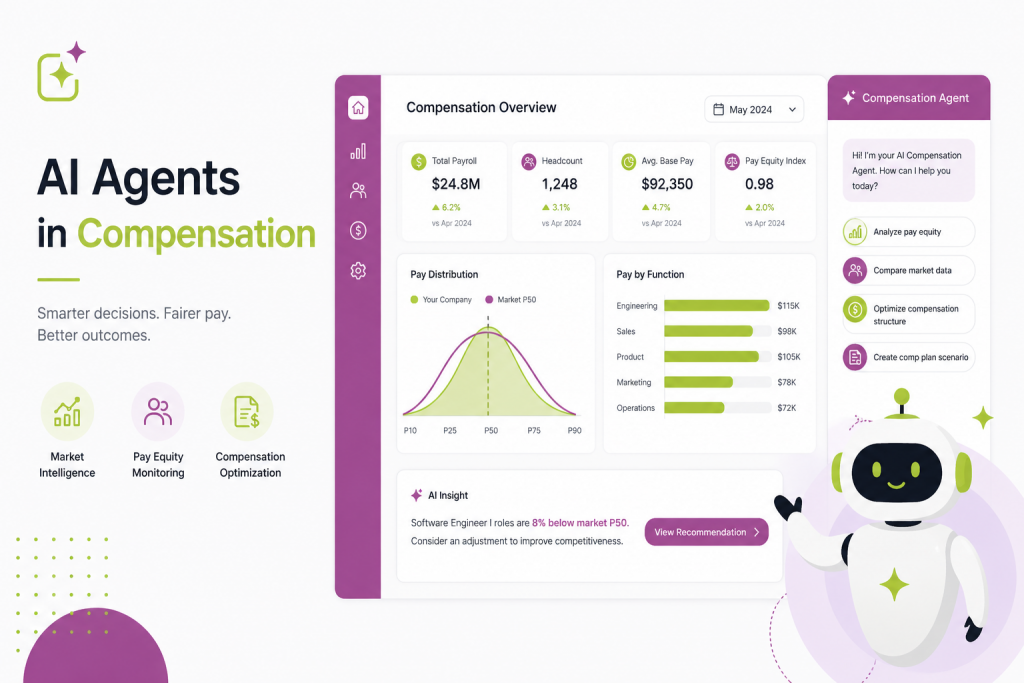
- Stello AI’s Compensation Agent works across benchmarking, equity monitoring, merit cycle support, and offer recommendations, with human governance built into every decision point.
AI Agents vs. AI Tools – Why the Distinction Matters
Most comp teams have already experimented with AI in some form. A chatbot that answers benefits questions. A copilot that drafts job descriptions or summarizes survey data. These tools are useful, but they are not agents.
The difference is autonomy. A copilot helps you draft the email explaining a pay decision. An agent pulls the benchmark data, compares it against internal equity, flags the compression risk, and then helps you draft the communication, all in one interaction, without you managing each step manually.
This distinction matters because the market is flooded with what Gartner calls “agentwashing” — vendors that rebrand basic chatbots as agents by claiming autonomy or integration to justify the label. A real AI agent in compensation does three things a copilot cannot: it monitors continuously rather than responding on demand, it executes multi-step workflows rather than completing single tasks, and it surfaces issues proactively rather than waiting to be asked.
For comp teams evaluating tools in 2026, the right question is not whether a platform uses AI. It is whether the AI acts or just advises.
What AI Agents Actually Do in Compensation
The use cases for AI agents in compensation are more specific and more proven than most vendor marketing suggests. Here is where they are delivering real results today.
Real-time benchmarking
Monitors market movement continuously and flags when a role drifts outside its band.
Outcome: always-current salary bands, no stale survey lag
Pay equity monitoring
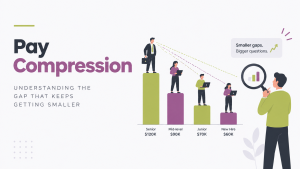
Flags compression within bands and equity drift across teams before they become legal or retention problems.
Outcome: continuous equity analysis, not annual audits
Merit cycle support
Analyzes performance data, market positioning, and internal equity to recommend increases at scale.
Outcome: days of modeling compressed into hours
Offers and promotions
Brings comp strategy into every offer, giving recruiters access to approved ranges without waiting on comp team reviews.
Outcome: faster offers, comp oversight maintained
Rather than running an annual survey cycle and hoping the data holds for twelve months, AI agents monitor market movement continuously. They flag when a role drifts outside its band, surface emerging premiums for in-demand skills, and generate market analyses in minutes rather than weeks. According to Salary.com, this kind of real-time intelligence is no longer optional in a market where role-level salary movement can shift significantly within a single quarter.
Pay equity monitoring
Agents monitor compensation data continuously across teams, levels, and demographics, flagging compression building within a band, equity drift across groups, and anomalies in promotion or bonus patterns before they become retention problems or legal liabilities. The shift from annual equity audits to continuous monitoring is one of the highest-value changes AI agents enable for comp teams.
Merit cycle support
AI agents analyze performance data, market positioning, and internal equity simultaneously to recommend merit increases and promotional adjustments at scale. What previously required days of manual modeling across spreadsheets gets compressed into hours, with recommendations that are documented, consistent, and defensible.
Offer and promotion decisions
Partner-style agents bring comp strategy directly into the offer workflow, giving recruiters access to real-time benchmarks and approved ranges without requiring a comp team review on every hire. Comp maintains oversight and control while the speed of execution improves significantly.
Incentive and variable pay
AI agents handling commission processing deliver measurably higher payout accuracy and a significant reduction in admin time. For event-driven variable pay, agents track project milestones in real time, calculate spot bonuses automatically as work is completed, and route approvals for manager review without waiting for a merit cycle.
Also read: Types of Compensation in HRM: A Full Breakdown
The Strategic Shift – From Reactive to Proactive
The most important thing AI agents change in compensation is not the speed of any individual task. It is what comp teams spend their time on.
When an agent handles the first draft of a market analysis, fields routine manager questions about offer ranges, and flags anomalies before anyone has to go looking for them, the comp team’s attention shifts. Less time answering questions. More time shaping the strategy behind the answers.
This is the advisory-to-agentic shift playing out across compensation in 2026. Most organizations that have adopted AI in comp started with tools that surface data and stopped there. The teams pulling ahead are the ones that have moved to tools that act on data, continuously and across the full compensation workflow.
The performance gap between the two approaches is becoming measurable. According to CaptivateIQ’s 2026 State of Incentive Compensation Report, organizations using AI extensively in compensation report a 67% preparedness rate for market shifts, compared to significantly lower rates among light users. Organizations that connect planning and incentives end-to-end report nearly double the rate of significant revenue growth compared to those with no plans to expand AI use.
The implication is straightforward. Adopting AI in compensation is no longer a differentiator. Using it well is.
Also read: The State of AI in Compensation Management: 2026 Stats and Trends
Where AI Agents Add Leverage Without Adding Risk
The case for AI agents in compensation is strong. The risks of deploying them without the right guardrails are equally real. Three things have to be true for AI agents to add leverage rather than create new problems.
Human approval on final pay decisions
AI agents should surface recommendations, not make unilateral calls. Every pay decision that affects an individual employee — a merit increase, a promotion adjustment, an offer — needs a human reviewing and approving the final outcome. This is not a limitation of the technology. It is what makes AI-driven compensation defensible internally, legally, and ethically. Organizations that treat agent recommendations as a starting point rather than a final answer get the efficiency gains without the governance risk.
Full transparency on how recommendations are generated
Employees and managers are increasingly asking how pay decisions are made. An AI agent that produces a recommendation without a traceable rationale creates more trust problems than it solves. The best implementations document the logic behind every recommendation — the market data used, the internal equity factors considered, the bands applied — so that any decision can be explained clearly by the manager delivering it.
Clean data and job architecture as the foundation
An AI agent is only as reliable as the data it runs on. Fragmented compensation data across disconnected systems, inconsistent job leveling, and undefined pay philosophy all produce agent recommendations that reflect existing problems rather than solving them. Organizations that invest in data infrastructure and job architecture before deploying agents see significantly faster and more reliable results. Those that skip this step tend to automate the mess rather than fix it.
How to Know If Your Team Is Ready
The technology is available. The use cases are proven. Whether your team is ready to deploy an AI compensation agent comes down to five questions.
Is your job architecture clean and consistently leveled?
AI agents benchmark, model, and recommend based on how roles are defined and leveled across the organization. If your job framework is inconsistent, incomplete, or has not been reviewed recently, agent recommendations will reflect that inconsistency. Clean job architecture is the single most important prerequisite for reliable AI output in compensation.
Is your compensation data connected across systems?
Pay data in one system, benefits in another, performance in a third. This is the norm for most organizations and the biggest practical barrier to agentic AI delivering on its promise. Before deploying an agent, map where your compensation data lives and whether it can be accessed and connected in a single workflow.
Do you have a defined compensation philosophy?
An AI agent executes against a strategy. If the strategy is unclear or undocumented, the agent has no anchor for its recommendations. A documented compensation philosophy — covering market positioning, pay mix, equity approach, and performance differentiation — is what gives agent output consistency and defensibility.
Does your governance model include human review at final decision points?
Before deploying, define exactly where human approval is required. Which decisions can agents recommend autonomously? Which require manager sign-off? Which require comp team review? Organizations that define this upfront avoid the governance gaps that create trust problems later.
Have you defined where you want AI to act versus advise?
Not every part of the compensation workflow needs an agent. Starting with a specific, high-volume use case — merit cycle support, benchmarking, offer recommendations — and expanding from there is consistently more effective than trying to deploy across the entire function at once.
If your team can answer yes to most of these, you are ready to move. If several are still works in progress, the foundation work is the right starting point — not the tool.
Where Stello AI Fits In
Stello AI’s Compensation Agent is built for exactly the kind of deployment this article describes. It works across the full compensation workflow — real-time benchmarking, continuous pay equity monitoring, merit cycle support, and offer recommendations — with human governance built into every decision point.
For comp teams that are ready to move from reactive to strategic, it gives every member of the team the analytical depth of a much larger function. For organizations still building the foundation, Stello AI helps establish the job architecture, data connectivity, and compensation philosophy that make agent deployment reliable and defensible.
The result is a compensation program that does not wait for the next planning cycle to catch up with what is happening in the market, the organization, or the workforce.
See Stello AI’s Compensation Agent in action → Book a Demo
FAQs-
What is an AI compensation agent?
An AI compensation agent is a system that takes autonomous action across compensation workflows rather than simply answering questions or surfacing data. It monitors salary bands continuously, flags equity gaps, supports merit cycle modeling, and routes recommendations for human approval, without requiring a comp professional to initiate each step manually.
How is an AI agent different from a chatbot or copilot?
A chatbot responds to questions. A copilot assists with single tasks like drafting a document or summarizing data. An agent executes multi-step workflows autonomously, monitors continuously, and surfaces issues proactively. The difference is not cosmetic. It determines whether the tool saves minutes on individual tasks or fundamentally changes what the comp team spends its time on.
Are AI agents safe to use for pay decisions?
Yes, when deployed with the right guardrails. Human approval on final pay decisions, full transparency on how recommendations are generated, and clean underlying data are the three non-negotiables. AI agents that operate as black boxes or make unilateral pay decisions without human review are not ready for enterprise compensation use.
What do I need in place before deploying an AI compensation agent?
Clean job architecture, connected compensation data, a documented compensation philosophy, a defined governance model, and clarity on which specific use cases you are starting with. Organizations that have these foundations in place before deployment see significantly faster and more reliable results.
Can AI agents replace compensation managers?
No, and the best implementations are not designed to. AI agents handle the analytical and administrative work that consumes comp team bandwidth, freeing professionals to focus on strategy, stakeholder relationships, and the judgment calls that require human expertise. The goal is leverage, not replacement.