Compensation is one of the most consequential decisions an organization makes about its people. It affects who joins, who stays, how fairly employees are treated, and increasingly, whether the organization stays compliant with a growing body of pay transparency legislation. The stakes make HR leaders cautious — and rightfully so.
That caution shows up in the data. According to a February 2026 Korn Ferry survey, 57% of organizations have not yet begun to experiment with AI in total rewards, despite leadership pressure to adopt being at an all-time high. The hesitation is not a technology problem. It is a trust problem rooted in legitimate questions about what AI compensation agents actually deliver and where they fall short.
This article gives HR leaders an honest answer to both. The benefits are real and increasingly well-documented. So are the limitations. Understanding both clearly is what separates organizations that deploy AI compensation agents successfully from those that automate the wrong things and spend months cleaning up the consequences.
TL;DR
Benefits and limitations of AI compensation agents, explained in 60 seconds
- 57% of organizations have not yet begun to experiment with AI in total rewards, despite growing leadership pressure to adopt — the hesitation is a trust problem, not a technology problem.
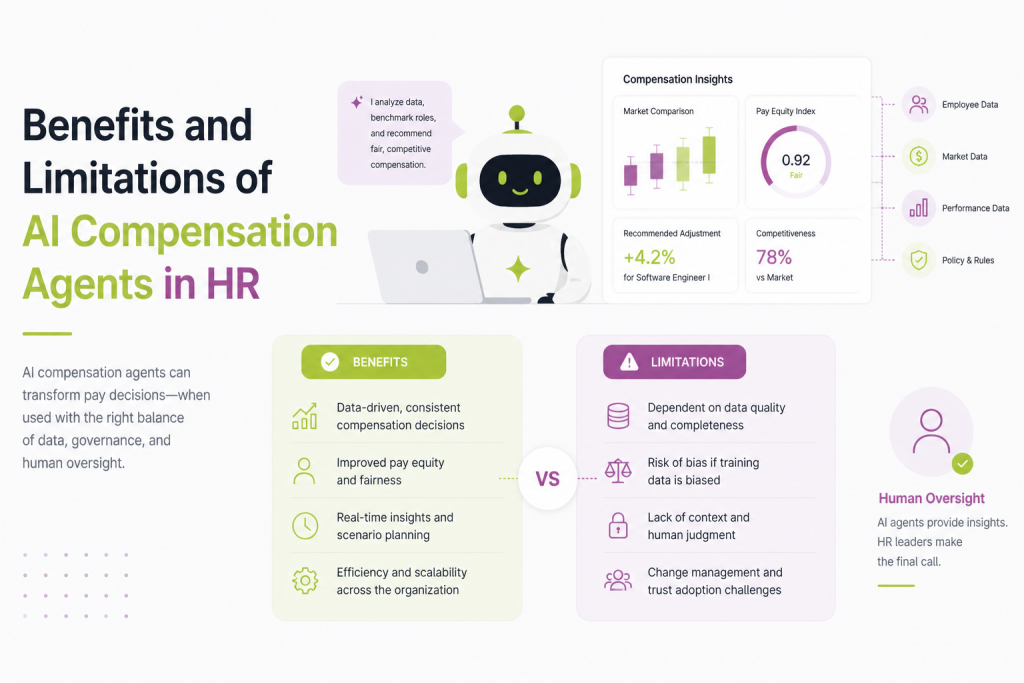
- The five core benefits of AI compensation agents are speed and scale, continuous pay equity monitoring, better decisions at every level, personalization at scale, and compliance readiness.
- AI agents shift pay equity analysis from an annual audit to a continuous function, flagging compression and demographic gaps while budget is still available to fix them.
- The most significant limitation is data quality. AI agents reflect the problems in the data they run on. Deploying before fixing data infrastructure automates the mess, not the solution.
- AI cannot replace human judgment on sensitive pay decisions. It cannot understand team dynamics, deliver difficult feedback, or align a decision with company culture and values.
- Bias risk is real. AI trained on historical pay data that contains inequities will reflect and potentially scale those inequities across the organization.
- Not every tool marketed as an AI compensation agent is genuinely agentic. Evaluating what a tool actually does versus what its marketing claims is a necessary step before any deployment decision.
- Only 8% of HR leaders say their teams have the right AI skills to evaluate, deploy, and oversee AI compensation tools effectively.
- Four principles for safe deployment: treat AI as decision support not an autonomous decision-maker, fix data and job architecture first, build governance in from day one, and upskill comp teams alongside tool deployment.
- Stello AI’s Compensation Agent is built with transparent recommendation logic and human approval at every decision point, giving comp teams analytical depth without removing human accountability.
The Benefits of AI Compensation Agents in HR
When deployed on a solid foundation, AI compensation agents deliver measurable improvements across five areas that matter most to comp teams and HR leaders.
Speed and scale that humans cannot match
The volume of data involved in modern compensation management — pay history, market benchmarks, equity schedules, performance ratings, organizational hierarchies across hundreds or thousands of roles — is simply beyond what comp teams can process manually at the speed the market now demands. AI compensation agents analyze thousands of employee records, benchmark roles against real-time market data, and model budget scenarios in minutes rather than days. For lean HR teams without a dedicated total rewards function, that scale difference is transformative.
Continuous pay equity monitoring
Most organizations run pay equity analysis once a year, during the comp planning cycle. By the time an issue surfaces, budget is often already locked and the damage — attrition, employee trust erosion, legal exposure — is already building. AI agents shift equity analysis from an annual exercise to a continuous one, flagging compression within bands, equity drift across teams, and demographic pay gaps while budget is still available to correct them.
Better decisions at every level
AI compensation agents do not just help comp teams. They bring comp strategy into every hiring decision, every promotion conversation, and every manager interaction. Recruiters get access to real-time benchmarks and approved ranges without waiting on comp team reviews. Managers get documented rationale for pay decisions they need to communicate clearly. The quality and consistency of pay decisions improves across the entire organization, not just within the comp function.
Personalization at scale
Manually customizing total rewards packages for every employee is not operationally possible for most organizations. AI agents make it possible by analyzing individual data — life stage, role, financial goals, enrollment history — and surfacing tailored recommendations within defined guardrails. Employees get a benefits and rewards experience that reflects their actual situation rather than a one-size-fits-all package built for the median employee.
Compliance readiness
As pay transparency regulations expand across U.S. states and the EU Pay Transparency Directive takes effect, continuous compliance monitoring is becoming a necessity rather than a differentiator. AI agents monitor compensation data against regulatory requirements continuously, flagging gaps before they become audit findings, legal liabilities, or employee relations issues.
The case for AI compensation agents is strong. But deploying them without a clear understanding of their limitations is where most organizations run into trouble. Here is where the risks actually sit.
The Real Limitations of AI Compensation Agents
Understanding these limitations is not a reason to delay adoption. It is the difference between a deployment that delivers and one that creates new problems alongside the old ones.
Garbage in, garbage out
AI agents are only as reliable as the data and job architecture they run on. Fragmented compensation data across disconnected systems, inconsistent role leveling, and an undefined pay philosophy all produce recommendations that reflect existing problems rather than solving them. Organizations that deploy AI before fixing their data foundation do not automate better compensation management. They automate the mess.
AI cannot replace human judgment on sensitive decisions
AI can produce charts, model scenarios, and surface benchmarks. It cannot understand team dynamics, read the context behind a performance situation, deliver sensitive feedback, or align a pay decision with company culture and values. These are the moments that determine whether an employee feels fairly treated or starts updating their resume. That judgment belongs to humans, and the best AI compensation implementations are designed to support it rather than replace it.
Bias risk
If historical pay data contains inequities — and in most organizations it does — AI trained on that data will reflect and potentially scale those inequities. An agent that recommends salary ranges based on patterns in past pay decisions may systematically recommend lower ranges for roles historically underpaid by demographic group. This is not a theoretical risk. It is an active governance challenge that requires regular auditing of agent recommendations and diverse training data as a baseline requirement.
The agentwashing problem
Not every tool marketed as an AI compensation agent is genuinely agentic. Many are rebranded dashboards or chatbots with limited autonomous capability dressed up in agent language. Deploying the wrong tool wastes implementation time, produces underwhelming results, and erodes organizational confidence in AI adoption more broadly. Evaluating what a tool actually does versus what its marketing claims is a necessary step before any deployment decision.
Governance gaps
AI introduces new ambiguity around what should be rewarded, increases the risk of inconsistency in performance-linked pay evaluations, and complicates already difficult compensation decisions. Without a clear governance model covering human approval checkpoints, documented recommendation logic, and a defined dispute process, automation accelerates problems rather than solving them.
Internal expertise gap
According to Gartner, only 8% of HR leaders say their teams have the right AI skills to evaluate, deploy, and oversee AI compensation tools effectively. Deploying a sophisticated tool into a team that lacks the skills to interrogate its outputs, identify anomalies, and course-correct when something goes wrong is a governance risk as significant as any of the above.