Compensation leaders navigate some of the most expensive and high-impact decisions in business, yet most are still armed with tools from the spreadsheet era.
The numbers tell a troubling story: according to Gartner’s 2024 research, 60% of organizations rely on spreadsheets or static surveys to guide new hire salary offers. Every mispriced hire can cost up to $50,000 in turnover or retention adjustments. HR and Finance teams spend weeks every year building budgets and headcount plans, manually piecing together market data across disconnected systems. Perhaps most alarming, 1 in 3 organizations face employee trust issues due to pay inconsistencies that often go undetected until it’s too late.
The stakes are simply too high, and traditional approaches are breaking down under the weight of modern complexity. Enter AI compensation agents — intelligent systems that are fundamentally transforming how enterprises make critical pay decisions, turning weeks of manual work into seconds of strategic insight.
What AI Compensation Agents Do
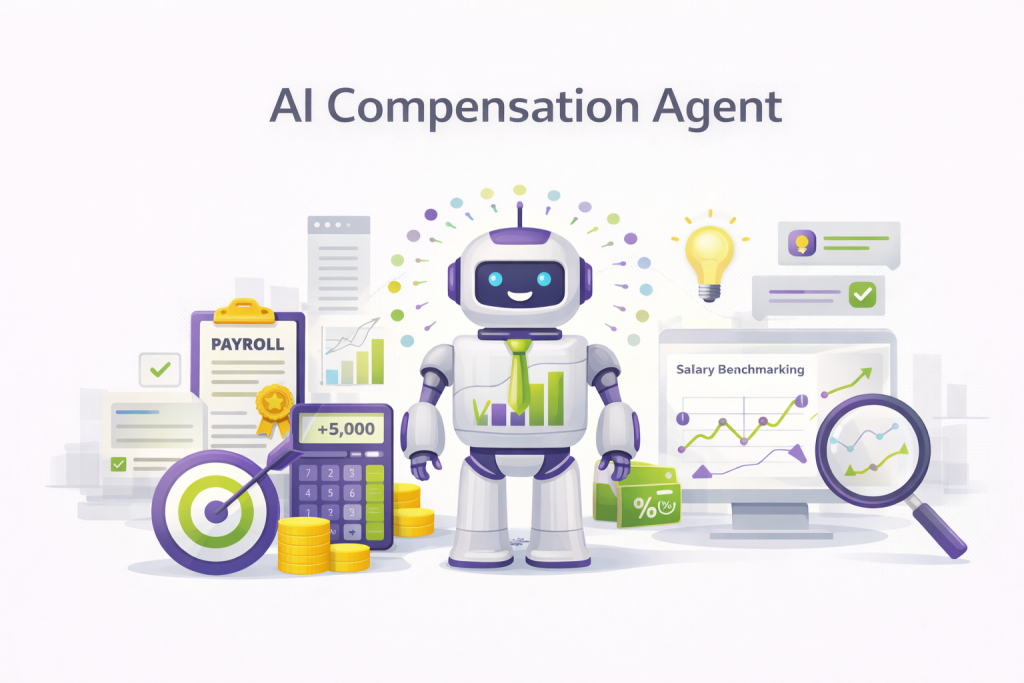
AI compensation agents represent a fundamental shift from static software to intelligent assistants. Unlike traditional compensation tools that simply store data, these systems analyze, reason, and recommend — combining internal employee data, real-time market benchmarks, and your organization’s compensation philosophy to deliver insights comparable to a senior compensation analyst, but in seconds rather than days.
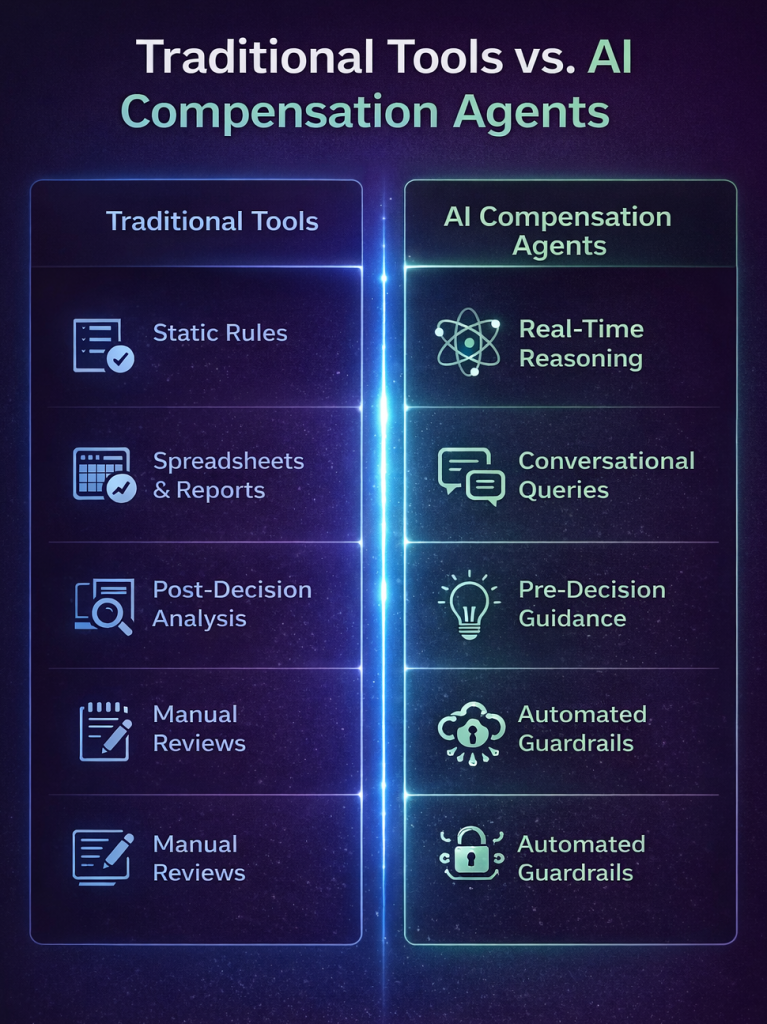
These agents excel across three critical capabilities:
- New Hire Offer Optimization: Analyzes salary ranges and market data to recommend competitive offers that maintain internal equity
- Budget Planning and Scenario Modeling: Allows leaders to run multiple compensation models simultaneously, instantly seeing impacts across departments, levels, and geographies
- Pay Equity Analysis: Continuously monitors for compensation gaps, flagging issues before they escalate into trust problems or legal exposure
The transformation is profound: what once required weeks of manual spreadsheet work now happens through conversational queries, freeing compensation leaders to focus on strategy rather than data wrangling.
How AI Compensation Agents Help Enterprise Companies
Enterprise organizations face compensation challenges at a scale that makes manual processes nearly impossible. With thousands of employees across multiple countries, departments, and job levels, maintaining pay equity and competitive positioning becomes exponentially complex. AI compensation agents transform this complexity into a manageable, strategic advantage.
These systems help enterprises in critical ways:
- Speed at Scale: Analyze compensation data for thousands of employees in seconds, enabling rapid decision-making during critical hiring periods or budget cycles
- Consistency Across Geographies: Apply compensation philosophy uniformly across global operations while accounting for local market variations and regulatory requirements
- Risk Mitigation: Identify pay equity issues before they become expensive legal problems or damage employer brand across large, diverse workforces
- Strategic Resource Allocation: Free compensation teams from manual analysis to focus on strategic initiatives like total rewards design and talent retention strategies
For enterprises managing complex, global compensation structures, AI agents aren’t just helpful, they’re becoming essential infrastructure for maintaining competitive advantage while managing cost and compliance risk.
Key Use Cases Enterprises Are Automating
Enterprise organizations are rapidly adopting AI compensation agents to automate decisions that once consumed weeks of manual work. What started with basic salary benchmarking has evolved into comprehensive automation across the entire compensation lifecycle. These use cases represent the frontline of transformation in enterprise compensation management.
AI agents are now automating critical decisions across five key areas:
- Merit and Promotion Decisions: Analyze performance data, market positioning, and internal equity to recommend appropriate increases and promotional adjustments at scale
- Incentive and Bonus Allocation: Calculate fair distribution of variable pay based on performance metrics, organizational goals, and budget constraints
- Equity Grants and Refresh Cycles: Determine competitive equity packages aligned with market data, retention goals, and dilution parameters
- Pay Equity and Compliance Checks: Continuously audit compensation for disparities and regulatory compliance across protected classes and geographies
- Budget Forecasting and Scenario Modeling: Project compensation costs under multiple scenarios, enabling strategic planning with real-time impact analysis
These aren’t future capabilities — they’re how leading enterprises are operating today, turning compensation from a reactive cost center into a strategic, data-driven function.
The Role of Stello in AI-Led Compensation Decisions
As enterprises evaluate AI compensation solutions, understanding how leading platforms approach this challenge provides valuable context. Stello’s Iconic AI platform offers a practical example of how modern compensation agents integrate into enterprise decision-making frameworks.
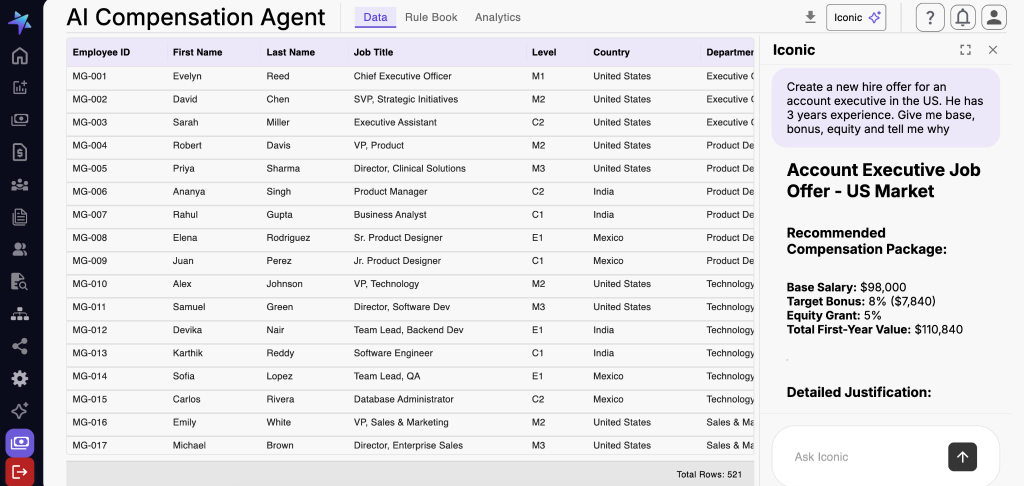
Compensation as an Ongoing Decision System
Traditional compensation tools treat pay decisions as discrete events; annual reviews, hiring moments, promotion cycles. Stello approaches compensation differently: as a continuous decision system that responds to changing business conditions, market dynamics, and organizational needs. Rather than providing point-in-time answers, ICONIC maintains an always-current view of compensation positioning, enabling leaders to make informed decisions whenever they’re needed, not just during scheduled cycles.
This ongoing approach is powered by Stello’s patent-pending Multi-Agent RAG Model, which creates a custom AI instance for each client. Unlike one-size-fits-all solutions, each enterprise gets an agent trained on their specific data, compensation philosophy, and organizational structure, ensuring recommendations align with company values rather than generic best practices.
AI-Assisted Recommendations with Financial Guardrails
One critical distinction in Stello’s approach is the combination of AI intelligence with deterministic financial controls. When calculating budget impacts or analyzing equity, precision matters — a miscalculation can cost tens of thousands of dollars. Iconic AI combines LLM capabilities with deterministic results, reducing AI hallucinations while maintaining the conversational intelligence that makes the system intuitive to use.
The platform provides AI-assisted recommendations across the compensation lifecycle:
- Merit and promotion decisions supported by performance data, market positioning, and internal equity analysis
- Incentive and bonus allocation that balances individual performance against budget constraints and organizational goals
- Equity grant modeling aligned with market data, retention objectives, and dilution parameters
- Real-time pay equity monitoring that flags disparities before they escalate into compliance or trust issues
- Budget scenario planning that shows immediate impact across levels, departments, and geographies
Built for Finance-Led Compensation Governance
Stello recognizes that in most enterprises, compensation decisions ultimately flow through finance. Iconic AI is architected for finance-led governance, providing the audit trails, approval workflows, and cost controls that CFO organizations require. The platform doesn’t replace human judgment — it augments it with data and analysis, ensuring decisions are both strategically sound and financially disciplined.
Where Stello Fits in the Enterprise Tech Stack
Iconic AI integrates into existing compensation infrastructure rather than requiring a rip-and-replace approach. The platform connects with HRIS systems for employee data, pulls from market data providers for benchmarking, and fits into financial planning tools for budget management. This integration approach allows enterprises to enhance their compensation capabilities without disrupting established workflows.
The platform’s enhanced security infrastructure — with bank-level data protection — ensures sensitive compensation information remains secure across this integrated environment, a critical requirement for enterprises managing pay data across multiple jurisdictions and regulatory frameworks.
The Future of Compensation: From Cycles to Continuous Decisions
The transformation underway extends beyond automation — it represents a fundamental rethinking of how organizations approach pay. Traditional annual cycles are giving way to compensation as a living system that continuously adapts to market conditions, business performance, and individual contributions.
The trajectory points toward increasing autonomy: AI agents that monitor retention risks, recommend preemptive adjustments, and execute approved actions within predefined guardrails. While full autonomy remains years away, the building blocks are already operational.
Just as ERP systems became essential for operations, AI compensation agents are following a similar adoption curve—evolving from experimental technology to fundamental infrastructure for managing one of the largest expense categories with appropriate rigor.
FAQs-
How do AI compensation agents differ from traditional compensation management software?
Traditional compensation software primarily stores and organizes data—it’s a repository. AI compensation agents analyze, reason, and recommend. They combine your internal employee data, real-time market benchmarks, and compensation philosophy to provide insights comparable to a senior analyst, but in seconds. The key difference is intelligence: AI agents understand context and provide strategic recommendations, not just calculations.
Will AI compensation agents replace compensation professionals?
No. AI agents augment human judgment rather than replace it. They handle time-consuming analysis, data gathering, and routine calculations, freeing compensation leaders to focus on strategic decisions that require human insight—like designing total rewards philosophies, managing stakeholder relationships, and making complex judgment calls. Think of AI as eliminating the spreadsheet work, not the strategic thinking.
How do enterprises ensure AI compensation recommendations are accurate and unbiased?
Leading solutions like Stello combine deterministic calculations with AI intelligence to reduce hallucinations and ensure financial precision. Additionally, enterprises implement guardrails: AI provides recommendations within predefined parameters, human approvals are required for final decisions, and continuous monitoring flags potential equity issues. The AI operates within a governance framework, not autonomously.
What data do AI compensation agents need to function effectively?
AI agents require integration with your HRIS for employee data (titles, levels, performance, current compensation), market data providers for benchmarking, and your defined compensation philosophy (salary ranges, pay positioning, equity guidelines). The more comprehensive and clean your data, the more accurate the recommendations. Most enterprise deployments take 4-8 weeks for data integration and calibration.
Are AI compensation agents secure enough for sensitive pay data?
Enterprise-grade AI compensation platforms implement bank-level security with encryption, access controls, audit trails, and compliance frameworks for multi-jurisdictional regulations. Solutions like Stello provide transparent security documentation and maintain the highest security standards. The key is selecting vendors with proven enterprise security infrastructure, not experimental consumer-grade AI tools.