For most organizations, compensation management is still a surprisingly manual process. HR and comp teams spend weeks each cycle pulling salary surveys, cross-referencing job levels, updating spreadsheets, and trying to reconcile what the market is paying against what the budget actually allows.
And the data problem is real. Companies are often working with salary benchmarks that are months, sometimes years, out of date. Market conditions shift fast. A role that was easy to fill at a certain pay band in 2022 might require a completely different number today. Without real-time data, comp decisions are often more educated guesswork than they are science.
The cost adds up too. Compensation reviews, offer approvals, pay equity audits are not lightweight tasks. For a mid-sized company running an annual comp cycle, the hours spent just gathering and cleaning data can run into the hundreds. For enterprise organizations managing thousands of roles across geographies, the complexity becomes almost unmanageable without significant headcount dedicated to it.
Then there’s the consistency problem. When comp decisions are made by different managers across different departments, with different levels of data literacy and different unconscious biases, the result is often a patchwork of pay decisions that create equity gaps over time, even when no one intended them to.
This is the environment AI compensation agents are stepping into.
- Compensation management is still largely manual, slow, and inconsistent
- AI compensation agents automate the data-heavy parts of comp work — benchmarking, pay equity audits, offer generation, and more
- They pull from both external market data and internal HR records to surface recommendations
- The goal is not to replace human judgment — it is to remove the grunt work so comp teams can focus on decisions that actually matter
- Like any AI tool, they are only as good as the data behind them and can encode existing biases if not designed carefully
What is an AI Compensation Agent?
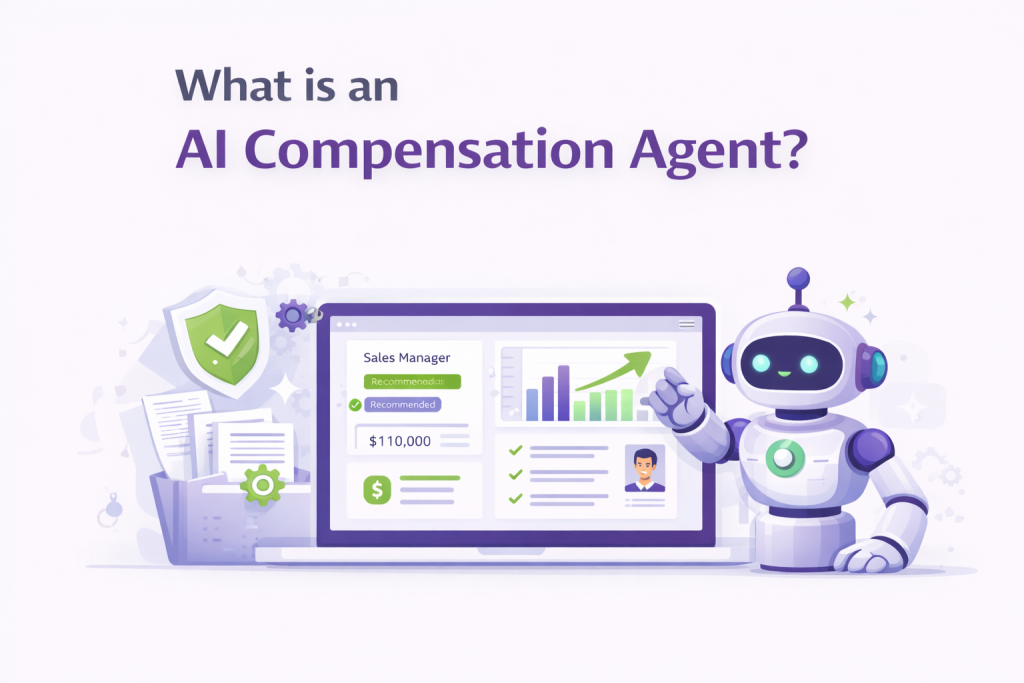
An AI compensation agent is a software system that uses artificial intelligence to automate, assist with, and improve compensation-related decisions and workflows. Think of it as a highly informed analyst that never sleeps, has read every salary survey on the market, and can process thousands of employee records in the time it takes a human team to open a spreadsheet.
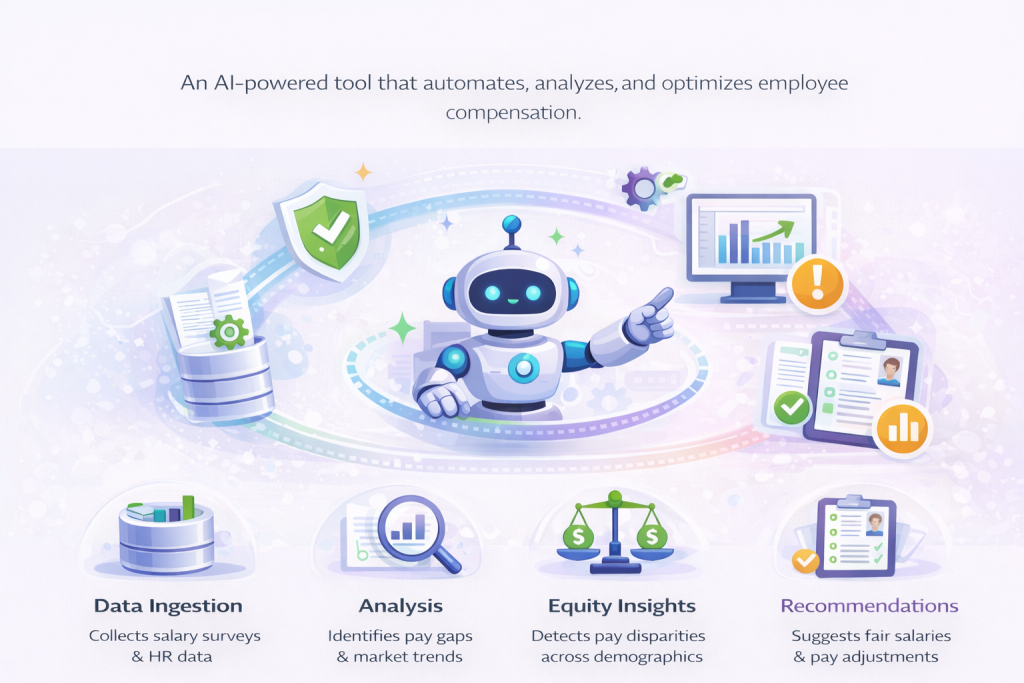
But it is more than just a data tool. What separates an AI compensation agent from a traditional comp platform or salary benchmarking tool is its ability to reason across multiple data sources, flag anomalies, generate recommendations, and in some cases, take action autonomously within defined parameters.
A traditional compensation tool might show you what the market is paying for a software engineer in Austin. An AI compensation agent goes further. It cross-references that market data against your internal pay bands, looks at where your current employees sit within those bands, flags anyone who is significantly underpaid relative to peers, and surfaces a recommended adjustment range, all without someone having to manually build that analysis from scratch.
The “agent” part matters here. In AI terminology, an agent is not just a passive tool that responds to queries. It is a system capable of taking a sequence of actions toward a goal, pulling in the information it needs, reasoning through a problem, and producing an output that is ready to act on. Applied to compensation, that means the system can handle multi-step tasks that would otherwise require significant human coordination.
How an AI Compensation Agent Works
At its core, an AI compensation agent is only as good as the data it can access. Most systems pull from a combination of external and internal sources.
From Raw Data to Comp Decision:
How an AI Compensation Agent Works
External data inputs typically include:
- Labor market data and salary surveys
- Job posting intelligence and hiring trends
- Industry benchmarks by role, level, and geography
Internal data inputs include:
- HR and payroll systems
- Performance reviews and ratings
- Job levels, pay bands, and grade structures
- Tenure, promotion history, and past compensation changes
Once it has that data, the agent does what humans do in a comp review, just faster and at scale. It maps roles to market equivalents, identifies where pay is lagging or leading, surfaces patterns across teams and demographics, and generates recommendations based on predefined rules or learned patterns.
The more sophisticated agents go a step further. They can:
- Detect pay equity issues before they become legal or reputational problems
- Model the budget impact of different compensation scenarios
- Flag retention risks by identifying employees whose pay has fallen meaningfully behind market rates
Where humans stay in the loop matters just as much as what the agent handles on its own. Most AI compensation agents are designed to augment human decision making, not replace it. The agent surfaces the analysis and the recommendation. A comp professional, HR business partner, or manager then reviews it, applies context the system cannot see, and makes the final call. The goal is to take the grunt work off the human’s plate so they can focus on judgment, not data wrangling.
Where AI Compensation Agents Are Being Used
The range of applications is broader than most people expect. While the most obvious use case is salary benchmarking, AI compensation agents are showing up across the entire compensation lifecycle.
Salary benchmarking at scale
Instead of manually pulling survey data and mapping roles one by one, the agent continuously updates market positioning across every role in the organization. What used to take weeks now takes minutes.
Annual comp review cycles
The most time-intensive comp event of the year gets significantly lighter. The agent pre-populates recommendations for every employee based on performance, tenure, market position, and budget, giving managers a starting point rather than a blank slate.
Pay equity audits
The agent can scan the entire organization for statistically significant pay gaps across gender, ethnicity, tenure, and other dimensions, surfacing issues that manual audits often miss simply due to the volume of data involved.
New hire offer generation
When a recruiter needs to put together an offer, the agent can generate a recommended range in real time based on the role, level, location, and current market conditions, keeping offers competitive and internally consistent.
Retention risk flagging
By tracking how individual employee pay compares to market rates over time, the agent can identify people who are at risk of leaving before they start interviewing elsewhere.
Why HR and Comp Teams Are Paying Attention
The appeal of AI compensation agents is not just about speed, though that matters. It is about what becomes possible when the data work is no longer the bottleneck.
Speed and efficiency
Comp cycles that used to take six to eight weeks can be compressed significantly. Teams spend less time gathering and cleaning data and more time on the decisions that actually require human judgment.
Better data visibility
One of the most consistent frustrations in compensation work is not having a clear, real-time picture of where the organization stands relative to the market. AI compensation agents make that visibility continuous rather than something you only get during a formal review cycle.
Reduced inconsistency
When recommendations are generated from the same data and logic across the entire organization, the patchwork problem gets smaller. Managers are working from a shared baseline rather than making calls in isolation.
A stronger case for pay equity
Having a system that continuously monitors for pay gaps gives HR teams both an early warning mechanism and a defensible audit trail. It does not eliminate bias, but it makes it harder for gaps to quietly compound over time.
More strategic use of comp professionals
Perhaps the most underrated benefit. When analysts are not buried in spreadsheets, they can focus on the work that actually moves the needle, things like compensation philosophy, workforce planning, and executive pay strategy.
AI as a Co-Pilot, Not a Replacement
AI compensation agents are not going to replace the humans who do compensation work. The judgment calls, the organizational context, the employee relationships, the ethical weight of pay decisions — none of that goes away because a system can benchmark a role in seconds.
What these tools do is remove the part of the job that was never really the job to begin with. The spreadsheet wrestling, the manual data pulls, the hours spent building analyses that should have been automated years ago. When that work is off the table, comp professionals can focus on what actually matters: making sure people are paid fairly, competitively, and in a way that reflects the value they bring.
The organizations that will get the most out of AI compensation agents are not the ones that hand everything over to the system. They are the ones that use it to ask better questions, catch problems earlier, and make decisions with more confidence than they could before.
Compensation has always been one of the most consequential things a company does. AI is not changing that. It is just raising the bar for how well it can be done.