Compensation is one of the most searched topics in HR, and also one of the most misunderstood. Ask most employees what their compensation is and they will tell you their salary. Ask most HR teams and they will hand you a spreadsheet with fifteen line items. The gap between those two answers is where retention problems quietly begin.
In HRM, compensation is not just what lands in an employee’s bank account every month. It is the full system of financial returns, benefits, equity, and non-monetary rewards an organization offers in exchange for an employee’s time, skills, and contribution. When that system is designed deliberately and communicated clearly, it becomes one of the most powerful levers in talent strategy. When it is not, it becomes a source of confusion, perceived unfairness, and avoidable attrition.
This article breaks down every type of compensation in HRM, what each one does strategically, and how to put them together into a package that works for both the organization and the people in it.
TL;DR
- ● Compensation is more than salary. It includes total rewards.
- ● Employees and HR view pay differently. That gap drives attrition.
- ● Total compensation combines direct pay and indirect benefits.
- ● Direct compensation includes salary, bonuses, commissions, and equity.
- ● Indirect compensation includes benefits, flexibility, and development.
- ● Strong compensation improves hiring, retention, and performance.
- ● Job architecture enables consistent, fair, and scalable pay decisions.
- ● Low transparency reduces trust and perceived pay fairness.
- ● AI enables real-time benchmarking and continuous pay equity checks.
- ● Winning strategies balance pay, communicate clearly, and adapt fast.
What is Compensation in HRM?
Compensation in HRM refers to every form of financial return and tangible benefit an employee receives in exchange for their work. This includes direct cash payments like salary and bonuses, indirect benefits like health insurance and retirement plans, equity in the form of stock options or RSUs, and non-monetary perks ranging from flexible work arrangements to professional development opportunities.
Compensation is not the same as salary, and it is not the same as benefits. It is the combination of all of them — and managing that combination deliberately is one of the most consequential responsibilities in people operations.
Getting compensation right matters for four interconnected reasons. It determines whether an organization can attract the talent it needs. It influences whether employees stay or leave. It shapes how motivated and productive people are in their roles. And increasingly in 2026, it determines whether an organization stays compliant with a growing body of pay transparency and pay equity legislation.
Direct vs. Indirect Compensation – The Core Framework
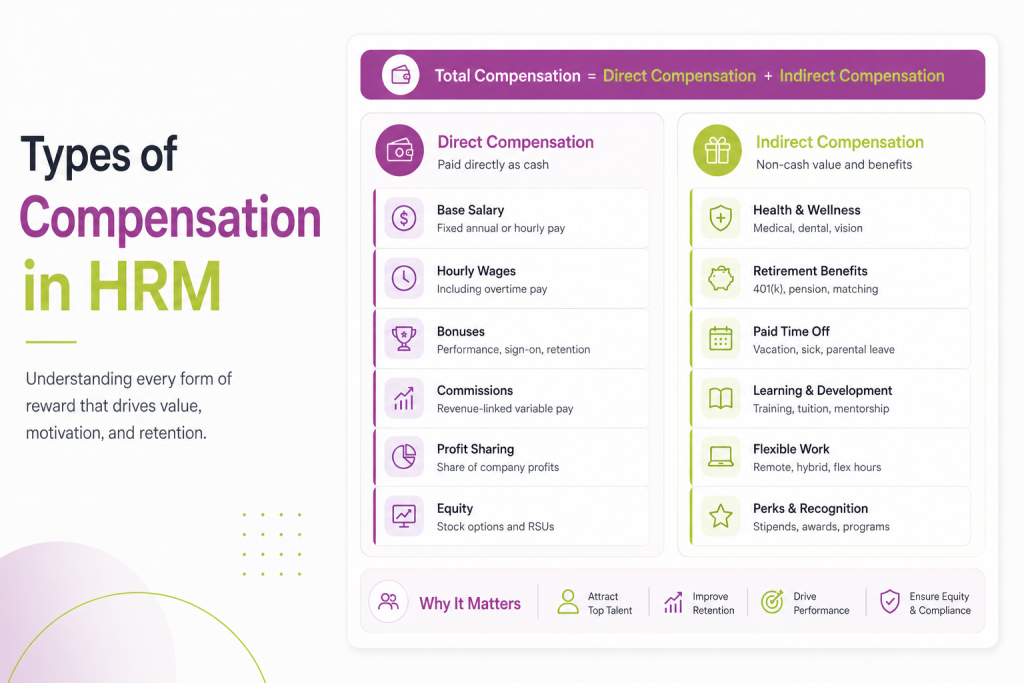
Every type of compensation falls into one of two categories.
Direct compensation is money paid directly to the employee in cash or cash-equivalent form. It includes base salary, hourly wages, bonuses, commissions, profit sharing, and equity. Employees see it clearly, feel it immediately, and benchmark it against the market.

Indirect compensation is everything of financial value that does not arrive as cash in hand. It includes health insurance, retirement contributions, paid time off, learning and development support, and flexible work arrangements. Employees often underestimate its value because they do not receive it as a number on their payslip.
Total compensation is what you get when you add both together. It represents the full cost an organization bears and the full value an employee receives — and the gap between those two numbers is often larger than either side realizes. A well-designed total compensation strategy manages both buckets deliberately, communicates the full picture clearly, and revisits the balance regularly as the market and workforce needs evolve.
Also read: The State of AI in Compensation Management: 2026 Stats and Trends
Types of Direct Compensation
Base salary
Base salary is the fixed amount an employee receives for their role, typically expressed as an annual figure and paid in regular installments. It is the foundation of every compensation package and the number most candidates and employees use to evaluate whether they are paid fairly relative to the market.
Base salary decisions are anchored to job architecture — the structured framework of roles, levels, and salary bands that defines where each position sits within the organization and how it compares to market benchmarks. Without clean job architecture, base salary decisions become inconsistent and difficult to defend. With it, they become predictable, equitable, and scalable.
Strategically, base salary provides the financial stability that allows employees to focus on long-term value creation rather than short-term financial anxiety. Organizations that pay strong base salaries tend to attract candidates who can afford to think strategically, take reasonable risks, and commit to the role for the long term.
Hourly wages and overtime
For non-exempt employees, compensation is structured around hourly pay rather than an annual salary. This applies across manufacturing, retail, healthcare, hospitality, and other industries where work is measured in hours rather than outputs.
Under the Fair Labor Standards Act in the U.S., non-exempt employees are entitled to overtime pay at 1.5 times their regular rate for any hours worked beyond 40 in a week. Managing hourly compensation requires careful attention to scheduling, classification, and compliance — misclassification of employees as exempt when they are not is one of the most common and costly payroll errors organizations make.
Bonuses
Bonuses are variable cash payments tied to performance, business results, or specific events. Unlike base salary, they are not guaranteed — which is both their strength and their limitation as a compensation tool.
The main types of bonuses serve different strategic purposes. Annual performance bonuses reward overall contribution at the end of a cycle and are the most common form. Sign-on bonuses are used to close candidates who need an incentive to leave a current role or forfeit unvested equity elsewhere. Retention bonuses are paid to keep high-value employees through a critical period, such as an acquisition, a product launch, or a leadership transition. Spot bonuses are immediate, one-time payments recognizing exceptional work in the moment — and among the most effective recognition tools available because they are timely, specific, and visible.
Commissions
Commission-based pay ties a portion of an employee’s compensation directly to the revenue or sales they generate. It is most common in sales roles, though it appears in real estate, financial services, and other performance-driven functions as well.
Commission structure matters significantly. A well-designed plan aligns individual effort with organizational goals, rewards the right behaviors, and creates meaningful upside for top performers. A poorly designed one drives short-term thinking, encourages gaming the system, and creates pay outcomes that feel arbitrary. The most effective commission structures are simple enough to understand, transparent in their mechanics, and reviewed regularly to ensure they still reflect current business priorities.
Profit sharing
Profit sharing distributes a portion of company profits to employees, typically on an annual basis. Unlike bonuses, which can be paid regardless of company performance, profit sharing directly links employee rewards to business outcomes. This creates a sense of shared ownership and aligns employee interests with organizational success.
Profit sharing is less common than performance bonuses but is growing in use, particularly in organizations trying to build a stronger ownership culture without offering equity. It works best when employees understand how company profitability is calculated and can see a clear connection between their work and the outcomes being shared.
Equity compensation
Equity gives employees an ownership stake in the company, typically through stock options or restricted stock units (RSUs). It is one of the most powerful long-term retention tools available — and in 2026, it is increasingly central to competing for technical and AI talent.
Stock options give employees the right to purchase company shares at a fixed price after a vesting period. If the company’s value increases, the options become worth more than the exercise price, creating meaningful upside. RSUs are grants of actual shares that vest over time — simpler to understand than options and increasingly preferred by both employers and employees.
Vesting schedules are the retention mechanism built into equity. A standard four-year vest with a one-year cliff means an employee receives no equity until their first anniversary, then vests the remainder monthly or quarterly over the following three years. This creates a strong financial incentive to stay, particularly as equity value grows.
For startups and high-growth companies competing for talent against larger organizations that can offer higher base salaries, equity is often the primary differentiator. For established companies, it is a long-term supplement to a competitive cash package.
Types of Indirect Compensation
Health and wellness benefits
Health insurance is the single most expected indirect compensation benefit in the U.S. market. Medical, dental, and vision coverage form the core, with employers typically covering a portion of premiums and employees contributing the remainder. The quality and comprehensiveness of health benefits is a significant factor in candidate decision-making, particularly for employees with families or ongoing healthcare needs.
Beyond standard insurance, wellness benefits are expanding to include mental health support, Employee Assistance Programs, gym memberships, and wellness stipends. As healthcare costs continue to rise, the structure and generosity of health benefits is becoming an increasingly important differentiator in competitive talent markets.
Retirement and financial benefits
Retirement benefits provide employees with a mechanism for long-term financial security. In the U.S., this typically means a 401(k) plan with an employer matching contribution. The match is one of the highest-return financial benefits available to employees — and one of the most underutilized, particularly among younger workers who do not yet prioritize retirement savings.
Pension plans, where the employer funds a defined benefit at retirement, are less common in the private sector but remain significant in public sector and unionized environments. Financial wellness programs, including student loan repayment support, financial planning resources, and emergency savings programs, are growing as employers recognize that financial stress directly affects productivity and retention.
Paid time off
Paid time off covers vacation days, sick leave, parental leave, and public holidays. It is legally mandated at minimum levels in most jurisdictions and offered far beyond those minimums by employers trying to stay competitive.
Parental leave has become a significant differentiator, particularly for organizations competing for talent in the 25 to 40 age range. Policies that offer generous, equal leave for all parents signal a commitment to equity and work-life balance that resonates strongly with modern candidates.
Unlimited PTO policies have produced mixed results in practice. Employees at organizations with unlimited PTO often take less time off than those with defined allowances, because the absence of a defined entitlement creates social ambiguity around what is acceptable. The policy works best when leadership actively models taking time off and managers are trained to encourage it.
Learning and development
Tuition reimbursement, professional development budgets, access to training platforms, conference attendance, and mentorship programs all fall under learning and development as a form of indirect compensation. Employees receive value not in cash but in career capital — skills, credentials, and experiences that make them more valuable in the market.
As skills-based pay models expand and the shelf life of technical skills shortens, learning and development is becoming a more prominent component of the total value proposition. Employees — particularly those in technical roles — increasingly evaluate employers on whether the organization will invest in their growth, not just compensate them for current capabilities.
Flexible work arrangements
Remote work, hybrid schedules, compressed workweeks, and flexible hours are not traditionally classified as compensation, but in the post-2020 talent market they function as one of the most valued components of the total package.
A meaningful percentage of employees across multiple workforce surveys would accept lower base salaries in exchange for genuine flexibility. This makes flexible work arrangements a cost-effective lever for organizations that cannot compete on cash alone — and a retention risk for organizations that eliminate flexibility without offsetting it elsewhere in the package.
Non-monetary perks and recognition
Company cars, transportation subsidies, childcare support, meal benefits, wellness stipends, and employee recognition programs round out the indirect compensation picture. These perks vary significantly by industry, company size, and geography.
Recognition programs deserve particular attention. Formal recognition — tied to specific behaviors, publicly acknowledged, and delivered in a timely way — has a disproportionate impact on engagement and retention relative to its cost. Employees who feel recognized for their contributions are significantly more likely to stay and to perform at a high level.
Total Compensation – Putting It All Together
Total compensation is the sum of everything above. For many roles, base salary represents only 60 to 70 percent of total comp. The remainder — bonuses, equity, benefits, and perks — can represent tens of thousands of dollars in annual value that employees often do not fully see or appreciate.
This is where total rewards statements become essential. A total rewards statement presents the full picture of what an employee receives — base salary, variable pay, equity value, benefits contributions, and perks — in one clear document. It turns an invisible benefit package into a visible, quantifiable statement of organizational investment.
According to Salary.com’s 2026 State of Pay and Compensation Practices Report, only 34.3% of organizations are transparent with employees about how pay is determined, and fewer than half of organizations have a formal job architecture in place. These structural gaps are the primary reason employees undervalue their compensation and why the confidence gap between what HR believes about pay fairness and what employees feel remains so wide.
How AI Is Changing Compensation Management in HRM
Every type of compensation described in this article is being touched by AI in 2026 — not just in terms of how it is administered, but how it is designed, monitored, and communicated.
AI-powered benchmarking is replacing static annual compensation surveys with real-time market data, allowing organizations to keep salary bands current as the market moves rather than relying on data that may already be six to twelve months old by the time it is applied.
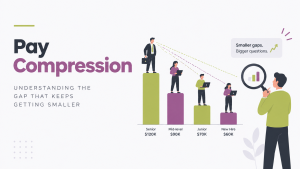
Continuous pay equity monitoring is moving from an annual audit exercise to an ongoing function. AI can flag compression building within a band, equity drift across teams, and demographic pay gaps before they become retention problems or legal liabilities — while budget is still available to correct them.
Personalization of indirect compensation is becoming possible at scale. Agentic AI systems can analyze individual employee data — life stage, role, financial goals, enrollment history — and surface tailored benefits recommendations that a human comp team could never produce manually for an entire workforce.
Event-driven variable pay is another emerging capability. Rather than waiting for an annual merit cycle, AI agents can track project milestones, calculate spot bonuses automatically as work is completed, and route approvals for manager review in real time.
At Stello AI, our platform is built to manage the full compensation picture — from salary benchmarking and band management to pay equity monitoring and total rewards communication — giving comp teams the visibility and tools they need to make every compensation decision with confidence.
How to Build a Compensation Package That Works
Understanding the types of compensation is the foundation. Building a package that actually works requires a few additional principles.
Start with a compensation philosophy. Before deciding what to pay, decide how you want to pay. Where does the organization aim to sit relative to the market? How does performance differentiate pay? What role does equity play? A documented philosophy gives every downstream decision a consistent foundation and gives managers and employees a framework for understanding pay decisions.
Build job architecture before setting ranges. Salary bands are only as reliable as the job framework they are built on. Roles that are not clearly defined and consistently leveled produce compensation decisions that are inconsistent, hard to defend, and prone to creating equity problems over time.
Balance direct and indirect compensation based on your workforce. A 28-year-old engineer and a 50-year-old operations manager are not looking for the same package. Understanding the life stage, priorities, and needs of different workforce segments allows organizations to design compensation that resonates rather than defaulting to a one-size-fits-all approach.
Communicate total compensation, not just salary. If employees only see their base salary number, they are only seeing part of what the organization invests in them. Total rewards statements, onboarding conversations, and manager training on how to discuss the full package are how organizations close the perception gap.
Review and adjust continuously. Annual compensation cycles were designed for a slower market. In 2026, role-level salary movement can shift significantly within a single quarter. Organizations that build in regular market checks for their highest-variance roles and use AI to monitor equity and compression between cycles will consistently outperform those that wait until the next planning season to catch up.
Conclusion
Compensation is not a single decision. It is a system — one that spans base pay, variable rewards, equity, benefits, perks, and recognition, each serving a different purpose and reaching a different employee need. Organizations that understand the full picture, design each component deliberately, and communicate the whole clearly are the ones that attract the talent they want, keep the people they invest in, and build the kind of pay culture where employees trust that their contribution is recognized and rewarded fairly.
If you are building or rethinking your compensation infrastructure, Stello AI gives you the tools to manage every component in one place — from benchmarking and band management to pay equity monitoring and total rewards communication.
See how Stello AI works → Book a Demo