Artificial intelligence has moved well past the pilot phase in HR. What started as experimental chatbots and basic resume screening tools has matured into a sophisticated layer of intelligence woven across the entire employee lifecycle. In 2026, AI isn’t a novelty in HR — it’s fast becoming a baseline expectation.
But where exactly is AI making the biggest difference? This article breaks down the most impactful and widely adopted use cases for AI in HR right now — and what each one means for HR teams on the ground.
TL;DR
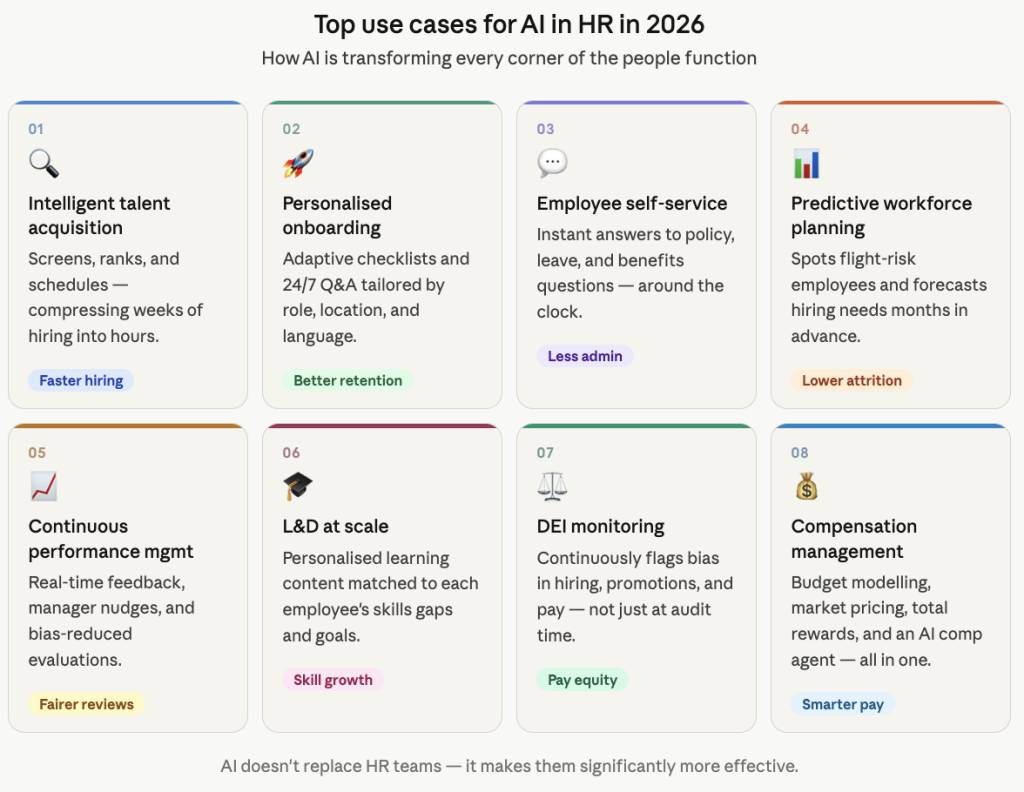
- AI in HR is no longer experimental — in 2026, it’s a baseline expectation across the entire employee lifecycle.
- Talent acquisition is transformed: AI screens resumes, ranks candidates, schedules interviews, and conducts first-round conversations — compressing weeks of work into hours.
- Onboarding is now personalised — AI tailors the new hire experience by role, location, and learning style, and handles multi-language, multi-region compliance automatically.
- Employee self-service is the most widespread use case — AI answers policy, leave, and benefits questions 24/7, dramatically reducing HR inbox volume.
- Predictive workforce planning lets HR identify flight-risk employees and forecast hiring needs months in advance — shifting HR from reactive to strategic.
- Continuous performance management replaces the annual review with real-time feedback aggregation, manager nudges, and bias-reduced evaluations.
- L&D becomes adaptive — AI recommends personalised learning content based on each employee’s role, skills gaps, and career goals.
- DEI monitoring moves from periodic audits to continuous tracking — AI flags biased job descriptions, hiring patterns, and pay disparities in real time.
- Compensation management gets a full AI upgrade: budget modelling, market pricing, compensation planning, total rewards portals, ad hoc increases, and an AI compensation agent — all working together for fairer, faster pay decisions.
- Bottom line: AI handles the high-volume, data-heavy work so HR professionals can focus on judgment, empathy, and strategy. Start with one or two use cases — and expand from there.
1. Intelligent Talent Acquisition
Hiring remains one of the most resource-intensive functions in HR, and AI has transformed nearly every step of it. In 2026, AI-powered recruitment tools go far beyond keyword matching on resumes.
Modern AI can assess candidates holistically — evaluating experience, skills, career trajectory, and even job-switching patterns — to surface the most relevant profiles from thousands of applications in minutes. Automated interview scheduling eliminates the back-and-forth email chains that eat up recruiter time. AI-assisted outreach personalises messages to passive candidates at scale.
Perhaps most significantly, AI can now conduct structured first-round screening conversations, asking consistent questions and evaluating responses before passing shortlisted candidates to a human recruiter — compressing a week-long process into hours.
Impact: Faster time-to-hire, reduced recruiter workload, and more consistent candidate evaluation.
2. Personalised Employee Onboarding
First impressions matter. Yet onboarding is frequently chaotic — a flood of forms, logins, policies, and introductions crammed into the first few days. AI is making onboarding adaptive and personalised.
AI-driven onboarding platforms can tailor the experience based on role, department, location, and even learning style. New hires are guided through personalised checklists, receive timely nudges for pending tasks, and can ask onboarding questions conversationally at any hour without waiting for an HR rep to respond.
For global organisations, AI handles multi-language onboarding and ensures compliance with local regulations automatically — a task that previously required significant manual coordination.
Impact: Higher new hire satisfaction, faster time-to-productivity, and fewer onboarding errors.
Also read: AI Agents for HR: The Complete Guide to Transforming Human Resources
3. Always-On Employee Self-Service
This is arguably the most widespread AI use case in HR today. Employees have a near-constant stream of questions: How many leave days do I have? What’s the process for claiming expenses? When does my health insurance renew?
AI-powered HR assistants answer these questions instantly, around the clock, drawing from your company’s policies, HR systems, and benefits documentation. They handle requests conversationally — understanding natural language rather than requiring employees to navigate clunky HR portals.
The result is a dramatic reduction in the volume of routine queries landing in HR inboxes, freeing HR professionals to focus on higher-value work.
Impact: Faster resolution times, improved employee experience, and significant HR admin savings.
4. Predictive Workforce Planning
One of the most powerful — and underutilised — applications of AI in HR is its ability to predict what’s coming before it happens. In 2026, leading organisations are using AI to model workforce scenarios with remarkable accuracy.
AI can analyse historical attrition data, engagement scores, performance trends, and external labour market signals to identify which employees are at flight risk — often months before they hand in their notice. It can forecast future hiring needs based on business growth projections and flag skills gaps before they become critical.
For HR leaders, this shifts the function from reactive to genuinely strategic. Instead of scrambling to backfill roles, they can proactively develop talent pipelines and retention strategies.
Impact: Lower attrition, smarter headcount planning, and a more proactive HR function.
5. Continuous Performance Management
The annual performance review is increasingly seen as a relic. AI is enabling a shift toward continuous, real-time performance management that is more useful for both employees and managers.
AI tools can aggregate signals from across the organisation — project completions, peer feedback, goal progress, communication patterns — to give managers a richer, more current picture of team performance. They can flag when an employee may be disengaged or overwhelmed, prompt timely check-ins, and help managers craft more constructive and specific feedback.
AI also reduces the bias that often creeps into performance reviews by surfacing objective data alongside subjective assessments.
Impact: More accurate evaluations, stronger manager-employee relationships, and earlier intervention when performance issues arise.
Also read: What is an AI HR Agent?
6. Learning and Development at Scale
Training programmes have historically been one-size-fits-all. AI is making L&D genuinely personalised. In 2026, AI-driven learning platforms analyse each employee’s role, skills, career goals, and learning history to recommend the most relevant content at the right time.
AI can identify skill gaps across teams and departments, automatically surface learning resources when an employee takes on a new project, and even generate custom training content tailored to specific roles or compliance requirements. For organisations navigating rapid technological change — and most are — this kind of adaptive learning infrastructure is a competitive advantage.
Impact: Higher course completion rates, more relevant skill development, and better alignment between learning and business needs.
7. DEI Monitoring and Bias Reduction
Diversity, equity, and inclusion initiatives are often undermined by unconscious bias embedded in hiring, promotion, and compensation decisions. AI is increasingly being deployed to identify and reduce this bias systematically.
AI tools can audit job descriptions for exclusionary language, flag patterns of bias in hiring outcomes, analyse pay equity across demographic groups, and track representation trends over time. Rather than relying on periodic manual audits, organisations can monitor DEI metrics continuously and act on data-driven insights.
It’s worth noting that AI itself can carry bias if trained on biased data — so responsible implementation, human oversight, and regular auditing of AI systems remain essential.
Impact: More equitable hiring and promotion outcomes, stronger DEI accountability, and reduced legal risk.
8. Data-Driven Compensation Management
Compensation decisions have long been vulnerable to inconsistency — influenced by negotiation style, manager bias, or simply a lack of visibility into what the market is paying. AI is bringing much-needed rigour and fairness to the entire compensation lifecycle, from benchmarking to planning to employee communication.
Here’s what AI-powered compensation management looks like in practice in 2026:
AI Budget Modelling. HR teams can model multiple budget scenarios simultaneously — stress-testing different pay increase strategies to stay within budget while maintaining pay equity and ensuring top performers are rewarded appropriately. What once took days of spreadsheet work can be done in minutes.
AI Market Pricing. Manual salary benchmarking is slow and often inconsistent. AI accelerates the entire process by automatically matching roles to market data and surfacing real-time pricing intelligence — so compensation teams always know where they stand relative to the competition.
Compensation Planning. AI integrates data from across the organisation — performance ratings, tenure, current pay, market benchmarks — to support compensation change decisions throughout the full review cycle. Managers get data-driven recommendations rather than making changes in the dark.
Total Rewards Portal. Beyond base salary, employees increasingly expect transparency into their full package — benefits, bonuses, equity, and more. AI-powered total rewards portals generate personalised statements and give employees on-demand access to their complete rewards history, reducing the volume of compensation queries landing in HR inboxes.
Ad Hoc Increases. Not all pay changes happen during annual review cycles. AI makes it easier to manage mid-year adjustments — whether base salary corrections, spot bonuses, or retention awards — with the data to back up every decision and a clear audit trail.
AI Compensation Agent. Perhaps the most transformative development is the emergence of conversational AI agents specifically built for compensation. These agents can answer complex questions about compensation data, run calculations, flag anomalies, and support decision-making in seconds — acting as an always-on compensation partner for HR leaders and managers alike.
Impact: More equitable and competitive pay structures, faster compensation cycles, reduced bias in pay decisions, and stronger retention of top performers.
The Common Thread
Across all of these use cases, a consistent pattern emerges: AI handles the high-volume, data-intensive, and time-consuming aspects of HR work, while humans focus on judgment, empathy, and strategy. The organisations getting the most value from AI in HR aren’t replacing their HR teams — they’re making them significantly more effective.
In 2026, the question for HR leaders is no longer whether AI belongs in the people function. It clearly does. The more pressing question is how to implement it thoughtfully, ethically, and in a way that genuinely serves both the business and its people.
FAQs-
Which AI use case in HR delivers the fastest ROI?
Employee self-service typically shows the quickest return. Organisations can deploy an AI HR assistant in weeks and immediately see a measurable drop in routine HR queries — freeing up significant HR team capacity. Recruitment automation is a close second, given the direct cost savings from reduced time-to-hire and lower reliance on external agencies.
Do we need a large HR team to benefit from AI in HR?
Not at all. In fact, smaller HR teams often see the most dramatic impact because AI effectively multiplies their capacity. A lean HR function of two or three people can deliver the responsiveness and consistency of a much larger team when routine tasks are handled by AI. The key is starting with the use cases that create the most immediate relief — typically self-service and onboarding.
How does AI help with pay equity specifically?
AI compensation tools continuously audit pay data across the organisation, flagging statistical anomalies by gender, ethnicity, tenure, or role. Rather than discovering pay gaps during an annual review or, worse, a legal challenge, HR leaders can monitor equity in real time and make corrections proactively. AI also removes the inconsistency of manager-by-manager salary decisions by anchoring recommendations to objective market and internal data.
Can AI in HR work alongside our existing HRIS?
Yes — and this is a critical point. Most modern AI HR tools are designed to integrate with leading HRIS platforms like Workday, BambooHR, SAP SuccessFactors, and others. The AI sits on top of your existing systems, drawing data from them and writing back to them, rather than replacing them. That said, integration complexity varies, so it’s worth evaluating compatibility carefully during vendor selection.
What’s the biggest mistake organisations make when adopting AI in HR?
Trying to do too much at once. Organisations that attempt to roll out AI across recruitment, onboarding, performance, and compensation simultaneously often struggle with change management and end up with poor adoption across the board. The most successful implementations start with one or two high-impact use cases, build confidence and internal capability, and then expand from there. A phased, people-centred rollout almost always outperforms a big-bang approach.