HR leaders today are caught in a paradox. The expectations on HR have never been higher — build culture, retain top talent, drive DEI, support mental health, align with business strategy — yet most HR teams are still spending the bulk of their time on tasks that a well-designed system should handle automatically. Scheduling interviews. Answering the same policy questions. Chasing paperwork. Running reports.
Something has to give.
AI agents are emerging as the practical answer to this gap. Not the chatbots that frustrate employees with canned responses, and not the rigid automation workflows that break the moment an edge case appears. We’re talking about genuinely intelligent, autonomous systems that can reason through multi-step HR tasks, take action, and hand off to a human only when it truly matters.
This isn’t a futuristic concept. HR leaders at companies of all sizes are already deploying AI agents to screen candidates, onboard new hires, resolve employee queries, and surface workforce insights, all without adding headcount.
This guide breaks down exactly how AI agents work in an HR context, where they deliver the most value, what to watch out for, and how to evaluate whether a solution is right for your team. Whether you’re just starting to explore the space or ready to move from pilot to full deployment, this is your practical roadmap.
AI agents for HR — everything you need to know
- AI agents are not chatbots. They complete multi-step tasks autonomously — screening candidates, running onboarding, resolving queries — without needing a human at every step.
- Six areas deliver the most value: recruitment, onboarding, HR helpdesk, performance management, learning and development, and workforce analytics.
- The core benefit is time. HR teams that deploy agents spend less time on admin and more time on strategy, culture, and people.
- Risks are real but manageable. Bias, data privacy, and over-automation are legitimate concerns — addressed through audits, transparency, and clear human handoff points.
- Start small. Pick one painful process, run a 60 to 90 day pilot, and build from a position of proven ROI.
- AI doesn’t replace HR. It amplifies it — freeing the human layer to do what it was always meant to do.
What is an AI Agent for HR?
The term “AI” gets applied to almost everything in HR tech right now, so it’s worth being precise about what an AI agent actually is and how it differs from the tools you may already be using.
Most HR software with AI features works reactively. You ask a question, it gives an answer. You upload resumes, it ranks them. The system waits for input and responds to it. That’s useful, but it’s not agentic.
An AI agent is different because it can pursue a goal across multiple steps, make decisions along the way, use tools and data sources, and complete tasks without needing a human to guide every move. Think of it less like a search engine and more like a capable new team member who you can hand a task to and trust to see it through.
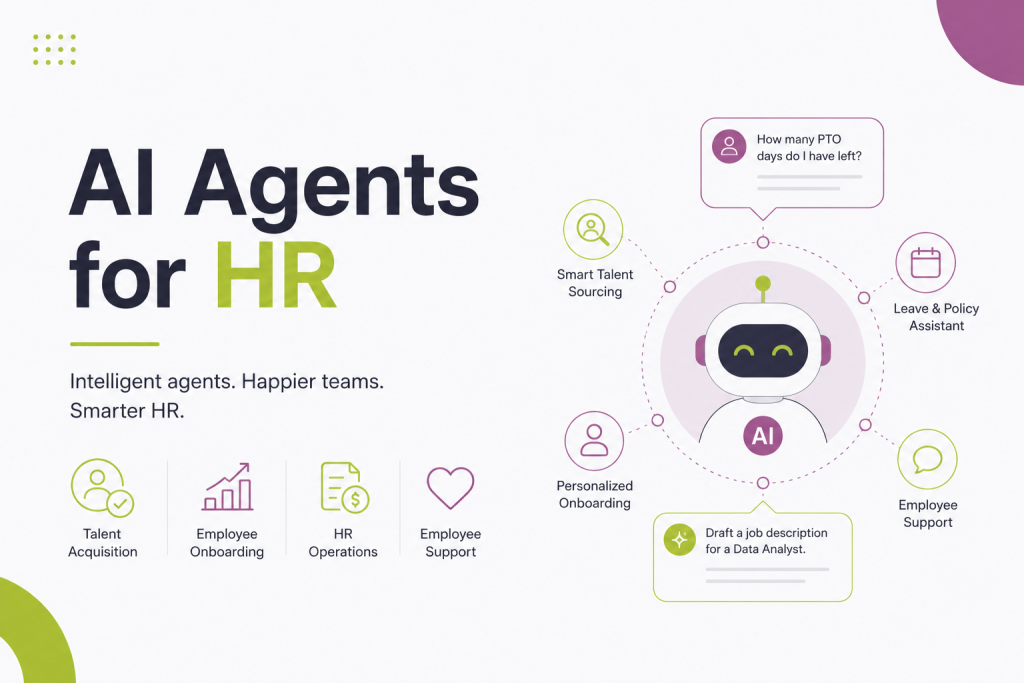
AI agent for HR
What it is · What it does · Why it matters
schedule interviews
day-one helpdesk
24/7 query resolution
goal tracking
skill gap analysis
DEI data
In an HR context, that might look like this: a hiring manager opens a new role, and the agent automatically posts the job, sources candidates from multiple platforms, screens applications against the job criteria, schedules interviews with shortlisted candidates, and sends status updates to applicants who didn’t make the cut. The hiring manager steps in to conduct the actual interviews. Everything else was handled.
This is the key distinction between an AI agent, a basic chatbot, and a traditional automation tool:
A chatbot responds to questions but cannot take action or complete tasks. A workflow automation tool follows a fixed script and breaks when anything unexpected happens. An AI agent can handle variability, make judgment calls within defined boundaries, and coordinate across systems to get a job done.
For HR leaders, this distinction matters because it changes what you can actually delegate. Chatbots save your team from answering repetitive questions. AI agents save your team from doing repetitive work.
Also read: What is HRIS Software? And When You’ve Outgrown It
Key Use Cases of AI Agents in HR
Understanding what AI agents can do in theory is one thing. Seeing where they actually slot into your HR operation is another. Here are the six areas where HR teams are getting the most tangible value today.
1. Recruitment and Talent Acquisition
Hiring is where most HR leaders feel the pain most acutely. Hundreds of applications, a handful of qualified candidates, and a hiring manager who needed someone yesterday.
AI agents can take over the full top-of-funnel recruiting workflow. They screen incoming applications against the job requirements, rank candidates, send personalized outreach to strong matches, follow up with applicants who go quiet, and coordinate interview scheduling across calendars without a single back-and-forth email. Some agents can also proactively source passive candidates from LinkedIn or talent databases based on a role brief.
The result is that your recruiters stop spending 60% of their time on logistics and start spending it on conversations that actually require human judgment.
2. Employee Onboarding
The first 90 days of employment have an outsized impact on retention, yet onboarding is one of the most administratively heavy processes in HR. Document collection, system access requests, benefits enrollment, compliance training, introductions to team members — the checklist is long and the coordination is tedious.
AI agents can run a personalized onboarding journey for each new hire. They send the right documents at the right time, follow up on incomplete tasks, answer day-one questions about policies and tools, and flag any blockers to the HR team. New hires get a responsive, consistent experience. HR gets hours back.
3. HR Helpdesk and Policy Q&A
How much of your team’s week goes toward answering questions that are already answered in your employee handbook? Leave balances, payroll queries, benefits eligibility, reimbursement processes — these questions are important to the employee asking them, but they don’t require a skilled HR professional to answer.
An AI agent trained on your internal policies and HR documentation can handle these queries instantly, at any hour, with consistent and accurate answers. It can also recognize when a question crosses into sensitive territory and route it to the right HR person with full context already attached. Ticket volume drops. Response times drop. Employee satisfaction goes up.
4. Performance Management
Performance cycles are painful for everyone involved. Managers miss deadlines. Employees feel blindsided by reviews. HR spends weeks chasing submissions and compiling feedback that should take minutes to aggregate.
AI agents can manage the entire operational layer of your performance process. They send timely reminders to managers and employees, collect self-assessments and peer feedback, synthesize 360-degree input into structured summaries, and track goal progress throughout the year rather than just at review time. HR leaders get cleaner data and more time to focus on the coaching conversations that the process is actually meant to drive.
5. Learning and Development
Most L&D programs suffer from the same problem: generic content pushed to everyone, low completion rates, and little connection to actual skill gaps. AI agents can make L&D feel personal rather than like a compliance checkbox.
By analyzing an employee’s role, performance data, and career goals, an agent can recommend specific learning paths, nudge employees when they haven’t engaged with assigned content, and surface new courses as the employee’s responsibilities evolve. At a team level, agents can identify skill gaps across the organization and flag where L&D investment is most needed.
6. Workforce Analytics and Reporting
HR leaders are increasingly expected to show up to leadership meetings with data, not just intuition. But pulling together headcount reports, attrition analysis, DEI metrics, and engagement trends from multiple systems is a time-consuming exercise that often falls to the most junior person on the team.
AI agents can connect to your HRIS, ATS, and engagement platforms and generate on-demand reports in plain language. Ask the agent what your 90-day attrition looks like by department, and it pulls the data, runs the analysis, and gives you an answer. More advanced agents can proactively flag early warning signs of disengagement or flight risk before they show up in your exit interview data.
Also read: The Ultimate Guide to AI in HR: Strategy, Tools & Implementation
Benefits of AI Agents for HR Teams
The use cases above point to a broader shift in what HR can accomplish. But it’s worth naming the benefits explicitly, because the case for AI agents isn’t just about efficiency. It’s about what becomes possible when your team isn’t buried in administrative work.
Your team gets its time back.
Studies consistently show that HR professionals spend anywhere from 50 to 70 percent of their time on administrative tasks. AI agents don’t just speed those tasks up, they remove them from your team’s plate entirely. That time gets redirected toward the work that actually requires human judgment: difficult conversations, culture building, strategic workforce planning.
Consistency and compliance become easier to maintain. Human processes are inconsistent by nature. One recruiter screens resumes differently than another. One manager runs onboarding more thoroughly than the next. AI agents apply the same criteria every time, which reduces both the risk of bias creeping into processes and the risk of compliance gaps forming when a team member is out or overwhelmed.
The employee experience improves. Employees don’t care that a query was handled by an AI agent. They care that they got an accurate answer in two minutes instead of waiting two days. Faster responses, proactive communication, and personalized onboarding journeys all contribute to an employee experience that feels attentive and organized, even when the HR team is stretched thin.
HR becomes a more strategic function. This is the benefit that matters most to CHROs. When the operational layer of HR runs more autonomously, HR leaders can show up differently in the business. More time for talent strategy. More bandwidth for leadership development. More capacity to be a genuine partner to the CEO and the board rather than the team that processes paperwork.
Scaling stops being a headcount conversation. Growth typically means more HR hires to handle increased volume. With AI agents absorbing the transactional workload, HR teams can support a significantly larger employee population without a proportional increase in team size. That’s a meaningful shift in how HR justifies its budget and demonstrates its leverage.
Also read: Agentic AI in Total Rewards: From Automating Workflows to Personalizing Packages
Challenges and Considerations
AI agents in HR are genuinely powerful, but they are not a plug-and-play solution. HR leaders who go in with clear eyes about the challenges will get far better outcomes than those who treat this as a straightforward technology purchase.
Bias doesn’t disappear. It can get harder to spot. AI agents trained on historical hiring or performance data can encode and scale the same biases that existed in your past decisions. If your organization has historically promoted a certain profile of employee, an agent optimizing for “high performers” may quietly replicate that pattern at scale. The fix isn’t to avoid AI in hiring, it’s to audit your training data, set explicit fairness criteria, and review agent decisions regularly rather than assuming the system is neutral.
Employees need to trust the process. When people find out that an AI screened their application or flagged them as a flight risk, the reaction isn’t always positive. Transparency matters. HR leaders who communicate clearly about where and how AI agents are being used, and what human oversight exists, will face far less resistance than those who deploy quietly and hope nobody notices.
Integration with your existing stack takes real work. An AI agent is only as useful as the data it can access. If your HRIS, ATS, payroll system, and communication tools don’t connect cleanly, the agent will operate with incomplete information and deliver incomplete results. Before evaluating vendors, map out your current tech stack and be honest about where the data gaps and integration challenges are.
Over-automation can strip out the human touch. Not every HR interaction should be handled by an agent. A performance improvement conversation, a mental health concern, a sensitive investigation — these require a human being. The risk with AI agents isn’t that they take over HR entirely, it’s that the boundaries get set too broadly and employees start feeling like they are interacting with a system rather than a function that genuinely cares about them. Defining clear handoff points is not optional.
Change management is its own project. HR teams are often the ones leading organizational change, but that doesn’t make them immune to it. Introducing AI agents changes how your team works, what skills matter, and what success looks like day to day. Bringing your HR team along, involving them in the rollout, and addressing concerns early will determine whether adoption sticks or stalls.
How to Evaluate and Choose an HR AI Agent
The HR AI market is crowded and moving fast. Vendors make similar promises, demos look impressive, and it’s easy to get swept up in capability showcases that don’t reflect your actual day-to-day reality. Here’s how to cut through the noise and make a decision you won’t regret six months into deployment.
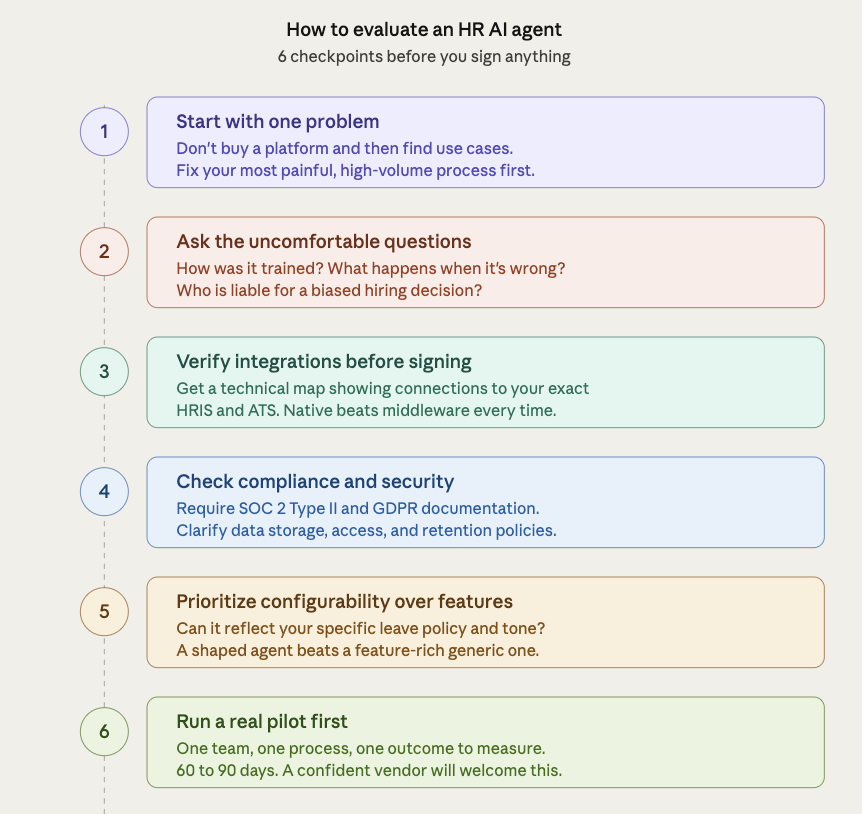
Start with one problem, not a platform. The most common mistake HR leaders make is buying a broad AI platform and then trying to figure out where to use it. Flip that approach. Identify the single most painful, high-volume process in your HR operation right now and look for a solution that solves that specific problem exceptionally well. A focused win builds internal confidence, generates measurable ROI, and makes the case for expanding from a position of strength.
Ask vendors the uncomfortable questions. How was the model trained and on what data? How does the system handle edge cases and exceptions? What happens when the agent gets something wrong? Who is liable when a biased hiring decision gets traced back to the tool? A vendor who struggles to answer these questions clearly is a vendor whose product isn’t ready for your organization.
Verify integrations before you sign anything. Ask for a technical integration map that shows exactly how the agent connects to your specific HRIS, ATS, and communication tools. Native integrations are always preferable to middleware workarounds. If a vendor tells you integration is straightforward without knowing what systems you use, that’s a red flag.
Check compliance and security certifications. HR data is among the most sensitive data your organization holds. At minimum, look for SOC 2 Type II certification and clear GDPR compliance documentation. If you operate in regulated industries or geographies, go deeper. Understand where data is stored, who can access it, and how long it is retained.
Prioritize configurability over features. A long feature list is less valuable than a system you can actually configure to match your policies, workflows, and tone. Can you customize the agent’s responses to reflect your company’s leave policy specifically? Can you set escalation rules that match your team’s structure? The more the agent can be shaped to your organization, the more useful it will be in practice.
Run a real pilot before full deployment. Negotiate a structured pilot with defined success metrics before committing to a full rollout. Pick one team, one process, and one clear outcome to measure. Give it 60 to 90 days and review the data honestly. A vendor confident in their product will welcome this. One who pushes back on a pilot is telling you something important.
The Future of AI Agents in HR
The agents available today are early. The trajectory matters more than the current state.
The next shift is from task automation to full workflow ownership. Agents that don’t just screen resumes or answer queries, but own entire processes end to end, adapt to exceptions, and escalate only when a human is genuinely needed.
Personalization is the other frontier. Training, onboarding, career development, and benefits guidance tailored to each individual employee rather than broad cohorts.
For CHROs, the bigger prize is AI as a strategic co-pilot. Agents that surface recommendations, not just reports. Which teams are at attrition risk. Where compensation is drifting out of market. Where a manager needs coaching, not their team a replacement.
The organizations that wait for this technology to feel fully settled before engaging will simply fall behind.
Conclusion
The question for HR leaders is no longer whether AI agents will change how HR operates. That is already happening. The question is whether your team will be among those who shape how it happens in your organization, or whether you will inherit a system someone else designed.
The opportunity here is significant. HR has long fought to be seen as a strategic function rather than an administrative one. AI agents make that transition practical, not just aspirational. When the transactional layer runs itself, the human layer gets to do what it was always meant to do: build great teams, develop people, and drive the culture that determines whether a business wins or loses.
Start with one problem. Prove the value. Build from there.
FAQs-
What is an AI agent for HR?
An AI agent for HR is an autonomous software system that can complete multi-step HR tasks without human involvement at every stage. Unlike a chatbot that answers questions or a workflow tool that follows a fixed script, an AI agent can reason through a task, use multiple tools and data sources, handle exceptions, and escalate to a human only when genuinely needed.
Will AI agents replace HR professionals?
No. AI agents take over the transactional and administrative layer of HR work — scheduling, screening, answering policy questions, chasing paperwork. The work that requires human judgment, empathy, and relationships — difficult conversations, culture building, leadership development, strategic workforce planning — remains firmly human. The net effect is that HR professionals spend more time on the work that actually matters.
Is AI in HR hiring legally compliant?
It depends on how it is implemented. AI tools used in hiring carry legal risk if they produce biased outcomes or lack transparency, particularly under emerging regulations in the US and EU. HR leaders should audit training data, document decision criteria, maintain human oversight at key decision points, and work with legal counsel when deploying AI in any part of the hiring process.
How long does it take to implement an HR AI agent?
A focused pilot on a single use case — such as HR helpdesk or interview scheduling — can typically be live within four to eight weeks, depending on the complexity of your existing tech stack and the vendor’s integration capabilities. A broader deployment across multiple HR functions is a longer project, often three to six months, and should follow a phased rollout rather than a big-bang launch.