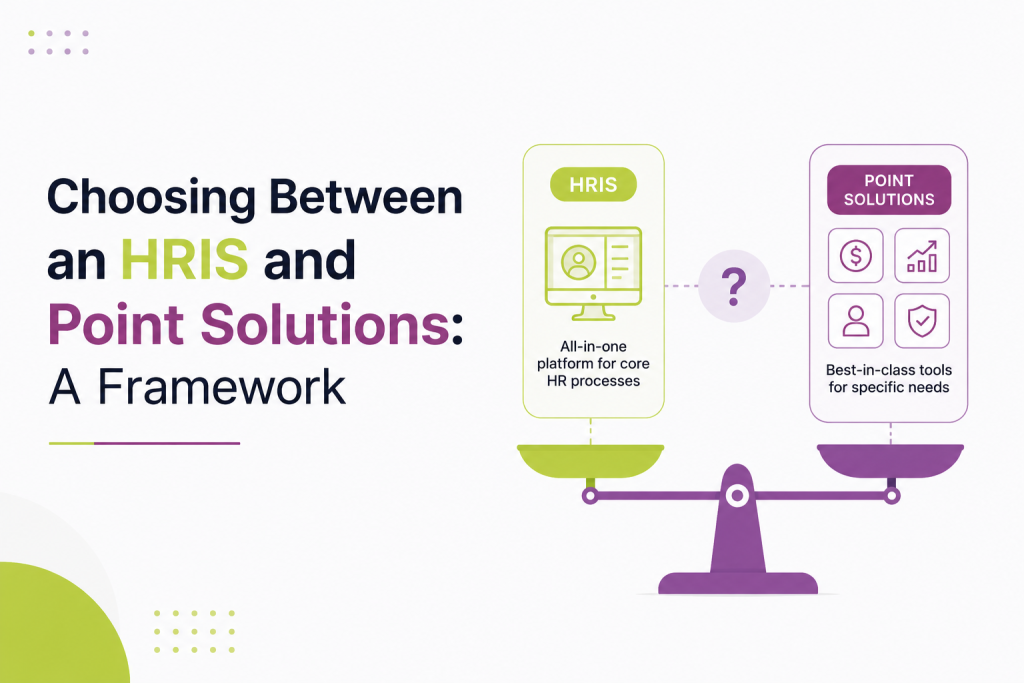
Every growing company hits this decision eventually. You’ve outgrown spreadsheets. You need real systems for HR, payroll, benefits, performance, and compensation. So you’re standing at a fork in the road: buy one HRIS that does everything, or stitch together best-in-class point solutions for each function.
There’s no universally right answer. But there is a wrong way to make this decision, and that’s picking based on vendor demos and gut feel. This framework will help you think through it properly.
TL;DR
- Don’t treat HRIS vs. point solutions as one big decision. Decide function by function: payroll, recruiting, performance, compensation, benefits, learning.
- Use four questions per function: How standardized is it? What’s the cost of getting it wrong? How fast are you growing? What does integration actually cost?
- Standardized, low-risk processes like payroll and time-off tracking usually run fine on a generic HRIS module.
- Strategic, high-stakes, complexity-growing functions like compensation, performance, and recruiting usually need a dedicated point solution.
- Compensation planning is the clearest case for a point solution: it’s non-standardized, high-risk if wrong, and scales in complexity with headcount.
- Companies under 200 employees usually do fine with an all-in-one HRIS. Complexity typically outgrows it between 150 and 300 employees.
- Before buying any point solution, confirm real API integration with your HRIS, not a manual CSV upload someone has to babysit every cycle.
What “HRIS vs Point Solutions” Actually Means
An HRIS (Human Resource Information System) is a single platform meant to handle most or all of your HR operations: employee records, payroll, time tracking, benefits administration, sometimes performance management and compensation planning too. Think Workday, Rippling, or BambooHR.
Point solutions are specialized tools built to do one thing exceptionally well. A dedicated compensation planning tool. A standalone applicant tracking system. A purpose-built performance management platform. Each one solves a narrow problem deeply instead of a broad set of problems adequately.
Most companies don’t choose one path and stay there forever. They start with an HRIS, hit its limits in a specific function, and bolt on a point solution. Or they start with point solutions and eventually consolidate into an HRIS as complexity grows. Understanding when to do which is the actual skill here.
Also read: Total Rewards vs. Total Compensation: What’s the Difference?
The Core Tradeoff
Everything in this decision comes down to one tension: breadth versus depth.
An HRIS gives you one source of truth. One login. One vendor relationship. One data model that (mostly) stays consistent across functions. That’s powerful when you’re a lean team trying to avoid tool sprawl, and it’s especially valuable for basic, well-understood processes like payroll and time-off tracking where the underlying logic doesn’t change much company to company.
Point solutions give you depth. A dedicated compensation planning tool will handle merit cycles, pay bands, and equity modeling in ways a generalist HRIS module simply can’t match. The same goes for recruiting, performance reviews, or engagement surveys. When a function is core to how you compete for talent or run your business, the generic module inside your HRIS often isn’t built for the complexity you actually have.
The mistake most companies make is treating this as an all-or-nothing decision. It’s not. It’s a portfolio decision, function by function.
Also read: Merit Increase vs. Raise vs. Promotion: What’s the Difference?
A Four-Question Framework
Instead of asking “HRIS or point solutions” as one big question, break it down function by function. For each HR process (payroll, recruiting, performance, compensation, benefits, learning), ask these four questions.
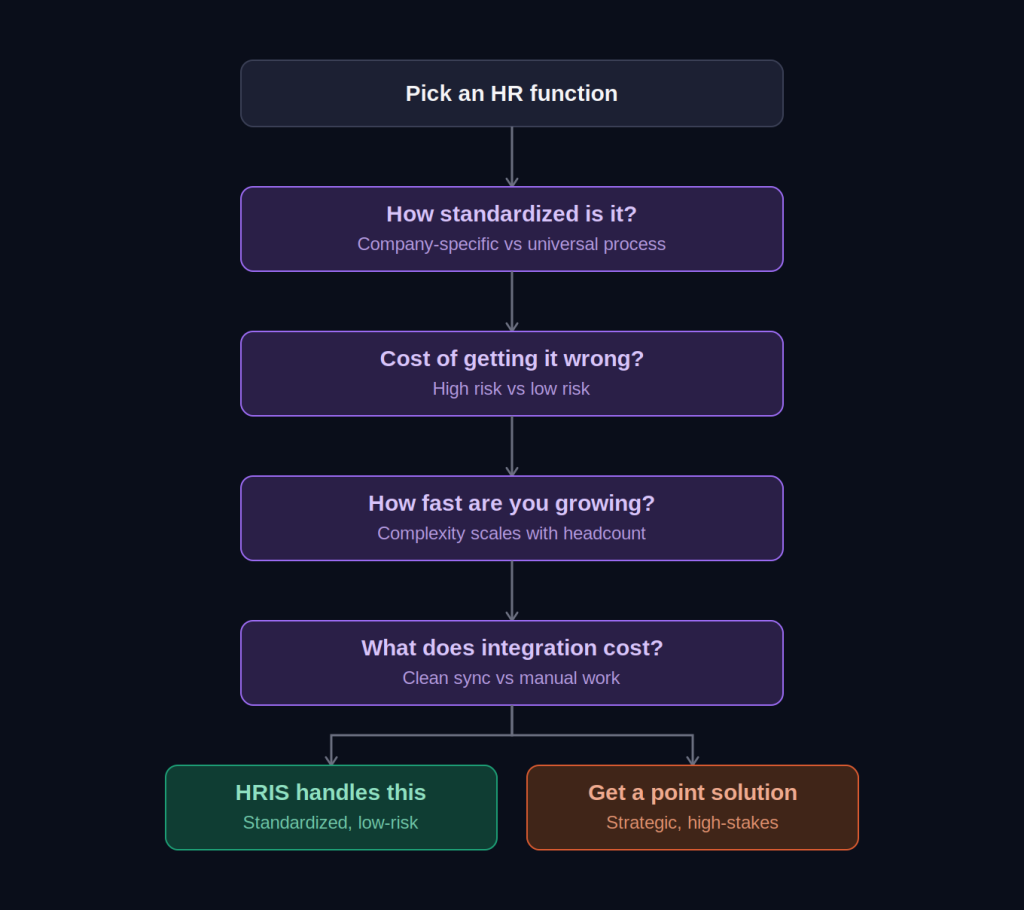
1. How Standardized Is This Process?
Some HR functions are genuinely commoditized. Payroll follows tax law. Time-off tracking follows PTO policy. Benefits enrollment follows your carrier’s rules. These processes don’t vary much from company to company, so a generalist HRIS module handles them fine.
Other functions are where companies actually differentiate. How you plan compensation, how you evaluate performance, how you source and evaluate candidates. These are strategic levers, not administrative tasks. The more strategic and company-specific a process is, the more a point solution earns its keep.
Rule of thumb: administrative and compliance-heavy processes lean HRIS. Strategic and judgment-heavy processes lean point solution.
2. What’s the Cost of Getting It Wrong?
A clunky time-tracking interface is annoying. A broken compensation planning process can blow your budget, create pay equity gaps, or lose you your best people during a critical review cycle.
Weigh the downside risk of each function, not just the feature checklist. Compensation planning, in particular, is one of the highest-stakes processes in HR. Errors here aren’t just inconvenient, they show up as lawsuits, attrition, and trust issues that take years to repair. That’s a strong argument for a dedicated compensation tool over a bolt-on HRIS module, even if the HRIS module is “good enough” on paper.
3. How Fast Are You Growing (or Changing)?
Early-stage companies with under 50 employees usually benefit from an HRIS. You don’t have the headcount to manage five different vendor relationships, and your processes probably aren’t complex enough yet to need specialized depth.
Once you cross into mid-market territory, usually 200 to 500 employees, complexity increases fast. You’re running multiple pay structures, expanding into new geographies, managing more nuanced performance and compensation cycles. This is typically where the cracks in an all-in-one HRIS start to show, particularly in compensation, performance, and recruiting.
If you’re growing quickly, build your stack for where you’ll be in 18 months, not where you are today. Ripping out a system mid-growth is expensive and disruptive.
4. What Does Integration Actually Cost You?
This is the question people underestimate the most. Point solutions only work well if they integrate cleanly with your core systems, especially your HRIS and payroll. A best-in-class compensation tool that can’t sync employee data, pay history, and org structure from your HRIS creates more manual work than it saves.
Before you buy any point solution, ask the vendor directly: what does your HRIS integration actually look like? Is it a real API sync, or a CSV upload someone has to babysit every cycle? The answer tells you whether you’re buying a tool or a chore.
Also read: Self-Service HRIS: Why Employee Self-Service Matters
When to Choose an HRIS-First Approach
Lean toward an all-in-one HRIS when:
- You’re under 200 employees and still building out basic HR infrastructure
- Your HR team is small (1 to 3 people) and can’t manage multiple vendor relationships
- Your processes across functions are relatively standard and not yet differentiated
- Budget is tight and consolidation saves real money
- You value one login, one data model, and fewer integration headaches over specialized functionality
When to Choose Point Solutions
Lean toward point solutions, function by function, when:
- The process is strategically important and directly affects retention, growth, or compliance risk
- Your HRIS’s native module is clearly a checkbox feature, not a built-for-purpose tool
- You’ve already hit real limitations (manual workarounds, spreadsheet shadow systems, frustrated managers) with the HRIS-native version
- The point solution has strong, proven integration with your existing HRIS
- The function scales in complexity with your headcount (compensation and performance usually do; time-off tracking usually doesn’t)
Compensation Planning: A Case Study in This Framework
Compensation is worth calling out specifically because it’s one of the clearest cases where the framework points toward a point solution, even for companies otherwise happy with their HRIS.
Run it through the four questions. Is it standardized? No, comp philosophy, pay bands, and merit logic vary enormously by company. Is the cost of getting it wrong high? Extremely, bad comp decisions drive attrition and create pay equity exposure. Does complexity grow with headcount? Yes, fast, especially once you’re managing multiple locations, levels, and pay structures. Can it integrate cleanly with your HRIS? A good compensation platform pulls employee and pay data directly from your HRIS, so this isn’t a blocker.
Three out of four questions point toward a dedicated tool, and the fourth isn’t a dealbreaker. That’s why so many companies that are otherwise satisfied with their all-in-one HRIS still run compensation planning through a specialized platform.
Making the Decision
Don’t try to solve this in one meeting with a single vendor comparison chart. Instead:
- List out every HR function you need to run: payroll, benefits, time tracking, recruiting, performance, learning, compensation.
- Run each one through the four questions above.
- Group functions into “HRIS handles this fine” and “this needs a point solution.”
- For anything landing in the point solution bucket, prioritize integration quality as a hard requirement, not a nice-to-have.
- Revisit this exercise annually. What was “good enough” at 80 employees often isn’t at 300.
The goal isn’t to pick a philosophy and defend it. It’s to build a stack that matches what each function actually demands, and to be honest about where your generalist tools are quietly costing you more than a specialized one would.
Most mature HR stacks end up as a hybrid: an HRIS as the system of record for the basics, with a handful of best-in-class point solutions layered in for the functions that actually move the needle on retention and growth. That’s not a compromise. That’s the framework working the way it should.
FAQs-
1. Can I use both an HRIS and point solutions at the same time?
Yes, and most mature companies do. The HRIS acts as your system of record for core data like employee profiles, payroll, and time off. Point solutions plug in for specific functions like compensation or performance where you need more depth. The key is making sure they integrate cleanly so you’re not duplicating data entry.
2. At what company size should I move from an HRIS to point solutions?
There’s no universal headcount trigger, but most companies start feeling the limits of an all-in-one HRIS somewhere between 150 and 300 employees. That’s usually when pay structures, performance cycles, and recruiting needs get complex enough that generic modules stop keeping up.
3. Isn’t it cheaper to just stick with one HRIS platform?
Sometimes, but not always. A single HRIS is cheaper on paper and in vendor management overhead. But if a generic module forces your team into manual workarounds and spreadsheets, you’re paying for that in hours, errors, and risk. The real cost comparison has to include what a bad process costs you, not just the subscription fee.
4. How do I know if my HRIS’s native module is “good enough”?
Ask if your team has built a shadow process around it, like a separate spreadsheet for compensation planning or a manual tracker for performance reviews. If people are routing around the tool, that’s a clear sign it isn’t good enough for that function, even if it technically checks the box.
5. What should I prioritize when evaluating a point solution?
Integration quality first. A best-in-class tool that doesn’t sync cleanly with your HRIS creates more manual work than it saves. After that, look at how well it handles the specific complexity of your process, not just the features listed on the pricing page.