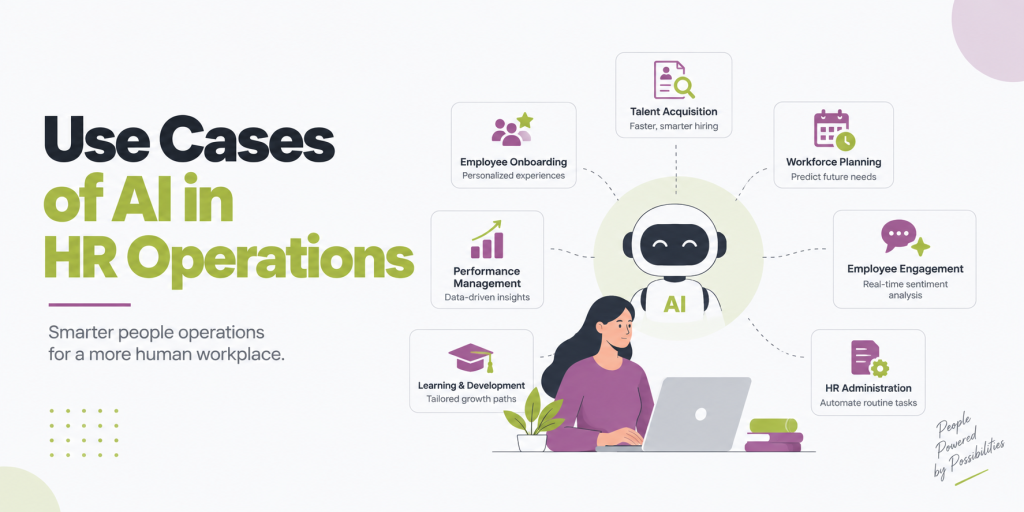
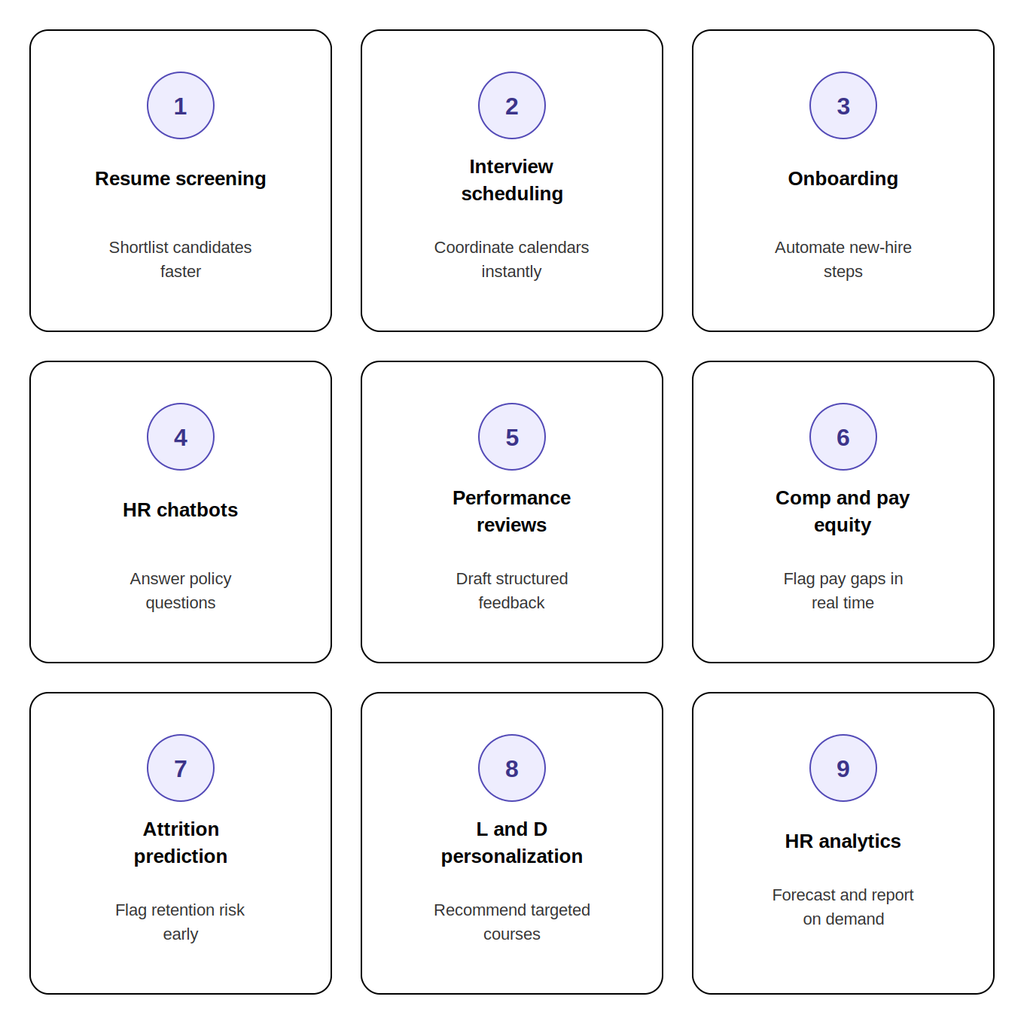
Most HR teams didn’t get bigger as their companies scaled — they got asked to do more with the same headcount. That gap is exactly where AI has quietly become useful in HR: not as a replacement for judgment on people decisions, but as the layer that handles the repetitive, data-heavy work sitting underneath those decisions. Below are nine places AI is already delivering real time savings and better decisions in HR operations today, along with what to watch out for in each.
1. Resume screening and candidate shortlisting
Recruiters historically spent hours manually scanning resumes against a job description. AI-powered applicant tracking systems now parse resumes, match candidates against required skills and experience, and rank or filter applicants before a human ever opens a file.
What it looks like in practice: A recruiter posts a role, and the ATS automatically surfaces the top 20 candidates out of 400 applicants based on skills matching, rather than a recruiter reading every application in order of arrival.
Watch out for: Bias baked into training data. Screening models trained on historical hiring patterns can quietly replicate past discrimination (Amazon’s abandoned resume-screening tool is the most cited cautionary example). Any AI screening tool needs regular audits against outcome data by gender, race, and age.
Also read: Equity Compensation Planning: A Guide for HR and Comp Teams
2. Interview scheduling and coordination
Coordinating interviews across multiple interviewers, time zones, and candidate availability is one of the most tedious parts of recruiting — and one of the easiest to automate. AI scheduling assistants read calendars, propose times, and handle rescheduling without a recruiter playing email tag.
What it looks like in practice: A candidate picks from AI-generated time slots that already account for every interviewer’s availability, room bookings, and buffer time — cutting scheduling turnaround from days to minutes.
3. Employee onboarding automation
New hire onboarding involves a long checklist: paperwork, account provisioning, benefits enrollment, introductions, training assignments. AI-driven onboarding platforms sequence these steps automatically and answer common new-hire questions (“when does my health insurance start?”) without routing every question to an HR generalist.
What it looks like in practice: A new hire gets a personalized onboarding plan generated based on their role and location, with a conversational assistant handling FAQs during their first two weeks.
Also read: What are Salary Bands? Definition, Examples, and How to Create Them
4. HR chatbots for policy questions and employee self-service
A large share of HR’s day-to-day volume is repetitive: “How many PTO days do I have left?” “What’s our parental leave policy?” “How do I update my direct deposit?” AI chatbots trained on company policy documents can answer these instantly, freeing HR staff for higher-judgment work.
What it looks like in practice: An employee messages an internal Slack bot instead of emailing HR, and gets an accurate, policy-grounded answer in seconds, with escalation to a human for anything outside its confidence threshold.
Watch out for: Chatbots need clear escalation paths for sensitive topics — harassment complaints, medical accommodations, and legal questions should never be fully automated, even if the bot could technically generate a plausible-sounding answer.
5. Performance review assistance
Writing thoughtful, specific performance feedback is hard and time-consuming, especially for managers with large teams. AI tools can help managers draft review language, summarize peer feedback into themes, and flag reviews that are vague, overly harsh, or inconsistent with a person’s actual documented performance.
What it looks like in practice: A manager pastes rough notes and self-review input, and an AI tool drafts a structured first pass they then edit and personalize — cutting review-writing time significantly without removing the manager’s voice or judgment.
Watch out for: AI should assist drafting, not replace the manager’s actual assessment. Reviews that read as generic or clearly AI-generated undermine trust with employees.
6. Compensation benchmarking and pay equity analysis
Comparing internal pay against market data, and checking for unexplained pay gaps across gender, race, or role, used to require a compensation analyst manually cross-referencing spreadsheets against survey data. AI-powered compensation platforms can now run this analysis continuously, flag anomalies in real time, and model the cost of remediation before a comp cycle even starts.
What it looks like in practice: Instead of running a pay equity audit once a year as a standalone project, a compensation platform flags a potential pay gap the moment a new hire’s offer would create one — before the offer goes out, not after.
Watch out for: Pay equity analysis is only as good as the underlying job leveling framework it’s built on (see our guide to job leveling for how to get that foundation right). Running equity analysis on top of inconsistent leveling just produces confident-looking wrong answers.
Also read: What is Incentive Compensation? A Guide for Comp and HR Teams
7. Attrition prediction and retention risk flagging
Machine learning models can analyze patterns — tenure, engagement survey scores, manager changes, compensation relative to market, promotion velocity — to flag employees at elevated flight risk before they hand in a resignation letter.
What it looks like in practice: An HR business partner gets a monthly signal that a specific team has an elevated attrition risk score, prompting a proactive conversation rather than a reactive exit interview.
Watch out for: These models can be directionally useful at the team or department level but are prone to false positives at the individual level. Using an AI-generated “flight risk” score to make individual decisions (like who gets a retention bonus) without human context is where this use case gets ethically shaky.
8. Learning and development personalization
Generic, one-size-fits-all training doesn’t map well to what any individual employee actually needs next. AI-driven L&D platforms can assess skill gaps against a role’s requirements (or against where an employee wants to grow) and recommend a personalized learning path.
What it looks like in practice: An employee working toward a promotion gets course recommendations mapped directly to the specific gaps between their current level and the next one in their leveling framework, rather than a generic course catalog.
9. HR analytics and workforce planning
Headcount forecasting, DEI representation reporting, span-of-control analysis, and org design modeling all involve synthesizing large, messy datasets. AI analytics tools can generate these reports on demand and surface patterns a manual quarterly report would miss.
What it looks like in practice: A People leader asks a natural-language query like “which departments have the widest pay compa-ratio variance” and gets an instant answer, instead of waiting on a data team to build a custom report.
Where AI Should Stay Out of HR Decisions
Across all nine use cases, the pattern is consistent: AI is strongest at synthesizing data, drafting first passes, and surfacing patterns humans would miss — and weakest (and riskiest) when used to make the final call on anything that materially affects a person’s job, pay, or standing. Termination decisions, final hiring calls, disciplinary action, and individual compensation decisions should always have a human accountable for the outcome, with AI treated as an input, not a decision-maker.
TL;DR
- AI’s clearest wins in HR are in high-volume, repetitive, data-heavy tasks: screening, scheduling, chatbot support, and analytics.
- The highest-risk use cases (screening, attrition prediction, performance review) require ongoing bias audits, not a one-time validation.
- AI works best as an assistant that drafts, flags, and summarizes — with a human making the final call on anything with real consequences for an employee.
- Compensation and pay equity analysis is one of the fastest-growing AI use cases in HR, but it’s only as reliable as the job architecture and leveling framework underneath it.
- Teams adopting AI in HR operations see the most durable gains when they start with the most repetitive, lowest-judgment tasks first, and expand from there as trust in the tooling builds.