Base salary answers “what does this role pay.” Incentive compensation answers a different question: “what does this person get paid for doing well.” The two work together, but they’re designed to do different jobs, and mixing them up in plan design is one of the most common mistakes comp teams make.
This guide covers what incentive compensation actually is, the main types companies use, how to design a plan that works, and where it tends to go wrong.
TL;DR
- Incentive compensation is variable pay tied to hitting specific, predefined performance targets, unlike a merit increase, which permanently raises base salary.
- Common types include individual, team, and company-wide incentives, sales incentive compensation (commission), long-term incentive plans, and spot bonuses.
- A solid plan needs 5 components: target metrics, target amount, payout curve, payout frequency, and clear eligibility rules.
- It gives companies a direct lever to drive specific behavior, attract performance-driven talent, and build in natural cost flexibility.
- The most common design mistakes: misaligned metrics, overcomplicated formulas, and changing the plan mid-cycle.
What is incentive compensation?
Incentive compensation is pay that’s tied directly to performance, whether that’s individual results, team outcomes, or company-wide metrics, rather than being fixed like base salary. It’s meant to reward specific behaviors or outcomes the company wants more of, and it typically varies based on how well those targets are hit.
Unlike a merit increase, which raises base salary permanently based on a past performance review, incentive compensation is usually variable and forward-looking. It’s earned by hitting specific, predefined targets, and it doesn’t automatically carry over or compound the way a base salary increase does.
Incentive compensation vs. other types of pay
It’s easy to blur incentive compensation with adjacent comp terms. Here’s how they differ:
Incentive compensation vs. merit increase. A merit increase permanently raises base salary based on past performance. Incentive compensation is typically a separate, variable payout tied to hitting specific forward-looking targets, and doesn’t change base pay.
Incentive compensation vs. bonus. These overlap significantly, and the terms are often used interchangeably. Where they’re distinguished, “bonus” often refers to a more discretionary or one-time payout, while “incentive compensation” implies a structured plan with predefined metrics and payout formulas known in advance.
Incentive compensation vs. commission. Commission is a specific type of incentive compensation, most common in sales roles, calculated as a percentage of a sale or deal value. Incentive compensation is the broader category commission falls under.
Incentive compensation vs. equity compensation. Equity ties financial upside to company value over a longer horizon, often years. Incentive compensation is typically shorter-term, tied to quarterly or annual performance, and paid in cash rather than shares.
Also read: What is a Merit Increase? Meaning, Examples, and How It Works
Types of incentive compensation
Incentive compensation plans vary widely depending on role, level, and company strategy. The most common types:
Individual performance incentives
Payouts tied to a single employee’s own results, commonly used for sales roles (commission on closed deals) but increasingly applied to other individual contributor roles with clear, measurable outputs.
Team-based incentives
Payouts tied to a group’s collective performance, used when individual contribution is hard to isolate or when the company wants to encourage collaboration over internal competition. Common in engineering and product teams working toward shared milestones.
Company-wide incentives
Payouts tied to overall company performance, such as revenue targets or profitability goals. Often structured as an annual bonus pool distributed across eligible employees, sometimes weighted by role or level.
Sales incentive compensation
A specialized category built around quota attainment, deal size, and sometimes multi-tiered accelerators that increase the payout rate once a rep exceeds target. Sales incentive compensation often involves the most complex plan design of any incentive category, since it needs to account for deal timing, splits between team members, and clawbacks if a deal falls through.
Long-term incentive plans (LTIPs)
Multi-year incentive structures, common at the executive level, that pay out based on performance over two to four years rather than a single quarter or year. These sometimes overlap with equity compensation but can also be structured as deferred cash payouts.
Spot bonuses and recognition awards
Smaller, often unplanned incentive payouts given for a specific achievement outside the standard incentive plan cycle. These function more like discretionary recognition than a structured incentive program, but they still fall under the broader incentive compensation umbrella.
Also read: Compensation Benchmarking: A Practical Guide for Senior HR Managers
How incentive compensation plans are structured
A well-designed incentive compensation plan generally includes a few core components.
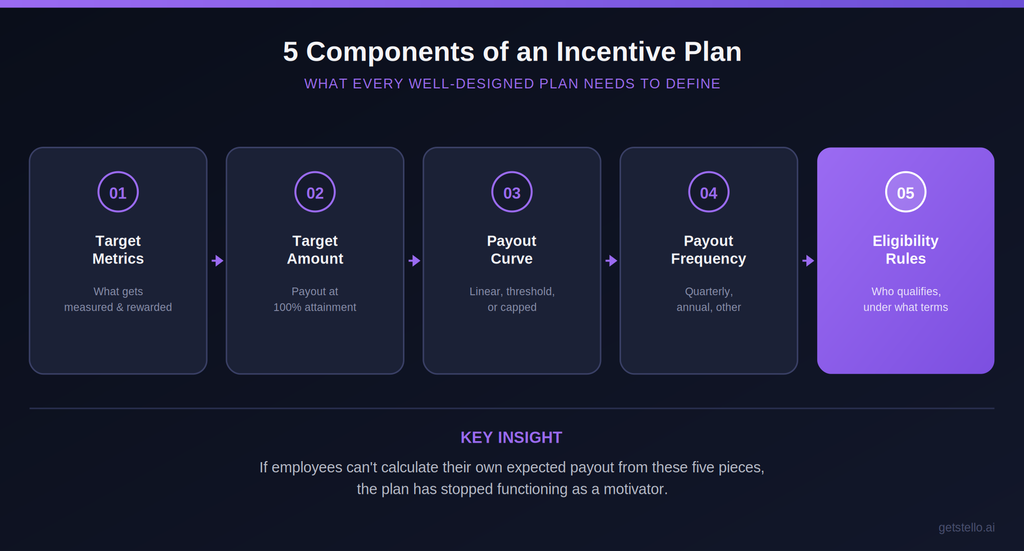
Target metrics. The specific, measurable outcomes the plan rewards, revenue, units sold, project milestones, customer retention, and so on. The best plans tie metrics closely to what the role can actually influence, rather than company-wide numbers an individual contributor has little control over.
Target incentive amount. Often expressed as a percentage of base salary (a “20% target bonus,” for example) or a fixed dollar amount, representing what the employee earns at 100% target attainment.
Payout curve. The formula connecting performance to payout. Some plans pay out linearly (hit 80% of target, get 80% of the incentive), while others use thresholds, accelerators, or caps that change the relationship between performance and payout at different levels.
Payout frequency. Incentive compensation can be paid quarterly, annually, or on some other cadence, depending on how frequently performance can reasonably be measured and how much cash flow predictability the company needs.
Eligibility rules. Which roles and levels participate in the plan, and under what conditions, new hires partway through a period, employees who leave before payout, and similar edge cases all need clear rules defined upfront.
Also read: What is Compensation Management Software? A Complete Guide
Why incentive compensation matters
Incentive compensation plays a distinct role in a broader comp strategy.
Driving specific behavior. Because incentive compensation is tied to defined metrics, it’s a direct lever for encouraging the outcomes a company cares about most, in a way base salary alone can’t.
Attracting performance-driven talent. Especially in sales and revenue-generating roles, strong performers often actively prefer compensation structures where upside is tied to results, rather than a flat salary regardless of output.
Cost flexibility. Because incentive payouts scale with results, they give companies a built-in cost control that fixed base salary doesn’t offer. In a slow quarter, incentive payouts naturally shrink along with performance.
Reinforcing strategic priorities. Shifting incentive metrics is one of the fastest ways to redirect organizational focus, for example, moving a sales team’s incentive weighting from new logo acquisition to customer retention when that becomes the bigger priority.
Common incentive compensation mistakes
A handful of design mistakes show up repeatedly, even in well-intentioned plans.
Misaligned metrics. If the incentive rewards a metric the employee can’t meaningfully influence, or that doesn’t actually reflect the outcome the company wants, the plan will drive the wrong behavior, or none at all.
Overcomplicating the formula. If employees can’t easily calculate their own expected payout, the incentive stops functioning as a motivator. The best plans are simple enough to explain in a sentence or two.
Setting targets without enough data. Targets set too high demotivate quickly; targets set too low cost more than intended without driving extra performance. Well-calibrated targets usually require solid historical performance data, not guesswork.
Ignoring plan gaming. Any incentive plan creates incentives to optimize for the metric itself, sometimes at the expense of the underlying goal. Sales reps might rush deals to hit quarterly quotas even when a slower close would serve the customer, and the company, better. Anticipating these edge cases during design saves a lot of after-the-fact plan patching.
Changing plans too frequently. Incentive compensation only works as a motivator if employees trust the rules will hold for the length of the measurement period. Changing targets or payout formulas mid-cycle, even for good reasons, erodes that trust quickly.
FAQs
What is the difference between incentive compensation and a bonus?
The terms overlap significantly and are often used interchangeably. Where a distinction is made, “bonus” tends to imply a more discretionary, sometimes one-time payout, while “incentive compensation” usually refers to a structured plan with predefined metrics and payout formulas known in advance.
Is commission a type of incentive compensation?
Yes. Commission, typically calculated as a percentage of sales, is one specific and common form of incentive compensation, most often used in sales roles.
How is incentive compensation typically calculated?
Most incentive compensation is calculated using a target amount (often a percentage of base salary) combined with a payout curve that determines what percentage of that target is earned based on actual performance against the defined metric.
Does incentive compensation count toward total compensation?
Yes. Incentive compensation is typically included when calculating an employee’s total compensation, alongside base salary, equity, and benefits, even though it’s variable rather than fixed like base pay.
What roles typically receive incentive compensation?
Sales roles are the most common, but incentive compensation has expanded well beyond sales into customer success, marketing, operations, and executive roles, wherever a company can define clear, measurable outcomes worth directly rewarding.
The bottom line
Incentive compensation gives companies a direct way to reward the specific outcomes that matter most, something fixed base salary alone can’t do. Getting it right comes down to picking metrics people can actually influence, keeping the payout formula simple enough to understand at a glance, and resisting the urge to change the rules mid-cycle. Done well, it becomes one of the most effective tools in a comp team’s toolkit for aligning pay with what the business actually needs.