Pay decisions carry more scrutiny than they used to. Boards ask about pay equity. Candidates negotiate with offer data pulled from three other companies. Employees compare notes on Glassdoor and Blind before their first day. In that environment, guessing at competitive pay is not a viable strategy.
Compensation benchmarking is how HR leaders replace guesswork with data. Done well, it becomes the backbone of your entire pay strategy, from setting salary ranges to defending budget requests to your CFO. Done poorly, it becomes a spreadsheet nobody trusts and updates once a year, if that.
This guide walks through what compensation benchmarking actually involves, how to run the process well, and the mistakes that quietly undermine it at most companies.
TL;DR
- Compensation benchmarking compares your pay against external market data to set salary ranges that are competitive and defensible.
- The process has 5 steps: define your comparison market, match roles accurately, collect data from multiple sources, set ranges around a target percentile, and refresh regularly.
- Most companies target the 50th percentile of market pay, going higher (60th–75th) for hard-to-fill or strategic roles.
- Use more than one data source (paid surveys, benchmarking software, public data) since no single source captures the full market.
- Benchmarking shows external competitiveness. It doesn’t replace a separate internal pay equity review, strong comp programs run both.
What is compensation benchmarking?
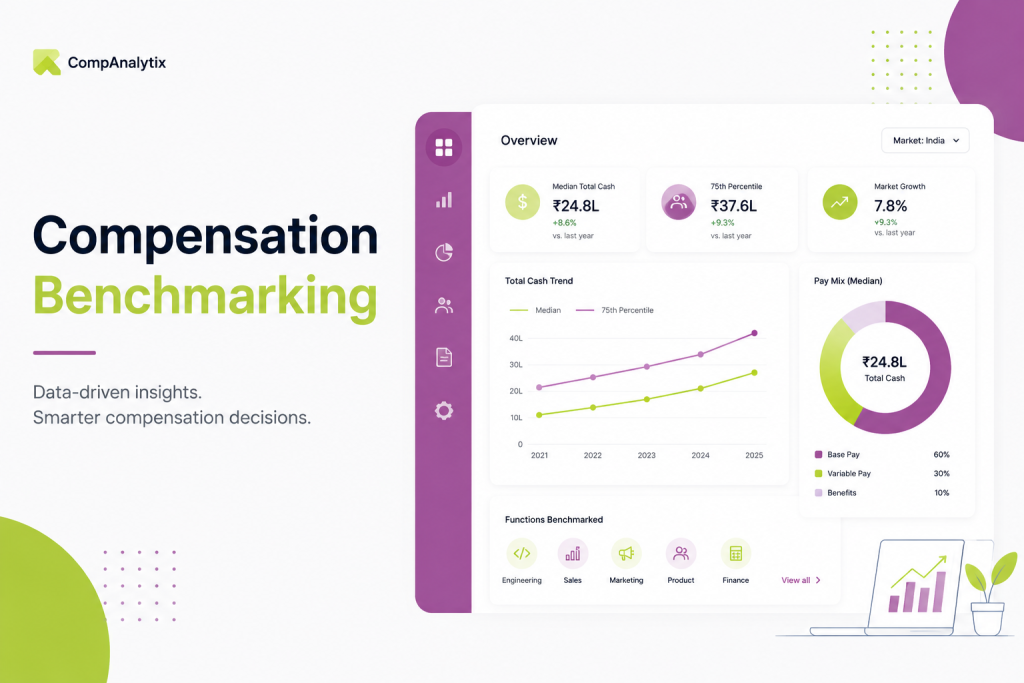
Compensation benchmarking is the process of comparing your organization’s pay for specific roles against external market data, so you can set salary ranges that are competitive, defensible, and aligned with your talent strategy.
At its core, it answers a simple question: what does the market pay for this job, at this level, in this location, at companies like ours? The answer shapes your salary ranges, which in turn shape hiring offers, merit increases, and promotion decisions.
Benchmarking isn’t a one-time project. It’s an ongoing discipline. Markets shift, especially in high-demand functions like engineering, data, and product, and ranges that were competitive 18 months ago can quietly fall behind.
Also read: What is a Compensation Cycle? A Complete Guide for HR and Comp Teams
Why compensation benchmarking matters for HR leaders
For senior HR managers, benchmarking isn’t just a compensation team exercise. It touches nearly every part of the talent function.
Hiring competitiveness. If your ranges lag the market, you lose candidates late in the process, after investing weeks of recruiter and hiring manager time. Benchmarking data lets you catch that before it costs you a hire.
Retention. Employees increasingly know their market value, thanks to salary transparency laws and sites like Levels.fyi and Glassdoor. If your internal pay quietly falls behind what benchmarking data shows the market paying, you’re exposed to attrition you won’t see coming until the resignation letter.
Pay equity and compliance. With more states requiring pay transparency in job postings, HR leaders need defensible, data-backed ranges, not numbers pulled from last year’s budget conversation. Benchmarking gives you a paper trail that holds up under both legal and internal scrutiny.
Budget conversations with finance and the board. When you ask for a larger merit budget or propose adjusting ranges for a hot role, benchmarking data is what makes the case. “The market moved” is a much stronger argument than “the team feels underpaid.”
Executive and board-level pay. Executive compensation benchmarking carries its own weight, since it’s often subject to board approval, proxy disclosure requirements (for public companies), and heightened scrutiny from compensation committees. Getting this layer right matters as much as it does for the broader workforce, arguably more.
Also read: How to Conduct Salary Benchmarking: A Practical Guide for HR and Compensation Teams
The compensation benchmarking process, step by step
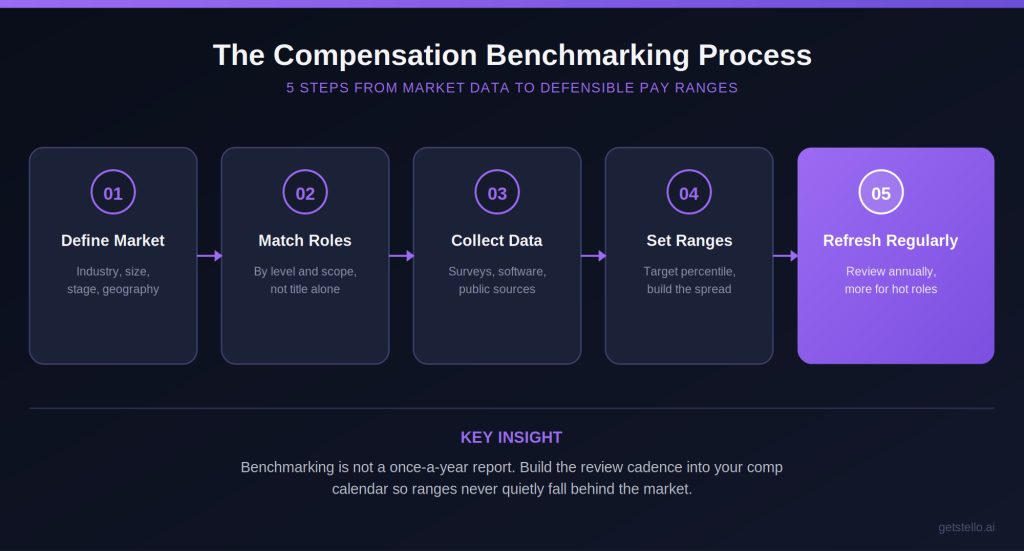
A solid compensation benchmarking process usually follows five stages.
1. Define your comparison markets
Before pulling any data, decide what “market” means for your company. This includes industry, company size, funding stage (for startups), geography, and sometimes function-specific labor markets (engineering talent often competes nationally or even globally, while operations roles may compete locally).
Getting this wrong skews everything downstream. Benchmarking a Series B startup’s engineering roles against Fortune 500 pay data will produce ranges you can’t actually afford. Benchmarking against too narrow a peer set can leave you underpaying without realizing it.
2. Match roles accurately
This is the step most teams underestimate. Job titles are inconsistent across companies. A “Senior Manager” at one company might be doing work that maps to “Director” somewhere else. Benchmarking by title alone produces unreliable results.
Instead, match roles based on job level, scope, and core responsibilities, not just title. Many compensation benchmarking tools and survey providers offer leveling guides specifically to help with this kind of matching.
3. Collect compensation benchmarking data
There are a few common sources for compensation benchmarking data, each with tradeoffs:
- Paid salary surveys (Radford, Mercer, Willis Towers Watson) offer high-quality, verified data, particularly strong for executive compensation benchmarking, but come at a real cost and often require a minimum company size to participate.
- Compensation benchmarking software and platforms (Pave, Carta Total Comp, OpenComp, and similar tools) aggregate real-time data, often pulled directly from HRIS systems across participating companies, and tend to be more accessible for growth-stage companies.
- Public and semi-public data sources (Levels.fyi, Glassdoor, government labor statistics) are free or low-cost but vary in reliability and are easier for employees to access too, which cuts both ways.
- Peer group data-sharing consortiums, common among startups in the same investor networks or industry associations, offering informal but often highly relevant comparisons.
Most mature comp functions use two or three of these in combination rather than relying on a single source.
4. Analyze and set ranges
Once you have market data mapped to your roles, the next step is translating that into actual salary ranges. Most companies target a specific percentile of the market, commonly the 50th percentile for most roles, with more competitive percentiles (60th–75th) for hard-to-fill or strategic roles.
From there, you build out a range around that target, typically with a spread of 20-40% between minimum and maximum, wide enough to accommodate performance and tenure differences within a level, but not so wide it stops meaning anything.
5. Review and refresh regularly
Compensation benchmarking isn’t a “set it and forget it” exercise. Most companies refresh their ranges annually at minimum, with a full market analysis. Fast-moving functions or highly competitive talent markets may warrant a check-in every six months.
Build the review cadence into your annual comp calendar rather than leaving it to whenever someone notices the ranges feel stale. Reactive benchmarking is how companies end up scrambling to justify a counteroffer instead of getting ahead of the market.
Also read: How to Conduct a Pay Equity Analysis: Step-by-Step Framework
Compensation benchmarking best practices
A few practices separate benchmarking programs that actually influence pay decisions from ones that just produce a report nobody opens:
Get more than one data source. No single salary survey or platform captures the full market. Cross-referencing two or three sources catches outliers and gives you more confidence in the final number.
Loop in finance early. Benchmarking exercises that surface big gaps between current pay and market rates need budget backing to act on. Bringing finance into the process before the analysis is done, not after, avoids a range recommendation that gets shelved for lack of funding.
Document your methodology. When someone asks why a role is priced where it is, whether that’s a candidate negotiating an offer, an employee raising a pay equity question, or a board member reviewing executive pay, you want a clear, repeatable answer, not “that’s just what we’ve always paid.”
Don’t chase every data point. Markets fluctuate, and small shifts in benchmarking data don’t necessarily justify range changes every quarter. Set a threshold, for example, a 5-10% market shift, before triggering a range adjustment.
Tailor benchmarking depth to role criticality. Not every role needs the same level of benchmarking rigor. Reserve the most detailed analysis (multiple data sources, custom peer groups) for roles that are hard to fill, strategically important, or high-visibility, like executive positions.
Common compensation benchmarking mistakes
Even well-resourced HR teams run into the same handful of problems:
- Relying on outdated data. Using last year’s survey results in a market that’s moved 15% is worse than having no data at all, because it creates false confidence.
- Ignoring geographic pay differences. With remote and hybrid work now standard, benchmarking against a single location median can badly misprice roles for a distributed workforce.
- Treating benchmarking as a one-time compliance exercise. Running an analysis once, setting ranges, and never revisiting them defeats the purpose. Markets don’t stay still.
- Skipping internal equity checks. External benchmarking tells you what the market pays. It doesn’t tell you whether two people doing the same job internally are paid fairly relative to each other. Both lenses matter.
FAQs-
What is the difference between compensation benchmarking and a salary survey?
A salary survey is a data source, a dataset showing what companies report paying for specific roles. Compensation benchmarking is the broader process of using that data (often from multiple surveys) to compare your pay against the market and set ranges.
How often should compensation benchmarking be done?
Most companies refresh their compensation benchmarking analysis annually, typically ahead of the merit and budget planning cycle. Roles in fast-moving or highly competitive markets, like software engineering, often warrant a mid-year check as well.
What percentile should we target for compensation benchmarking?
Many companies target the 50th percentile of the market as a baseline, adjusting upward (60th to 75th percentile) for roles that are hard to fill or strategically critical, and downward for roles with a deep, readily available talent pool.
What’s the best compensation benchmarking software for a growing company?
There isn’t a single best option, since it depends on company size, budget, and industry. Compensation benchmarking software like Pave, OpenComp, and Carta Total Comp tend to be popular for growth-stage companies, while larger enterprises often rely on traditional survey providers like Radford or Mercer, particularly for executive compensation benchmarking.
Does compensation benchmarking account for pay equity?
Not directly. Benchmarking focuses on external market competitiveness, telling you what the market pays for a role. Pay equity analysis is a separate, internal exercise that checks whether employees doing similar work are paid fairly relative to each other, regardless of what the external market says. Strong comp programs run both.
The bottom line
Compensation benchmarking turns pay decisions from guesswork into strategy. For senior HR managers, it’s the foundation that makes hiring offers competitive, retention conversations easier, and budget requests defensible. Build a consistent process, pull from more than one data source, and revisit your ranges on a regular cadence, and benchmarking stops being a once-a-year report and starts being the thing your entire comp strategy runs on.