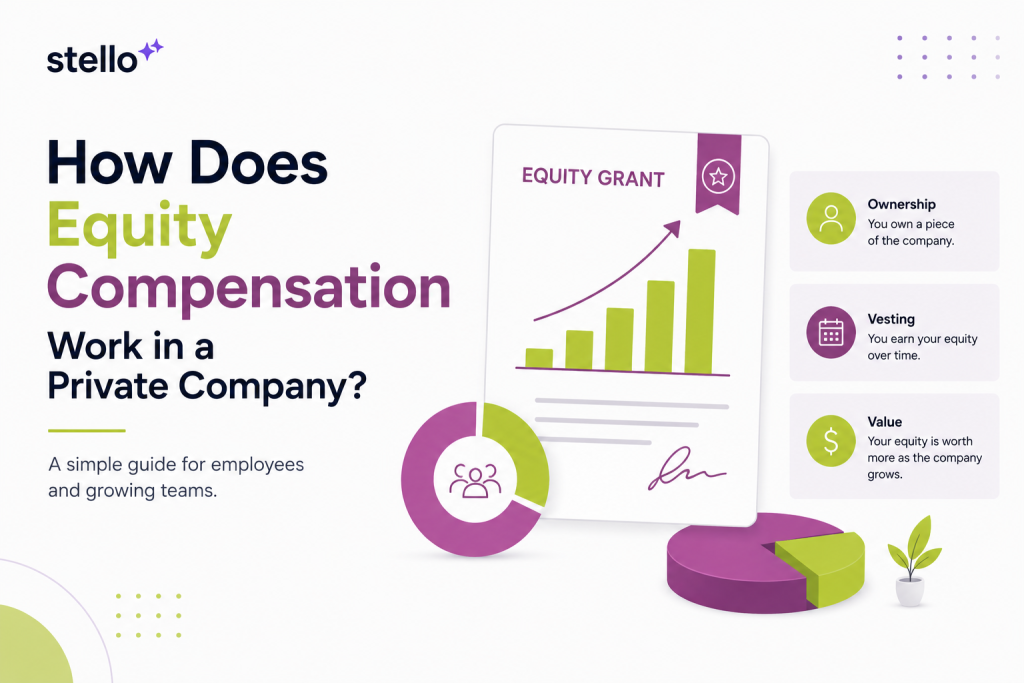
Cash is easy to understand. You see the number, it hits your account, done. Equity compensation is different. It shows up in an offer letter as a number of shares or a percentage, and for a lot of employees, especially at their first startup, it’s genuinely unclear what that number actually means, or whether it’s worth anything at all.
This guide breaks down how equity compensation actually works at a private company, what the different types mean, and what both employees and comp teams should understand before treating equity as a meaningful part of a pay package.
TL;DR
- Equity compensation gives employees an ownership stake instead of, or alongside, cash salary. At private companies, it’s illiquid until an IPO, acquisition, or secondary sale.
- Three main types: stock options (right to buy at a fixed price), RSUs (a promise of shares once vested), and RSAs (shares purchased upfront, common for early employees and founders).
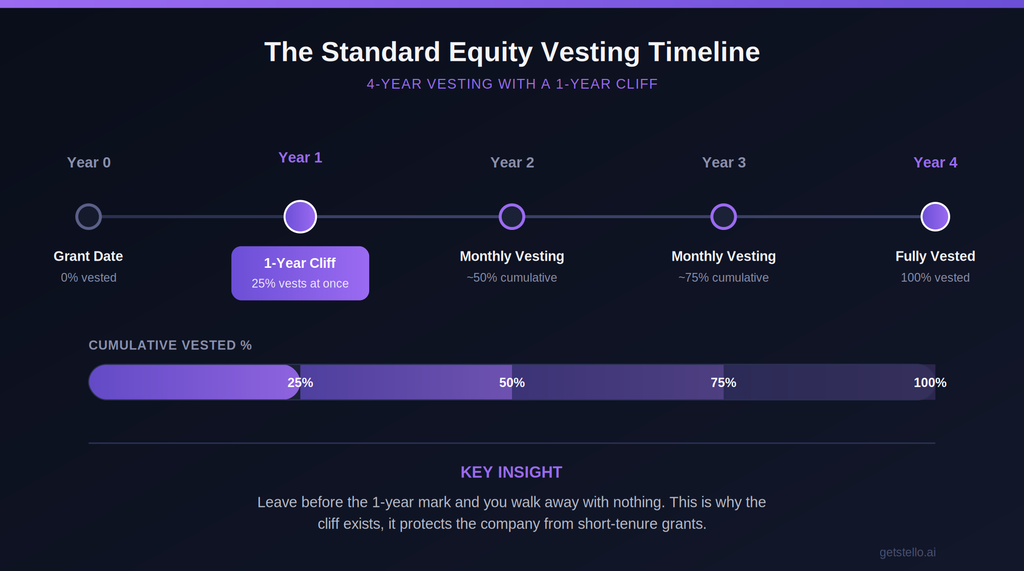
- Most companies use 4-year vesting with a 1-year cliff, 25% vests at year one, the rest vests monthly or quarterly after that.
- What equity is worth today depends on the company’s 409A valuation, and can be reduced by investor liquidation preferences in an exit.
- Comp teams build trust by giving employees real context, current valuation and vesting status, not just a share count.
What is equity compensation?
Equity compensation is a form of non-cash pay that gives employees an ownership stake, or the right to eventually own a stake, in the company they work for. Instead of receiving that value entirely in salary, part of an employee’s total compensation comes in the form of company shares or the right to purchase them.
At a private company, this looks different than it does at a public company, mainly because there’s no public market to sell the shares in. That single fact shapes almost everything else about how equity compensation works before a company goes public or gets acquired.
Also read: Pay Equity vs. Pay Parity: What’s the Difference and Why It Matters
Why private companies use equity compensation
Private companies, particularly startups, use equity compensation for a few practical reasons.
Cash conservation. Early-stage companies often can’t compete on cash salary alone. Equity lets them offer a competitive total compensation package without straining limited cash runway.
Alignment with company performance. Equity ties an employee’s financial upside directly to the company’s success. In theory, this motivates employees to think and act like owners, not just employees collecting a paycheck.
Retention. Because equity typically vests over several years, it gives employees a financial reason to stay through that vesting period rather than leaving early.
Competitive necessity. In competitive talent markets, particularly tech, equity has become a standard expectation for many roles, not just executives. Candidates evaluating multiple offers often factor equity heavily into their decision.
Also read: What is Compa-Ratio? A Simple Guide for Comp Teams
Types of equity compensation
Not all equity compensation works the same way. The type matters, since it changes how and when it actually becomes valuable.
Stock options
Stock options give an employee the right, but not the obligation, to buy company shares at a fixed price, called the strike price or exercise price, set on the day the options are granted. If the company’s value grows, the employee can exercise the option and buy shares at that original, lower price, capturing the difference as value.
There are two common types:
- Incentive Stock Options (ISOs), which offer favorable tax treatment if certain holding requirements are met, but are only available to employees, not contractors or advisors.
- Non-Qualified Stock Options (NSOs), which don’t get the same tax advantages but can be granted to a broader group, including contractors and board members.
Restricted Stock Units (RSUs)
RSUs are a promise to grant actual shares once certain conditions, usually a vesting schedule, are met. Unlike stock options, employees don’t need to buy anything. Once RSUs vest, the shares (or their cash equivalent) simply become the employee’s.
RSUs are more common at later-stage private companies and public companies, since they carry real value even without stock price appreciation, unlike options, which are worthless if the stock price falls below the strike price.
Also read: What is a Merit Increase? Meaning, Examples, and How It Works
Restricted Stock Awards (RSAs)
RSAs involve purchasing shares upfront, often at a very low price, subject to a vesting schedule that determines when the company’s right to repurchase unvested shares expires. These are most common at very early-stage startups, often granted to founders and very early employees.
How vesting works
Vesting is the schedule that determines when an employee actually earns the equity they’ve been granted. Most private companies use a standard structure:
Four-year vesting with a one-year cliff is the most common schedule. Under this structure, no equity vests during the first year. At the one-year mark, 25% vests all at once (the “cliff”). After that, the remaining equity typically vests monthly or quarterly over the following three years.
This structure exists largely to protect the company. If an employee leaves within the first year, they walk away with no equity at all, which discourages very short tenures from diluting the cap table for little contribution.
Exercising stock options
For stock options, vesting is only half the story. Vested options still need to be exercised, meaning the employee pays the strike price to actually purchase the shares, before they’re truly owned.
This creates a real decision point. Exercising costs real money upfront, and depending on the option type and timing, it can also trigger a tax bill even before the shares can be sold, since there’s typically no public market yet to sell into at a private company.
Some companies offer early exercise provisions, allowing employees to exercise options before they’ve fully vested, which can offer tax advantages but comes with more risk if the employee leaves before the shares vest.
What equity is actually worth at a private company
This is where equity compensation gets genuinely complicated, and where a lot of employees misunderstand what they’ve been offered.
At a private company, shares aren’t worth what they’ll eventually be worth if the company succeeds. They’re worth what the company is currently valued at, divided across all outstanding shares, adjusted for the specific rights attached to the employee’s shares versus what investors hold.
A few concepts matter here:
409A valuation. Private companies get an independent appraisal, called a 409A valuation, that sets the fair market value of common stock for tax purposes. This is typically lower than the price investors paid in the most recent funding round, since investor shares usually come with preferences that common stock (what employees usually get) doesn’t have.
Liquidation preferences. In an acquisition or exit, investors are often paid out before common shareholders, based on preferences negotiated when they invested. This means employee equity can be worth significantly less than a simple “shares times valuation” calculation would suggest, especially in a modest exit.
Illiquidity. Unlike public company stock, private company equity generally can’t be sold on the open market. Employees are often locked in until an IPO, acquisition, or a secondary sale event, which may be years away, or may never happen at all.
What comp teams should get right
For HR and comp teams building or managing an equity compensation program, a few things matter for keeping it credible and defensible.
Total compensation transparency. Employees increasingly want to understand the real, current value of their equity, not just the number of shares. Providing context, current 409A value, vesting status, what a realistic outcome range might look like, builds far more trust than handing someone a share count and leaving them to guess.
Consistent equity bands. Just like cash salary, equity grants should follow a consistent structure by role and level, not be negotiated ad hoc, which can create both internal equity issues and cap table headaches down the line.
Refresh grants. Since initial grants vest out over four years, companies need a plan for refresh grants to keep retention incentives in place for tenured employees, particularly high performers whose original grant is mostly or fully vested.
Clear communication at exit or IPO events. These are the moments equity compensation actually becomes real for employees, and also the moments most likely to generate confusion or frustration if the mechanics weren’t clearly explained well in advance.
FAQs-
What’s the difference between stock options and RSUs?
Stock options give employees the right to buy shares at a fixed price, so they only have value if the stock price rises above that price. RSUs are a promise to receive actual shares once vesting conditions are met, so they carry value as soon as they vest, regardless of price appreciation.
How long does equity typically take to vest?
The most common structure is four-year vesting with a one-year cliff, meaning 25% vests after the first year, with the remainder vesting monthly or quarterly over the following three years.
Can I sell my equity in a private company before it goes public?
Usually not easily. Private company equity is generally illiquid until an IPO, acquisition, or a secondary sale event organized by the company, which may or may not happen, and timing is rarely guaranteed.
What happens to my equity compensation if I leave the company?
Vested shares are typically yours to keep, though for stock options, you’ll usually have a limited window (often 90 days) to exercise them before they expire. Unvested equity is generally forfeited when you leave.
How do I know what my equity is actually worth?
Look at the company’s most recent 409A valuation for a rough sense of current fair market value, keeping in mind that liquidation preferences and dilution from future funding rounds can significantly affect what you’d actually receive in an exit. It’s worth asking your company directly for context rather than estimating based on share count alone.
The bottom line
Equity compensation can be a genuinely valuable part of a pay package at a private company, but it’s also easy to misunderstand or overvalue without the right context. Understanding vesting, exercise mechanics, and what shares are actually worth today, not just in a best-case future, makes the difference between equity being a meaningful benefit and just a confusing number on an offer letter.