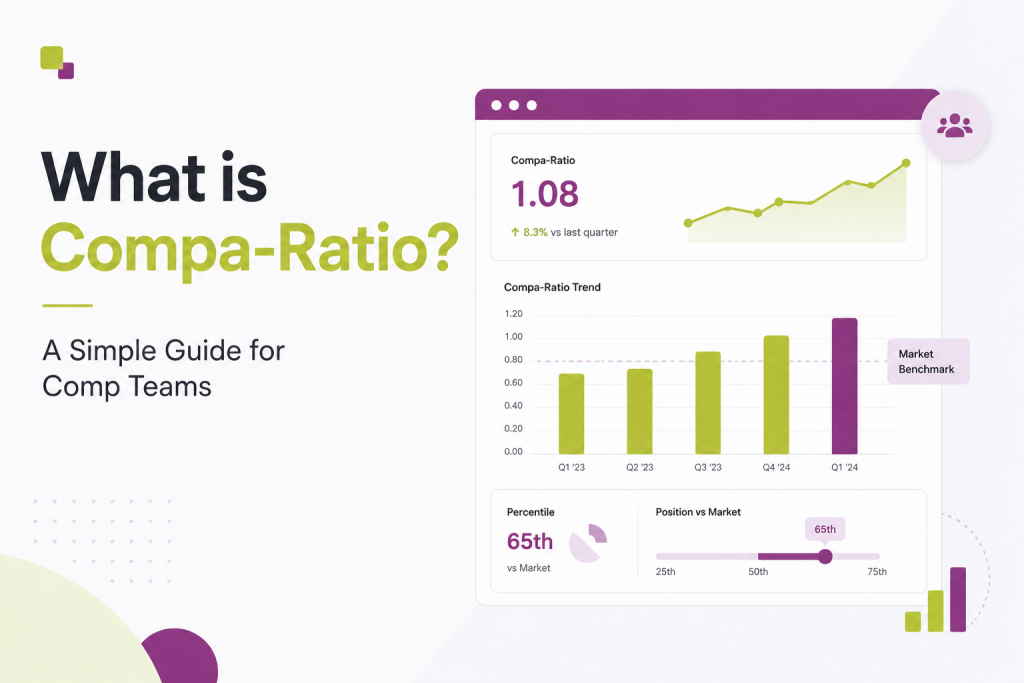
If you work in compensation, you’ve probably seen the term compa-ratio thrown around in comp reviews, HRIS dashboards, and pay equity audits. It sounds technical, but it’s one of the simplest and most useful numbers in your comp toolkit.
This guide breaks down what compa-ratio means, how to calculate it, and how to actually use it to make better pay decisions.
TL;DR
- Compa-ratio compares an employee’s pay to the midpoint of their salary range, not to the market or the full range.
- Formula: Compa-Ratio = Current Salary ÷ Range Midpoint. A ratio of 1.0 means the employee sits right at midpoint.
- Most companies treat 0.95–1.05 as a healthy range, but tenure and performance should shape what counts as “good.”
- It’s used for merit budgeting, pay equity audits, range design, and leveling decisions, not as a standalone metric.
- It only measures internal pay against your own ranges. It doesn’t reflect market competitiveness unless your ranges are built on solid market data.
What is compa-ratio?
Compa-ratio (short for “comparative ratio”) measures how an employee’s current pay compares to the midpoint of their salary range for that role.
In plain terms: it tells you whether someone is paid below, at, or above the market rate you’ve set for their position.
A compa-ratio of 1.0 (or 100%) means the employee is paid exactly at the midpoint of their salary range. Below 1.0 means they’re paid under the midpoint. Above 1.0 means they’re paid over it.
The compa-ratio formula
The formula is straightforward:
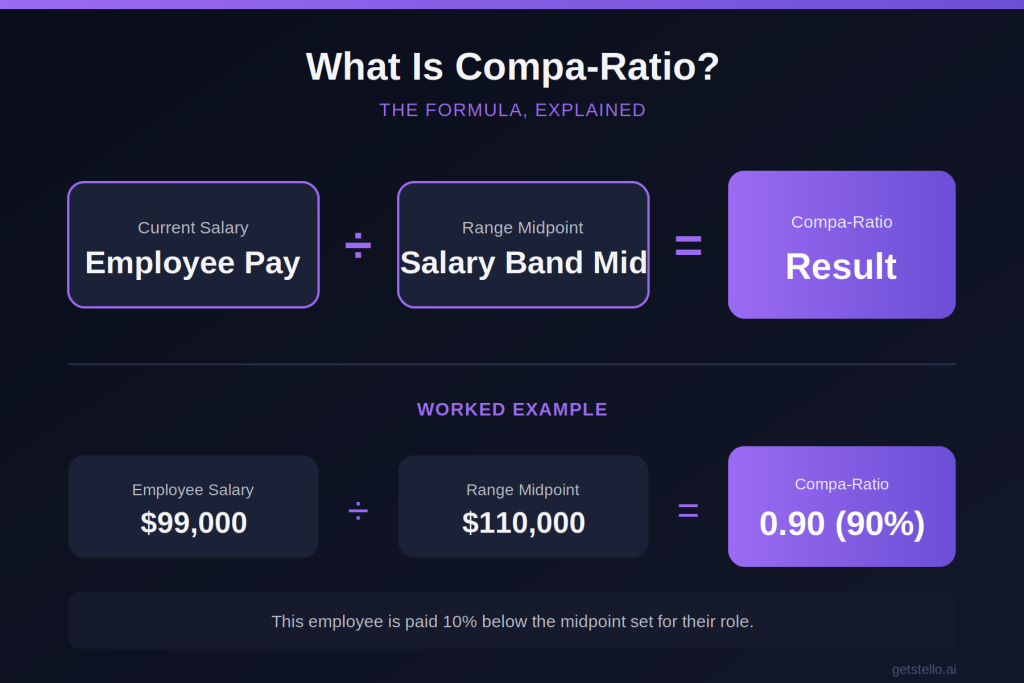
Compa-Ratio = Employee’s Current Salary ÷ Midpoint of Salary Range
Multiply the result by 100 to express it as a percentage.
Example
Say your salary range for a Product Manager role is $90,000 to $130,000, with a midpoint of $110,000. An employee in that role currently earns $99,000.
Compa-Ratio = $99,000 ÷ $110,000 = 0.9, or 90%
This employee sits at 90% of the range midpoint, meaning they’re paid somewhat below the market rate you’ve established for the role.
Also read: Compensation Management: 60+ Compensation Terms
How to interpret compa-ratio ranges
Most comp teams use rough bands to interpret compa-ratio scores:
- Below 0.80 (80%): Significantly underpaid relative to the range. Often a flight risk or a sign the employee is new to the role.
- 0.80–0.95 (80–95%): Paid below midpoint. Common for employees still growing into the role.
- 0.95–1.05 (95–105%): Paid near midpoint. Typically reflects solid, fully proficient performance in the role.
- 1.05–1.20 (105–120%): Paid above midpoint. Usually tenured, high-performing employees.
- Above 1.20 (120%+): Paid well above the range. Worth reviewing to confirm the range itself is still accurate, or whether the employee has outgrown their leveling.
These bands aren’t fixed rules. Some companies use tighter thresholds, especially in pay equity audits where even a 5% gap between similar employees can raise questions.
Why compa-ratio matters
Compa-ratio shows up in a few different parts of comp work:
Budgeting merit increases. Compa-ratio helps you decide who gets a bigger raise. An employee at 85% of range typically has more room to grow than someone already at 115%, even if their performance ratings are similar.
Pay equity audits. If two employees doing the same job have very different compa-ratios with no clear reason (tenure, performance, scope), that’s a signal worth investigating.
Range design. If most of your team clusters at the low end of a range, the range itself might be miscalibrated, or you’re underpaying relative to your stated bands.
Promotion and leveling decisions. A high compa-ratio in a current role can be a sign someone is ready to level up, since they’ve maxed out what the current band can offer.
Also read: What is a Compensation Cycle? A Complete Guide for HR and Comp Teams
Compa-ratio vs. other comp metrics
It’s easy to confuse compa-ratio with other range-based metrics. Here’s the quick distinction:
- Compa-ratio compares pay to the range midpoint.
- Range penetration compares pay to where it falls across the entire range (min to max), not just the midpoint.
- Market ratio compares pay to external market data, not your internal range.
Compa-ratio is an internal measure. It tells you where someone sits relative to your own pay structure, not necessarily relative to the broader market.
Common compa-ratio mistakes
A few things trip up comp teams new to this metric:
- Treating 1.0 as a hard target for everyone. Not every employee should sit exactly at midpoint. Tenure, performance, and scope all justify natural variation.
- Ignoring range quality. Compa-ratio is only as useful as the salary range behind it. If your ranges are outdated, the ratio will be misleading.
- Using it in isolation. Compa-ratio works best alongside performance data, tenure, and market benchmarking, not as a standalone decision-maker.
Also read: Pay Equity vs. Pay Parity: What’s the Difference and Why It Matters
FAQs-
What is a good compa-ratio?
Most companies consider a compa-ratio between 0.95 and 1.05 to be healthy, meaning the employee is paid close to the range midpoint. What counts as “good” depends on tenure and performance too. A newer employee at 0.85 might be perfectly fine, while a tenured top performer at the same ratio could be a retention risk.
What does a compa-ratio of 1.2 mean?
A compa-ratio of 1.2 means the employee is paid 20% above the midpoint of their salary range. This usually points to a tenured or high-performing employee, but it can also mean the range itself is outdated or the employee has outgrown their current level.
Is a higher or lower compa-ratio better?
Neither is automatically better. A higher compa-ratio isn’t a problem if it’s backed by tenure and performance. A lower compa-ratio isn’t necessarily bad either, especially for employees new to a role. What matters is whether the ratio makes sense given the full context.
How often should compa-ratio be reviewed?
Most comp teams review compa-ratio at least once a year, typically ahead of merit or promotion cycles. Companies doing regular pay equity work often review it more frequently, sometimes quarterly, to catch gaps early.
Does compa-ratio account for market pay data?
No. Compa-ratio only compares an employee’s pay to your internal salary range midpoint. It doesn’t factor in external market rates directly. If your ranges aren’t built on solid market data, your compa-ratios won’t reflect true market competitiveness either.
The bottom line
Compa-ratio is a simple way to answer one question: is this person paid fairly relative to the range you’ve set for their role? It won’t tell you everything about pay fairness on its own, but it’s one of the fastest checks a comp team can run before merit cycles, pay equity reviews, or leveling conversations.
Get your ranges right, calculate the ratio, and use it as a starting point for a deeper conversation, not the final word.