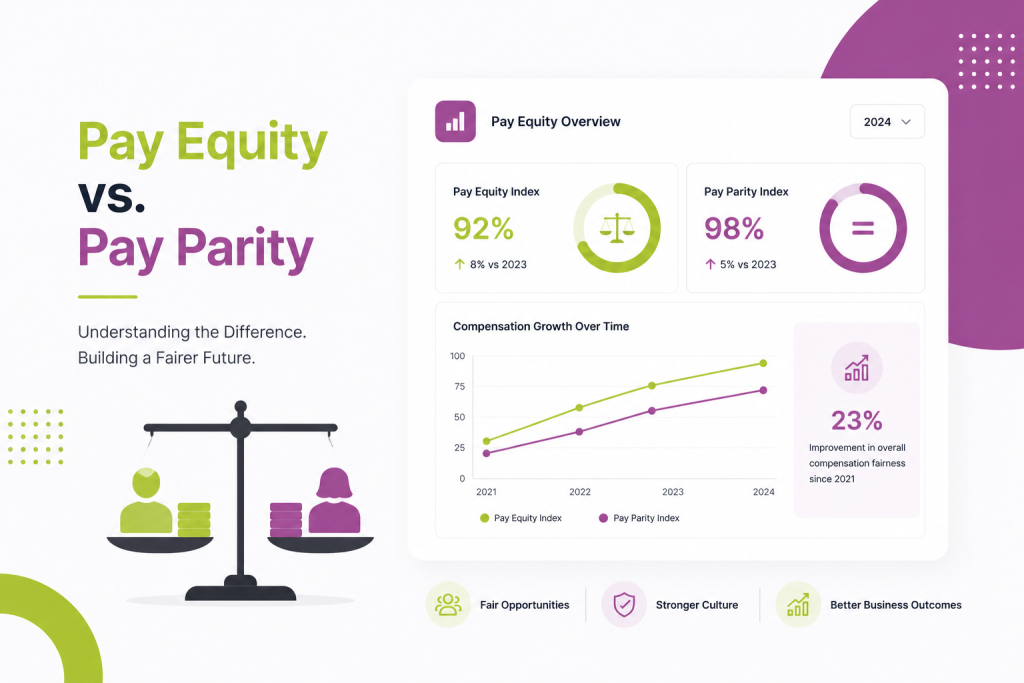
“Pay equity” and “pay parity” get used interchangeably all the time, and most people who use them wrong don’t realize it. HR teams say one when they mean the other. Job postings mix them up. Even some compensation software vendors blur the line.
The problem is that they’re not the same thing. Pay parity is a narrow, mathematical concept. Pay equity is a broader, more nuanced one. Confusing them can lead to compliance gaps, bad audits, and compensation decisions that look fair on paper but aren’t.
This guide breaks down what each term actually means, where they overlap, and why the distinction matters more than most comp teams realize.
Pay Equity vs. Pay Parity: What’s the Difference
- Pay parity means people in the same role, same level, same experience, are paid the same. It’s a like-for-like comparison.
- Pay equity is broader. It asks whether pay differences across the whole company are explainable by legitimate factors like role, level, and performance, not by gender, race, or other protected characteristics.
- Parity is a subset of equity. A company can pass every parity check and still have an equity gap if certain groups are underrepresented in higher-paying roles or promoted more slowly.
- Parity is easier to fix than equity. Parity gaps often need a one-time salary correction. Equity gaps usually point to structural issues like biased promotions or hiring patterns.
- Pay equality is close to pay parity in meaning, mostly used in legal and anti-discrimination contexts. Most comp teams use “parity” and treat “equity” as the bigger, system-wide concept.
- Fixing both takes different tools: a straightforward audit for parity, and regression-based analysis plus ongoing monitoring for equity.
Read the full article for the definitions, a real-world example, and FAQs.
What is pay parity?
Pay parity means employees in the same role, doing the same work, with the same experience and qualifications, are paid the same amount. It’s a like-for-like comparison. Same job, same pay.
Pay parity is easy to measure. You can pull a spreadsheet, group employees by job title and level, and check whether the numbers line up. If two software engineers at the same level, with the same tenure, are earning different base salaries for no explainable reason, that’s a pay parity problem.
Most legal frameworks around “equal pay” are actually pay parity frameworks. The Equal Pay Act in the US, for example, requires equal pay for equal work performed under similar conditions. It’s checking for parity, not equity.
What is pay equity?
Pay equity is bigger. It asks whether your entire compensation system is fair, not just whether two people in the same role earn the same amount. Pay equity looks at whether pay differences across your workforce can be explained by legitimate factors like experience, performance, and scope of role, rather than by gender, race, age, or other characteristics that shouldn’t affect pay.
Here’s where it gets more complex. Pay equity doesn’t assume everyone should be paid the same. It assumes pay differences should be explainable and fair. A senior employee can reasonably earn more than a junior one. A high performer can reasonably earn more than an average one. Pay equity is about making sure the differences that do exist are justified, and that no group is systematically disadvantaged.
This is why pay equity analysis is statistical, not just a side-by-side comparison. Compensation teams typically run regression models that control for legitimate pay factors (role, level, tenure, performance, location) and then check whether gender, race, or other protected characteristics still predict pay after controlling for those factors. If they do, that’s a red flag.
The core difference
Pay parity asks: are two people in the same job paid the same?
Pay equity asks: is our whole compensation system fair, accounting for legitimate differences in role, experience, and performance?
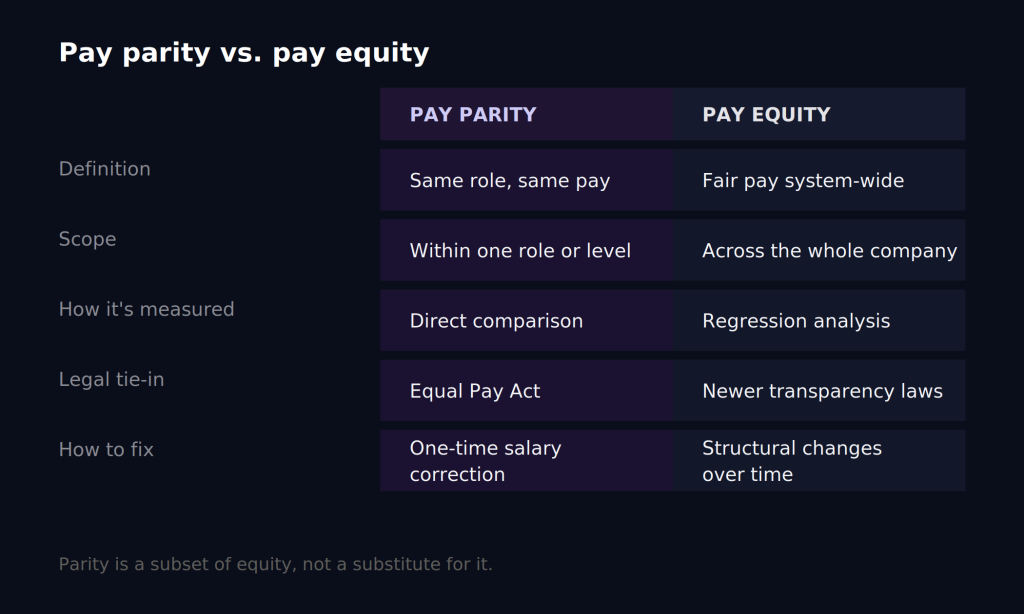
Parity is a subset of equity. You can have pay parity within specific job titles and still have a pay equity problem, if, for example, women are systematically underrepresented in higher-paying roles or promoted more slowly than men with similar performance. Parity checks the math within a role. Equity checks the system across the whole organization.
This is the distinction that trips people up. A company can pass every pay parity check, meaning nobody with the exact same title and experience is underpaid relative to a peer, and still have a significant pay equity gap, because women or people of color are clustered in lower-paying roles or levels.
Why the distinction matters
Legal risk looks different for each. Most equal pay laws are built around parity: same job, same pay. But newer pay transparency and pay equity legislation, especially at the state level in the US, is starting to require broader equity analysis, including how people move through roles and levels over time, not just what they earn on day one.
Fixing parity is easier than fixing equity. A parity gap can often be corrected with a one-time salary adjustment. An equity gap usually points to something structural, like biased promotion practices, unequal access to high-visibility projects, or hiring patterns that funnel certain groups into lower-paying roles. Fixing equity gaps takes longer and touches more of the organization.
Reporting to the board or investors requires knowing which one you’re measuring. If a company says it has “closed its pay gap” after fixing parity issues, but hasn’t looked at equity across roles and levels, that claim can be misleading, intentionally or not.
DEI and comp strategy depend on getting this right. Compensation teams that only check parity might miss the bigger story. A workforce can look fine at the job-title level while still having a meaningful equity gap driven by who gets promoted, who gets stretch assignments, and who ends up in higher-paying job families in the first place.
How they relate to pay equality
A third term, pay equality, sometimes gets thrown into the mix too. Pay equality is close to pay parity: it generally refers to the principle that people should be paid equally for equal work, often used in the context of anti-discrimination law rather than compensation analysis specifically.
For practical purposes, most compensation teams treat pay equality and pay parity as functionally the same idea, while treating pay equity as the broader, system-wide concept. If you’re writing a comp policy, it’s worth picking one term (parity is more common in comp circles) and using it consistently, rather than switching between the two.
How companies typically approach both
Getting pay parity right usually starts with a straightforward audit: group employees by role and level, compare pay within each group, and flag outliers. This can be done manually for smaller companies, though it gets harder to track accurately as headcount grows and roles become less standardized.
Getting pay equity right takes more. It typically involves:
- A regression-based pay equity analysis that controls for legitimate pay factors
- A review of how people move into roles, including hiring, promotion, and internal mobility patterns
- An examination of who ends up in higher-paying job families and levels in the first place
- Regular re-analysis, since equity gaps can reopen after every hiring cycle, promotion round, or reorg
This is also where compensation technology has started to matter more. Manually running regression analysis across a growing headcount, multiple job families, and changing org structures is slow and error-prone in a spreadsheet. Compensation management software, and increasingly AI-powered tools built specifically for comp teams, can flag both parity and equity issues automatically, run the underlying statistics, and surface which gaps need attention before a formal audit finds them.
A quick example
Say a company employs 20 product managers at the same level. A pay parity check shows all 20 are paid within a tight, defensible range of each other. No red flags. The company concludes it has no pay problem.
But look one level up. Out of 60 total product management employees across all levels, only 15% of senior and staff-level PMs are women, compared to 45% at the entry level. Women are being hired in at similar rates but aren’t advancing into higher-paying levels at the same pace as men. Pay parity looks clean. Pay equity, once you look at representation and progression across the job family, tells a very different story.
This is exactly the kind of gap a parity-only audit misses. It requires looking beyond individual role comparisons and into how people move through the organization over time.
Common mistakes to avoid
Treating a clean parity check as proof of equity. This is the single most common mistake. Passing a same-role, same-pay comparison doesn’t mean the broader system is fair.
Only checking equity once a year. Equity gaps can shift with every hire, promotion, and reorg. An annual check catches problems long after they’ve compounded.
Fixing individual outliers without addressing root causes. Giving one underpaid employee a raise solves that person’s parity issue. It doesn’t fix the pattern that put them there in the first place, whether that’s biased leveling, inconsistent offer negotiation, or unequal promotion rates.
Using the terms interchangeably in policy documents. If your compensation philosophy or pay equity statement uses “pay equity” and “pay parity” as synonyms, it can create confusion internally and, in some jurisdictions, legal ambiguity about what your company is actually committing to.
The bottom line
Pay parity is the narrower check: same role, same pay. Pay equity is the bigger question: is the whole compensation system fair once you account for legitimate differences in experience, performance, and scope.
Both matter. But they require different tools, different analysis, and different timelines to fix. A company that only ever checks parity is doing half the work. Getting both right, and understanding which one you’re actually measuring at any given moment, is what separates a compensation program that looks fair from one that actually is.
FAQs
Is pay equity the same as pay parity?
No. Pay parity means people in the same role with the same experience are paid the same amount. Pay equity is broader. It asks whether pay differences across the whole organization are explainable by legitimate factors like role, level, and performance, rather than by gender, race, or other protected characteristics.
Why is pay equity important?
Pay equity protects a company from legal and reputational risk, but it also affects retention and trust. Employees who suspect their pay isn’t fair, even if they can’t prove it, tend to disengage or leave. Pay equity analysis catches systemic gaps before they show up in exit interviews or lawsuits.
How do you do a pay equity analysis?
Most pay equity analyses use regression modeling to control for legitimate pay factors like role, level, tenure, performance, and location. Once those factors are accounted for, analysts check whether gender, race, or other protected characteristics still predict pay. If they do, that indicates an equity gap worth investigating further.
What is pay parity in simple terms?
Pay parity simply means two people doing the same job, at the same level, with similar experience, are paid the same. It’s the most basic form of pay fairness and the easiest to measure, since it’s a direct comparison rather than a statistical analysis.
How do you ensure pay equity in the workplace?
Ensuring pay equity takes more than a one-time audit. It typically requires regular pay equity analysis, standardized pay ranges tied to clear job leveling, consistent promotion and offer practices, and ongoing monitoring, since gaps can reopen after every hiring cycle or reorg.