Ask five people at the same company what they think a fair salary range looks like for their role, and you’ll likely get five different answers. Without a structured system, pay decisions end up inconsistent, hard to defend, and increasingly out of step with pay transparency laws that now require companies to publish exactly this kind of information.
Salary bands solve that problem. This guide covers what salary bands actually are, real examples of how they’re structured, the advantages and disadvantages of using them, and a practical process for building your own.
TL;DR
- Salary bands are predefined pay ranges (minimum, midpoint, maximum) assigned to a role or level, replacing ad hoc pay negotiation with a consistent structure.
- Bands typically overlap between adjacent levels and widen at senior levels, both intentional to reflect real variation in experience and impact.
- Building them takes 7 steps: define job architecture, gather market data, set target position, build the range, check overlap, validate against current pay, and refresh regularly.
- Key benefits: consistency, budget predictability, pay transparency law compliance, and clearer career paths.
- Bands support pay equity but don’t guarantee it. A separate pay equity analysis is still needed to catch gaps within a well-structured band.
What are salary bands?
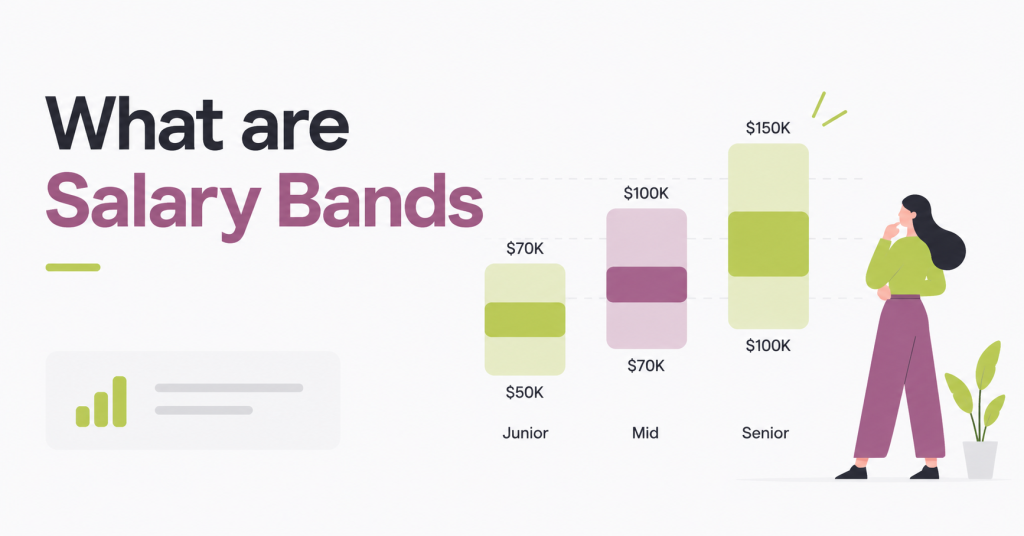
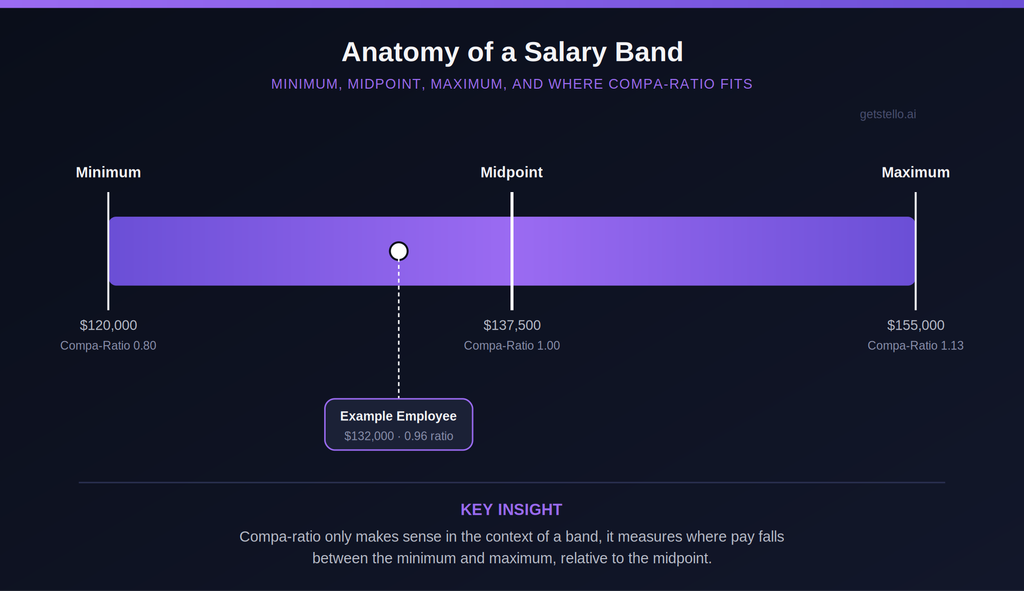
Salary bands, also called pay bands or pay grades, are predefined salary ranges assigned to specific roles, levels, or job families within a company. Each band has a minimum, a midpoint, and a maximum, defining the acceptable pay range for anyone in that role or level.
Instead of negotiating pay individually for every hire and every raise, salary bands give a company a consistent structure to work within. An employee’s actual salary falls somewhere inside their band depending on factors like experience, performance, and tenure, but the band itself sets the outer boundaries.
Salary bands are the foundation that other comp concepts, like compa-ratio, are built on. Compa-ratio measures where someone sits within their band relative to the midpoint; the band itself is what makes that measurement possible in the first place.
Salary bands vs. salary ranges vs. pay grades
These terms get used inconsistently across companies, which causes some confusion.
Salary range is often used interchangeably with salary band, referring to the minimum-to-maximum pay span for a role.
Pay grade typically refers to a broader classification level (Grade 5, Grade 6, and so on) that may encompass multiple related roles, with each grade having its own associated salary band.
Salary band is generally the more specific term, tied directly to a role or level, though in practice many companies use “band,” “range,” and “grade” more or less interchangeably in everyday conversation.
Also read: Compensation Benchmarking: A Practical Guide for Senior HR Managers
Examples of salary bands
Seeing actual structured examples makes the concept much more concrete. Here’s what salary bands commonly look like across levels within a single job family:
Software Engineer job family (illustrative example):
- Level 1 (Associate): $70,000 – $90,000 (midpoint $80,000)
- Level 2 (Mid): $90,000 – $120,000 (midpoint $105,000)
- Level 3 (Senior): $120,000 – $155,000 (midpoint $137,500)
- Level 4 (Staff): $155,000 – $195,000 (midpoint $175,000)
- Level 5 (Principal): $195,000 – $240,000 (midpoint $217,500)
Notice two things about this structure. First, each band overlaps slightly with the next, a Level 2 engineer near the top of their band can out-earn a Level 3 engineer near the bottom of theirs. This overlap is intentional and common, reflecting the reality that a highly experienced person at one level can be worth more than someone newly promoted into the next.
Second, the bands widen as level increases. A $20,000 spread at Level 1 becomes a $45,000 spread by Level 5. This is standard practice, since more senior roles typically have more variation in scope, impact, and negotiating leverage.
Sales Account Executive job family (illustrative example, base salary only):
- Level 1 (SMB): $60,000 – $75,000
- Level 2 (Mid-Market): $75,000 – $95,000
- Level 3 (Enterprise): $95,000 – $130,000
Note that sales roles typically layer incentive compensation on top of these base salary bands, so the bands here represent only one part of total compensation, not the full earning picture.
Also read: What is Compensation Management Software? A Complete Guide
Advantages and disadvantages of using salary bands
Salary bands aren’t without tradeoffs. Understanding both sides helps set realistic expectations before rolling them out.
Advantages
Consistency and fairness. Bands reduce the risk of unexplained pay gaps between employees doing similar work, supporting broader pay equity goals rather than leaving pay to ad hoc negotiation.
Budget predictability. Knowing the band for every role makes it much easier to forecast headcount costs and plan merit budgets, since pay decisions have defined boundaries rather than being open-ended.
Compliance with pay transparency laws. A growing number of states require salary ranges in job postings. Companies with formal salary bands already have this information ready to publish; companies without them are often scrambling to construct ranges retroactively.
Clearer career paths. When bands are tied to levels, employees can see what a promotion actually means in compensation terms, making career growth more tangible and motivating.
Easier manager conversations. Bands give managers a defensible, structured answer when employees ask about pay, rather than vague or inconsistent explanations.
Disadvantages
Less individual negotiation flexibility. Bands can make it harder to make exceptions for a candidate with unusual, hard-to-value experience, since offers are expected to stay within the defined range.
Risk of becoming outdated. Bands built on stale market data quietly become uncompetitive over time. This is why bands need to be reviewed regularly against fresh compensation benchmarking data, not set once and forgotten.
Complexity at scale. Building and maintaining accurate bands across many roles, levels, and locations, especially with remote or hybrid teams spanning multiple markets, takes real ongoing effort.
Employee perception issues. If bands are communicated poorly, employees sometimes interpret them as a ceiling on their growth rather than a structure that still allows for real progression within and between bands.
How to create salary bands: step by step
1. Define your job architecture
Before building bands, you need a clear structure of roles, levels, and job families. This means grouping similar roles together and defining what distinguishes each level within them, scope, complexity, and impact, not just years of experience.
2. Gather market data
Use compensation benchmarking data to understand what the market pays for each role and level. This typically comes from paid salary surveys, benchmarking software, or a combination of sources, matched carefully to your company’s size, industry, and location.
3. Set your target market position
Decide where you want to position pay relative to the market, commonly the 50th percentile as a baseline, with some roles targeted higher if they’re strategically critical or hard to fill. This target becomes your band midpoint.
4. Build the range around the midpoint
Set your band width, the spread between minimum and maximum, typically 20% to 40% depending on level. Junior roles usually have narrower bands; senior and executive roles usually have wider ones to account for greater variation in experience and impact.
5. Check for overlap and progression logic
Review how bands relate to each other across levels. Some overlap between adjacent bands is normal and expected, but bands that overlap too heavily can blur the distinction between levels, while bands with large gaps between them can create awkward promotion math.
6. Validate against current pay
Map your existing employees into the new bands to see who falls outside their band’s minimum or maximum. This step often surfaces pay equity issues that need to be addressed as part of rolling out the new structure, not after.
7. Review and refresh regularly
Salary bands aren’t a one-time project. Most companies refresh bands annually, alongside their compensation benchmarking cycle, to keep pace with market movement.
Common mistakes when building salary bands
Building bands around headcount rather than fresh market data. Bands built by just formalizing whatever people currently earn bakes existing pay gaps into the new structure instead of fixing them.
Making bands too narrow. Tight bands leave little room for growth without a promotion, forcing more frequent leveling conversations than necessary.
Ignoring geographic pay differences. A single national band can badly misprice roles in a distributed workforce, either overpaying in lower-cost markets or underpaying in expensive ones.
Failing to communicate the structure. Employees who don’t understand how bands work, or where they sit within theirs, often assume the worst. Clear communication about what the band means and how progression works matters as much as the band design itself.
FAQs-
What is the difference between a salary band and a salary range?
The terms are largely used interchangeably. Both refer to the minimum-to-maximum pay span defined for a role or level. Some companies use “range” more informally and reserve “band” for a formally documented compensation structure.
How wide should a salary band be?
Most salary bands span 20% to 40% between minimum and maximum, with narrower bands at junior levels and wider bands at senior levels. There’s no universal rule, and the right width depends on how much pay variation the company wants to accommodate within a single level.
How often should salary bands be updated?
Most companies review and refresh salary bands annually, typically alongside their compensation benchmarking cycle, so bands stay aligned with current market data rather than gradually falling behind.
Can two salary bands overlap?
Yes, and this is common and intentional. Overlapping bands between adjacent levels reflect the reality that a highly experienced person at a lower level can be paid more than someone newly promoted into the next level.
Do salary bands help with pay equity?
Yes, significantly. Salary bands create a consistent structure that reduces unexplained pay variation between employees in similar roles, which supports pay equity goals. That said, bands alone don’t guarantee equity, a formal pay equity analysis is still needed to catch gaps that can exist even within a well-structured band.
The bottom line
Salary bands turn pay decisions from ad hoc negotiations into a consistent, defensible structure, one that supports pay transparency compliance, budget planning, and pay equity all at once. Building them well takes real work: solid market data, a clear job architecture, and a commitment to reviewing them regularly rather than setting them once and letting them go stale. Get that foundation right, and nearly every other comp decision downstream gets easier.