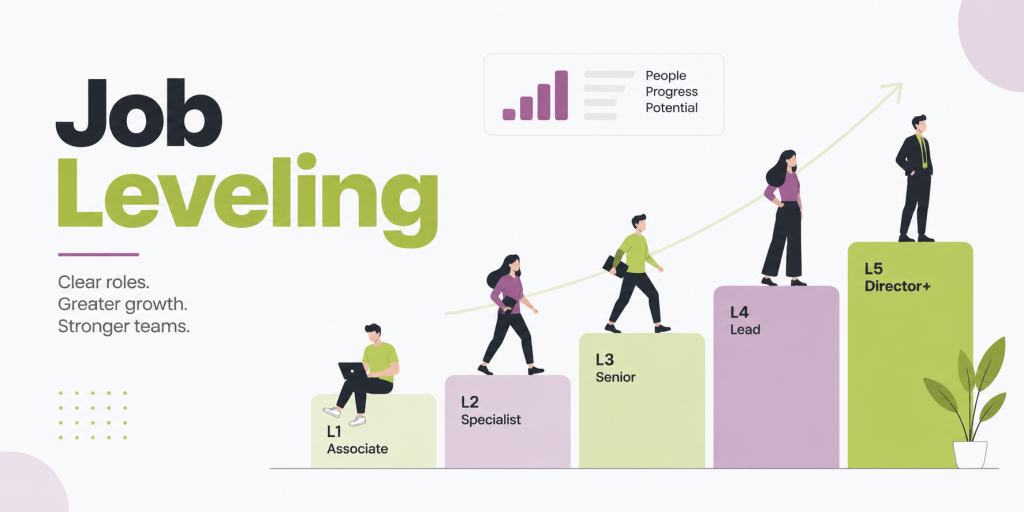
Most companies don’t set out to pay people inconsistently or promote based on gut feel — it just happens by default once headcount outgrows what one founder or one manager can hold in their head. Job leveling is the fix: a structured way to define what different levels of contribution actually look like, so pay, promotions, and hiring decisions are based on a shared framework instead of whoever negotiated hardest or who a manager happens to like. This guide walks through what job leveling is, why it matters, how the major frameworks work, and how to actually build one without turning it into a shelfware HR document.
- Job leveling organizes roles into a consistent hierarchy based on scope, complexity, and impact — not job title.
- It’s the foundation for pay equity: compensation bands are built on top of levels, so consistent leveling means consistent, defensible pay.
- A complete framework has four parts: job families, career tracks (IC vs. management), level definitions, and compensation bands.
- Common methodologies include Radford, Mercer IPE, and Willis Towers Watson, plus publicly shared frameworks from companies like GitLab and Buffer.
- Building one takes 7 steps: scope it, choose dimensions, draft definitions, calibrate real employees against them, attach comp bands, publish transparently, and maintain annually.
- The most common failure modes: leveling titles instead of actual work, skipping cross-functional calibration, keeping bands secret, and treating the framework as a one-time project.
- Compensation management software increasingly automates the mechanics — band mapping, market benchmarking, and pay equity flagging — for lean HR/Finance teams.
What Is Job Leveling?
Job leveling is the process of organizing every role in a company into a structured hierarchy based on scope, complexity, impact, and required skill — independent of job title, department, or who happens to hold the role. A job level (sometimes called a grade or band) groups roles of comparable value to the organization, so a Level 4 engineer, a Level 4 marketer, and a Level 4 recruiter are all recognized as contributing at a similar depth, even though their day-to-day work looks nothing alike.
At its core, job leveling answers three questions every growing company eventually has to face:
- What does it actually mean to be “senior” here?
- How do we pay people fairly and consistently as we scale past a handful of employees?
- How does someone move from where they are to where they want to be?
Without a leveling framework, these answers live in individual managers’ heads — which means they’re inconsistent, hard to defend, and quietly biased. With one, they’re documented, comparable across teams, and auditable.
Also read: What are Salary Bands? Definition, Examples, and How to Create Them
Why Job Leveling Matters
It’s the backbone of pay equity
You cannot pay people fairly if you have no consistent way to say two roles are “equal work.” Compensation bands are built on top of levels — each level maps to a salary range, and that range is what HR and compensation teams use to make offers, plan raises, and run pay equity audits. Skip leveling, and pay decisions default to negotiation skill, manager generosity, or tenure — all of which reliably produce gender and race pay gaps over time.
It removes ambiguity from promotions
“You’re not ready for senior yet” is a frustrating thing to hear with no rubric behind it. A leveling framework turns vague feedback into a checklist: here is what Level 5 looks like, here is where you currently sit against it, here is the gap. This doesn’t eliminate manager judgment, but it gives that judgment a shared reference point.
It enables org design at scale
Once you’re past ~50 people, you can’t manually calibrate every hire against every other hire. Levels let recruiting, finance, and leadership plan headcount, budget for raises, and benchmark against the external market using a shared vocabulary — “we’re hiring three L5 engineers” means the same thing to everyone in the room.
It supports market benchmarking
Compensation data providers (Radford, Pave, Carta, Option Impact, Mercer) organize survey data by level and job family. A clean internal leveling structure is what lets you map your roles to that external data and know whether you’re paying at market, above, or below.
Also read: What is Incentive Compensation? A Guide for Comp and HR Teams
Core Components of a Leveling Framework
1. Job families
A job family is a grouping of roles that require similar skills, even if scope differs — Engineering, Product, Design, Sales, Marketing, People, Finance. Each family typically has its own ladder, because “impact” looks different for an engineer than for an account executive.
2. Career tracks (IC vs. management)
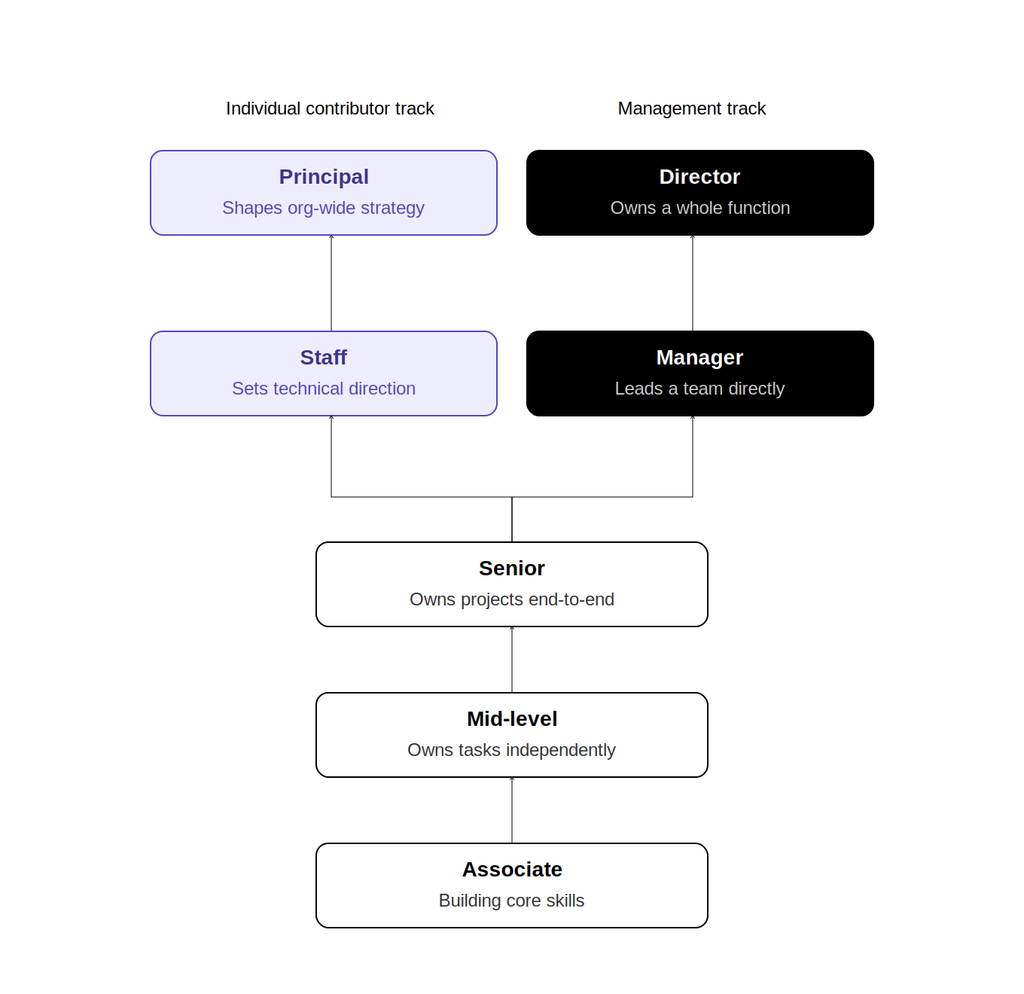
Most modern frameworks split into at least two tracks past the mid-level:
- Individual contributor (IC) track — impact scales through technical depth, ownership of hard problems, and influence without direct reports.
- Management track — impact scales through team leadership, org design, and multiplying other people’s output.
Some companies add a third technical leadership track (architects, principal-level ICs) to avoid forcing strong technologists into management just to keep advancing their pay and title.
3. Levels
The actual rungs — commonly numbered (L1–L8) or named (Associate, Mid, Senior, Staff, Principal). Each level is defined by a consistent set of dimensions, typically:
- Scope — how big is the problem space you own? A task, a project, a product area, a function, the company?
- Complexity — how ambiguous or novel is the work? Executing a known playbook vs. inventing the playbook.
- Autonomy — how much direction do you need? Closely supervised vs. self-directed vs. setting direction for others.
- Impact — how far does your work reach? Your own output, your team’s output, the org’s output, company strategy.
- Influence — who do you need to align and persuade? Peers, cross-functional partners, leadership, external stakeholders.
4. Level definitions (the actual written rubric)
This is the document people read to self-assess or prepare for a promotion case. Good level definitions are behavioral, not just descriptive — they describe what someone does, not just adjectives like “strategic” or “expert,” which mean nothing without examples.
A weak definition: “Senior engineers write high-quality code and mentor others.”
A strong definition: “Owns a project end-to-end from design through launch with minimal oversight; proactively identifies risks before they become blockers; is the go-to reviewer for at least one system; regularly gives feedback that changes the direction of a teammate’s work.”
5. Compensation bands
Each level is tied to a salary range (and, where relevant, equity and bonus targets), usually informed by market data for that job family and geography. Bands typically overlap slightly between adjacent levels, reflecting that a strong performer at one level may out-earn a weak performer at the next.
Common Leveling Frameworks and Methodologies
Companies rarely build leveling from scratch. Most either license a methodology or adapt a well-known public framework:
- Radford (Aon) — widely used point-factor methodology for tech and life sciences; strong for benchmarking against survey data.
- Mercer IPE (International Position Evaluation) — a global, points-based job evaluation system common in large multinational enterprises.
- Willis Towers Watson Global Grading System — another points-based methodology popular with large enterprises needing cross-country comparability.
- Public “open-source” frameworks — companies like GitLab, Buffer, and Carta have published their full leveling and comp frameworks publicly, and many startups start by adapting these rather than paying a consultancy.
- Progression frameworks by function — for engineering specifically, publicly shared frameworks (such as those popularized by circle.so’s progression.fyi index) are a common starting reference point.
The methodology matters less than the discipline of applying it consistently — a homegrown framework applied rigorously beats a “best practice” framework applied loosely.
Also read: Average Raise Percentage: What to Expect in 2026
How to Build a Job Leveling Framework: A Step-by-Step Process
Step 1: Decide on scope and depth
Start with one or two job families rather than trying to level the whole company at once. Engineering and Sales are common starting points because they tend to have the most people and the most vocal pay-equity pressure.
Step 2: Choose your leveling dimensions
Pick 4–6 dimensions (scope, complexity, autonomy, impact, influence are the standard set) and define what “more” looks like at each level, for each dimension.
Step 3: Draft level definitions with real examples
Pull in a small group of respected senior ICs and managers to sanity-check drafts against real people and real work. Definitions that don’t map cleanly onto anyone’s actual job need revision.
Step 4: Slot existing employees (calibration)
This is the hardest and most political step. Managers propose levels for their reports; a calibration committee reviews proposals across teams to catch inconsistency (e.g., one manager leveling generously, another conservatively). Expect this to surface uncomfortable gaps — including pay equity issues you’ll need a remediation plan for.
Step 5: Attach compensation bands
Benchmark each level/family combination against market data for your company’s size, industry, and geography. Decide your target market positioning (e.g., 50th, 65th, or 75th percentile) — this should be a deliberate compensation philosophy decision, not an afterthought.
Step 6: Document and communicate
Publish the framework (or at least the level definitions and how promotion works) to employees. Transparency is what makes leveling function as a trust-building tool rather than a black box HR uses internally.
Step 7: Build a maintenance cadence
Leveling isn’t a one-time project. Revisit definitions annually, recalibrate compensation bands against fresh market data at least once a year, and re-run calibration whenever the org restructures significantly.
Common Mistakes Companies Make
- Leveling titles instead of work. Giving someone a “Senior” title to retain them without the scope to match creates title inflation that erodes the whole system’s credibility.
- No cross-functional calibration. If Engineering and Sales level independently with no shared committee, “Level 5” stops meaning anything comparable across the company.
- Treating it as a one-time project. Frameworks that aren’t revisited go stale, especially at fast-growing companies where scope changes every six months.
- Opaque bands. Keeping compensation ranges secret from employees while claiming to have “fair, structured pay” undermines the trust leveling is supposed to build.
- Ignoring pay equity findings. Calibration often surfaces that people doing equivalent work are paid unequally along gender or race lines. A framework that documents this without a remediation budget just creates a paper trail of a known problem.
- Copy-pasting someone else’s framework verbatim. Public frameworks are excellent starting references, but scope and impact look different at a 20-person startup than at a 2,000-person company; definitions need local calibration.
Job Leveling and Compensation Management Software
As companies scale past spreadsheets, purpose-built compensation management platforms increasingly handle the mechanics that used to live in ad hoc HR documents: mapping levels to bands, running market benchmarking against survey data, flagging pay equity outliers during calibration, and modeling the cost of a leveling redesign before it’s rolled out. This matters most for lean People and Finance teams who need leveling to be rigorous without needing a dedicated compensation analyst to maintain it by hand.