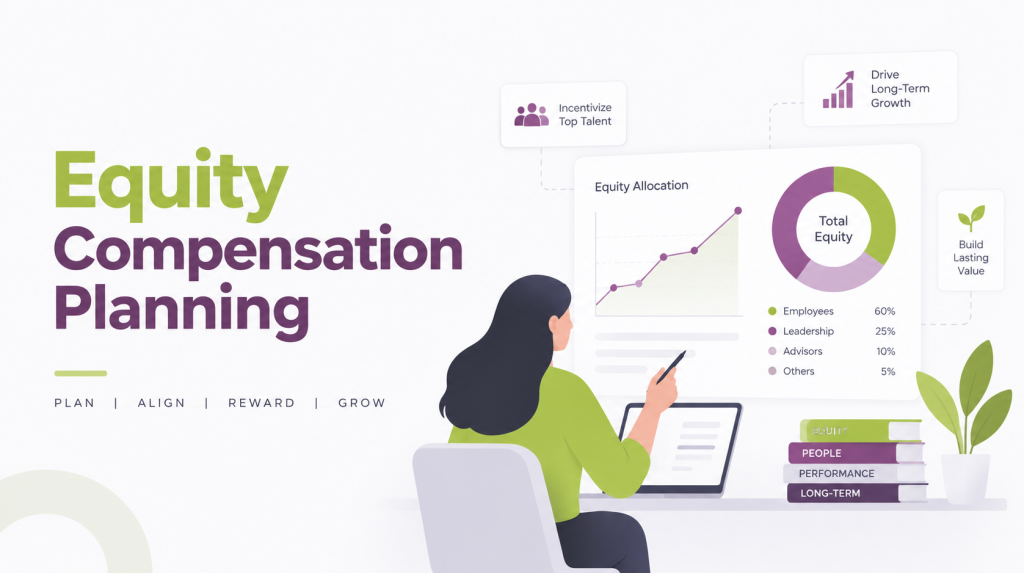
Granting equity is the easy part. Planning an equity compensation program that stays sustainable for years, doesn’t dilute the company into a bad spot, and still feels meaningful to employees, that’s the harder problem, and it’s one a lot of growing companies solve reactively instead of strategically.
This guide covers what equity compensation planning actually involves for HR and comp teams, the core levers you’re managing, and how to build a program that holds up as the company scales.
TL;DR
- Equity compensation planning is how companies design, budget, and manage their equity program: how much gets granted, to whom, and how it’s tracked over time.
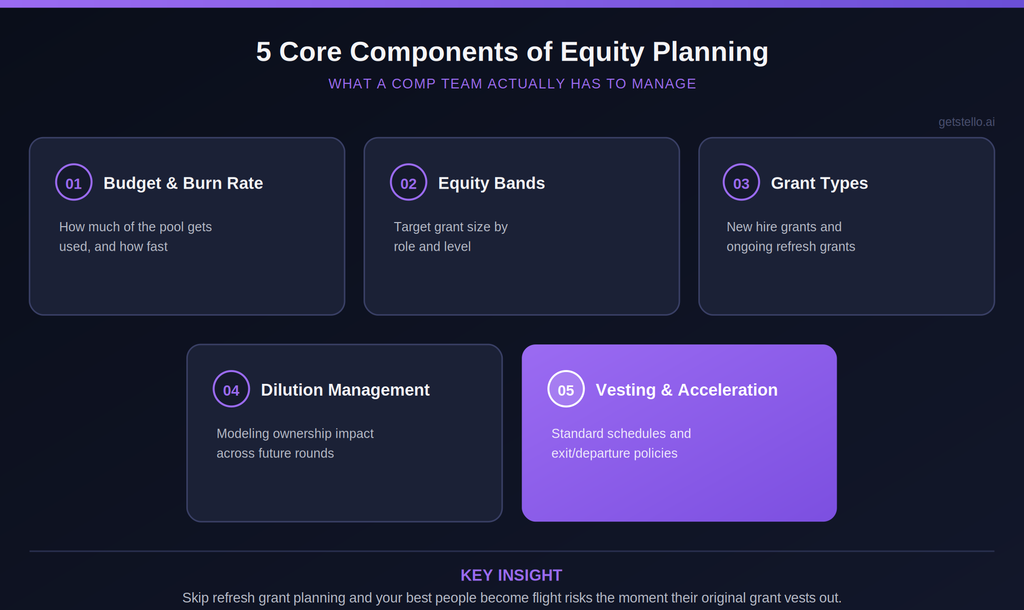
- Five core components: equity budget and burn rate, equity bands by level, new hire vs. refresh grants, dilution management, and vesting/acceleration policies.
- Programs that only plan new hire grants and skip refresh grants often lose tenured, high-performing employees right when their original grant fully vests.
- Building a plan takes 7 steps: set the budget, build equity bands, define refresh strategy, model dilution, set governance, communicate clearly, and review regularly.
- Equity and cash compensation planning should happen together, since they’re two halves of the same total compensation strategy.
What is equity compensation planning?
Equity compensation planning is the process of designing, budgeting, and managing a company’s equity program: how much equity gets granted, to whom, on what schedule, and how the company tracks the cumulative impact on ownership over time.
It sits alongside cash compensation planning as one half of total compensation strategy, but it comes with its own set of constraints that cash doesn’t: a finite share pool, dilution effects on existing shareholders, and value that fluctuates with the company’s own performance rather than being fixed like salary.
Done well, equity compensation planning balances three competing goals: staying competitive enough to attract and retain talent, keeping dilution at a sustainable level, and maintaining enough share pool runway to keep making meaningful grants for years, not just the next funding round.
Core components of an equity compensation plan
Equity budget and burn rate
Just like a cash merit budget, most companies set an annual or ongoing equity budget, often expressed as a percentage of the total share pool or a target dollar value of grants per year. Burn rate tracks how quickly that pool is actually being used, and comparing planned burn against actual burn is one of the most important recurring checks a comp team runs.
A burn rate that’s too high risks running out of pool before the next funding round or refresh cycle. A burn rate that’s too conservative can mean grants that are too small to meaningfully compete for talent.
Also read: Pay Equity Analysis: How to Conduct One (Step-by-Step)
Equity bands by level
Similar to salary bands, most mature equity programs define a target equity grant, often expressed as a dollar value or number of shares, for each role and level. This keeps grants consistent and defensible, rather than being negotiated ad hoc for every new hire, which is one of the fastest ways to create pay equity issues in a program that’s otherwise well-run.
New hire grants vs. refresh grants
Equity compensation planning has to account for two very different grant types. New hire grants are the initial equity offered when someone joins, typically vesting over four years. Refresh grants are additional equity given to existing employees, often as their original grant nears full vesting, to maintain retention incentives and keep total compensation competitive over time.
Companies that only plan for new hire grants and never build a refresh strategy often see their most tenured, highest-performing employees become flight risks right around the three to four year mark, exactly when their original grant is mostly vested and their retention incentive quietly disappears.
Dilution management
Every new equity grant dilutes existing shareholders, including employees who were granted equity earlier. Equity compensation planning has to account for this dilution and communicate it honestly, both to the board, which cares about overall cap table health, and sometimes to senior employees who are sophisticated enough to track their own ownership percentage over time.
Vesting and acceleration policies
Beyond the standard vesting schedule, equity compensation planning includes decisions about acceleration policies: what happens to unvested equity in an acquisition (single-trigger or double-trigger acceleration), and how the company handles vesting for departing employees, particularly in cases like layoffs versus voluntary departures.
Also read: What is Compa-Ratio? A Simple Guide for Comp Teams
How to build an equity compensation plan
1. Set your overall equity budget
Start by determining how much of the company’s total share pool you’re willing to allocate to compensation over a defined period, typically annually, factoring in expected headcount growth, planned refresh grants, and a buffer for unplanned hires or retention grants.
2. Build equity bands by role and level
Using market benchmarking data specific to equity, since cash benchmarking data doesn’t capture this, build target grant sizes for each role and level, similar in structure to how you’d build salary bands. Equity benchmarking data is available from many of the same providers offering cash compensation benchmarking, though the data set is often smaller and more specific to stage and industry.
3. Define your refresh grant strategy
Decide the cadence and sizing logic for refresh grants before you need them, not reactively when a senior employee already has a competing offer in hand. Common approaches include automatic refreshes at set vesting milestones or performance-based refresh eligibility tied to the regular comp review cycle.
4. Model dilution scenarios
Before finalizing a plan, model out what cumulative dilution looks like over the next few years under your planned burn rate, including anticipated future funding rounds. This is typically done in partnership with finance and sometimes legal, since dilution modeling connects directly to cap table management and investor expectations.
5. Set governance and approval processes
Define who can approve equity grants, within what bands, and what requires additional sign-off, larger grants, off-cycle grants, or exceptions to standard bands typically warrant a higher approval threshold than a standard new hire grant within band.
6. Communicate the plan clearly to employees
A well-designed equity program still fails to build trust or retention value if employees don’t understand what they have. This means giving employees real context: current valuation, vesting status, and a clear explanation of what their equity actually represents, not just a share count buried in an offer letter.
7. Review and adjust regularly
Equity compensation planning isn’t static. Review burn rate against budget, refresh grant needs, and how competitive your equity bands remain against market data at least annually, ideally aligned with your broader comp planning cycle.
Common equity compensation planning mistakes
Planning grants without planning refreshes. A program that only accounts for new hire grants will systematically under-retain tenured employees once their original grant vests out.
Underestimating dilution. Companies that grant generously early without modeling multi-year dilution sometimes find themselves with a much smaller effective share pool than expected by the time later funding rounds and later hires need to be accommodated.
Inconsistent grant sizing. Without defined equity bands, grants tend to reflect negotiating leverage more than role or level, creating the same kind of internal equity problems that unstructured cash pay does.
Underinvesting in communication. Employees who don’t understand their equity, its current value, vesting status, or what a realistic outcome looks like, often either overvalue it unrealistically or dismiss it as worthless, neither of which serves the retention purpose it was granted for.
Treating the plan as fixed. Market conditions, company stage, and competitive pressure all shift. A plan built for a Series A company needs real revisiting by the time that company is raising a Series C.
FAQs-
Who typically owns equity compensation planning at a company?
It’s usually a shared responsibility between HR or People teams, finance, and sometimes legal, since it touches compensation strategy, cap table management, and grant governance simultaneously. In larger companies, a dedicated compensation or total rewards team often leads the process.
How often should equity compensation plans be reviewed?
Most companies review their equity compensation plan at least annually, often aligned with the broader compensation planning and benchmarking cycle, so equity bands and burn rate assumptions stay current with market conditions and company stage.
What is a healthy equity burn rate?
There’s no universal number, since it depends heavily on company stage, growth rate, and how much of the share pool is allocated to compensation versus reserved for future rounds. The key is comparing actual burn against your planned budget consistently, rather than targeting a specific industry benchmark in isolation.
What’s the difference between a new hire grant and a refresh grant?
A new hire grant is the initial equity offered when someone joins, typically vesting over four years. A refresh grant is additional equity given to an existing employee, usually as their original grant nears full vesting, to maintain a meaningful retention incentive and keep total compensation competitive over time.
Does equity compensation planning affect cash compensation planning?
Yes, the two are typically planned together as part of total compensation strategy. Companies with strong equity programs sometimes offer more conservative cash bands, and vice versa, depending on company stage, cash position, and what candidates in a given market or role tend to prioritize.
The bottom line
Equity compensation planning is what separates a sustainable, competitive equity program from one that quietly runs into trouble, whether that’s an exhausted share pool, disengaged tenured employees, or a cap table nobody modeled properly. Building real structure around budgeting, bands, refresh strategy, and communication turns equity from a one-time hiring perk into a genuine, ongoing part of your total compensation strategy.