Most HR teams start managing compensation in spreadsheets. It works, until it doesn’t. A single spreadsheet turns into a dozen versions floating between HR, finance, and hiring managers. Formulas break. Someone accidentally overwrites last quarter’s merit numbers. By the time a company has more than a hundred employees, tracking pay in spreadsheets isn’t just inefficient, it’s a liability.
Compensation management software exists to solve that problem. This guide covers what it actually is, what it does, who needs it, and how to think about evaluating it if your team is outgrowing manual processes.
TL;DR
- Compensation management software centralizes pay planning, salary ranges, merit cycles, pay equity, and reporting, replacing error-prone spreadsheets.
- Companies typically adopt it once headcount growth, pay transparency laws, or multiple pay components (equity, bonus, commission) make manual tracking unreliable.
- Core features include salary range management, merit/bonus planning, pay equity analysis, and total rewards statements.
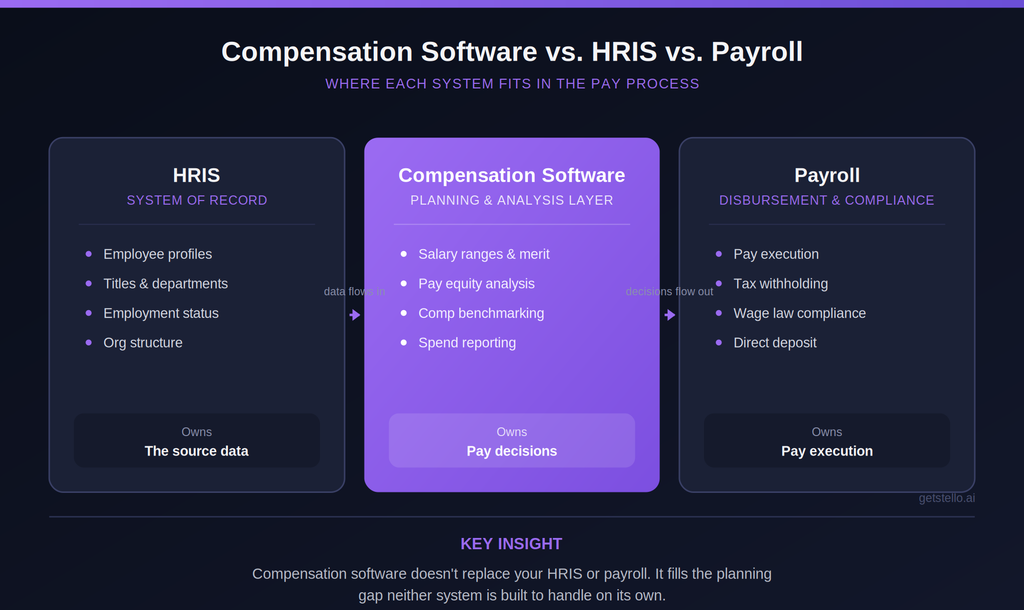
- It’s distinct from an HRIS (system of record) and payroll (disbursement). Comp software adds the planning and analysis layer between the two.
- The right platform depends on company size and pay complexity, not just which vendor has the longest feature list.
What is compensation management software?
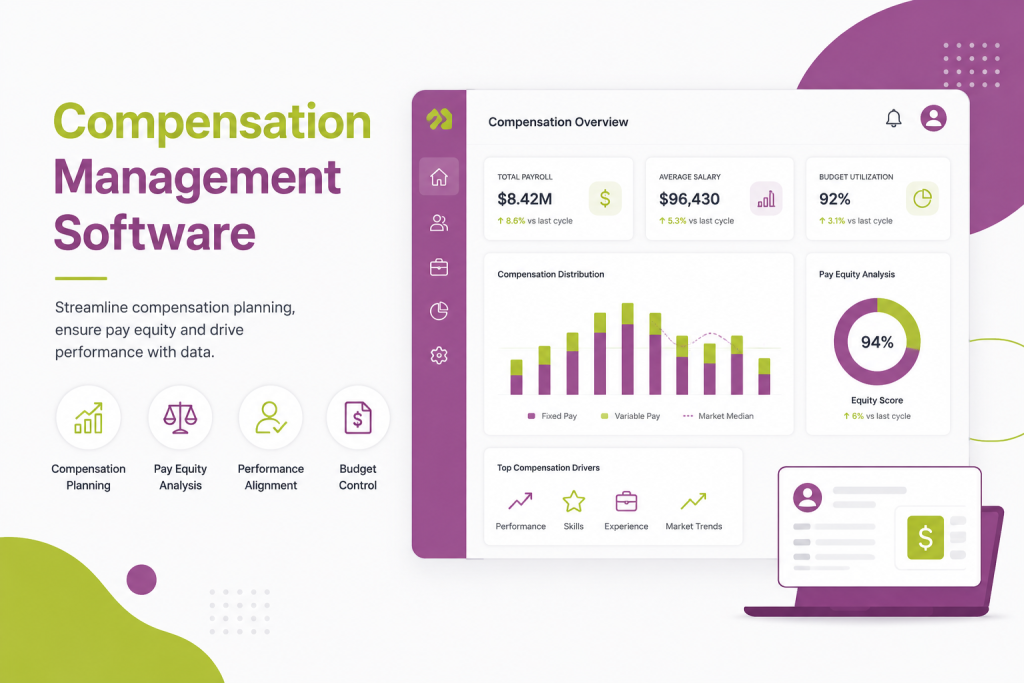
Compensation management software is a purpose-built platform that helps HR and compensation teams plan, manage, and analyze employee pay, including base salary, bonuses, equity, and other forms of compensation, in one centralized system.
Instead of tracking salary ranges, merit budgets, and pay equity data across scattered spreadsheets, compensation management software brings that information into a single source of truth. It typically connects to your HRIS and payroll systems, pulling in employee data automatically rather than requiring manual entry, and gives HR, finance, and people leaders a shared view of how pay decisions are being made across the organization.
At its core, the software handles four things most comp teams need to do repeatedly: build and maintain salary ranges, plan and distribute merit increases, run pay equity analysis, and report on compensation spend to leadership and the board.
Why companies adopt compensation management software
Companies typically move to dedicated compensation management software once manual processes start breaking down. A few common triggers:
Headcount growth. What works for 50 employees in a spreadsheet becomes unmanageable at 300. Merit cycles that took a week start taking a month, and errors become harder to catch.
Pay transparency requirements. With more states and countries mandating salary ranges in job postings, companies need a reliable, auditable way to manage and update those ranges, not a spreadsheet that only one person knows how to update correctly.
Multiple pay components. Once a company introduces equity compensation, bonuses, or commission structures on top of base pay, tracking total compensation manually becomes genuinely difficult. Software designed for this consolidates everything into a single view.
Pay equity scrutiny. Boards, investors, and employees increasingly expect companies to be able to demonstrate pay equity. Running that analysis by hand, across every role, level, and demographic cut, is slow and error-prone.
Manager self-service needs. As companies scale, HR can’t be the only team touching every merit decision. Compensation management software often includes manager-facing tools that let people leaders make recommendations within guardrails, without HR manually reviewing every line.
Also read: Pay Equity vs. Pay Parity: What’s the Difference and Why It Matters
Core features of compensation management software
Not every platform includes the same feature set, but most compensation management software covers some combination of the following.
Salary range management
The foundation of most platforms. This includes building ranges based on benchmarking data, organizing them by job level and location, and keeping them updated as market data changes. Good platforms make it easy to see where every employee sits within their range (their compa-ratio) at a glance.
Merit and bonus planning
Tools for running annual or semi-annual comp cycles: setting merit budgets, applying merit matrices that combine performance rating and compa-ratio, and distributing increases across the organization. Many platforms let managers submit recommendations directly in the tool, with HR retaining approval control.
Pay equity analysis
Built-in reporting that flags pay gaps across gender, race, or other demographic lines, often before those gaps become legal or reputational problems. This is one of the features that differentiates dedicated compensation software from a general HRIS, which usually doesn’t offer this depth of analysis out of the box.
Compensation benchmarking integration
Some platforms include their own benchmarking data or integrate directly with survey providers, so comp teams don’t have to manually import and reconcile external market data. This ties directly into the range-building process, keeping ranges current without a fully manual refresh cycle.
Total rewards statements
Many platforms can generate personalized total compensation statements for employees, showing base pay, bonus, equity, and benefits in one place. This has become a common retention tool, since employees often underestimate the full value of their compensation package when they only see base salary on a pay stub.
Equity and long-term incentive tracking
For companies that grant stock options, RSUs, or other equity compensation, dedicated modules track vesting schedules, grant history, and dilution, information that’s painful to manage manually and easy to get wrong.
Reporting and analytics
Dashboards for HR, finance, and executives to track compensation spend against budget, headcount cost projections, and pay equity metrics over time. This is often what finance teams care about most, since it turns compensation from a black box into a forecastable line item.
Approval workflows and audit trails
Structured workflows that route merit and promotion decisions through the right approvers, with a documented history of who approved what and when. This matters increasingly for compliance, especially around pay equity and executive compensation decisions that may face outside scrutiny.
Also read: What is a Compensation Cycle? A Complete Guide for HR and Comp Teams
Types of compensation management software
Not all compensation management software is built for the same use case. Broadly, the category splits into a few types.
Broad-based compensation management covers salary, merit, and bonus planning for the general employee population. This is what most mid-market and growth-stage companies mean when they say “comp software,” and it’s the category most HR and people teams evaluate first.
Incentive compensation management (ICM) is built specifically for variable, performance-driven pay, most commonly sales commissions. These platforms calculate payouts based on complex compensation plans tied to quota attainment, deal size, or other performance metrics. Sales operations teams, not HR, are often the primary users here.
Executive compensation management handles the more complex, higher-scrutiny world of leadership and board-level pay, often including equity, long-term incentive plans, and the reporting required for public company disclosure requirements.
Total rewards platforms take the broadest view, combining compensation with benefits, perks, and other elements of the employee value proposition into a single statement or system.
Most growing companies start with broad-based compensation management and expand into other categories as their pay structures get more complex, for example, once they build out a formal sales incentive plan or start granting significant equity.
Also read: How to Conduct Salary Benchmarking: A Practical Guide for HR and Compensation Teams
Compensation management software vs. HRIS vs. payroll
It’s worth being clear about how compensation management software differs from adjacent tools, since the distinction gets blurry.
HRIS (Human Resource Information System) is the system of record for employee data, names, titles, departments, employment status. Many HRIS platforms include basic compensation fields, but they’re generally not built for the depth of planning, modeling, and analysis that dedicated comp software provides.
Payroll software handles the actual disbursement of pay, tax withholding, and compliance with wage laws. It executes compensation decisions, but it doesn’t help plan them.
Compensation management software sits between the two conceptually. It uses data from the HRIS, informs decisions that eventually flow into payroll, and adds the planning, modeling, and analysis layer that neither system is designed to handle on its own.
Some HRIS platforms are expanding into compensation planning natively, and some payroll providers are doing the same. Whether a standalone compensation platform still makes sense often comes down to how complex your pay structure is and how deep your HRIS’s native comp features actually go.
Who uses compensation management software
Compensation management software typically serves several audiences within the same company, which is part of why picking the right platform matters.
HR and compensation teams are usually the primary owners, using the platform to build ranges, run comp cycles, and manage pay equity analysis.
Finance teams rely on the reporting layer to track compensation spend against budget and to model the cost impact of merit increases or new hires before they’re finalized.
People managers interact with the platform during comp cycles, submitting merit and bonus recommendations for their direct reports, often within pre-set guardrails so recommendations stay within budget and equity guidelines.
Executives and boards typically see rolled-up reporting, particularly for headcount cost trends, pay equity metrics, and, where relevant, executive compensation details subject to board approval.
What to look for when evaluating compensation management software
If you’re comparing platforms, a few factors tend to matter most.
Integration with your existing HRIS. The software is only as good as the data flowing into it. Clean, automated integration with your HRIS and payroll system saves significant manual work and reduces the risk of data getting out of sync.
Depth of pay equity reporting. Not all platforms offer the same rigor here. If pay equity compliance is a priority, dig into exactly what demographic cuts and statistical methods the platform supports before assuming it covers what you need.
Manager experience. If managers will be submitting recommendations directly in the tool, the interface needs to be simple enough that non-HR users can use it correctly without extensive training.
Scalability. Consider not just your current headcount and pay complexity, but where the company is headed. A platform that works well for 200 employees on straightforward base pay may need real evaluation before it can handle 1,000 employees with equity and incentive comp layered in.
Benchmarking data access. Some platforms bundle their own market data, others expect you to bring your own from a separate survey provider. Understand which model you’re getting and whether the included data is actually relevant to your industry and company size.
Implementation timeline and support. Compensation software touches sensitive, high-stakes data. A vendor with a clear, well-supported implementation process is worth more than one with a slightly longer feature list but a rocky onboarding history.
Common mistakes when adopting compensation management software
A few pitfalls come up repeatedly during and after implementation:
- Migrating messy data. If your existing salary ranges or historical pay data are inconsistent, moving them into a new system without cleaning them up first just automates the mess rather than fixing it.
- Skipping manager training. Even the best platform fails if managers don’t understand how to use it correctly during their first comp cycle. Budget real time for training before rollout, not just a quick email announcement.
- Underestimating change management. Moving from spreadsheets to a formal system is a process change, not just a tool change. Teams that treat it purely as a software rollout, without addressing the workflow shift, often see slow adoption.
- Choosing based on feature checklist alone. The platform with the most features isn’t necessarily the right fit if it doesn’t match your company’s actual pay complexity and team size. A platform built for enterprise-scale incentive compensation may be overkill, and harder to implement, for a company still managing straightforward base pay and annual merit cycles.
FAQs
Is compensation management software the same as an HRIS?
No. An HRIS is the system of record for employee data. Compensation management software adds a dedicated planning and analysis layer for pay decisions, salary ranges, merit cycles, pay equity, that most HRIS platforms don’t handle in the same depth, even though some newer HRIS tools are adding basic comp features.
What size company needs compensation management software?
There’s no fixed headcount threshold, but many companies start evaluating dedicated software somewhere between 100 and 300 employees, once spreadsheet-based comp planning starts causing real errors or taking too long. Companies with complex pay structures, like equity compensation or sales commissions, may need it sooner regardless of headcount.
How much does compensation management software cost?
Pricing varies widely by vendor, company size, and feature set, often ranging from a per-employee monthly fee to enterprise contracts with custom pricing. It’s worth requesting quotes from a few vendors directly, since publicly listed pricing is often incomplete or outdated.
Does compensation management software replace compensation benchmarking?
Not entirely. Some platforms include or integrate with benchmarking data, but the underlying analysis, of comparing your pay against the external market, is a distinct process. The software makes managing and applying that data easier, but you still need reliable benchmarking data to feed it.
Can compensation management software help with pay equity compliance?
Yes, this is one of the strongest reasons companies adopt it. Most platforms include reporting that flags pay gaps across demographic groups, which is far more efficient and consistent than running that analysis manually in a spreadsheet. That said, the software supports compliance, it doesn’t guarantee it. The underlying pay decisions still need to be sound.
The bottom line
Compensation management software turns pay planning from a scattered, error-prone spreadsheet process into a centralized, auditable system that HR, finance, and managers can all rely on. It’s not just about convenience, it’s increasingly a compliance and retention necessity as pay transparency laws expand and employees expect clearer answers about how their pay is determined.
The right platform depends heavily on your company’s size, pay complexity, and existing HR tech stack. Get clear on what you actually need, salary range management, merit planning, pay equity reporting, incentive comp, or some combination, before comparing vendors, and you’ll have a much easier time separating the platforms that fit from the ones that just have the longest feature list.