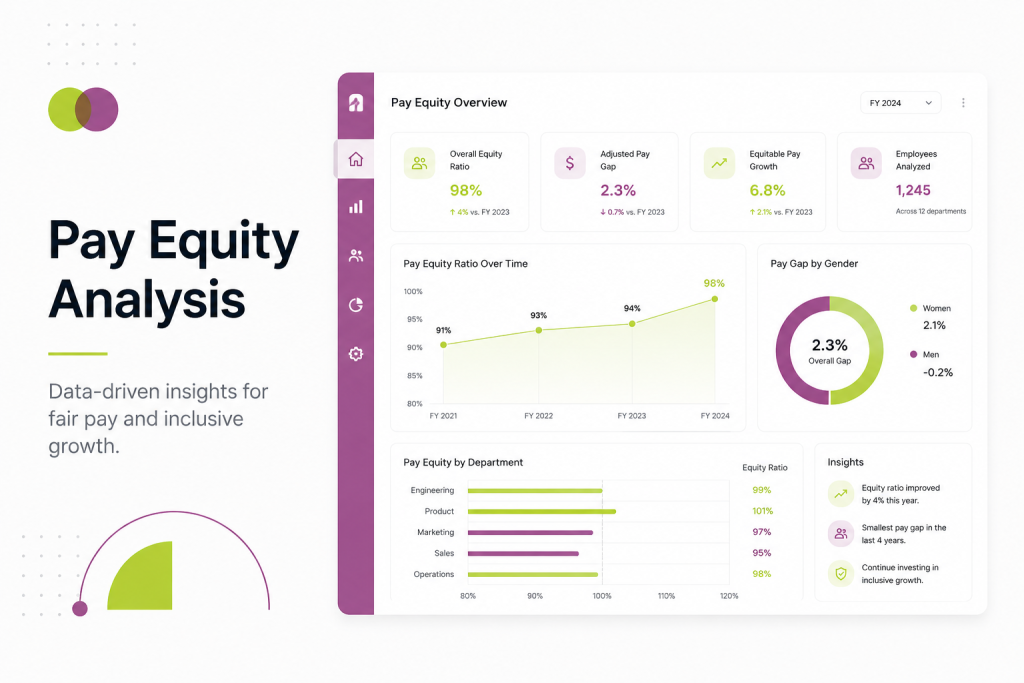
Pay equity used to be a once-in-a-while HR initiative, something you ran when a lawsuit made the news or a board member asked about it. That’s changed. With pay transparency laws expanding across states, and employees more willing than ever to compare notes on pay, a pay equity analysis has become a standard part of running a comp program, not an optional extra.
This guide walks through what a pay equity analysis actually is, how to run one properly, and the mistakes that quietly undermine the results at most companies.
TL;DR
- A pay equity analysis identifies unexplained pay gaps between employees doing similar work, separating legitimate factors (tenure, performance, location) from gaps tied to protected characteristics.
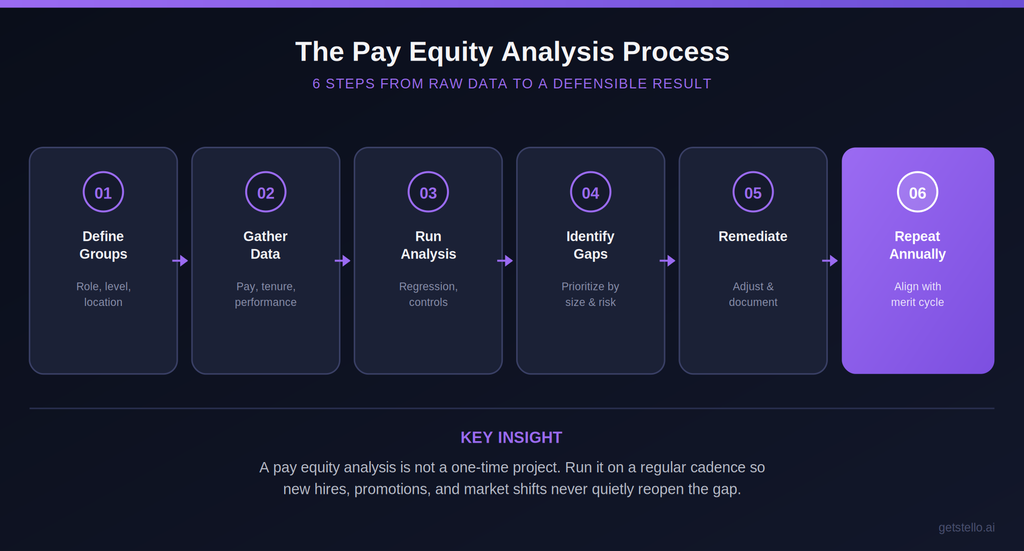
- The process has 6 steps: define comparison groups, gather clean data, run a regression analysis, identify and prioritize gaps, remediate and document, then repeat annually.
- Three ways to run it: a manual spreadsheet, dedicated pay equity software, or outside consulting under attorney-client privilege.
- Pay transparency laws, legal exposure, and employee trust have made this an annual necessity, not a one-time project.
- Pay equity is not the same as pay equality. It allows for legitimate pay differences, it just requires the differences to be explainable.
What is a pay equity analysis?
A pay equity analysis is a statistical review of employee pay data designed to identify unexplained pay gaps between employees doing similar work, particularly gaps that correlate with gender, race, age, or other protected characteristics.
The word “unexplained” matters here. Pay differences aren’t automatically a problem. Two employees in the same role can legitimately be paid differently because of tenure, performance, location, or scope of responsibility. A pay equity analysis exists to separate those legitimate factors from gaps that have no defensible explanation, the kind that create legal exposure and erode employee trust.
Pay equity analysis is sometimes called a pay equity audit, and the terms are largely used interchangeably, though “audit” sometimes implies a more formal, often externally reviewed process, while “analysis” can refer to either an internal or external exercise.
Also read: What is Compa-Ratio? A Simple Guide for Comp Teams
Why pay equity analysis matters now
A few forces have pushed pay equity analysis from a nice-to-have to a near-requirement for most mid-size and larger companies.
Pay transparency laws. A growing number of states now require salary ranges in job postings, and some go further, requiring proactive pay equity reporting. Running a regular analysis is how companies get ahead of these requirements instead of scrambling to respond to them.
Legal exposure. Pay discrimination claims are expensive, both in settlement costs and reputational damage. A documented, regularly run pay equity analysis gives companies a defensible position and, in many cases, functions as an affirmative defense if a gap is identified and being actively remediated.
Employee trust. Salary transparency has changed what employees expect. Many now have a rough sense of market pay before they ever ask for a raise. Companies that can proactively show they’ve checked for pay gaps build more trust than ones that wait for someone to raise a concern.
Investor and board scrutiny. ESG reporting increasingly includes pay equity metrics, and boards are asking comp and HR leaders for this data more often, not just once a year during budget season.
Also read: Pay Equity vs. Pay Parity: What’s the Difference and Why It Matters
How to conduct a pay equity analysis: step by step
1. Define your comparison groups
The first step is deciding which employees should be compared against each other. This typically means grouping employees by role, level, and sometimes location, since pay for the same title can legitimately vary by geography.
Getting this step wrong undermines everything downstream. Comparing employees who aren’t actually doing similar work, just because they share a job title, will produce misleading results. Many companies build these comparison groups around a formal leveling framework rather than titles alone.
2. Gather clean compensation data
Pull base salary, bonus, equity, and any other relevant pay components for every employee in scope, along with the explanatory variables you’ll need for the analysis: tenure, performance ratings, education, prior experience, location, and role scope.
This is often the most time-consuming step, and it’s where a lot of pay equity analyses stall out. Inconsistent job titles, missing performance data, or compensation history scattered across old spreadsheets all slow this down. Clean, centralized data, ideally pulled directly from your HRIS or compensation management software, makes this step dramatically faster.
3. Run the statistical analysis
With clean data and comparison groups defined, the next step is running a regression analysis that controls for the legitimate factors (tenure, performance, location, scope) and isolates whether gender, race, or other protected characteristics still correlate with a pay difference after those factors are accounted for.
This is typically done using multiple regression analysis, which can isolate the effect of a single variable, like gender, while holding everything else constant. Companies without in-house statistical expertise often bring in outside counsel or a specialized pay equity consulting firm for this step, particularly given the legal sensitivity involved.
4. Identify and prioritize gaps
Once the analysis flags unexplained pay gaps, the next step is prioritizing which to address first. Not every company can remediate every gap immediately, especially if the total cost is significant, so most prioritize based on gap size, legal risk, and how many employees are affected.
Some companies address the most severe gaps immediately as off-cycle adjustments, while rolling smaller gaps into the next merit cycle.
5. Remediate and document
Closing identified gaps is only part of this step. Documentation matters just as much. Keep a clear record of what gaps were found, how they were remediated, and when, since this record is often what protects a company if pay practices are ever challenged legally.
6. Repeat on a regular cadence
A pay equity analysis isn’t a one-time project. Most companies with mature comp programs run a full analysis annually, often timed to align with the merit cycle, so any pay adjustments needed for equity reasons can be built into that year’s budget rather than requiring a separate off-cycle spend.
Also read: What is a Compensation Cycle? A Complete Guide for HR and Comp Teams
Pay equity analysis tools and methods
Companies generally take one of three approaches to running the analysis itself.
Pay equity analysis spreadsheet. Smaller companies sometimes start with a manual spreadsheet-based approach, using basic statistical functions to compare pay across groups. This works at a small scale but becomes error-prone and slow as headcount grows, and it lacks the statistical rigor of a proper regression model.
Pay equity software. Dedicated pay equity software and pay equity audit tools automate much of the analysis, running regression models on employee data and flagging gaps without requiring in-house statistical expertise. Many compensation management platforms now include this as a built-in feature rather than a standalone purchase.
Pay equity consulting. For companies with complex pay structures, high legal exposure, or a first-time analysis, outside pay equity consulting firms or employment attorneys often run the analysis under attorney-client privilege, which can offer additional legal protection for the findings.
The right choice usually comes down to company size, budget, and how much legal risk is involved. A 50-person startup running its first pass might reasonably start with software or even a well-built spreadsheet. A public company with thousands of employees and board-level scrutiny will typically want the rigor (and privilege protection) of outside consulting, at least for the initial analysis.
Common pay equity analysis mistakes
A few issues show up repeatedly, even at companies genuinely trying to get this right:
- Comparing the wrong groups. Grouping employees by title alone, without accounting for real differences in scope and level, produces misleading results in both directions, hiding real gaps or flagging gaps that aren’t actually there.
- Treating it as a one-time project. An analysis run once, two years ago, tells you nothing about your current pay practices. New hires, promotions, and market adjustments all shift the picture.
- Fixing the gap but not the process. Remediating a specific pay gap without addressing the underlying process that created it, inconsistent offer negotiation practices, for example, means the same gap tends to reappear over time.
- Skipping legal counsel. Given the legal sensitivity of pay discrimination, running a pay equity analysis without any legal involvement can create discoverable documentation of a known gap without the protections that privileged review can offer.
FAQs-
What is the difference between a pay equity analysis and a pay equity audit?
The terms are largely used interchangeably. “Audit” sometimes implies a more formal process, occasionally conducted under attorney-client privilege or by an outside firm, while “analysis” can describe either an internal or external review. Functionally, both aim to identify unexplained pay gaps.
How often should a company run a pay equity analysis?
Most companies with an established comp program run a full analysis annually, typically ahead of the merit cycle so any needed pay adjustments can be built into that year’s budget. Companies going through rapid headcount growth or entering new pay transparency jurisdictions may want to run one more frequently.
Do small companies need a pay equity analysis?
There’s no fixed headcount threshold, but even smaller companies benefit from running a basic analysis, especially before pay transparency laws require it. Catching a gap early, when there are fewer employees affected, is far cheaper and simpler to fix than discovering it later at scale.
What’s the difference between pay equity and pay equality?
Pay equality means paying employees identically for the same work. Pay equity is more nuanced, it means employees are paid fairly relative to legitimate factors like experience, performance, and scope, without unexplained gaps tied to protected characteristics. Pay equity allows for legitimate pay differences; pay equality does not.
Should a pay equity analysis be conducted under attorney-client privilege?
Many companies choose to, particularly for their first analysis or in higher-risk situations, since privilege can protect the findings from discovery in litigation. This typically means having outside counsel direct the analysis rather than running it entirely in-house. It’s worth discussing with legal counsel before starting, not after gaps are already found.
The bottom line
A pay equity analysis turns “we think our pay is fair” into something a company can actually demonstrate. With pay transparency laws expanding and employees more informed than ever, running this analysis regularly, and documenting what you find and how you fix it, has become a core part of running a defensible, trustworthy comp program. Build it into your annual comp calendar rather than treating it as a reactive fire drill, and it becomes one of the most valuable tools in a comp team’s toolkit.