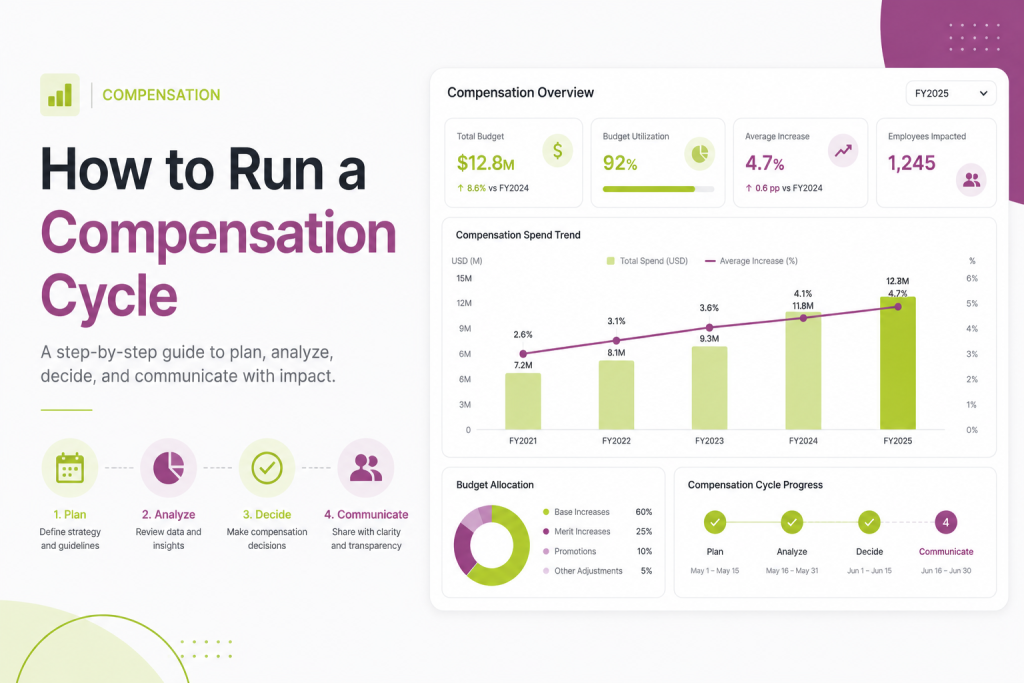
A compensation cycle is one of the highest-stakes, most time-pressured processes a finance and HR team runs each year. Budgets need to be set, managers need to make recommendations, equity and bonus calculations need to be accurate, and the whole thing needs to close on time — usually while everyone involved is also doing their regular job.
Most of the pain in a compensation cycle isn’t the decision-making itself. It’s the coordination: people managers working from outdated spreadsheets, finance reconciling numbers across a dozen tabs, and nobody having a single source of truth for who’s been approved for what. Stello AI’s Compensation Planning product is built to manage an entire compensation cycle with integrated data, so the cycle runs as a connected process rather than a series of disconnected handoffs.
Here’s how to run one from start to finish.
TL;DR
- Most of the pain in a compensation cycle isn’t decision-making, it’s coordination — managers working from outdated spreadsheets, finance reconciling numbers across a dozen tabs, no single source of truth.
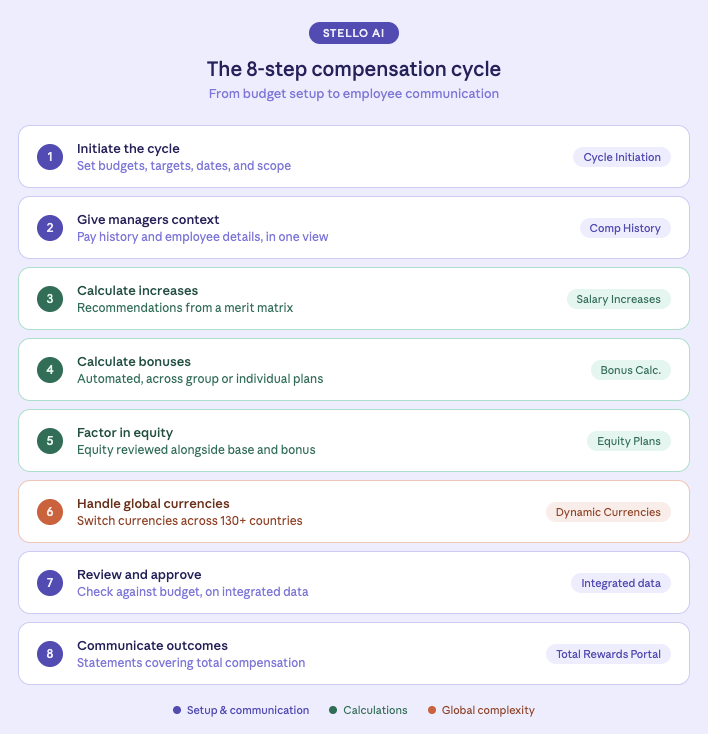
- A cycle runs in 8 connected steps: initiate budgets and scope, give managers context, calculate increases, calculate bonuses, factor in equity, handle global currencies, review and approve, then communicate outcomes.
- People managers make better recommendations when they can see an employee’s compensation history and full context (level, location, performance rating) in one place, not pieced together from memory.
- Salary increases should be calculated against a consistent merit matrix, not ad hoc manager judgment that varies person to person.
- Bonus and equity recommendations should be reviewed together with base salary, not as separate processes run by different teams on different timelines.
- Global teams add currency conversion complexity that compounds the manual reconciliation burden during a cycle, unless the platform handles it natively.
- Every handoff between disconnected tools is an opportunity for an error or missed deadline; that risk compounds with headcount, making fragmented processes far harder to run accurately past 100+ employees.
Step 1: Initiate the Cycle
Every compensation cycle starts with the same set of foundational decisions: what’s the budget, what are the targets, what’s the timeline, who’s in scope, and who’s running it.
Stello AI’s Cycle Initiation feature lets you set your compensation budgets, targets, dates, in-scope employees, and compensation planners all in one place before the cycle opens. This matters more than it sounds — a cycle that starts with ambiguity about scope or timeline creates confusion downstream that’s expensive to untangle once managers are already submitting recommendations.
Getting this step right means every subsequent stakeholder — finance, HR, and people managers — is working from the same defined parameters from day one.
Also read: Compensation Benchmarking Tool: What Finance Teams Should Actually Look For
Step 2: Give Managers the Context They Need
People managers are the ones actually making compensation recommendations for their teams, but they’re frequently asked to do this with incomplete information — no visibility into a person’s compensation history, no easy way to see how their recommendation compares to market data, and no consistent view of the factors that should inform a decision.
Stello AI addresses this directly with two connected features. Compensation History lets people managers view each of their individual employees’ compensation history as they make decisions for the current cycle — so a recommendation is grounded in where someone has actually been, not just where they are now. Employee Details brings department, level, location, job title, hire date, and performance rating into a single view, giving managers the full context needed to make an informed, defensible recommendation rather than a gut-feel number.
This step is where compensation cycles run on spreadsheets typically break down. Pulling this context together manually for every employee, for every manager, is exactly the kind of repetitive work that turns a compensation cycle into a multi-week slog.
Step 3: Calculate Salary Increases
Once managers have the context they need, the actual increase recommendations need to be generated — ideally against a consistent, defensible methodology rather than ad hoc judgment that varies by manager.
Stello AI’s platform recommends a salary increase based on your company’s pre-determined merit matrix, which can incorporate performance rating, location, hire date, level, or any other factor HR and finance leaders deem appropriate. This keeps recommendations consistent across the organization while still giving managers the flexibility to apply judgment within a defined structure — rather than each manager inventing their own approach to what a “strong performer” increase should look like.
Step 4: Calculate Bonuses
Bonus calculations introduce their own complexity, particularly for companies running multiple bonus structures across different employee groups or individual plans.
Stello AI is built to handle any type of bonus plan a company may have — for employee groups or individual employees — automatically calculating and recommending bonus amounts based on the company’s specific policies. This removes one of the most error-prone parts of a manual compensation cycle: hand-calculating bonus amounts across dozens or hundreds of employees against rules that vary by plan, role, or department.
Step 5: Factor in Equity
For companies that grant equity, a compensation cycle isn’t complete without accounting for how equity recommendations fit alongside base and bonus decisions. Treating equity as a separate, disconnected process — reviewed in a different tool, by a different team, on a different timeline — creates exactly the kind of inconsistency that makes total compensation hard to evaluate holistically.
Stello AI handles complex equity plans alongside base and bonus calculations, tailoring recommendations based on each program’s specific criteria. This means a manager or compensation planner reviewing an employee’s full compensation picture during the cycle sees base, bonus, and equity together — not three separate exports that need to be manually reconciled into a single view.
Also read: How to Conduct a Pay Equity Audit Without a Dedicated Comp Team
Step 6: Handle Global Teams Without Manual Currency Conversion
For companies with employees across multiple countries, a compensation cycle introduces a layer of complexity that purely domestic tools don’t need to solve: currency conversion, local compensation norms, and the operational headache of reviewing pay decisions in a currency that doesn’t match the employee’s actual paycheck.
Stello AI’s Dynamic Currencies feature lets compensation planners and managers easily switch between currencies to view compensation according to an employee’s local currency, with support for 130+ countries and currencies. For globally distributed teams, this single feature can eliminate a meaningful share of the manual reconciliation work that typically falls on finance during a cycle.
Step 7: Review, Approve, and Close the Cycle
With increases, bonuses, and equity recommendations in place, the cycle moves into review and approval. This is where having all the data integrated in one platform — rather than scattered across exports — pays off most directly. Finance and HR leaders can review recommendations against the original budget set in Step 1, confirm everything is within target, and approve changes without needing to reconcile numbers across multiple disconnected sources.
Because Stello AI centralizes compensation data in a single platform, this closing step is a review of what’s already been calculated and tracked throughout the cycle — not a separate reconciliation exercise that starts from scratch once recommendations come in.
Step 8: Communicate Outcomes
A compensation cycle isn’t truly finished until employees understand what changed and why. This is where Stello AI’s Total Rewards Portal becomes the natural next step after a cycle closes — turning the increases, bonuses, and equity decisions made during planning into employee-facing statements that communicate the full compensation picture, rather than leaving employees to piece it together from a payroll change they notice weeks later.
What This Looks Like Without an Integrated Platform
It’s worth being explicit about the alternative. Without a connected system, each of the steps above typically happens in a different tool or spreadsheet: budget targets in one document, manager recommendations collected over email, merit matrix calculations built and rebuilt each cycle, bonus math done by hand, equity reviewed separately by whoever manages the cap table, and currency conversions handled manually for any international employees.
Every handoff between those disconnected pieces is an opportunity for an error, a missed deadline, or a recommendation that doesn’t actually reflect the budget it’s supposed to respect. The operational cost of that fragmentation compounds with headcount — a cycle that’s manageable at 30 employees becomes genuinely difficult to run accurately at 150 or more.
The Bottom Line
A compensation cycle has the same fundamental steps whether you’re running it in spreadsheets or in a connected platform: set the budget, give managers context, calculate increases and bonuses, account for equity, review against target, and communicate outcomes. What changes is how much manual reconciliation sits between those steps — and how much risk that reconciliation introduces.
Stello AI’s Compensation Planning product is built to run the entire cycle on integrated data, from initiation through approval, so finance and HR teams spend their time on the decisions that need judgment rather than the manual work of pulling those decisions together.
See how Stello AI’s Compensation Planning, AI Budgets Modeling, and Total Rewards Portal work together to run your next compensation cycle. Book a demo →
FAQs-
1. How long does a typical compensation cycle take to run?
It depends on company size, but most of the time spent is reconciliation, not decision-making. Cycles run on integrated data close faster because everyone works from the same numbers throughout.
2. Can people managers see compensation history and market context while making recommendations?
Yes, when the platform supports it. Giving managers compensation history and employee context alongside the current cycle leads to more consistent, defensible recommendations than judgment alone.
3. How are bonus and equity recommendations handled differently from base salary?
Bonuses follow plan-specific rules that vary by employee group, while equity depends on each grant program’s criteria. The key is reviewing all three together per employee, not as separate processes.
4. Can a compensation cycle handle employees across multiple countries?
Yes, with the right tooling. A platform that supports dynamic currency switching removes most of the manual conversion work that international cycles otherwise require.