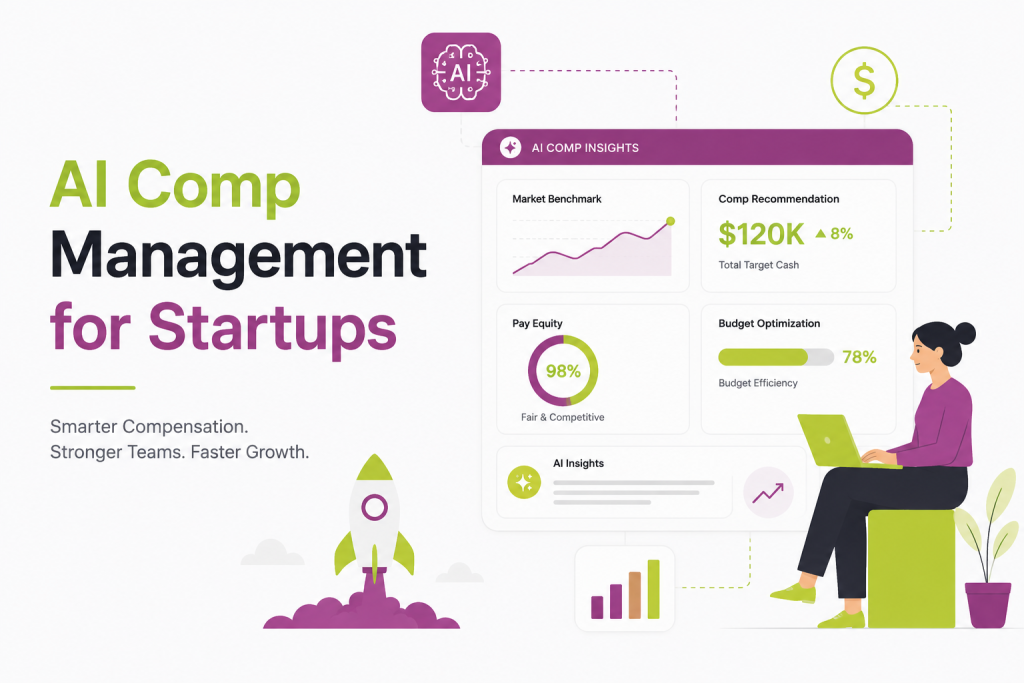
Most compensation management content is written for companies that already have a People Ops team, a comp philosophy on file, and a benchmarking subscription. That’s not you at 50, 100, or even 180 employees.
If you’re running compensation at a startup under 200 people, your problems aren’t the same as an enterprise HR team’s. Here’s what actually changes, and how AI fits into it.
TL;DR
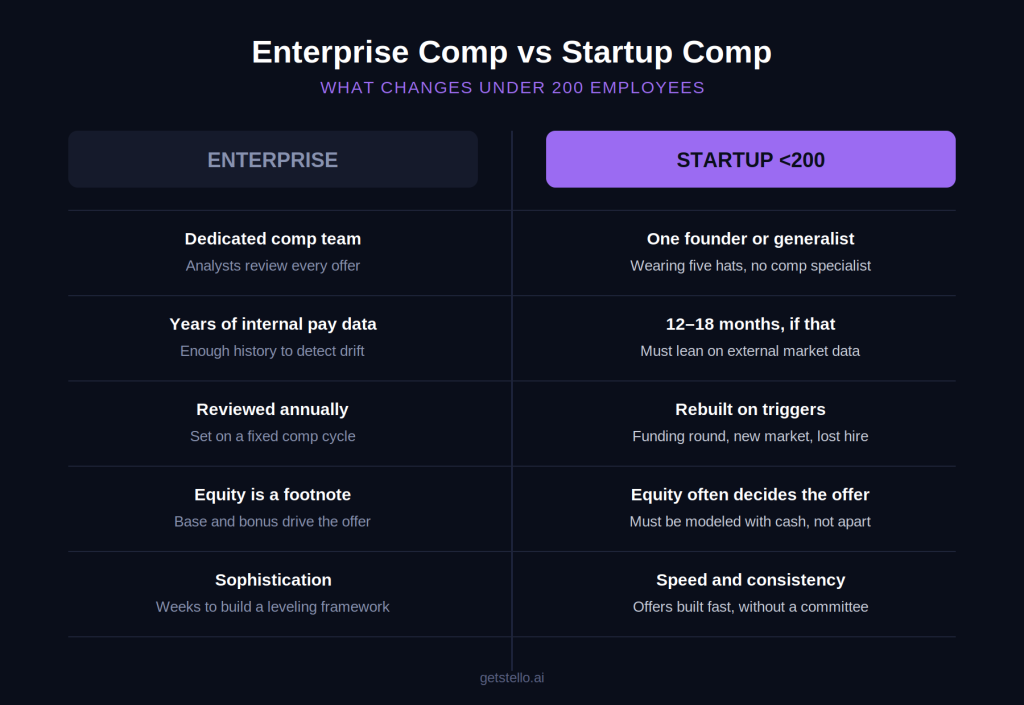
- Startups under 200 employees don’t have a comp function, so AI tools need to replace judgment, not just add dashboards for a team that doesn’t exist.
- Thin internal data means AI tools should lean on external market benchmarking rather than pattern-matching on a company’s own short history.
- Comp bands get rebuilt with every funding round or competitive hire, not once a year, so tools need to support fast rebuilds.
- Equity is often the deciding factor in offers at this stage, so cash and equity need to be modeled together, not separately.
- Speed and consistency matter more than sophistication. The best tools help non-specialists make defensible offers fast, without a full comp committee process.
You don’t have a comp function, you have a founder and a spreadsheet
At most startups this size, there’s no dedicated comp analyst. Pay decisions get made by a founder, a head of people wearing five hats, or a hiring manager who looked up a Glassdoor number once.
This is the real starting point for AI comp tools at this stage. The value isn’t “augmenting a comp team.” It’s giving one overloaded person the judgment of a comp team they can’t afford to hire yet. That reframes what the tool needs to do: less dashboard, more decision support.
Also read: 7 Tasks an AI Compensation Agent Can Take Off Your Plate This Year
Your data set is small, and that changes what AI can actually do
Enterprise AI comp tools lean on years of internal pay history to detect drift, compression, and bias. A 150-person company might have 18 months of real data, half of it from before the company found product-market fit and pay bands meant nothing.
This means:
- Market data matters more than internal history. Your AI tool needs strong external benchmarking, not just pattern-matching on your own thin data set.
- Bias detection works differently. You’re not auditing five years of raise cycles. You’re checking whether your first 50 offers were consistent, because those set the norm everyone after inherits.
- Small sample sizes make anomalies loud. One outlier hire can look like a trend when your total headcount is 120.
Bands get built and rebuilt constantly, not set once a year
Enterprise comp teams revisit bands annually. Startups revisit them every time they raise a round, enter a new market, or lose a hire to a bigger offer.
AI tools that assume a static annual cycle don’t fit this. What actually helps is a system that can rebuild bands quickly when the market shifts under you, without requiring a full comp committee review each time.
Also read: How to Evaluate an AI Compensation Platform: The RFP Checklist
Equity is doing half the work, and most comp tools ignore it
At 500+ employees, base pay and cash bonus usually carry the comp conversation. Under 200 employees, equity is often the deciding factor in whether someone takes the offer.
A comp tool built for large companies will treat equity as a footnote. A comp tool that actually helps startups needs to model cash and equity together, especially as you’re setting new-hire grants against a cap table that’s diluting with every round.
You’re optimizing for speed and consistency, not sophistication
A Fortune 500 comp team can spend three weeks getting a leveling framework exactly right. You don’t have three weeks. You have a candidate with a competing offer and a Friday deadline.
The AI comp tools that work well for smaller companies prioritize:
- Fast, defensible offer construction over deep customization
- Simple leveling that a hiring manager can actually explain in an offer call
- Guardrails that catch obvious inconsistency (two similar hires, wildly different offers) without requiring a full audit process
What this means if you’re evaluating tools
If you’re under 200 employees, the AI comp management pitch to watch for is “enterprise-grade” anything. What you actually need is:
- Strong external market data, since your internal history is too thin to lean on
- Equity and cash modeled together, not separately
- Fast band rebuilds that don’t require a comp committee
- Simple enough that a non-specialist can use it without a training cycle
The startups that get compensation right early aren’t the ones with the most sophisticated tooling. They’re the ones who used something simple, consistent, and fast enough to keep up with how quickly everything else about the company is changing.
FAQs
Do startups under 200 employees actually need an AI comp tool, or is a spreadsheet enough?
A spreadsheet works until you’re making more than a handful of offers a month or hiring across multiple functions at once. The moment two hiring managers can independently make inconsistent offers, you need something that enforces bands automatically. AI tools help most by catching that inconsistency before it becomes a pay equity problem.
How much historical pay data do we need before an AI comp tool is useful?
Less than you’d think, as long as the tool leans on external market data rather than just your own history. If a vendor’s pitch depends heavily on internal pattern detection, ask how it performs with under two years of data.
Should equity be included in AI-driven comp bands, or handled separately?
Included. At this stage, equity is often the deciding factor in an offer, not a bonus on top of it. A tool that models cash and equity separately will produce offers that look consistent on paper but aren’t, once a candidate compares total comp.
How often should a startup rebuild its comp bands?
More often than the annual cycle enterprise teams use. A funding round, a new market, or a competitive hire lost to a bigger offer are all real triggers to revisit bands, not just the calendar.
Can AI comp tools reduce pay bias at a company this small?
They can catch inconsistency early, which matters more at this stage than auditing years of history. The highest-leverage move is checking that your first wave of offers was consistent, since those set the pattern every hire after tends to follow.