If you run compensation at a mid-size or growing company, you already know the job is bigger than the headcount supporting it. One or two comp analysts are often responsible for merit cycles, offer approvals, pay equity audits, market benchmarking, and a constant stream of manager questions. Most of that work is repetitive, data-heavy, and time-sensitive. It is exactly the kind of work AI agents are built for.
An AI compensation agent is not a chatbot bolted onto your HRIS. It is a system that can pull live comp data, apply your pay structures and policies, run calculations, flag issues, and complete multi-step workflows with minimal human input. Done well, it does not replace your comp team. It gives them back the hours they currently spend on manual, low-judgment work so they can focus on strategy, negotiation, and the decisions that actually need a human.
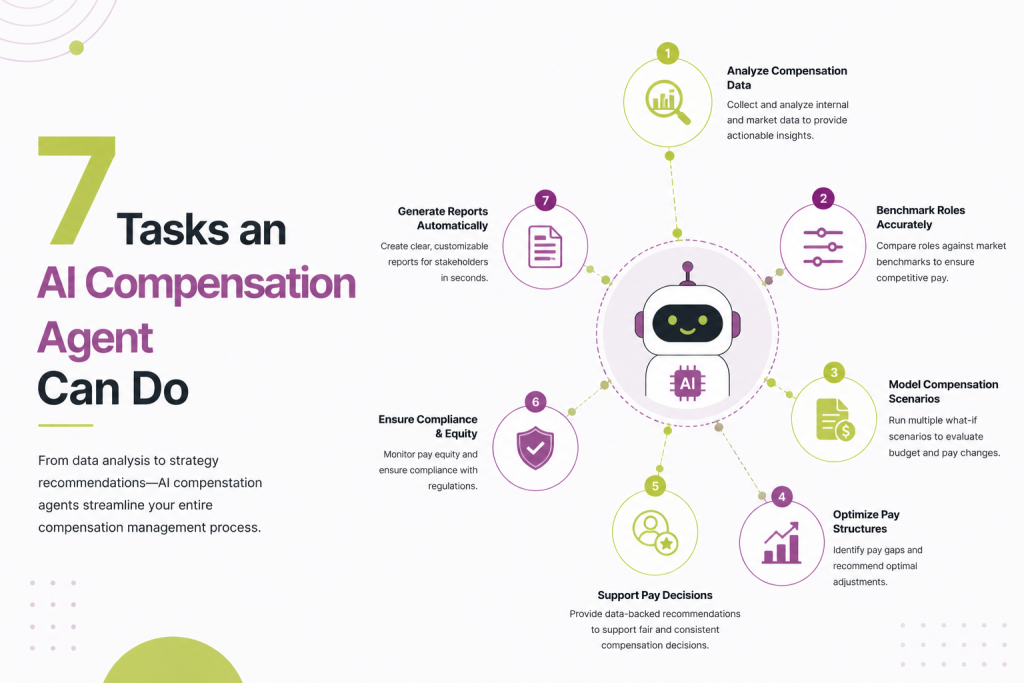
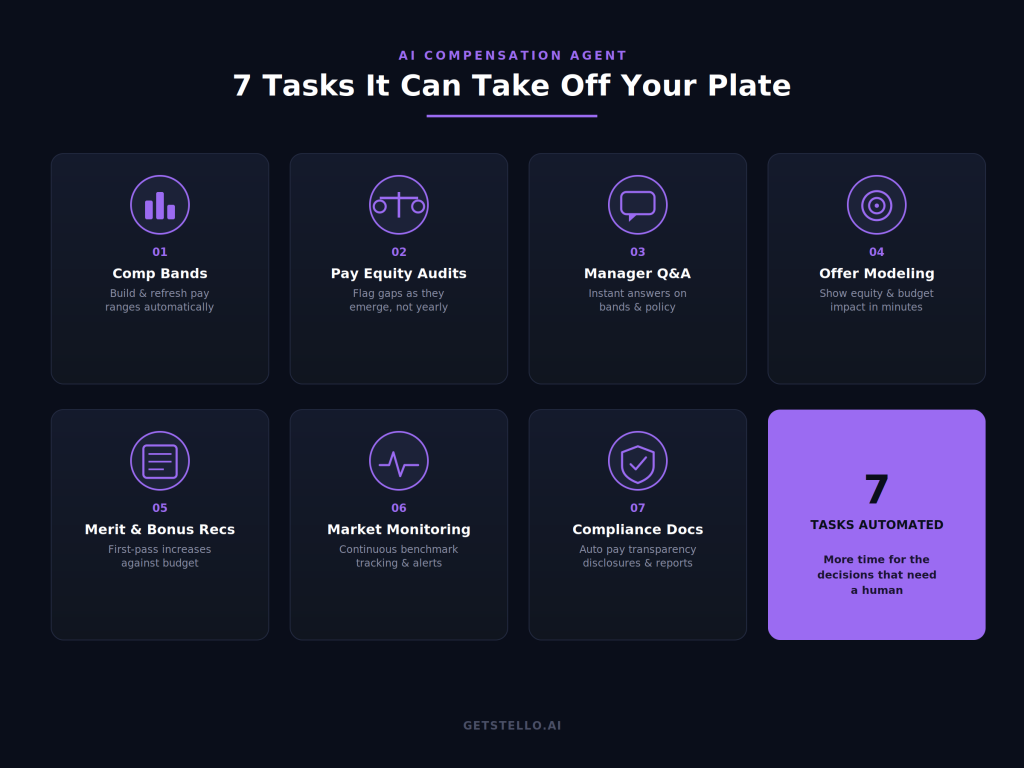
7 Tasks an AI Compensation Agent Can Take Off Your Plate This Year
- 01 Building and refreshing comp bands — pulls market data and drafts bands against your target percentile, so bands stay current instead of stale.
- 02 Running pay equity audits — flags statistically significant gaps continuously instead of once a year, and surfaces what’s driving them.
- 03 Answering manager questions on comp policy — resolves band, offer, and policy questions in real time, and routes exceptions to a human.
- 04 Modeling offer scenarios — shows the equity and budget impact of an above-band offer in minutes, with a documented rationale.
- 05 Preparing merit and bonus recommendations — generates first-pass increase recommendations against budget, flagging only real exceptions.
- 06 Monitoring market data and competitive positioning — watches benchmarks continuously and alerts you when a role drifts out of range.
- 07 Generating compliance and reporting documentation — tracks pay transparency rules by jurisdiction and drafts the required disclosures.
The common thread: none of this replaces comp judgment. It clears the manual data work so your team has time for the decisions that actually need a human.
Here are seven tasks an AI compensation agent can realistically take off your plate this year.
1. Building and Refreshing Compensation Bands
Building pay bands used to mean weeks of pulling market data, cross-referencing job levels, and manually adjusting for location and role scope. An AI agent can automate most of that process. It can ingest market survey data, match it against your internal job architecture, and generate draft bands based on your target market positioning, whether that is 50th percentile, 75th percentile, or a custom blend.
This matters because stale bands are one of the most common causes of pay compression and inequity. When bands do not get refreshed on a predictable cycle, new hires get paid market rate while existing employees fall behind. An agent that can refresh bands quarterly or even monthly, instead of once a year, keeps your pay structure closer to reality without adding headcount to your comp team.
Your team still reviews and approves the output. But the agent handles the data pull, the matching, and the first draft, which is usually the most time-consuming part.
Also read: How AI Compensation Agents Change the Comp Analyst’s Job (Not Replace It)
2. Running Pay Equity Audits
Pay equity audits are essential and also genuinely tedious. Someone has to segment employees by role, level, location, tenure, and performance, then run statistical comparisons across protected classes, then investigate every flagged outlier to determine if there is a legitimate business reason for the gap.
An AI compensation agent can run this analysis continuously instead of once or twice a year. It can flag statistically significant pay gaps as they emerge, before they compound into larger problems, and it can surface the underlying drivers, such as a specific manager, location, or job family where disparities cluster.
This does not remove the need for legal review or human judgment on remediation. But it turns pay equity from a periodic fire drill into an ongoing monitoring process, which is a much better position to be in if you are ever audited or challenged.
3. Answering Manager Questions About Comp Policy
A large share of a comp analyst’s time goes to answering the same handful of questions over and over. What is the band for this role? Can I offer above the midpoint? What is our policy on relocation adjustments? How do I handle a counteroffer situation?
An AI agent trained on your comp philosophy, bands, and policy documents can answer most of these questions directly, in real time, without a manager having to file a ticket and wait two days for a response. It can also route the genuinely ambiguous cases, like an exception request outside policy, to a human for approval.
This is one of the highest-leverage uses of an AI agent because it compounds. Every manager question the agent handles is time your comp team gets back, and every manager who gets an instant answer is a manager who is less likely to make an off-policy offer out of frustration.
4. Modeling Offer Scenarios
When a hiring manager wants to extend an offer above the posted range, or a candidate has a competing offer, someone needs to model the financial impact quickly. What does this offer do to internal equity on the team? What does it do to the budget for the quarter? Is there a compression risk with the next-most-senior person on the team?
An AI compensation agent can run these scenarios in minutes instead of the hours or days it currently takes to loop in a comp analyst, pull data manually, and build a comparison. It can show the hiring manager and the comp team the tradeoffs side by side, which speeds up decision-making during a stage of the hiring process where speed often determines whether you win the candidate.
This also reduces a quieter risk: inconsistent exception-making. When every above-band offer runs through the same modeling process, you get a documented, defensible reason for each exception instead of a pattern of ad hoc decisions that only surface as a problem during the next pay equity audit.
Also read: Building a Pay Equity Audit Workflow With AI
5. Preparing Merit and Bonus Cycle Recommendations
Merit cycles are one of the most operationally intense periods for any comp team. Someone has to pull performance ratings, compare them against current pay position in band, apply budget constraints, and generate recommended increases for hundreds or thousands of employees, all while managers push back on allocations they think are too low.
An AI agent can generate first-pass recommendations based on your merit matrix, performance ratings, and budget parameters, then flag exceptions that need human review, such as employees near the top of their band or those with unusual performance-to-pay ratios. Managers still make the final call, and comp still owns governance, but the agent removes the spreadsheet-building phase that eats the first two weeks of every cycle.
This is also where a lot of comp teams see the fastest ROI, since merit cycles are so time-boxed and the manual version of this process is so painful.
6. Monitoring Market Data and Competitive Positioning
Market data changes constantly, but most companies only check their competitive positioning once or twice a year because pulling and analyzing survey data is slow work. That gap creates risk. If your target market moves and you do not notice for six months, you may already be losing candidates and employees to competitors offering more.
An AI compensation agent can continuously monitor market data feeds and alert your team when specific roles or job families drift out of your target percentile. Instead of a comp analyst manually checking dozens of benchmarks on a schedule, the agent surfaces only the roles that actually need attention, when they need it.
This is especially valuable for hard-to-fill or fast-moving roles, like anything in AI or data engineering right now, where market rates can shift meaningfully in a single quarter. A comp team that only checks these roles annually is effectively negotiating with year-old information.
7. Generating Compliance and Reporting Documentation
Pay transparency laws are expanding across states and countries, and each one comes with its own reporting requirements, from pay range disclosures in job postings to annual pay data reports. Keeping track of which requirements apply where, and generating the documentation to prove compliance, is a job in itself.
An AI agent can track which jurisdictions your open roles fall under, generate the required pay range disclosures automatically, and compile the documentation needed for annual reporting. This is low-judgment, high-stakes work, which makes it a good fit for automation with human sign-off before anything is filed or published.
The Bigger Shift
None of these seven tasks require replacing your comp team’s judgment. They require removing the manual data work that currently stands between your team and the decisions only they can make. A comp analyst who is not spending Tuesday afternoon rebuilding a spreadsheet has more time to think about retention risk, negotiate with a hiring manager, or catch a policy gap before it becomes a legal problem.
The companies getting the most out of AI compensation agents right now are not the ones trying to automate comp strategy. They are the ones automating the parts of the job that were never strategy to begin with, and giving their comp teams room to actually do the strategic work they were hired for.
If you are evaluating where to start, pick the task on this list that currently eats the most hours on your team. That is usually merit cycle prep or manager Q&A. Start there, prove the time savings, then expand from there.
FAQs-
1. What is an AI compensation agent?
An AI compensation agent is a system that helps HR and compensation teams automate repetitive, data-heavy compensation tasks. It can work with compensation data, company policies, pay structures, and market information to perform tasks such as building pay bands, analyzing pay equity, modeling offers, and answering manager questions.
2. Can AI replace compensation analysts?
AI compensation agents are better suited to taking over repetitive operational work than replacing compensation professionals. Human judgment is still important for strategy, exceptions, negotiations, remediation decisions, and other complex compensation decisions.
3. How can AI help with pay equity?
An AI compensation agent can continuously analyze compensation data and flag statistically significant pay gaps as they emerge. It can also help identify potential drivers behind those gaps, while leaving remediation and legal decisions to human teams.
4. Can an AI compensation agent help with merit cycles?
Yes. An AI agent can generate first-pass merit and bonus recommendations using factors such as performance ratings, pay position, merit matrices, and available budgets. It can then flag exceptions that require review by managers or the compensation team.
5. Where should HR teams start with AI compensation agents?
Start with a repetitive task that currently consumes a significant amount of your compensation team’s time. The article suggests merit-cycle preparation and manager Q&A as practical starting points where teams can demonstrate time savings before expanding AI into additional workflows.