Buying a compensation platform used to mean comparing a few dashboards and asking about pricing tiers. Now every vendor claims to have “AI-powered” benchmarking, forecasting, or pay equity analysis, and the differences between what’s actually useful and what’s a marketing label aren’t obvious from a demo.
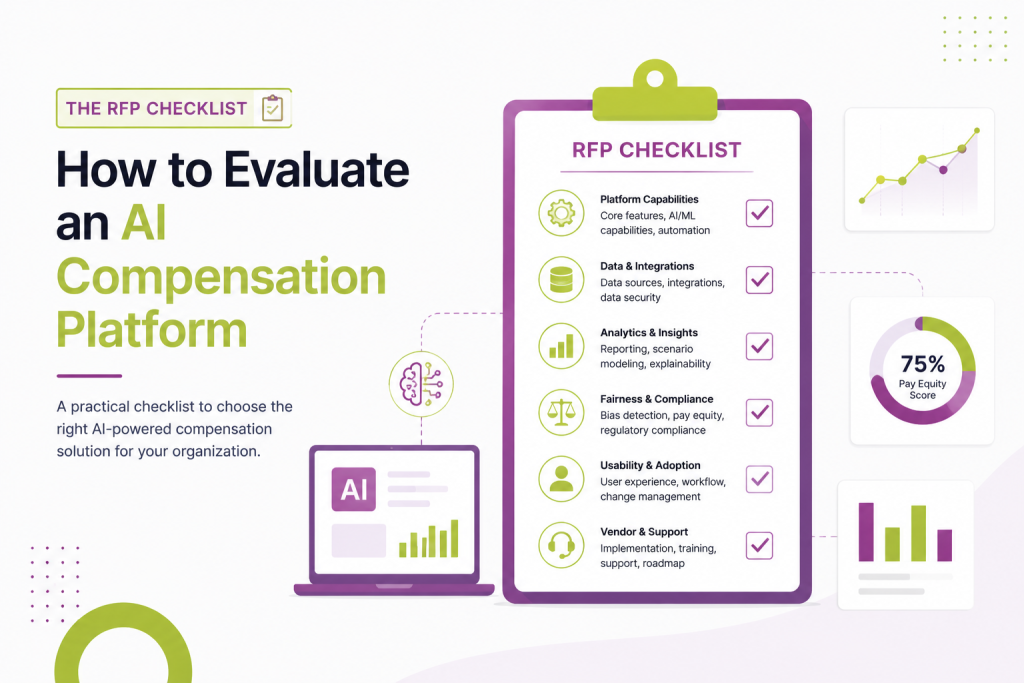
An RFP forces the comparison to get specific. If you’re evaluating AI comp platforms, here’s what actually belongs on that checklist, and why each item matters more than it looks.
TL;DR
- Start your RFP with data foundation questions, not AI features. Sourcing, refresh rate, and import compatibility determine everything downstream.
- Make vendors explain how their AI actually works. If they can’t describe the model in plain language, treat outputs as a black box.
- Give pay equity its own RFP section. Ask specifically for regression-based analysis and pre-decision flagging, not just averages in a report.
- Push on integrations and configurability. Native HRIS connections and customizable pay bands matter more than a polished demo.
- Score categories separately (data, AI transparency, equity, integrations, security) instead of one blended score, so real strengths and gaps don’t get averaged out.
Start with the data foundation, not the AI features
Before you ask what the AI does, ask where it gets its data from. This is the question most RFPs skip, and it’s the one that determines whether everything downstream is trustworthy.
Questions to include:
- What market data sources power your benchmarking, and how often are they refreshed?
- How do you handle data from companies with non-standard job architecture?
- Can we import our existing HRIS and comp data without manual reformatting?
- How is data validated before it’s used in AI recommendations?
A platform with sophisticated AI running on stale or poorly sourced market data will produce confident, wrong answers. That’s worse than a simpler tool with honest data.
Ask how the AI actually works, not just what it does
“AI-powered” is not a feature. Vendors need to explain the mechanism, especially if you’ll ever need to defend a pay decision to an employee, a regulator, or your own leadership.
Questions to include:
- Is this a rules-based system, a machine learning model, or a large language model, and for which specific features?
- Can you show us why the system made a specific recommendation, in plain language?
- What happens when the model is uncertain? Does it flag low-confidence outputs or present everything with the same authority?
- How is the model retrained, and how often?
If a vendor can’t explain their model in a sentence a comp analyst would understand, that’s worth noting. Black-box outputs are hard to defend later.
Also read: Building a Pay Equity Audit Workflow With AI
Push on pay equity and bias specifically
This deserves its own section in the RFP, not a bullet buried under “compliance.” Pay equity capability varies enormously between vendors, and the difference matters legally, not just operationally.
Questions to include:
- Does the platform run regression-based pay equity analysis, or simple average comparisons?
- Can it flag pay equity risk before an offer or raise is finalized, or only after the fact in periodic reports?
- What legally protected variables does the model control for, and is that list configurable by jurisdiction?
- Does the platform generate audit-ready documentation, or just a dashboard view?
A platform that only reports averages by gender or race is doing far less than one that isolates the unexplained gap after controlling for legitimate factors like tenure and role.
Get specific about integrations
AI comp tools are only as useful as the systems they connect to. A platform that can’t talk cleanly to your HRIS will create manual reconciliation work that undermines the “automation” pitch.
Questions to include:
- Which HRIS and payroll systems do you have native integrations with, versus custom build required?
- How does data sync, in real time, daily batch, or manual export/import?
- What happens to historical data if we switch platforms later?
- Is there an API for custom workflows, and what’s documented versus available on request?
Ask about configurability, not just capability
Two platforms can have the same underlying AI capability and produce very different results depending on how configurable the system is to your specific comp philosophy, job levels, and geographic pay strategy.
Questions to include:
- Can we customize pay bands, geographic differentials, and job leveling logic, or are we constrained to vendor defaults?
- How does the platform handle multi-currency and global compensation structures?
- Can different business units or regions have different comp philosophies within the same instance?
- What’s the actual implementation timeline for a company our size and structure?
Don’t skip security and access control
Compensation data is some of the most sensitive information a company holds. This section is standard in most RFPs, but worth reinforcing with AI-specific questions, since some vendors train models on aggregated customer data by default.
Questions to include:
- Is our data used to train models that serve other customers, and can we opt out?
- What access controls exist for role-based visibility into comp data and AI recommendations?
- What’s your data retention and deletion policy if we terminate the contract?
- Do you carry SOC 2 or equivalent certification, and can we see the report?
Weight the criteria before you send the RFP
Once the questions are out, decide internally how much each section matters before responses come in. A platform that’s brilliant at benchmarking but weak on pay equity documentation might still be wrong for a company facing upcoming pay transparency requirements. A platform with excellent equity analysis but no HRIS integration might create more manual work than it saves.
Score categories separately, data foundation, AI transparency, pay equity, integrations, configurability, security, rather than blending everything into one number. It’s easier to see where a vendor is actually strong versus where the demo just looked polished.
Also read: How AI Compensation Agents Change the Comp Analyst’s Job (Not Replace It)
What this looks like in practice
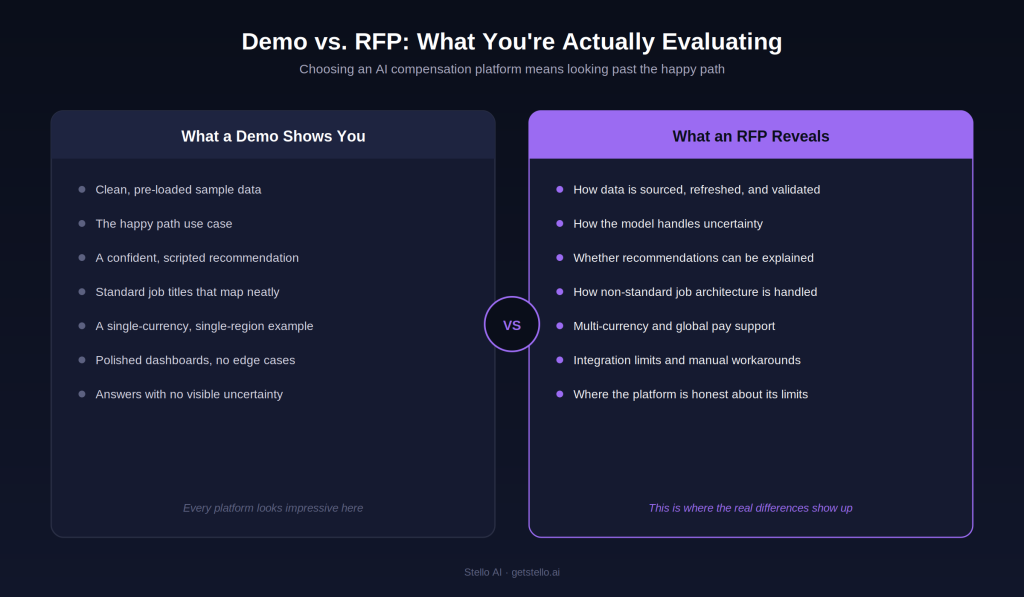
The strongest RFP responses will differ from the best demos. A demo shows you the happy path: clean data, a clear recommendation, a satisfied comp analyst nodding along. An RFP response, if you’ve asked the right questions, shows you what happens at the edges: uncertain data, unusual job structures, and how transparent the system is willing to be about its own limits.
That’s the real test. Any platform can look impressive with clean data and a scripted use case. The one worth choosing is the one that’s honest about where the AI helps, where it doesn’t, and what still needs a human comp analyst in the loop.