Every time a new AI tool shows up in HR tech, someone asks the same question: is this going to replace my job?
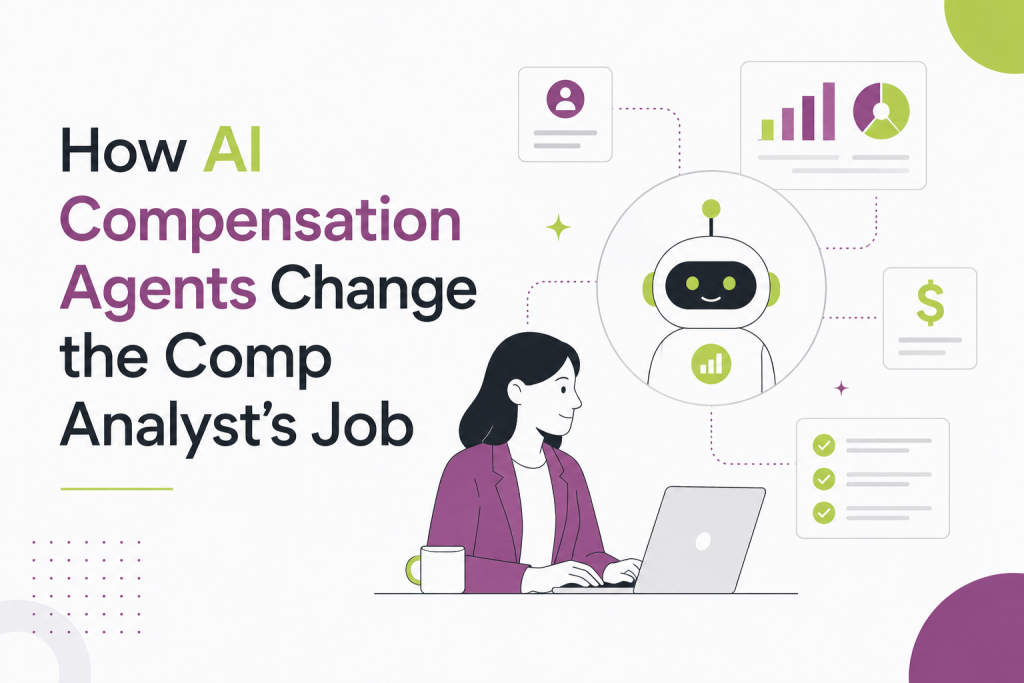
Comp analysts are asking it right now about AI compensation agents. It’s a fair question. These tools can pull market data, model pay bands, flag equity gaps, and run merit increase scenarios in minutes instead of days. That sounds like a lot of what a comp analyst does.
But look closer at what actually changes when an AI agent enters a comp team’s workflow, and a different picture shows up. The job doesn’t disappear. It shifts. The parts that get automated were never the valuable parts to begin with. What’s left, and what grows, is the part that actually requires a human who understands people, context, and judgment.
Here’s what that shift looks like in practice.
TL;DR
- AI compensation agents automate the mechanical middle of comp work: market data aggregation, merit cycle modeling, pay equity screening, and first-pass offer recommendations.
- They don’t replace comp analysts because they can’t hold organizational context, like a pending promotion, a tight budget, or team morale, that changes how a number should be used.
- Judgment calls stay human: how to close a pay gap, how to manage stakeholder pushback, and what comp philosophy the company should actually follow.
- The shift mirrors what already happened in finance and marketing analytics: less time on data pulls, more time on interpretation and strategy.
- Teams that adopt AI agents well redirect analyst hours toward equity work, manager coaching, and faster response to market shifts, not headcount cuts.
- Bottom line: AI agents make comp analysts more consultative and strategic, not obsolete.
What comp analysts actually spend their time on today
Before talking about what changes, it’s worth being honest about what the job looks like right now at most companies.
A typical comp analyst spends a large chunk of their week on things like:
- Pulling and reconciling market data from multiple survey sources
- Building and updating pay bands in spreadsheets
- Running merit increase calculations across hundreds or thousands of employees
- Checking for pay compression and equity issues after the fact
- Answering the same manager questions about where an offer should land
- Preparing comp committee decks with the same charts, updated quarterly
None of this is the reason someone became a compensation analyst. Most people in this field got into it because they’re interested in fairness, structure, and how pay strategy connects to business outcomes. Instead, a lot of their time goes to data wrangling and spreadsheet maintenance.
This is exactly the kind of work AI compensation agents are built to absorb.
Also read: Benefits and Limitations of AI Compensation Agents in HR
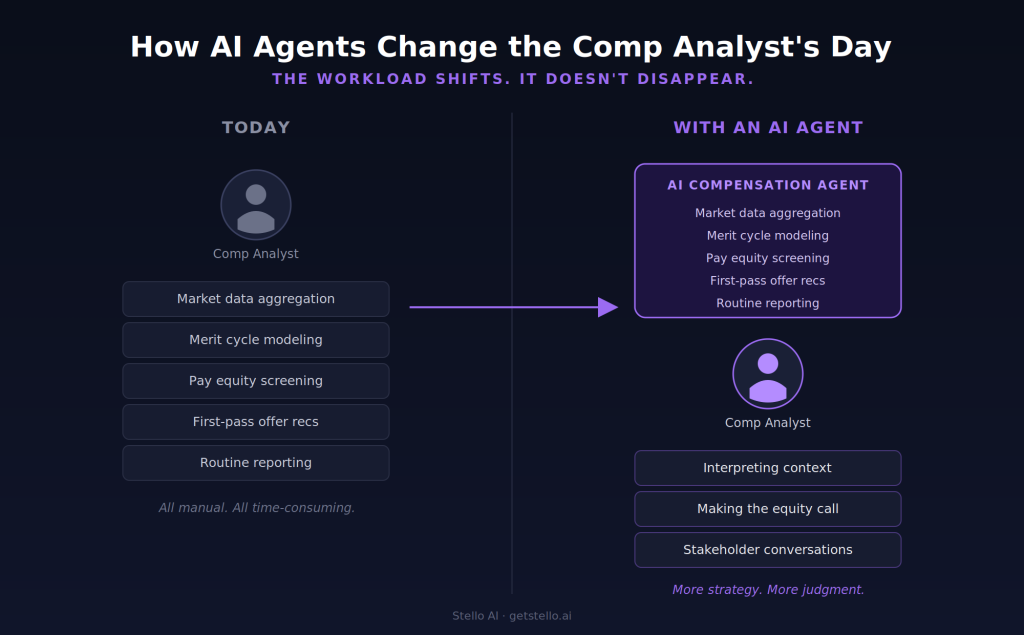
The tasks AI agents take over first
AI compensation agents are good at structured, repeatable, data-heavy work. That’s where they show up first in a comp analyst’s day.
Market data aggregation. Instead of manually pulling from three or four survey providers and reconciling job matches by hand, an AI agent can ingest multiple sources, match roles, and surface a benchmarked range in a fraction of the time.
Merit cycle modeling. Running budget scenarios across departments, testing different increase percentages, and seeing the downstream effect on compa-ratios used to mean hours in a spreadsheet with broken formulas. An agent can run dozens of scenarios and hand back a clean comparison.
Pay equity screening. AI agents can continuously scan compensation data for statistical anomalies tied to gender, race, tenure, or role, flagging what needs review long before an audit season forces the issue.
First-pass offer recommendations. When a recruiter needs a number for a candidate, an agent can generate a data-backed starting point based on role, location, experience, and internal equity, instead of the analyst manually pulling comparables every time.
Routine reporting. Comp committee decks, quarterly compression reports, and manager-facing pay guidance can be generated automatically instead of rebuilt from scratch each cycle.
This is real automation. It’s not a minor efficiency gain. For a mid-sized comp team, this can cut the manual workload by a significant margin.
Also read: AI-Driven Pay Equity Audit: How AI Is Transforming Compensation Fairness
What doesn’t get automated
Here’s where the “replace” narrative falls apart. Everything an AI compensation agent does well is upstream of the actual decision. The judgment calls still belong to a person.
Interpreting context AI doesn’t have. An agent can tell you a role is underpaid relative to market. It can’t tell you that the person in that role is six months from a planned promotion, or that the team just lost two people and morale is fragile, or that finance flagged budget constraints that haven’t hit the system yet. A comp analyst holds that context. The agent doesn’t.
Making the equity call, not just flagging it. Flagging a pay gap is a data task. Deciding how to close it, in what order, with what budget, and how to explain it to a manager without triggering a dozen other comparisons, is a judgment task. That’s still squarely human work, and arguably more important now that the flags come faster and more often.
Managing stakeholder relationships. A VP pushing back on a comp band, a manager who thinks their star performer deserves an off-cycle bump, a founder asking why engineering pay looks different than sales. These are conversations, not calculations. AI agents don’t sit in that room.
Designing comp philosophy and structure. Someone still has to decide what the company’s pay philosophy actually is: where it wants to sit relative to market, how much weight to give internal equity versus external competitiveness, how aggressive to be with equity compensation versus cash. An agent can model the implications of those choices. It can’t make them.
Owning the narrative for leadership. When comp data goes to the board or the exec team, someone needs to translate what the numbers mean for the business, not just present a chart. That’s storytelling built on judgment, not a report an agent auto-generates.
The job becomes less operator, more strategist
The pattern across all of this is consistent. AI compensation agents take over the mechanical middle of the job, the parts that were always closer to data processing than decision-making. What’s left is the part that requires understanding people and business context.
This is the same shift that’s happened in other analyst-heavy functions once automation matured. Finance analysts spend less time building models from scratch and more time interpreting what a model means for a decision. Marketing analysts spend less time pulling campaign reports and more time deciding what to do with the insight. Comp is following the same arc.
The practical effect for a comp analyst is that the job gets less repetitive and more consultative. Instead of being the person who builds the pay band spreadsheet, you become the person managers come to for advice on how to use it. Instead of manually flagging pay gaps once a year during an audit, you’re the person deciding what to do about the gaps an AI agent surfaces every week.
That’s a more interesting job, not a smaller one. It’s also a harder one to automate away, because it depends on things that don’t sit in structured data: relationships, organizational context, and judgment under ambiguity.
What this means for comp teams adopting AI agents
For HR and comp leaders evaluating AI compensation agents, the framing matters. This isn’t a headcount reduction tool. It’s a leverage tool.
A comp team that adopts an AI agent well doesn’t shrink. It redirects. The hours that used to go into data pulls and spreadsheet maintenance go into things that actually move the needle: proactive equity work, stronger manager coaching on pay conversations, more sophisticated comp philosophy design, and faster response to market shifts instead of reactive quarterly catch-up.
Teams that get this wrong tend to treat the AI agent as a cost-cutting headcount play, then wonder why pay decisions start feeling disconnected from business reality. The agent doesn’t know that reality. The analyst does.
The bottom line
AI compensation agents are genuinely good at the parts of comp work that were always mechanical: data aggregation, scenario modeling, gap flagging, first-pass recommendations. That’s real, meaningful automation, and comp analysts should welcome it instead of fearing it.
What it doesn’t touch is the part of the job that was always the actual value: judgment, context, and the ability to translate data into decisions people trust. If anything, AI agents make that part of the job more visible, because it’s no longer buried under hours of spreadsheet work.
The comp analyst job isn’t disappearing. It’s getting closer to what it should have been all along.