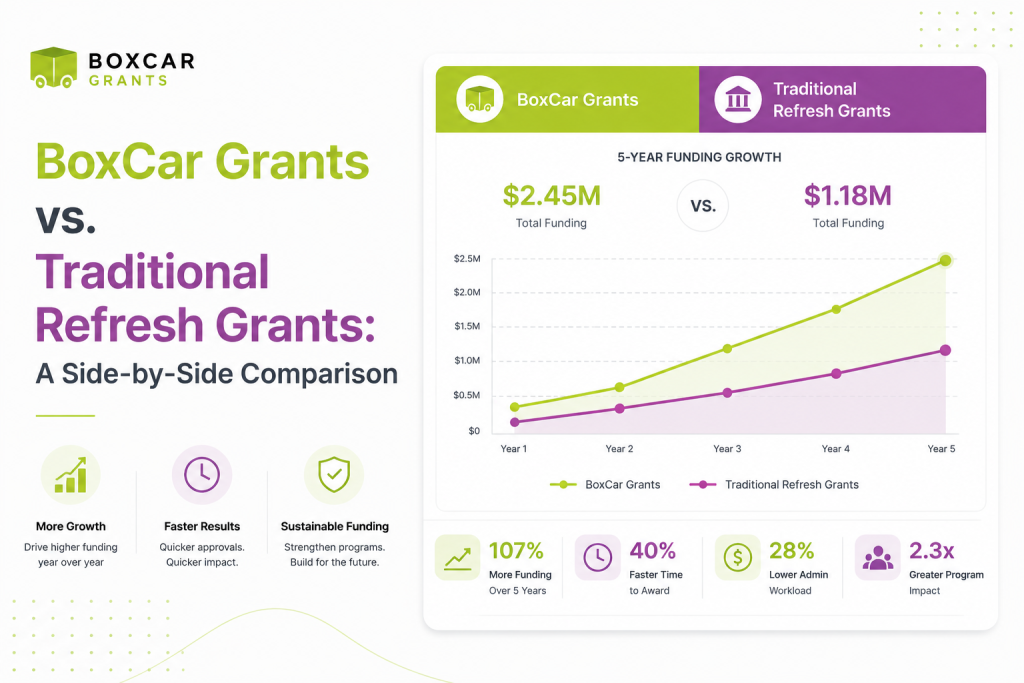
Equity compensation has always been a retention tool. But for most companies, the system governing how equity is refreshed has stayed largely unchanged for decades — reactive, discretionary, and difficult to forecast.
As companies scale, that model breaks down. Finance teams are left scrambling to model costs they can’t predict. HR is fielding refresh requests driven by politics rather than policy. And employees are left guessing what, if anything, is coming next.
BoxCar grants offer a structural alternative. This article breaks down the two models side by side — timing, cost predictability, dilution impact, employee experience, and administrative burden — so finance leaders can make an informed decision about which approach belongs in their compensation architecture.
TL;DR
- Traditional refresh grants are reactive — triggered by retention risk, manager advocacy, or HR bandwidth, not policy.
- BoxCar grants follow a fixed cadence: smaller, overlapping grants issued on a schedule tied to tenure and level.
- BoxCar makes equity expense forecastable — finance teams can model budget and dilution years in advance.
- Traditional refreshes create lumpy, unpredictable share pool consumption; BoxCar smooths it out.
- Grant sizing under BoxCar is policy-driven, not negotiated — improving consistency, fairness, and defensibility.
- BoxCar keeps retention leverage active continuously; traditional grants lose impact once the vesting cliff passes.
- Stello AI automates the full BoxCar lifecycle — from policy setup to grant issuance, scenario modeling, and employee statements.
The Core Difference: Reactive vs. Structured
Before diving into the comparison, it helps to define what each model actually is.
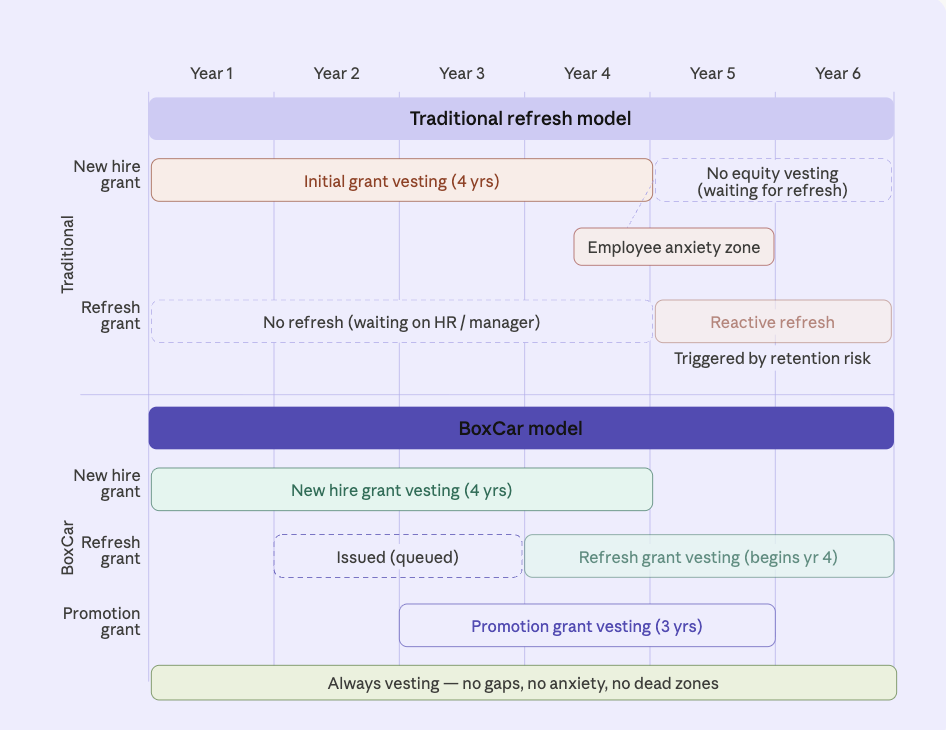
Traditional refresh grants are issued on an ad-hoc or loosely scheduled basis — typically when an employee’s initial grant is nearing expiration, when a manager flags a retention risk, or during a periodic compensation review cycle. There is no fixed policy governing timing or amount. Decisions are made case by case.
BoxCar grants replace this with a defined cadence. Employees receive a series of smaller, overlapping grants issued on a fixed schedule tied to tenure and level. Each grant is structured so that its vesting begins precisely when the previous one ends — eliminating gaps and making the equity timeline continuous and predictable.
The result is a fundamentally different relationship between the company and its equity program: one is a series of ad-hoc decisions; the other is a system.
Also read: HRIS Systems Explained: Core Features, Use Cases, and Limitations
Side-by-Side Comparison
The following breakdown examines both models across six critical dimensions — timing, cost predictability, dilution, grant consistency, retention effectiveness, and administrative burden. Each section includes a direct finance implication so the trade-offs are clear.
1. Grant Timing
| Traditional Refresh | BoxCar | |
|---|---|---|
| When grants are issued | Reactively — triggered by retention risk, manager advocacy, or periodic review cycles | Proactively — on a fixed cadence defined by policy (e.g., year 2 or 3 of tenure) |
| Who drives the timing | Managers, HR bandwidth, or employee escalations | Compensation policy |
| Predictability | Low — timing varies by employee, team, and circumstance | High — employees and finance teams know the schedule in advance |
Finance implication: Unpredictable timing makes grant expenses difficult to forecast. When refreshes are triggered by retention events rather than policy, finance teams are perpetually in reactive mode — approving grants under pressure with limited visibility into downstream cost impact.
2. Cost Predictability & Budget Modeling
| Traditional Refresh | BoxCar | |
|---|---|---|
| Expense forecasting | Difficult — grant volumes and timing are irregular | Straightforward — cadence and sizing by level allow multi-year modeling |
| Budget planning | Requires constant re-estimation | Defined policy enables rolling 3–5 year projections |
| Surprise grant requests | Common, especially near vesting cliffs | Rare — grants are scheduled, not requested |
Finance implication: BoxCar programs convert equity expense from a variable, event-driven line item into a structured, forecastable cost. Finance teams can build grant schedules into their models the same way they forecast salary increases — with confidence rather than approximation.
Under a traditional model, a single unexpected wave of refresh requests can materially shift a quarter’s equity expense. Under BoxCar, that variability is designed out of the system.
3. Dilution Management
| Traditional Refresh | BoxCar | |
|---|---|---|
| Share pool consumption | Lumpy and hard to project | Smooth and modeled in advance |
| Dilution forecasting | Requires scenario-by-scenario analysis | Predictable at a cohort and company level |
| Board reporting | Difficult to present with confidence | Clean multi-year dilution schedules |
Finance implication: Dilution is one of the most sensitive topics in board conversations. Traditional refresh models make it nearly impossible to present a credible multi-year dilution picture because the inputs — how many people get refreshed, when, and at what size — are unknown until they happen.
BoxCar programs make dilution a planning variable, not a surprise. Given a defined headcount, level distribution, and grant sizing policy, finance teams can model share pool consumption years in advance.
4. Grant Sizing Consistency
| Traditional Refresh | BoxCar | |
|---|---|---|
| How grant size is determined | Manager judgment, negotiation, or comp team discretion | Policy-driven — tied to level and tenure |
| Consistency across employees | Low — similar employees often receive materially different refreshes | High — same level, same cadence, same sizing |
| Defensibility | Difficult to defend under scrutiny or audit | Fully defensible — grounded in documented policy |
Finance implication: Inconsistent grant sizing creates two risks. The first is legal and regulatory — inconsistent equity treatment across similarly situated employees invites pay equity scrutiny. The second is financial — without consistent sizing rules, budget estimates are built on assumptions that rarely hold.
BoxCar programs enforce sizing discipline. When grant amounts are determined by level and tenure rather than negotiation, the numbers are both fairer and more accurate to model.
5. Employee Experience & Retention Effectiveness
| Traditional Refresh | BoxCar | |
|---|---|---|
| Employee visibility | Low — employees rarely know if or when a refresh is coming | High — employees know their grant schedule from day one |
| Retention leverage | Concentrated around vesting cliffs, then drops sharply | Continuous — multiple overlapping grants ensure ongoing incentive |
| Equity anxiety | High near vesting expiration | Low — next grant is already in the queue |
Finance implication: This one matters more than it might seem. When equity stops being a retention lever, companies compensate through other means — larger salaries, discretionary bonuses, or costly counter-offers. BoxCar programs keep the retention incentive active at all times, reducing the need for reactive, off-cycle spend to hold onto talent.
The cost of losing a senior employee — recruiting fees, onboarding time, lost productivity — routinely exceeds the cost of a well-structured refresh grant. BoxCar programs reduce that risk systematically.
6. Administrative Complexity
| Traditional Refresh | BoxCar | |
|---|---|---|
| Tracking requirements | Moderate per-grant, but unpredictable volume | Higher per employee, but structured and automatable |
| HR workload | High — constant fielding of refresh requests and negotiations | Lower once policy is defined — execution becomes process |
| Spreadsheet viability | Manageable at small scale; breaks down quickly | Requires tooling at any meaningful scale |
Finance implication: The administrative overhead of BoxCar programs is real, but it is upfront and one-time. Defining the policy, building the cadence, and establishing the tooling is a bounded investment. Traditional refresh models, by contrast, carry ongoing overhead — every refresh request is a new negotiation, a new approval cycle, and a new line in someone’s spreadsheet.
As headcount grows, the administrative cost of traditional refreshes scales with it. BoxCar’s complexity is largely fixed once the system is running.
Also read: What is HRIS? A Plain-English Guide for HR Teams
Summary: Which Model Belongs in a Modern Compensation Architecture?
| Dimension | Traditional Refresh | BoxCar |
|---|---|---|
| Grant timing | Reactive | Structured |
| Budget forecasting | Difficult | Predictable |
| Dilution modeling | Variable | Forecastable |
| Grant consistency | Low | High |
| Retention leverage | Intermittent | Continuous |
| Administrative load | Ongoing | Front-loaded |
| Board defensibility | Limited | Strong |
For companies at early stage with fewer than 50 employees, traditional refreshes may be manageable. But for any organization scaling past that threshold — or any finance leader who needs to present a credible equity expense forecast to a board — the case for BoxCar is difficult to argue against.
The structure is not just operationally cleaner. It is financially sounder.
How Stello AI Powers BoxCar Grant Programs
Implementing a BoxCar program requires more than a policy decision — it requires tooling that can manage overlapping grant schedules, automate cadence-based issuance, model budget and dilution scenarios, and communicate clearly with employees about their equity picture.
Stello AI is built for exactly this. Finance and HR teams use Stello to:
- Model BoxCar scenarios before committing to a policy — running budget, dilution, and retention trade-off analysis across different grant cadences and sizing rules
- Automate the grant lifecycle — from policy definition to issuance, with no manual tracking or spreadsheet maintenance
- Generate personalized employee equity statements that show each employee what they have, what’s vesting, and what’s coming next
- Report confidently to boards with clean, multi-year dilution and share pool consumption forecasts
The result is a BoxCar program that runs predictably, scales with headcount, and gives finance leadership the visibility they need to make equity decisions with confidence.
Ready to see how Stello AI can power your BoxCar grant program? Book a demo →
FAQs-
1. Are BoxCar grants more expensive than traditional refresh grants?
Not necessarily. BoxCar grants distribute equity spend across a defined cadence, making total cost comparable to traditional refreshes — but far more predictable. The real difference is that finance teams can model and forecast BoxCar costs in advance, whereas traditional refreshes create unplanned, reactive expenses that are harder to control.
2. How do BoxCar grants affect our share pool and dilution?
BoxCar programs actually make dilution easier to manage. Because grant timing and sizing are governed by policy, finance teams can project share pool consumption years out — giving boards a credible, defensible dilution schedule instead of a best-guess estimate.
3. At what company size does it make sense to switch to BoxCar?
Most companies start feeling the pain of traditional refreshes somewhere between 50–150 employees, when ad-hoc decisions become hard to track and inconsistencies start surfacing. That said, any company with a defined leveling framework and a desire for compensation predictability can benefit from BoxCar, regardless of size.
4. Do employees respond well to BoxCar grants vs. traditional refreshes?
Yes — and the data backs it up. Employees with visibility into their future equity are significantly less likely to interview elsewhere near vesting cliffs. BoxCar grants give employees a clear picture of what’s vesting and what’s coming next, which reduces anxiety and removes one of the most common triggers for attrition.
5. Can we implement BoxCar grants if we already have employees on traditional vesting schedules?
Yes. Most companies transition to BoxCar on a go-forward basis — new grants follow the BoxCar structure while existing grants continue on their original schedule. Stello AI is built to manage both simultaneously, ensuring a clean transition without disrupting employees currently mid-vest.