The case for BoxCar grants is compelling on paper. Predictable equity costs, continuous retention incentives, defensible grant sizing, and cleaner dilution modeling — it is a structurally superior system to the reactive, ad-hoc refresh model most companies default to. (If you haven’t read our side-by-side breakdown of BoxCar vs. traditional refresh grants, that’s a good place to start.)
But knowing why BoxCar works is different from knowing how to implement it. The rollout requires decisions across compensation philosophy, finance modeling, HR operations, and employee communication — and getting those decisions wrong early creates compounding problems later.
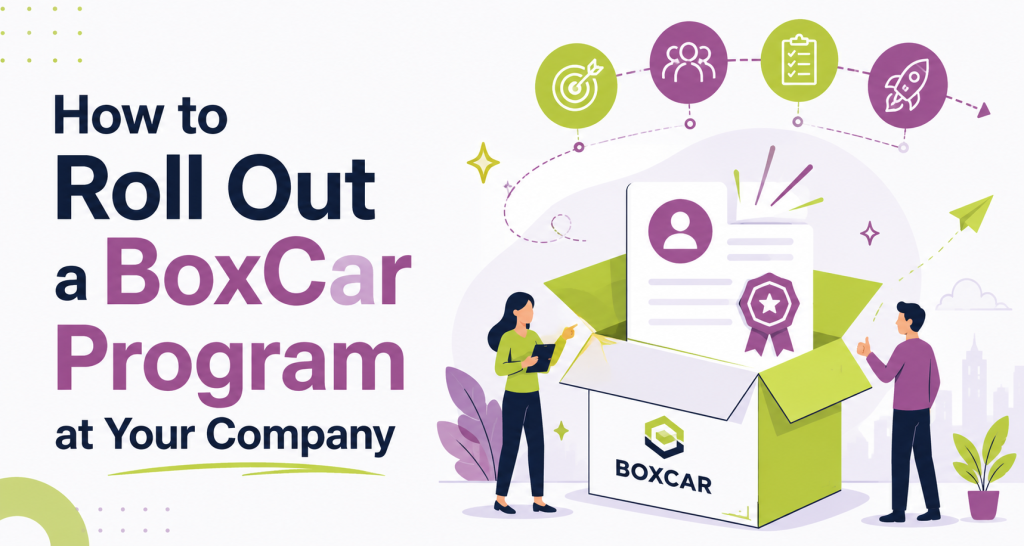
This guide walks finance and HR leaders through a practical, phase-by-phase rollout — from building the policy to communicating it to employees to operationalizing it at scale.
TL;DR
- A successful BoxCar rollout starts with two prerequisites: a documented job leveling framework and Finance-HR alignment on equity budget and dilution limits.
- BoxCar policy has four core components — grant cadence (typically 2 years), sizing by level (20–40% of initial grant), vesting schedule, and a defined promotion grant policy.
- Finance must model three scenarios before seeking approval: base case, hiring acceleration, and hiring freeze — with explicit attention to the grant overlap effect in years 2–3.
- Stakeholder buy-in requires sign-off from CFO, CEO, legal counsel, and the Board Compensation Committee — plan for two to three rounds of review.
- Employee communication should be personalized, not policy-driven — every employee should see their own equity timeline, next grant date, and promotion impact.
- At 100+ employees, BoxCar programs cannot be managed in spreadsheets — automation is required to handle overlapping schedules, level-based sizing, and real-time budget modeling.
- Transition from traditional refreshes on a go-forward basis — existing grants run their course while all new grants follow the BoxCar structure.
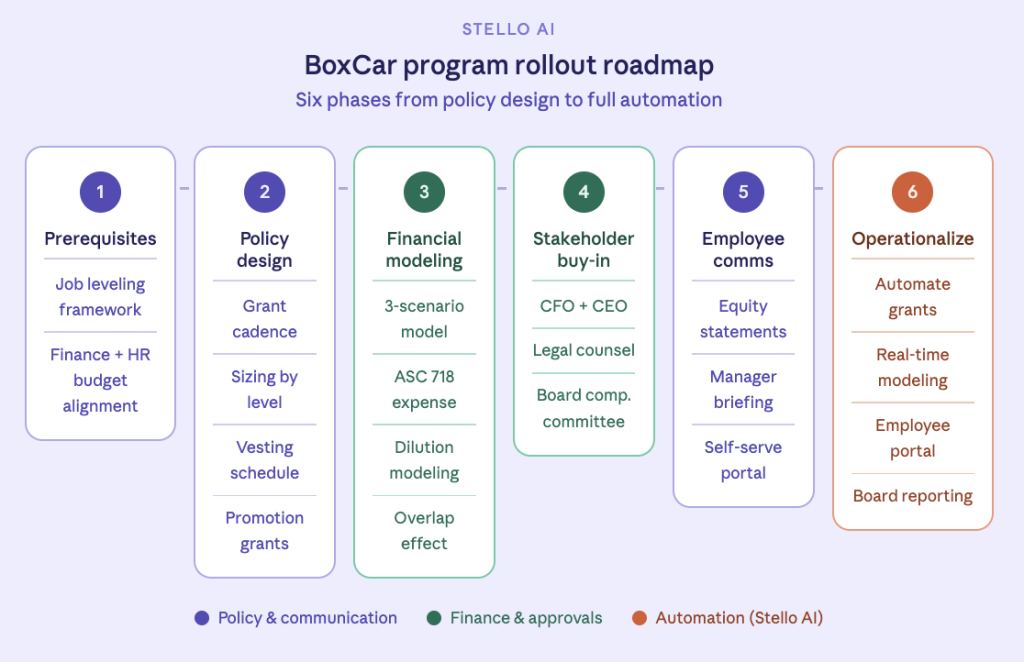
Phase 1: Establish the Prerequisites
Before you define a single grant amount or cadence, two foundational elements need to be in place. Skipping these is the most common reason BoxCar programs fail in practice.
Define Your Job Leveling Framework
BoxCar programs are only as consistent as the level structure beneath them. If your organization doesn’t have a clearly defined, documented leveling framework — with levels that map to scope, seniority, and compensation bands — grant sizing will default to manager judgment, which defeats the purpose.
If you already have a leveling framework, audit it first. Levels should be consistent across functions, reviewed by HR and Finance, and tied to compensation bands that have been approved at the executive level. BoxCar grant amounts will anchor to these levels, so any inconsistencies in the framework will surface immediately when the program launches.
If you don’t have a leveling framework, building one is a prerequisite — not a parallel workstream.
Align Finance and HR on Equity Budget
A BoxCar program is a multi-year commitment. Before defining grant sizes or cadences, Finance and HR need to agree on two things: the total annual equity budget available for refresh grants, and the acceptable dilution range per year.
These constraints should drive policy design, not the other way around. Starting with a desired grant size and reverse-engineering the budget is a common mistake that leads to programs that look generous on paper but are unsustainable over a three-to-five year horizon.
Run scenario models before committing. Model different cadence intervals (annual vs. biennial), grant sizing approaches (fixed amounts by level vs. percentage of initial grant), and headcount growth assumptions. The goal is a program that remains financially viable even in a hiring acceleration scenario.
Phase 2: Design the BoxCar Policy
With the foundational elements in place, you can define the actual program structure. A BoxCar policy has four core components.
Grant Cadence
Most companies issue BoxCar grants on a two-year cadence — meaning employees receive a refresh grant at the start of year two or three of their tenure, timed so that vesting on the new grant begins as the previous one reaches its midpoint or end. Annual cadences create higher administrative overhead and faster share pool consumption. Three-year cadences can leave retention gaps for high-performers who receive competitive offers mid-cycle.
A two-year cadence with a four-year vesting schedule on each grant is the most common structure and provides near-continuous vesting coverage for most employee tenures.
Grant Sizing by Level
Grant amounts should be expressed as a percentage of the employee’s initial new hire grant, differentiated by level. A typical structure might look like:
- Individual Contributor (Mid): 20–25% of initial grant per refresh cycle
- Individual Contributor (Senior): 25–30% of initial grant per refresh cycle
- Manager / Lead: 30–35% of initial grant per refresh cycle
- Director and above: 35–40% of initial grant, subject to executive review
These percentages are starting points, not prescriptions. The right numbers depend on your equity budget, dilution tolerance, and competitive market data. Benchmark against peer companies in your sector and stage before finalizing.
Vesting Schedule
The vesting schedule on BoxCar grants should mirror your standard grant structure — typically a one-year cliff followed by monthly or quarterly vesting over the remaining term. Deviating from your standard schedule creates confusion for employees and complexity for your equity management system.
One important decision: whether to apply a cliff to refresh grants at all. Some companies eliminate the cliff on refresh grants, arguing that the employee has already demonstrated commitment through their tenure. This is a reasonable position, but it has retention implications — cliff vesting on refresh grants creates an additional anchor point that reduces the incentive to leave in the first year of a new grant cycle.
Promotion and Off-Cycle Grants
BoxCar policy should also define how promotions are handled. The cleanest approach: promotion grants are issued at the time of promotion, sized according to the new level’s grant band, and run on their own vesting schedule independent of the existing refresh cadence. This keeps the BoxCar cadence intact while ensuring promotions are reflected meaningfully in equity.
Document the off-cycle grant policy explicitly. Leaving it undefined invites the same ad-hoc decision-making that BoxCar is designed to eliminate.
Phase 3: Model the Financial Impact
Before presenting the program for board or executive approval, Finance should produce a detailed multi-year model covering three scenarios: base case (current headcount growth), upside case (accelerated hiring), and downside case (hiring freeze).
Each scenario should project:
- Annual grant expense under ASC 718, accounting for fair value at grant date and amortization schedule
- Share pool consumption by year, showing cumulative dilution against the authorized share pool
- Refresh grant overlap — the period during which multiple grants are vesting simultaneously for tenured employees, which creates a temporary increase in per-employee equity expense
The overlap effect is one of the most frequently underestimated costs in BoxCar implementations. In the first two to three years of a program rollout, employees who were previously on a single grant schedule will begin accumulating multiple active grants. This is by design — it is the continuous vesting feature that makes BoxCar effective — but it needs to be modeled explicitly so Finance isn’t caught off guard when grant expense rises in year two.
Present the model with clear assumptions documented. Boards and compensation committees respond well to programs that are grounded in scenario analysis rather than single-point estimates.
Phase 4: Get Stakeholder Buy-In
A BoxCar program touches more stakeholders than most compensation changes. The finance and HR sign-off process should include:
CFO and Finance team — budget approval, dilution sign-off, ASC 718 treatment confirmation with your auditors.
CEO and executive team — alignment on compensation philosophy, particularly the shift from discretionary to policy-driven refresh decisions. This is a cultural change as much as a financial one. Executives accustomed to using equity as a bespoke retention lever will need to understand why consistency is a feature, not a constraint.
Legal and Equity counsel — review of grant documentation, plan document amendments if required, and confirmation that the new structure is consistent with your equity incentive plan.
Board Compensation Committee — formal approval of the program, including grant sizing ranges, cadence, and total share pool impact.
Plan for two to three rounds of review. The first presentation should focus on the rationale and policy framework. The second should present the financial model. Approval typically comes in the third meeting, after any outstanding questions on dilution or budget impact have been addressed.
Phase 5: Communicate to Employees
How you communicate the BoxCar program to employees is as important as the program itself. The goal is to shift equity from a source of anxiety to a source of confidence — and that requires clarity, not complexity.
Every employee should receive a personalized equity statement that shows: what they currently hold and what is vesting, when their next BoxCar grant is scheduled and at what approximate size, and how a promotion would affect their equity trajectory.
Avoid sending a company-wide policy document and calling it communication. Employees don’t want to read a policy — they want to understand their equity picture. Personalized statements, delivered through a self-serve portal or in a one-on-one with their manager, convert a policy change into a tangible benefit.
Managers should be briefed before the company-wide announcement and equipped with talking points. The most common employee questions will be: why is this changing, is my existing grant affected, and when do I get my next grant. Managers who can answer those three questions confidently will handle 90% of the follow-up.
Phase 6: Operationalize and Automate
A BoxCar program running across 100 or more employees cannot be managed in spreadsheets. The overlapping grant schedules, level-based sizing rules, vesting calculations, and employee-facing reporting create a volume of operational complexity that manual processes cannot sustain accurately.
Purpose-built equity management tooling — like Stello AI — handles the full BoxCar lifecycle: maintaining the grant schedule by employee and level, triggering issuance at the right cadence, modeling budget and dilution in real time as headcount changes, and generating the personalized employee equity statements that make the program visible and meaningful.
The operational investment in tooling pays back quickly. Finance teams that previously spent days on equity reconciliation and grant modeling can redirect that time to higher-value work. HR teams that fielded constant refresh inquiries from managers can point employees to a self-serve equity dashboard instead.
A Note on Transition
If your company is moving from a traditional refresh model to BoxCar, the cleanest approach is a go-forward transition: existing grants continue on their original schedule, and all new grants — including any refreshes issued after the program launch date — follow the BoxCar structure.
Retroactively restructuring existing grants is legally complex, operationally burdensome, and rarely worth the effort. The benefits of BoxCar accrue over time as the tenured employee population shifts to the new structure. Within two to three years of launch, the majority of active grants in your pool will be BoxCar-structured.
The Bottom Line
Rolling out a BoxCar program is a meaningful operational undertaking. It requires leveling infrastructure, financial modeling rigor, multi-stakeholder alignment, and disciplined employee communication. Done correctly, it replaces one of the most chaotic and reactive elements of your compensation architecture with a system that is predictable, defensible, and genuinely effective at retaining the people you most want to keep.
The companies that get it right don’t treat BoxCar as an HR project. They treat it as a finance transformation — because that is what it is.