Every percentage point of avoidable employee turnover costs the average 1,000-person company over $1 million annually. Yet most compensation teams are still making the budget decisions that drive those numbers inside a spreadsheet built in 2019. The problem isn’t effort or expertise — it’s infrastructure. AI-powered compensation budgeting solutions are changing that, with Stello AI leading the transformation.
TL;DR
- ✓ Compensation teams waste up to 70% of their time on manual data work — not strategy. AI fixes the infrastructure problem, not the people problem.
- ✓ Traditional tools calculate. AI-native platforms like Stello recommend — flagging misallocations, equity risks, and reallocation opportunities in real time.
- ✓ 5–15% of the average compensation budget is misallocated every year. For a $50M payroll, that’s up to $7.5M making less impact than it should.
- ✓ Pay equity analysis should be embedded in the budgeting workflow, not a separate audit after decisions are made — otherwise it’s too late to act within budget.
- ✓ Real-world results: a 500-person tech company cut budget admin time by 75% and identified $430K in reallocation opportunities. A 5,000-person firm saved $2.1M and reduced unexplained pay gaps by 40%.
- ✓ Implementation works best in phases — start with merit, expand to bonus and equity. Change management matters more than the tech choice.
The Evolution of Compensation Budgeting
Compensation budgeting has traditionally been a labor-intensive process:
- The Spreadsheet Era: Complex Excel workbooks with intricate formulas, pivot tables, and multiple versions circulating over email
- The Basic Software Phase: First-generation compensation tools that digitized processes but lacked intelligence
- Today’s AI Revolution: Intelligent systems that don’t just calculate but actively think and recommend
This evolution has been necessary as organizations face growing complexity in compensation planning, including:
- Managing diverse compensation elements (base salary, bonuses, equity, benefits)
- Addressing pay equity and pay transparency concerns
- Adapting to rapidly changing market conditions
- Balancing competing priorities with limited resources
- Meeting evolving regulatory requirements across jurisdictions
Why This Evolution Matters Now
The stakes have never been higher. According to industry research, the cost of employee turnover typically ranges from 50% to 200% of an employee’s annual salary. When compensation decisions are misaligned with market rates or internal equity standards, organizations don’t just lose budget efficiency — they lose people. The financial ripple effect of poor compensation planning can dwarf the cost of the technology investments required to fix it.
At the same time, the sheer volume of compensation decisions has grown. A mid-size company with 1,000 employees conducting an annual merit cycle may need to make thousands of individual allocation decisions, each with interdependencies across teams, roles, performance ratings, and pay bands. No human team can process these simultaneously with full context — but AI can.
Also read: AI HR Agents for Remote & Distributed Teams
Why Traditional Budgeting Methods Fall Short
Traditional compensation budgeting approaches create several critical challenges:
Disconnected Data and Systems
HR teams typically juggle multiple systems — HRIS platforms, payroll systems, performance management tools — leading to data silos and integration headaches. Data from these systems is rarely synchronized in real time, meaning compensation analysts are often working from snapshots that are days or weeks old. When a headcount change happens in Workday, it may not propagate to the compensation planning model until someone manually exports and reconciles. This lag introduces errors and erodes trust in the numbers.
Limited Scenario Planning
Excel-based processes make running multiple budget scenarios tedious and error-prone, often limiting the exploration of alternative approaches. A typical team might build one or two scenarios — a “base case” and a “stretch case” — because creating more is prohibitively time-consuming. This constraint means organizations routinely make major compensation decisions without ever stress-testing them against realistic alternatives.
Reactive Rather Than Proactive
Traditional tools provide calculations but offer little guidance on optimization opportunities or potential issues. They answer the question “what is the current state?” but cannot answer “what should we do?” or “what will happen if we do X?” This reactive posture means compensation leaders are perpetually in catch-up mode, discovering problems after decisions have already been made.
Time-Intensive Manual Processes
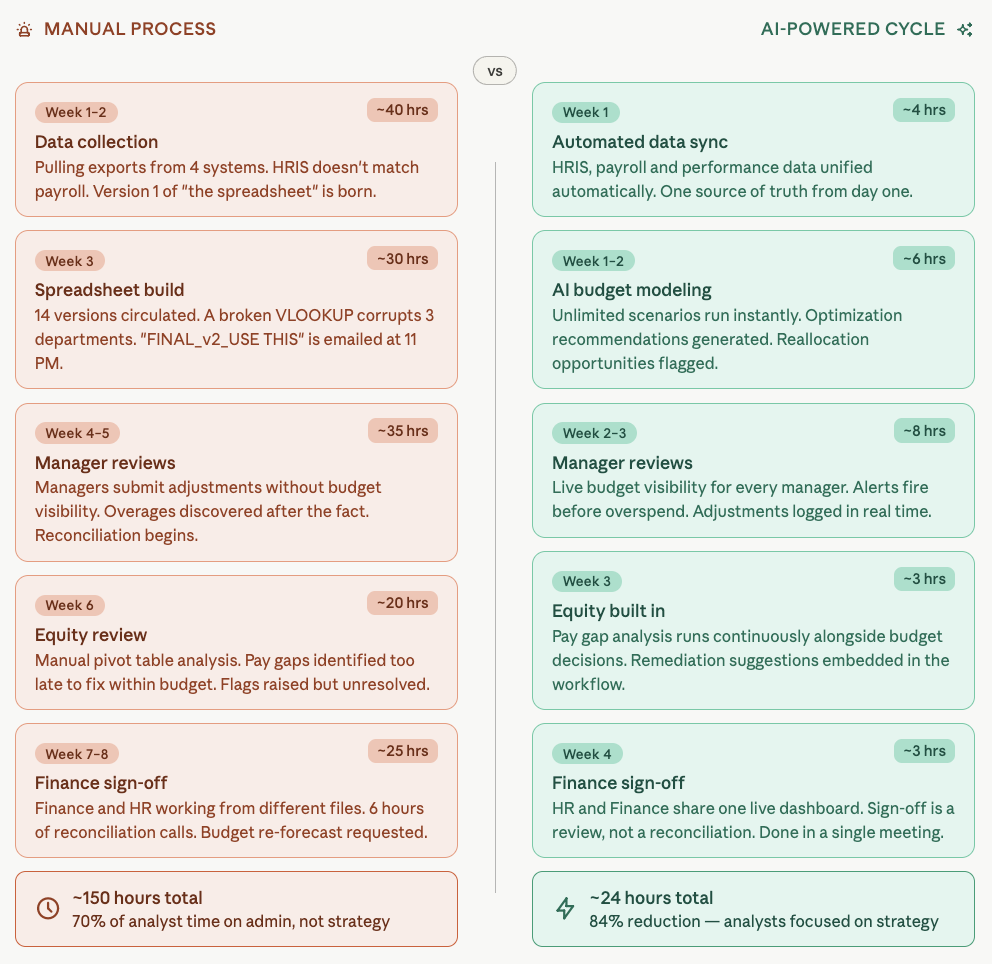
Compensation professionals report spending up to 70% of their time on manual data manipulation rather than strategic analysis. The actual intellectual work — interpreting equity gaps, advising business partners, modeling retention risk — is consistently crowded out by data wrangling. This is not just an efficiency problem; it is a talent problem. Skilled compensation professionals are hired for their judgment and expertise, not their Excel proficiency.
Lack of Real-Time Visibility
Budget utilization tracking often happens after decisions are made, creating the risk of overspending or inefficient allocation. Without live visibility, managers approve adjustments assuming budget is available, only to discover later that the pool was already exhausted in another part of the organization. These surprises erode relationships between HR, Finance, and business leaders, and create the perception that the compensation function lacks rigor.
The Hidden Cost of Manual Errors
Manual processes also introduce a category of risk that is rarely quantified: data entry and formula errors. A misplaced decimal, a broken VLOOKUP, or an outdated range reference can silently corrupt an entire compensation cycle. These errors may go undetected until employees receive incorrect offers or adjustments, creating legal exposure and trust damage that is difficult to repair.
Also read: Best HRIS Software in 2026: How to Evaluate Options
The AI Difference in Compensation Budgeting
AI-powered platforms like Stello AI are fundamentally changing the compensation budgeting landscape by bringing intelligence to what was previously just calculation.
From Calculation to Intelligence
The most significant difference between traditional budgeting tools and AI-native platforms is the shift from passive calculation to active intelligence. An AI-native compensation budgeting solution doesn’t just process the numbers you input — it analyzes patterns, identifies optimization opportunities, and generates recommendations.
Consider the difference:
- Traditional Tool: Shows you that your merit budget is $1.2M based on your inputs
- AI-Native Platform: Suggests that by reallocating $200K from one department to another, you could resolve pay gaps while staying within budget
This shift is not merely cosmetic. It represents a fundamentally different theory of how compensation decisions get made. In the traditional model, the system is a passive instrument and the human is the analyst. In the AI-native model, the system is an active collaborator — surfacing insights, flagging risks, and narrowing the solution space so that human judgment can be applied where it matters most.
How the AI Engine Actually Works
Understanding the mechanics behind AI-powered compensation recommendations helps clarify why they are more reliable than manual analysis alone.
Modern compensation AI systems typically operate across several layers:
Data integration and normalization: The platform ingests data from HRIS, payroll, performance management, and market data providers. Before any analysis can occur, this data must be normalized — converting different job title conventions to standard job families, reconciling conflicting effective dates, and handling missing values in a principled way. This is unglamorous but essential work.
Market benchmarking: The system continuously compares internal pay levels to external market data from providers like Radford, Willis Towers Watson, or Mercer. Rather than applying static survey data once per year, modern AI platforms can weight market data by geography, industry, company size, and role level — and can flag when market conditions shift mid-cycle.
Equity modeling: The system runs statistical analyses to identify unexplained pay disparities — differences in compensation that cannot be accounted for by legitimate factors like tenure, performance, location, or job level. Critically, it distinguishes between raw pay gaps (which may reflect legitimate differences) and adjusted gaps (which represent true equity concerns).
Optimization algorithms: Given a fixed budget envelope, the system searches for allocation strategies that maximize defined objectives — improving market competitiveness, reducing equity gaps, retaining high performers — while respecting constraints like organizational hierarchy, merit matrix guidelines, and approval workflows.
Recommendation generation: The system translates optimization outputs into human-readable recommendations, with plain-language explanations and projected impact estimates. This is where the interface between machine intelligence and human judgment becomes most important — the recommendations must be interpretable enough for a compensation professional to evaluate and accept or reject with confidence.
Also read: AI-Powered Employee Management: What’s Changed and What Hasn’t
Dynamic Multi-Factor Analysis
Modern compensation involves complex interrelationships between base pay, bonuses, equity, and other components. AI systems excel at handling this complexity through:
Multivariable optimization: Simultaneously considering multiple factors like performance, market position, internal equity, and budget constraints. A human analyst managing a 2,000-person merit cycle might be able to hold three or four variables in mind at once. An AI system can optimize across dozens simultaneously.
Pattern recognition: Identifying trends and anomalies that humans might miss when managing thousands of compensation decisions. For example, the system might detect that employees in a particular manager’s team are systematically underpaid relative to peers in similar roles — a pattern that would be nearly invisible in a manual review.
Predictive modeling: Forecasting the impact of different allocation strategies on key metrics like retention, engagement, and pay equity. Rather than asking “what is the pay gap today?”, predictive models answer “if we implement this merit allocation, what will the pay gap look like six months from now?”
Introducing Stello AI’s Budgeting Module
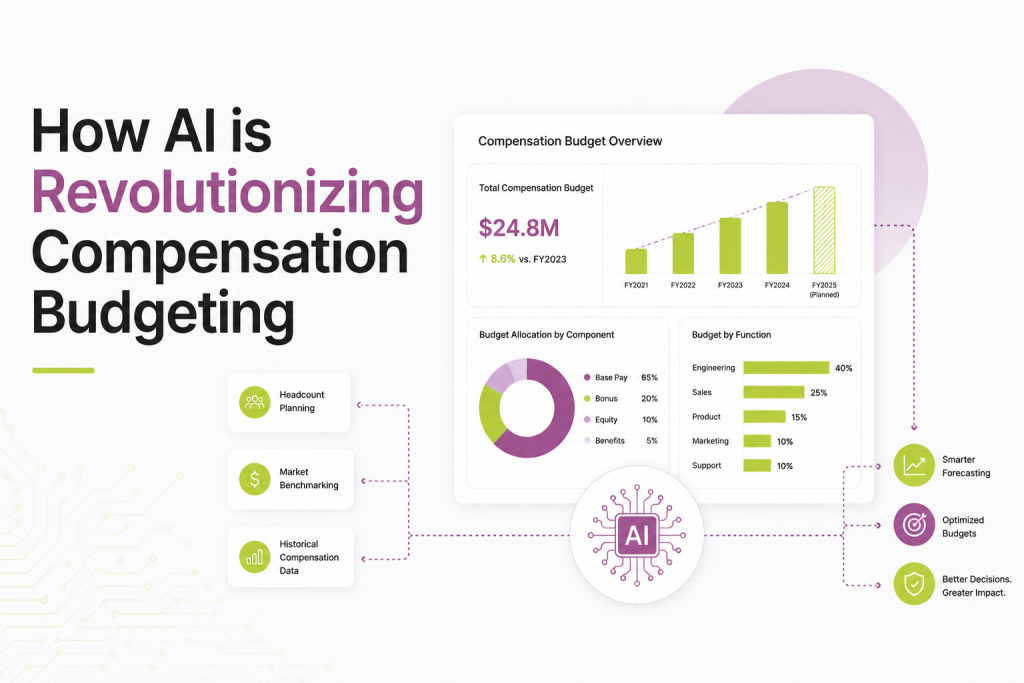
Stello AI has developed an AI-native budgeting module specifically designed to address these challenges. Unlike traditional compensation tools, Stello’s platform doesn’t just calculate — it thinks.
Key Capabilities
1. Intelligent Budget Optimization
The system proactively identifies opportunities to optimize budget allocation by:
- Analyzing current compensation distribution patterns
- Identifying areas where spending may be inefficient or inequitable
- Generating specific recommendations to reallocate funds for maximum impact
The optimization engine accounts for both hard constraints (total budget, approval thresholds, grade boundaries) and soft constraints (manager preferences, team stability, organizational culture). This means recommendations are not just mathematically optimal — they are practically actionable.
2. Dynamic Scenario Planning
Stello AI enables compensation teams to:
- Run unlimited what-if scenarios across base, bonus, and merit simultaneously
- Compare different allocation strategies side-by-side
- Understand the downstream implications of budgeting decisions
Scenario planning in Stello AI is not just about running numbers faster. The platform maintains a full audit trail for each scenario, allowing teams to trace the lineage of any decision back to the assumptions and data that drove it. This is critical for governance and for explaining decisions to senior leadership or regulators.
3. Real-Time Budget Visibility
The platform provides:
- Live tracking of fund utilization as decisions are made
- Automatic alerts when approaching budget thresholds
- Comprehensive dashboards showing allocation patterns across the organization
Real-time visibility transforms the relationship between HR and Finance. Instead of periodic reconciliation conversations, the two functions can operate from a shared source of truth. Finance can see, in real time, how the compensation budget is being deployed — and HR can make adjustments proactively rather than reactively.
4. Pay Equity Integration
Rather than treating pay equity as a separate concern, Stello AI:
- Automatically analyzes budgeting decisions for potential equity impacts
- Recommends adjustments to improve equity while respecting budget constraints
- Tracks equity metrics before and after budget implementation
This integration is particularly important given the accelerating pace of pay equity legislation. States and countries around the world are enacting pay transparency and pay equity requirements, and organizations that treat equity as an afterthought will find themselves exposed. By embedding equity analysis directly into the budgeting workflow, Stello AI makes compliance a byproduct of the normal planning process rather than a separate audit exercise.
5. Intelligent Recommendations
The system goes beyond passive reporting to actively suggest improvements, for example:
- “Reducing allocation in Department X by 0.5% would allow for critical adjustments in Department Y”
- “Based on performance distribution, reallocating $120K from merit to targeted adjustments would have greater impact”
- “Current allocation will widen the gender pay gap in engineering; consider this alternative approach”
Each recommendation includes a confidence score, a plain-language rationale, and a projected impact estimate — giving compensation professionals the context they need to evaluate and act on suggestions efficiently.
Real-World Impact: How Companies Are Using AI for Compensation Budgeting
Organizations implementing AI-powered budgeting solutions like Stello AI are seeing significant benefits:
Case Study: Mid-Size Technology Company
A 500-employee software company replaced their Excel-based process with Stello AI’s budgeting module and experienced:
- 75% reduction in time spent on budget administration
- Identification of $430,000 in potential reallocation opportunities
- Improved pay equity metrics without increasing overall budget
The compensation team reported that the most significant benefit was not the time savings, but the shift in the nature of their work. Instead of spending cycles building and checking spreadsheets, they spent their time on strategic conversations with business partners — explaining recommendations, facilitating trade-off discussions, and advising on talent risk.
Case Study: Enterprise Financial Services Firm
A 5,000-employee financial services organization leveraged Stello AI to:
- Run 12 different budget scenarios in the time it previously took to create one
- Reduce unexplained pay gaps by 40% through intelligent budget allocation
- Save approximately $2.1M through more efficient compensation distribution
For this organization, the pay equity improvement was the headline outcome. The firm had been aware that pay gaps existed but lacked the analytical infrastructure to systematically address them within the constraints of a fixed budget. Stello AI’s optimization engine identified reallocation strategies that meaningfully reduced gaps without requiring additional spend — a result that would have been nearly impossible to achieve through manual analysis.
The ROI Framework: Quantifying the Value of AI-Powered Budgeting
Organizations considering AI budgeting tools benefit from a structured ROI analysis. The value case typically has four components:
1. Direct Labor Savings
If a compensation team of five analysts each spends 60% of their time on administrative budget tasks, and each analyst costs $120,000 per year in fully loaded compensation, the team is spending $360,000 annually on work that could be automated. Even a 50% reduction in administrative burden would free $180,000 in capacity — more than enough to justify most platform investments.
2. Budget Optimization Value
Most organizations find that 5-15% of their compensation budget is sub-optimally allocated — either concentrated in areas with low retention risk, misaligned with market data, or perpetuating historical inequities. For a company spending $50M on compensation, even a 5% improvement in allocation efficiency represents $2.5M in realized value.
3. Risk Mitigation
The cost of pay equity litigation, regulatory fines, and reputational damage from pay gap disclosures can be substantial. While difficult to quantify precisely, the defensive value of proactive equity management is real and increasingly important as pay transparency laws proliferate.
4. Talent Retention
Perhaps the most significant but least-measured value driver is the impact of better compensation decisions on employee retention. When high performers are compensated competitively and internal equity is maintained, voluntary turnover decreases. Given that replacing a mid-level employee typically costs 50-100% of their annual salary, even modest improvements in retention among key talent segments generate significant financial returns.
Implementation Considerations: Moving to AI-Powered Budgeting
For organizations considering the shift to an AI-native budgeting solution like Stello AI, several factors can ensure successful implementation:
Data Readiness
While AI platforms can work with imperfect data, having basic compensation information organized will accelerate implementation. The most common data gaps that slow implementations are:
- Inconsistent job architectures (different titles for the same role, or the same title for different roles)
- Missing or stale market data mappings
- Incomplete performance ratings or proxy data
- Fragmented historical compensation records across HRIS migrations
A brief data audit before implementation — not a months-long data cleansing project — is typically sufficient to identify and address these gaps.
Change Management
Shifting from spreadsheets to an intelligent system represents a change in how compensation decisions are made; proper communication and training are essential. The most common point of resistance is among experienced compensation analysts who have built personal expertise in Excel-based workflows. It is important to frame the transition not as a replacement of their expertise, but as an amplification of it — the AI handles the computation so they can focus on the judgment.
Business partners (HRBPs, managers, Finance) also need to understand the new process. If managers are accustomed to receiving a spreadsheet and returning it with adjustments, they need to understand how the new workflow operates and what has changed about their role in it.
Integration Strategy
Consider how the budgeting module will connect with existing HRIS, performance management, and financial systems. Modern AI platforms like Stello AI offer pre-built connectors for major HRIS systems (Workday, SAP SuccessFactors, Oracle HCM) and can ingest data via API or secure file transfer. The integration design should address both the initial data load and the ongoing synchronization model — how often data refreshes, how conflicts are resolved, and who owns the integration maintenance.
Governance and Controls
Introducing AI into compensation decisions requires clear governance frameworks. Who can accept or override AI recommendations? What decisions require human review regardless of AI confidence? How are recommendations documented for audit purposes? Establishing these protocols before go-live prevents confusion and ensures accountability.
Phased Approach
Many organizations successfully implement AI budgeting in phases, starting with one compensation element (like merit increases) before expanding to others. A typical phased roadmap might look like:
- Phase 1 (Month 1-3): Merit budget planning with AI optimization and real-time visibility
- Phase 2 (Month 4-6): Bonus and incentive planning integration
- Phase 3 (Month 7-12): Equity compensation planning and full pay equity audit integration
- Phase 4 (Ongoing): Predictive analytics and continuous market benchmarking
Common Pitfalls and How to Avoid Them
Organizations implementing AI compensation tools encounter predictable challenges. Understanding them in advance significantly improves outcomes:
Over-relying on AI recommendations without human review
AI recommendations are a starting point, not a final answer. They reflect the patterns and priorities encoded in the system’s training data and configuration. A recommendation to reallocate budget from one department to another may be mathematically sound but organizationally infeasible for reasons the system cannot see — a planned reorg, a key leader departure, a product pivot. Human judgment remains essential.
Underinvesting in data quality
AI systems amplify whatever is in the data. If historical compensation data encodes biases — systematically lower salaries for certain demographic groups, for example — the AI will replicate and potentially reinforce those patterns unless the system is explicitly designed to detect and correct for them. Organizations should audit their compensation data for bias before and after implementation.
Treating implementation as an IT project
Successful AI budgeting implementations are led by compensation and HR leadership, not IT. The technology decisions matter less than the process design, change management, and governance decisions — all of which require domain expertise and organizational authority that lives in HR.
Neglecting ongoing model maintenance
AI models need to be recalibrated as organizations change. A model trained on pre-pandemic compensation data may generate recommendations that are poorly suited to current market conditions. Platforms like Stello AI build continuous calibration into their architecture, but organizations should understand how their vendor approaches model maintenance and what their role is in the process.
The Future of AI in Compensation Budgeting
As AI technology continues to evolve, compensation budgeting tools like Stello AI are expanding their capabilities:
Predictive Analytics
Future systems will move beyond analyzing current data to predicting outcomes like:
- Retention risk modeling: Identifying employees who are at elevated flight risk based on compensation positioning relative to market, combined with signals like tenure, performance trajectory, and internal mobility patterns
- Market movement forecasting: Predicting where market rates for specific roles will be in 6-12 months, enabling organizations to stay ahead of compression rather than react to it
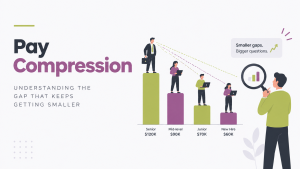
- Compression early warning: Flagging emerging compression situations — where new hire salaries are approaching or exceeding those of experienced employees — before they become acute retention problems
Natural Language Interfaces
Advanced systems will allow compensation professionals to interact with budgeting tools through conversational queries:
- “What would happen if we increased the engineering budget by 2%?”
- “Show me where we have the biggest pay gaps that could be addressed within budget”
- “Which departments could benefit most from reallocation?”
This shift from form-based interfaces to conversational interfaces dramatically lowers the barrier to sophisticated analysis. A business leader who could never navigate a traditional compensation analytics tool can ask a plain-language question and receive a structured answer — democratizing access to compensation intelligence.
Automated Regulatory Compliance
As pay transparency and equity legislation continues to evolve, AI systems will automatically ensure budgeting decisions maintain compliance with changing requirements. This includes jurisdictional awareness (different rules apply in Colorado versus the EU versus the UK), automatic generation of required disclosures, and audit-ready documentation of how compensation decisions were made and what equity impacts were assessed.
Integration with Total Rewards Optimization
The next frontier beyond compensation budgeting is total rewards optimization — modeling the combined value of salary, benefits, equity, flexibility, and other components as a single portfolio. AI systems will help organizations understand how to achieve competitive total rewards positioning not by maximizing every element, but by allocating across elements in ways that match the preferences of different employee segments.
Conclusion: The Competitive Advantage of AI-Powered Budgeting
In today’s competitive talent landscape, organizations that leverage AI for compensation budgeting gain significant advantages:
- Strategic Allocation: Ensuring limited resources go where they’ll have the greatest impact on retention, equity, and competitiveness
- Time Efficiency: Allowing compensation teams to focus on strategy rather than administration — shifting from operators to advisors
- Data-Driven Decisions: Moving beyond gut feelings to evidence-based compensation practices with clear audit trails
- Improved Outcomes: Achieving better results for both the organization and its employees, measurable in retention, equity metrics, and budget efficiency
- Risk Reduction: Proactively managing pay equity and compliance risk rather than discovering problems after the fact
As companies face increasing pressure to optimize compensation spending while ensuring fair, competitive pay, solutions like Stello AI’s budgeting module represent not just an improvement over traditional methods, but a fundamental transformation in how compensation budgeting works.
The organizations that will win the competition for talent in the coming decade are those that treat compensation not as a cost to be minimized but as an investment to be optimized. AI-powered budgeting platforms are the infrastructure that makes optimization at scale possible — translating compensation strategy into precise, equitable, defensible decisions across every level of the organization.
By leveraging AI that doesn’t just calculate but actively thinks and recommends, forward-thinking compensation teams are gaining a significant edge in the ongoing competition for talent.
Ready to transform your compensation budgeting process with AI? Visit Stello AI to learn more about their intelligent budgeting module designed specifically for modern compensation teams.