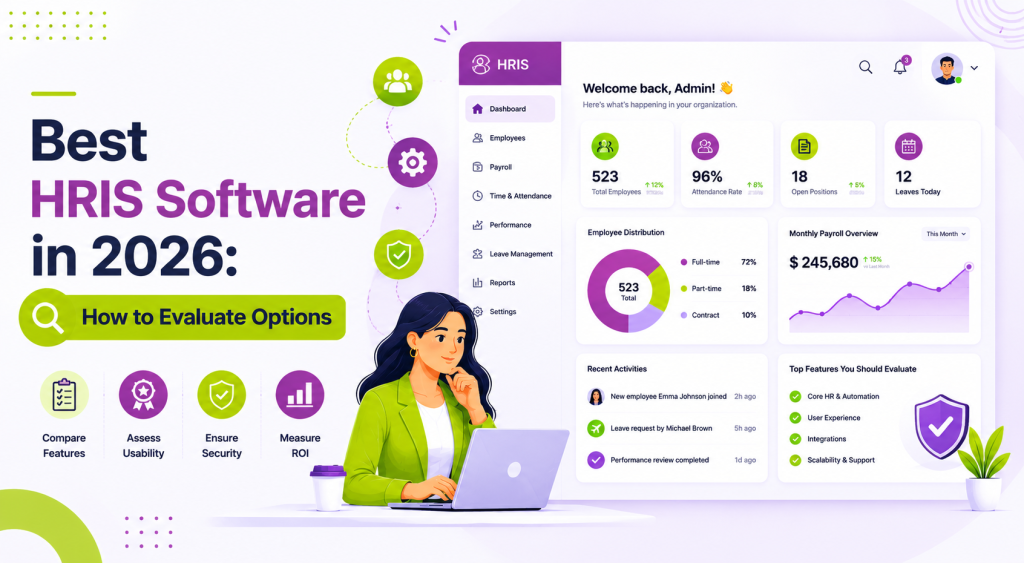
Choosing the best HRIS software in 2026 is harder than it was three years ago — not because there are fewer options, but because the category itself has shifted. Platforms that were pure systems of record are now positioning themselves as intelligent HR engines. Vendors are racing to bolt AI onto every module. And HR leaders are being asked to make a technology bet that will shape how their teams operate for the next five to seven years.
The good news: a structured evaluation framework still works. The catch: you need to update that framework for what AI actually changes — and what it doesn’t.
⚡ TL;DR
- The old HRIS checklist (modules, features, price) still applies — but it misses the more important question: does the system make your team more capable over time?
- Core modules still matter: employee records, payroll accuracy, leave, ATS data flow, performance, and self-service analytics are now baseline expectations, not premium features.
- There are two types of “AI HRIS” — AI as a wrapper (chatbot on top of old software) and AI embedded in workflows. Only the second one changes what HR teams can actually do.
- The sharpest AI gap is in compensation: real-time pay equity flags, market benchmarking in the planning cycle, and budget scenario modeling — most platforms still don’t do this well.
- Use a 5-step evaluation: audit pain points → map integrations → test with real data → evaluate the data model → run stakeholder sessions including employees.
- Vendor fit depends on company size: Rippling and HiBob lead mid-market; Workday and SAP SuccessFactors for enterprise; Lattice and Rippling for fast-growing teams.
- The question that cuts through every demo: “Does this system make my HR team more capable — or just faster?”
Why the Old HRIS Evaluation Checklist Falls Short
The traditional way to evaluate HRIS software looked something like this: list your modules (payroll, attendance, ATS, performance), score vendors on feature coverage, check integration compatibility, negotiate pricing. Done.
That approach still covers the basics. But it misses the more important question in 2026: how does the system make your HR team faster and smarter over time?
A platform with 95% feature coverage but brittle data architecture will hold you back the moment you try to run meaningful workforce analytics. A platform with a slick AI chatbot but no structured compensation data underneath it produces confident-sounding answers that are wrong. The evaluation criteria haven’t disappeared — they’ve deepened.
Also read: AI-Powered Employee Management: What’s Changed and What Hasn’t
The Core Modules Still Matter (Here’s What to Actually Assess)
Before you get to the AI layer, the fundamentals need to be solid. Here’s what to probe in each core area:
Employee Records & Core HR Database This is the foundation everything else sits on. Ask: how is data structured? Can you create custom fields without engineering support? How does the system handle multi-entity or multi-country employee records? A weak core database creates data quality problems that no AI layer can fix downstream.
Payroll Evaluate accuracy, run frequency flexibility, compliance update cadence, and error handling. Payroll errors erode employee trust faster than almost any other HR failure. If the vendor can’t show you their compliance update process — how quickly tax tables and statutory changes are reflected — walk away.
Leave & Attendance Look for configurable leave policies, integration with payroll, and manager visibility. The question that separates good from great: can a manager approve a leave request, see team coverage, and flag a potential overtime issue in a single workflow?
Recruitment & ATS Assess how candidate data flows into employee records after hire. A surprising number of HRIS platforms still require manual re-entry at the offer stage — a friction point that creates data inconsistencies from day one.
Performance Management Can you run continuous feedback cycles, not just annual reviews? Can the system connect performance data to compensation decisions? This linkage matters more than most vendors acknowledge.
Analytics & Reporting The bar here has risen significantly. Self-service reporting — where an HR business partner or CFO can answer workforce questions without building a report from scratch — is now a baseline expectation, not a premium feature. If your current system requires an IT ticket to pull attrition by department, that’s a red flag.
Also read: AI Agent vs. HRIS: Do You Replace, Integrate, or Layer?
What AI Actually Changes About This Decision
This is where 2026 is genuinely different. There are two types of “best HRIS software” on the market right now, and conflating them is a costly mistake.
Type 1: AI as a wrapper. The underlying platform is the same as it was in 2022. A conversational interface has been added on top. You can ask questions in natural language, and the system surfaces what it would have surfaced through a menu click. Useful for user adoption. Not transformative.
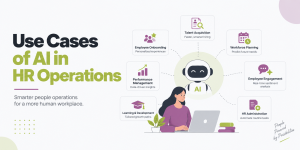
Type 2: AI embedded in workflows. The AI operates on structured data across modules to surface insights that weren’t previously visible — retention risk flags, compensation equity gaps, headcount scenario modeling, policy questions answered from live compliance data. This is the version that changes what HR teams can actually do.
The practical test: ask the vendor to show you an AI feature that changed a decision, not just answered a question. Can the platform tell you which employees are statistically most likely to leave in the next 90 days based on compensation data, tenure, and manager engagement scores — and then surface a recommended action? That’s embedded AI. A chatbot that summarizes the parental leave policy is not.
Also read: 6 Types of AI Agents Used in HR + Use Case for Each
The Compensation Intelligence Gap
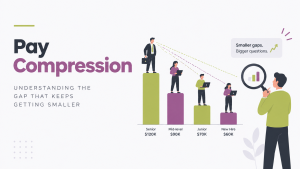
One area where AI creates the sharpest division between platforms is compensation. Most HRIS tools store compensation data. Very few do anything intelligent with it.
In 2026, leading platforms are beginning to offer:
- Real-time pay equity analysis — flagging unexplained gaps by gender, ethnicity, or role level during the comp planning cycle, not after it closes
- Market benchmarking integration — pulling external salary data into compensation workflows so managers make offers with current context, not last year’s bands
- Budget scenario modeling — letting finance and HR run “what if” analyses on merit cycles before numbers are locked
If compensation is a pain point at your organization — and it is at most companies above 100 employees — this is the AI capability worth prioritizing. A platform that automates scheduling but can’t answer “are we paying our mid-level engineers competitively?” is solving the wrong problem.
A Practical Evaluation Framework for 2026
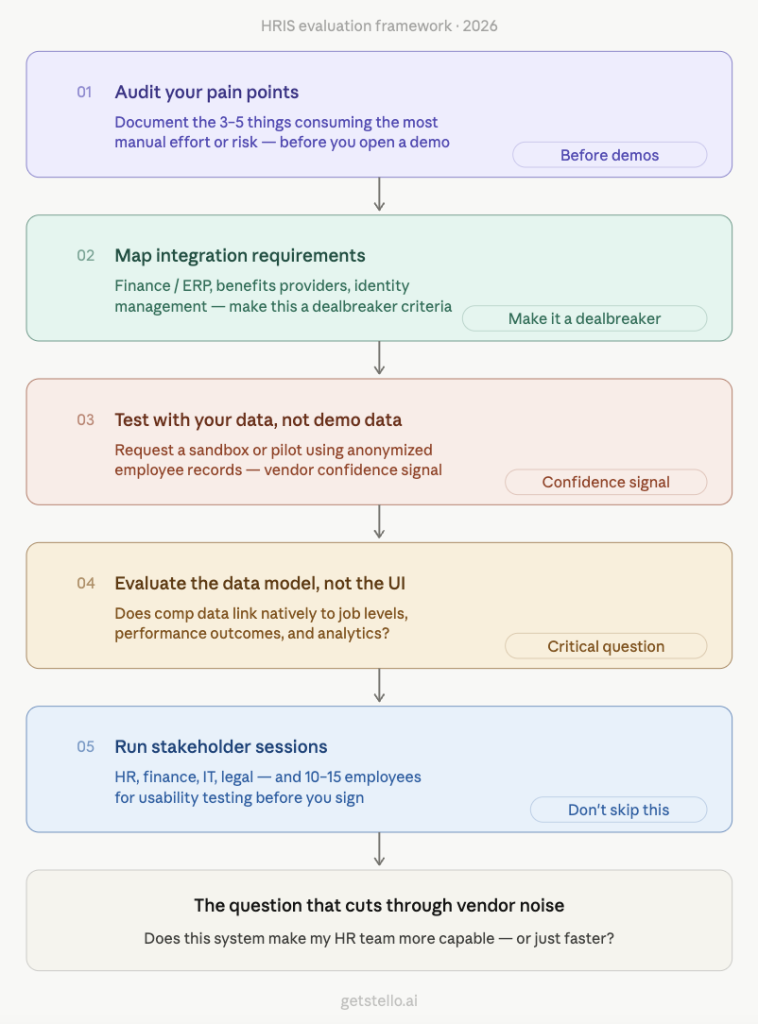
Use this structure to move from vendor shortlist to the best HRIS software:
Step 1: Audit your actual pain points, not your wish list. Before you open a single demo, document the three to five things that consume the most manual effort or create the most risk in your current HR operation. Payroll reconciliation? Annual comp planning? Attrition reporting? These become your primary evaluation criteria. A platform that solves your actual problems at 80% feature coverage beats one that covers everything at 60% of what you need.
Step 2: Map your integration requirements early. The most common implementation failure isn’t poor adoption — it’s broken data flows. Map how your HRIS needs to connect with your finance/ERP system, your benefits providers, and your identity management layer before you evaluate vendors. Make integration a dealbreaker criteria, not a post-selection discovery.
Step 3: Test the AI with your data, not demo data. Ask vendors for a sandbox environment or a structured pilot using anonymized data from your organization. AI features that look impressive on curated demo data often degrade significantly on messy, real-world employee records. The vendors confident enough to run a real pilot are telling you something.
Step 4: Evaluate the data model, not just the interface. The most important question you can ask in a technical evaluation: how is compensation data structured relative to job architecture? If the answer is vague, or if the system can’t natively link pay grades to role levels to performance outcomes, you’re looking at a platform that will hit a ceiling as your organization grows.
Step 5: Involve the right stakeholders — including employees. HR leaders, finance, IT, and legal all have legitimate interests in the evaluation. But the single most underweighted input is from individual contributors and managers who will use the system daily. Adoption failure is almost always a UX failure. Run structured usability sessions with 10 to 15 employees before you sign.
The Vendors Worth Evaluating in 2026
The market has consolidated somewhat, but meaningful differentiation still exists across segments:
For mid-market companies (100–2,000 employees): Workday, Rippling, and HiBob lead on breadth. Rippling’s unified workforce platform has genuine integration depth. HiBob remains strong on employee experience and manager enablement. ChartHop is worth serious consideration if workforce planning and org design are primary use cases.
For fast-growing startups and scale-ups: Rippling and Lattice have the most momentum. Both have invested heavily in AI features that are actually embedded in workflows rather than surfaced as add-ons.
For enterprise: Workday and SAP SuccessFactors are the default choices, and for good reason — depth of compliance tooling, global payroll coverage, and integration ecosystems are unmatched. The tradeoff is implementation complexity and cost.
For compensation-specific intelligence: Most best HRIS software handle compensation as a module within a broader system. If compensation accuracy, equity analysis, and planning cycle efficiency are primary concerns, evaluate whether a specialized layer — purpose-built for compensation decisions rather than bolted on — delivers better outcomes than the compensation module inside your HRIS of choice.
The Question That Cuts Through the Noise
Every vendor in 2026 will show you an AI roadmap. Most of them will show you the same five features: resume screening, self-service chatbots, sentiment analysis, workforce analytics, and onboarding automation. These are table stakes now.
The question that separates the platforms worth your investment from the ones that will disappoint you in 18 months: does this system make my HR team more capable over time, or does it just make existing tasks slightly faster?
Faster is incremental. More capable is strategic. In a market where HR is increasingly asked to answer questions about retention, equity, and workforce planning that used to require a consultant, the HRIS that earns its place at the leadership table is the one that turns your people data into decisions — not just reports.
That’s the evaluation frame worth holding onto when the demos start.