Every HR leader eventually hits the same wall. Their HRIS holds years of employee data, runs payroll without a hiccup, and keeps the compliance team from having a breakdown — but it can’t answer a manager’s question at 10 PM, can’t draft a performance improvement plan, and definitely can’t tell you why attrition is quietly spiking in your operations team.
Then an AI agent enters the conversation. Suddenly the question isn’t whether AI belongs in HR — it’s how it fits alongside the systems you already have.
Replace? Integrate? Layer? The answer matters more than most vendors want to admit.
TL;DR
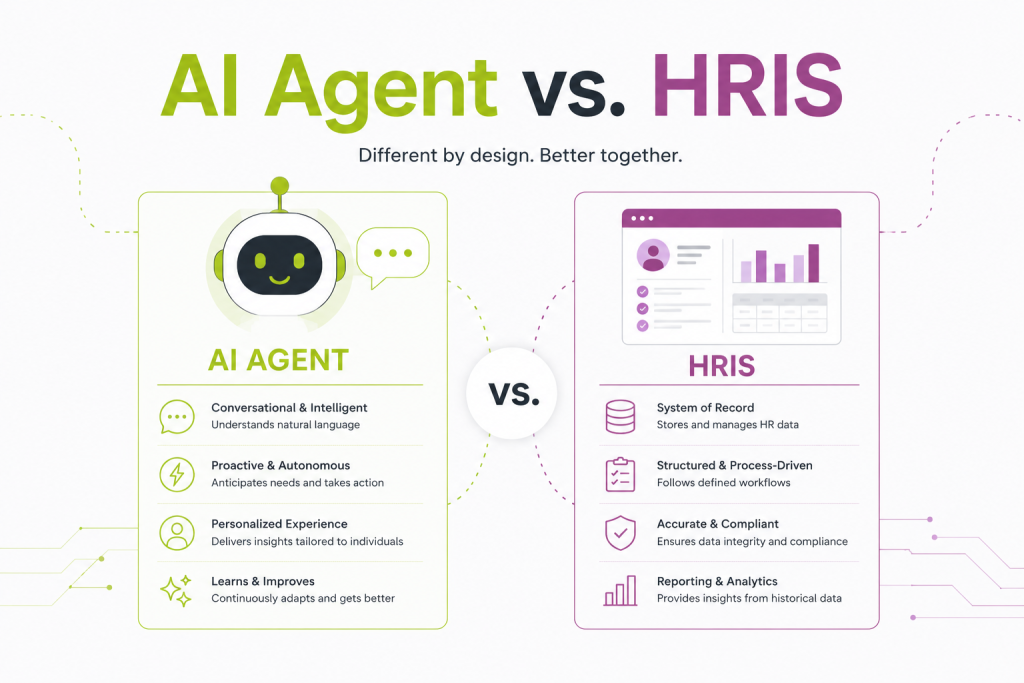
- Your HRIS is a system of record — built for compliance, payroll, and structured data. An AI agent is a system of intelligence — built for conversation, reasoning, and judgment.
- Replacing your HRIS with AI is almost always the wrong move. Compliance, audit trails, and data integrity still require a dedicated system of record.
- Layering (AI alongside HRIS, no direct integration) is the fastest way to start — low risk, quick ROI, no IT heavy-lifting required.
- Integration (AI connected to your HRIS) is the higher-value play — enabling personalized, real-time responses and workflow automation once you’re ready.
- The right path depends on three things: the problem you’re solving, your data quality, and your risk tolerance.
- Small HR teams often benefit most — AI handles high-volume, repetitive work so your team can focus on what actually needs a human.
First, Let’s Be Honest About What an HRIS Actually Does
Your HRIS — whether that’s Workday, BambooHR, SAP SuccessFactors, or something mid-market — is fundamentally a system of record. It stores structured data: headcount, compensation bands, job codes, time-off balances, org hierarchies, and compliance documentation.
It was built for accuracy, auditability, and workflow automation around discrete HR events — onboarding, offboarding, promotions, payroll cycles.
What it was not built for: reasoning, conversation, judgment, or anything that requires context beyond a form field.
That’s not a criticism. It’s a design boundary. And understanding that boundary is the key to making a smart AI decision.
What an AI Agent Brings to the Table
An AI agent — the kind worth deploying in an HR context — is a system of intelligence. It interprets natural language, draws on policy documents and unstructured data, reasons across multiple inputs, and takes action based on context rather than rigid rules.
Practically speaking, an AI agent can:
- Answer employee questions about PTO, benefits, or leave policy in plain language — at any hour
- Draft offer letters, PIPs, or promotion write-ups based on structured inputs
- Summarize engagement survey themes and surface patterns a dashboard would miss
- Guide managers through a difficult conversation or a complex HR process
- Pull together insights across HRIS data, performance records, and survey results to flag flight risk
This is where AI genuinely shines: the messy, language-heavy, judgment-dependent work that consumes an HR team’s day.
The Replace Temptation — And Why It’s Usually Wrong
When AI agents first land on an HR team’s radar, someone in the room inevitably asks: Can we just replace our HRIS with this?
In almost every case, the answer is no — and rushing toward replacement is how organizations create expensive, compliance-breaking disasters.
Here’s why:
Compliance requires a source of truth. HRIS systems maintain audit trails, enforce approval workflows, and produce the documentation that keeps you on the right side of labor law. An AI agent is not a ledger. It cannot be your system of record for compensation, headcount, or legal documentation.
Data integrity demands structure. AI models are powerful, but they do not self-audit. When a payroll system makes an error, there’s a traceable log. When a language model confabulates a policy detail, there may not be.
Replacement means migration — and migration is always harder than it looks. Years of organizational data, integrations, and institutional configurations don’t move cleanly. Replacing an HRIS is a multi-year, multi-million dollar project even under good conditions.
The replace path is rarely the right call, at least not in the short or medium term.
Also read: 6 Types of AI Agents Used in HR + Use Case for Each
Integration: The Responsible Middle Ground
The more mature path is integration — connecting your AI agent to your HRIS so it can read, and in some cases write, structured data while maintaining the integrity of the system of record.
A well-integrated setup looks like this: an employee asks the AI agent how many PTO days they have left. The agent queries the HRIS in real time, retrieves the balance, and responds conversationally. The data lives in one place. The AI is the interface.
Integration unlocks real value:
- Personalized responses — the agent knows who the employee is, their role, their manager, and their history
- Context-aware guidance — policy answers that account for location, employment type, or tenure
- Workflow triggers — the agent can initiate an action in the HRIS (submit a request, flag a record) without the employee navigating a clunky UI
The challenge with integration is that it requires technical investment and thoughtful governance. You need clear rules about what the agent can read, what it can write, and how errors are caught.
Also read: AI Agents vs. AI Chatbots in HR: What’s the Difference and Which One Do You Need?
Layering: When You’re Not Ready to Integrate (Yet)
For organizations that aren’t ready to build deep integrations — because of IT constraints, budget, or data security concerns — layering is a practical first step.
Layering means the AI agent operates alongside the HRIS without direct data access. It handles the conversational and content-generation work: answering policy questions, drafting documents, coaching managers, summarizing information a human pastes in. The HRIS continues running the structured workflows it always has.
This is less elegant, but it still delivers significant value. HR teams using a layered approach typically reclaim hours each week from repetitive drafting and Q&A tasks, without touching their core systems at all.
Think of layering as the proof-of-concept phase — where you demonstrate ROI and build organizational confidence before committing to deeper integration.
The Decision Framework
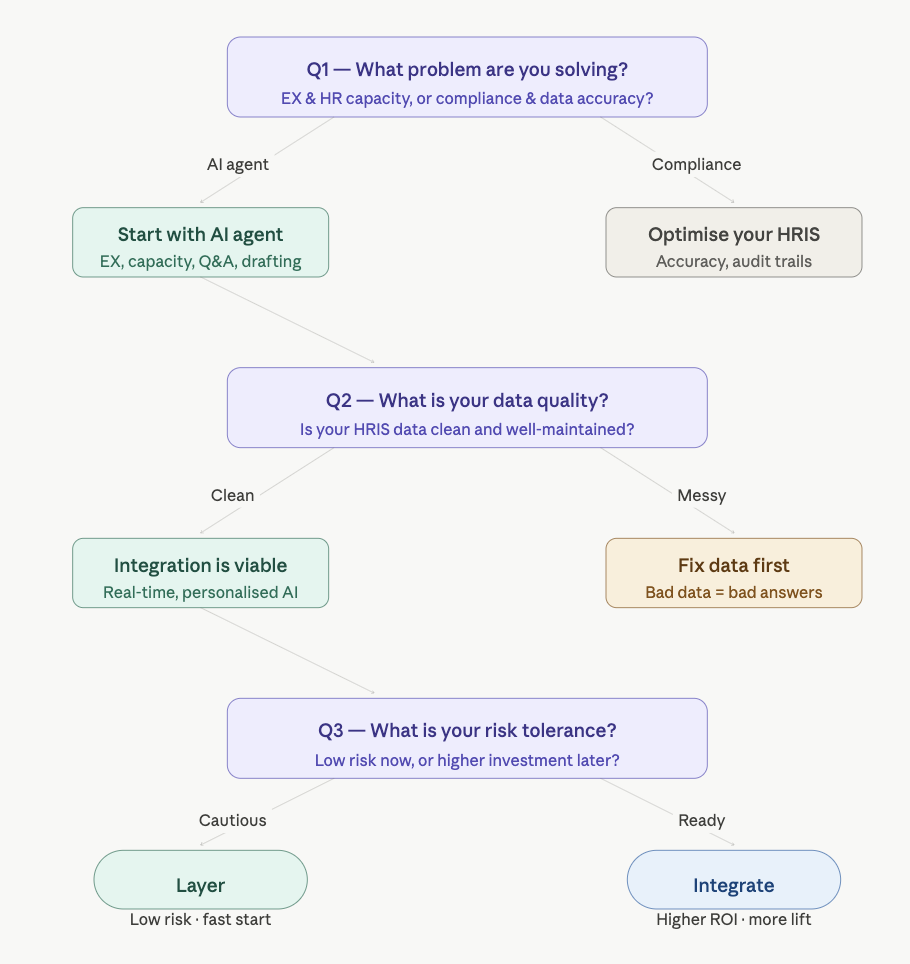
Ask yourself three questions:
1. What problem are you actually solving? If the pain is employee experience and HR team capacity — AI agent, starting with layering. If the pain is data accuracy or compliance process — HRIS optimization first.
2. What does your data infrastructure look like? Clean, well-maintained HRIS data makes integration faster and safer. Messy data makes the agent less trustworthy. Don’t deploy AI on top of a data problem.
3. What’s your risk tolerance? Layering is low-risk, lower-ceiling. Integration is higher-investment, higher-payoff. Replacement is high-risk and rarely warranted.
The Bottom Line
The HRIS and the AI agent are not competitors. They’re different tools solving different problems — one built for structure and compliance, the other for intelligence and conversation.
The organizations that will win aren’t the ones that bet everything on AI replacing what they have. They’re the ones that layer thoughtfully, integrate deliberately, and treat their AI agent as the intelligent interface sitting in front of a well-maintained system of record.
At Stello, that’s exactly the architecture we’re built around — AI that works with your HR stack, not against it.
FAQs-
Q: Will an AI agent make our HRIS redundant over time?
Unlikely — at least not in any timeframe worth planning around today. HRIS platforms are built for compliance, auditability, and structured data management. AI agents are built for reasoning and conversation. Even as AI becomes more capable, the need for a reliable system of record doesn’t go away. What may change is how much of the HRIS interface employees and managers actually touch — with AI handling the front-end interactions and the HRIS quietly running in the background.
Q: How long does it take to integrate an AI agent with an existing HRIS?
It depends on your HRIS, your IT setup, and how deep you want the integration to go. A read-only integration — where the agent can pull data like PTO balances or org structure — can often be stood up in weeks. Bidirectional integrations that allow the agent to trigger workflows or write data back take longer and require more governance planning. Starting with a layered approach while integration is scoped is a common and sensible path.
Q: What are the biggest risks of deploying an AI agent in HR?
The top three are data privacy, accuracy, and trust. Employees share sensitive information in HR contexts, so any AI deployment needs clear data handling policies and access controls. Accuracy matters because a wrong answer about a benefit or a leave policy can have real consequences. And trust is earned slowly — rolling out with a narrow, well-defined use case (like policy Q&A) before expanding scope is almost always better than a big-bang launch.
Q: Can an AI agent handle sensitive HR conversations — like performance issues or terminations?
It can assist, but it shouldn’t lead. An AI agent is well-suited to help a manager prepare for a difficult conversation — drafting talking points, summarizing context, flagging relevant policy — but the conversation itself should stay human. HR deals with situations that require empathy, judgment, and legal awareness that no AI agent today can fully replicate. Think of the agent as the prep work, not the meeting.
Q: We’re a small HR team. Is this overkill for us?
Often the opposite. Smaller HR teams have the most to gain from AI assistance because they’re stretched thinnest. A two- or three-person HR team supporting hundreds of employees can’t be available around the clock for every policy question or document request. An AI agent handles the high-volume, repeatable work so the team can focus on the complex and strategic. The layering approach — low integration, fast setup — is particularly well-suited for lean teams that need impact without a lengthy implementation.