AI agents are no longer a futuristic concept reserved for tech giants. They’re actively reshaping how HR teams hire, onboard, manage, and retain talent — right now, across companies of every size.
But here’s where most organizations go wrong: they treat “AI agent” as a single category. They either over-invest in the wrong type of automation or dismiss the technology entirely because a pilot project didn’t deliver. The reality is that AI agents come in distinct types, each with specific strengths. Deploy the right one for the right job, and the results are transformative. Deploy the wrong one, and you’re just adding complexity.
TL;DR
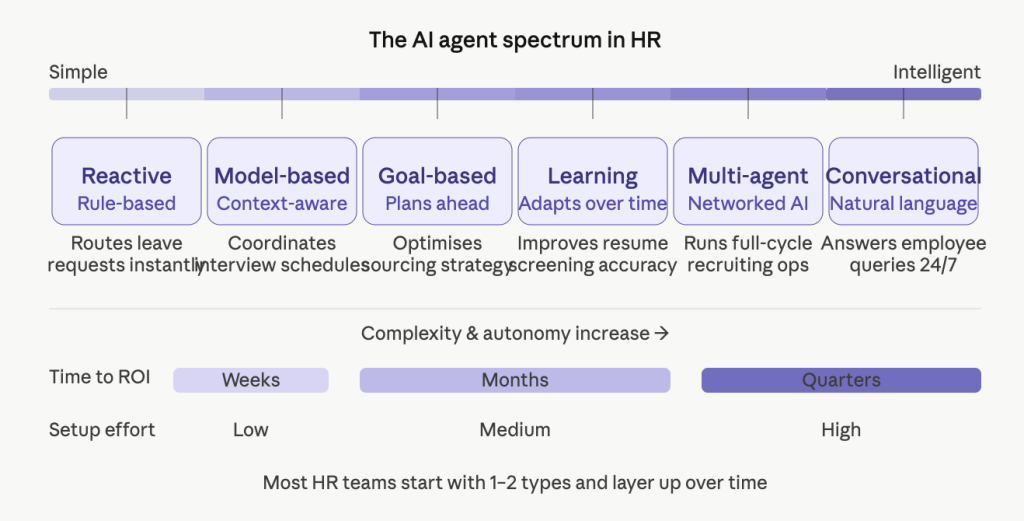
- Reactive agents — Handle fixed, rule-based tasks like routing leave requests and triggering onboarding checklists. Fast and consistent, but can’t handle exceptions.
- Model-based agents — Maintain context to manage complex workflows like multi-round interview scheduling and 90-day onboarding tracking.
- Goal-based agents — Evaluate options and plan ahead. Ideal for talent acquisition strategy and workforce planning.
- Learning agents — Improve over time using feedback. Powerful for resume screening and engagement analytics, but require bias auditing.
- Multi-agent systems — Network specialized agents together for end-to-end workflows like full-cycle recruiting or global compliance monitoring.
- Conversational agents — Handle employee self-service in natural language, 24/7. Best for high-volume informational queries, not sensitive HR situations.
The smartest HR AI strategies layer multiple agent types — the key is matching the right agent to the right problem, not deploying everything at once.
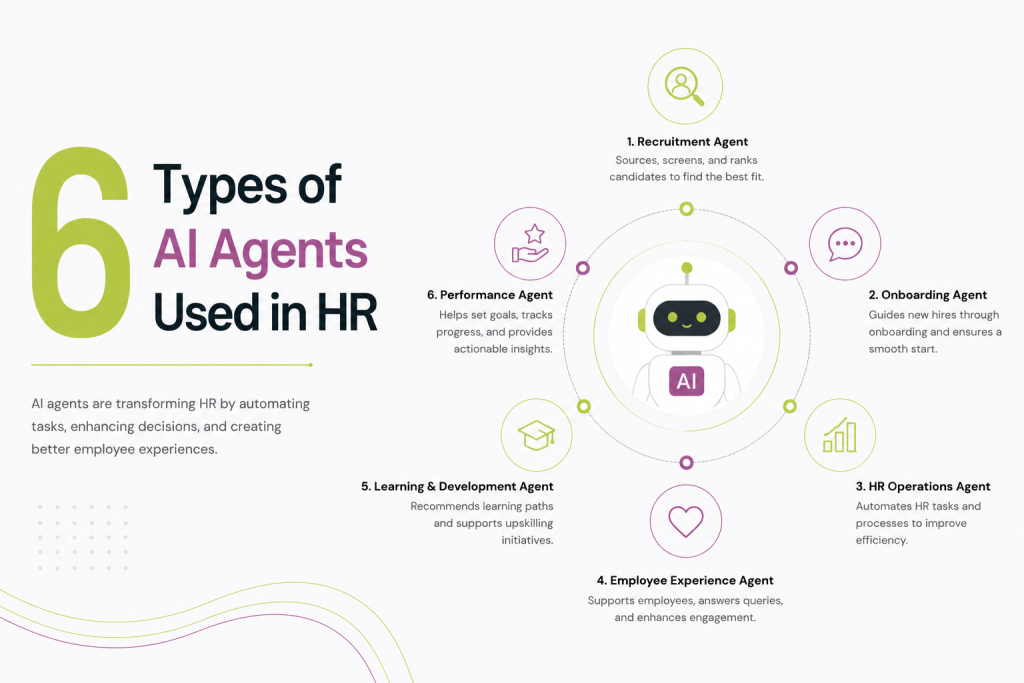
Here’s a practical breakdown of the six types of AI HR agents — and where each one actually earns its place.
1. Reactive Agents (Rule-Based Automation)
What they are: Reactive agents follow fixed if-then rules. They don’t learn or adapt — they simply respond to predefined triggers with predefined actions.
Right use case in HR: High-volume, repetitive administrative tasks with clear rules and no ambiguity. Think: auto-acknowledging job applications, sending interview reminders, routing leave requests to the correct manager, or triggering offboarding checklists when a resignation is submitted.
These agents shine in scenarios where consistency matters more than intelligence. They’re fast, cheap to deploy, and easy to audit. If an employee submits a time-off request, a reactive agent can instantly check the company policy, verify available balance, and route for approval — all without human involvement.
Where they fall short: The moment an exception occurs — an edge case the rules didn’t anticipate — reactive agents either fail silently or create errors. They have no ability to interpret context or handle nuance.
Also read: AI Agents vs. AI Chatbots in HR: What’s the Difference and Which One Do You Need?
2. Model-Based Agents (Context-Aware Automation)
What they are: Model-based agents maintain an internal representation of their environment. They use this model to make decisions based on current state, not just immediate input.
Right use case in HR: Intelligent scheduling and resource allocation. For example, coordinating multi-round interviews across dozens of candidates and interviewers — accounting for time zones, calendar availability, role seniority, and interview stage — requires a system that can hold context and make informed decisions dynamically.
These agents also work well for tracking the state of complex HR workflows like onboarding programs that span 30, 60, and 90 days across multiple departments. The agent understands where each new hire is in the process and can proactively flag bottlenecks or send the right content at the right time.
Where they fall short: They require accurate, up-to-date data to function well. If the underlying systems are fragmented or poorly maintained, model-based agents produce unreliable outputs.
3. Goal-Based Agents (Objective-Driven Decision Making)
What they are: Goal-based agents evaluate multiple possible actions and choose the one most likely to achieve a defined outcome. They plan ahead, not just react.
Right use case in HR: Talent acquisition strategy. When a hiring manager opens a requisition, a goal-based agent can analyze the job requirements, current candidate pipeline, historical time-to-fill data, and sourcing channel performance — then recommend the optimal sourcing strategy to fill the role within budget and timeline.
Goal-based agents are also valuable in workforce planning. Given targets around headcount, attrition rates, and growth projections, the agent can model different hiring and redeployment scenarios and recommend the path that best achieves organizational objectives.
Where they fall short: Defining the right goal is harder than it sounds. A poorly specified objective — like optimizing purely for speed of hire — can produce agents that technically achieve their goal while creating downstream problems like poor quality hires or damaged candidate experience.
4. Learning Agents (Adaptive Intelligence)
What they are: Learning agents improve over time by processing feedback. They adjust their behavior based on outcomes, becoming more accurate and effective with each iteration.
Right use case in HR: Resume screening and candidate matching. A learning agent can be trained on historical data — which candidates were hired, how they performed, how long they stayed — and continuously refine its screening criteria. Over time, it learns the subtle signals that predict success in a given role or culture, going far beyond keyword matching.
Learning agents are also effective for employee engagement analytics. By processing survey results, communication patterns, and behavioral signals over time, they can identify early indicators of disengagement or flight risk with increasing precision.
Where they fall short: Learning agents can inadvertently learn and amplify biases present in historical data. If past hiring decisions reflected demographic bias, the agent will learn to replicate it. Rigorous bias auditing and diverse training datasets are non-negotiable.
5. Multi-Agent Systems (Collaborative AI Networks)
What they are: Multi-agent systems involve multiple specialized AI agents working together — each handling a distinct part of a broader workflow and passing outputs between them.
Right use case in HR: End-to-end recruitment operations. One agent sources candidates, another screens applications, a third schedules interviews, a fourth synthesizes feedback, and a fifth generates offer letters — all coordinated seamlessly. No single agent needs to be a generalist; each is highly optimized for its specific task.
Multi-agent systems also work well for complex compliance monitoring across global workforces, where different agents track region-specific labor laws, flag potential violations, and route issues to the appropriate HR business partner.
Where they fall short: Coordination overhead can be significant. When multiple agents interact, errors can cascade and become harder to trace. These systems require robust architecture, clear handoff protocols, and careful monitoring.
6. Conversational AI Agents (Employee-Facing Assistants)
What they are: Conversational agents interact with people in natural language, either through chat interfaces or voice. They understand intent, retrieve information, and take actions through dialogue.
Right use case in HR: Employee self-service at scale. Benefits questions, policy clarifications, payroll inquiries, PTO balances, onboarding guidance — the average HR team spends a disproportionate amount of time answering questions that could be handled instantly by a well-trained conversational agent. Available 24/7, multilingual, and infinitely patient, these agents dramatically reduce HR’s administrative burden while improving the employee experience.
Conversational agents are also powerful in candidate engagement during the recruitment process — answering applicant questions in real time, collecting initial screening information, and keeping candidates warm throughout the hiring cycle.
Where they fall short: Conversational agents are only as good as the knowledge base they’re built on. Outdated or incomplete information leads to wrong answers that erode employee trust quickly. They also struggle with sensitive or emotionally complex situations — a conversation about a harassment complaint or a mental health concern needs a human, not a bot.
Choosing the Right Agent for the Right Job
The most effective HR AI strategies don’t rely on a single type of agent. They layer different types intelligently: conversational agents for employee self-service, learning agents for candidate matching, goal-based agents for workforce planning, and multi-agent systems for complex end-to-end workflows.
The key question isn’t “should we use AI agents?” It’s “which type of agent solves which specific problem — and what does success actually look like?” Start there, and the technology will follow.
Also read: AI Agents for HR: The Complete Guide to Transforming Human Resources
FAQs-
Do we need to implement all six types of AI agents to see results in HR?
Not at all. Most organizations start with one or two agent types that address their most pressing pain points — typically conversational agents for employee self-service or reactive agents for administrative automation. A single well-implemented conversational agent handling benefits and policy questions can save an HR team dozens of hours per week on its own.
How do AI agents in HR differ from basic HR automation tools we already use?
Traditional HR automation executes a fixed action on a fixed trigger. AI agents go further: they interpret context, handle variation, make decisions across multiple steps, and in some cases learn and improve over time. The difference is a rule that says “send email when status = hired” versus an agent that assesses where a new hire is in their journey and proactively reaches out with the right resource at the right moment.
What’s the biggest risk of using learning agents for resume screening?
Bias amplification. If past hiring decisions reflected conscious or unconscious bias, the agent will learn to replicate those patterns at scale. Bias audits, diverse training datasets, and human review checkpoints are essential from day one — not retrofitted after a problem surfaces.
Are conversational AI agents appropriate for sensitive HR situations?
For routine queries — policy questions, benefits, payroll — yes. But sensitive situations involving mental health, harassment, or terminations need a clear escalation path to a human. The best implementations build explicit handoff triggers so the moment a conversation moves into sensitive territory, the employee is routed to an HR professional, not another automated response.
How long does it typically take to see ROI from deploying AI agents in HR?
Conversational and reactive agents tend to deliver the fastest returns, often within the first few months, by reducing high-frequency administrative tasks immediately. Learning and goal-based agents take longer but deliver higher long-term value. A realistic expectation for most HR AI deployments is three to six months, with compounding returns as systems mature.