The conversation around AI in the workplace has been loud, fast, and — if we’re honest — occasionally overblown. Vendors promise revolution. Skeptics warn of dystopia. And HR leaders sit somewhere in between, trying to figure out what’s actually worth their attention.
So let’s cut through the noise. After several years of AI tools moving from pilot programs into mainstream adoption, we now have enough real-world evidence to separate genuine transformation from polished marketing. Here’s an honest look at what AI has meaningfully changed in employee management — and where the fundamentals remain stubbornly, importantly human.
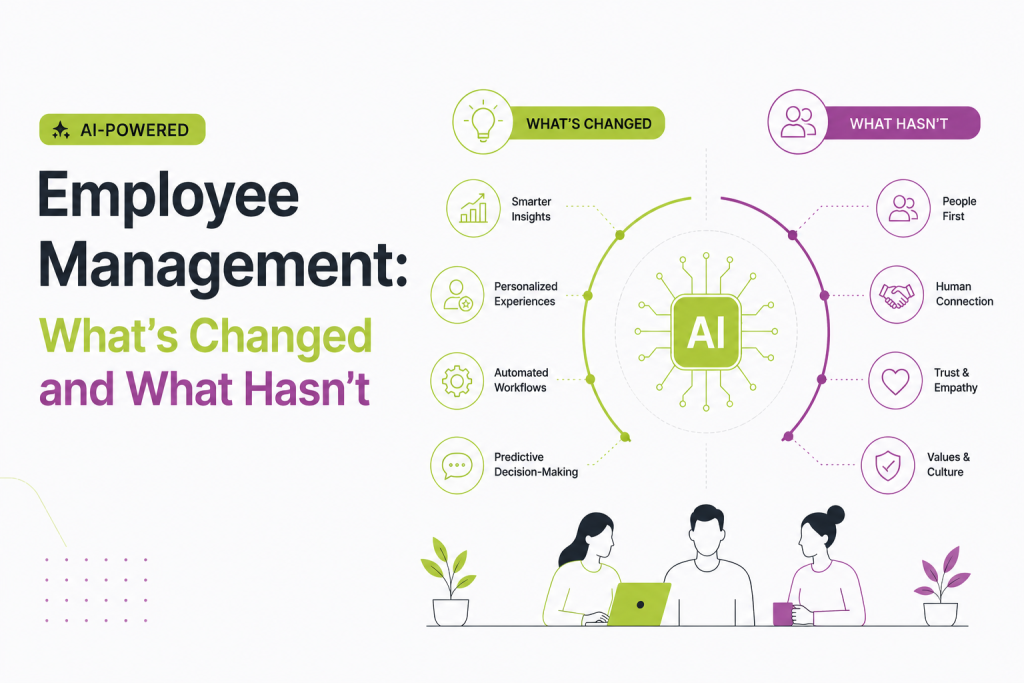
AI has transformed how HR operates — but not what good management requires.
- Hiring — AI screens thousands of applicants in minutes and surfaces non-obvious candidates, replacing hours of manual resume review.
- Onboarding — Adaptive learning paths replace generic training, cutting time-to-productivity and improving first-year retention.
- Performance reviews — Continuous feedback loops replace annual reviews, so no one should ever be surprised at review time.
- Workforce planning — Predictive analytics flag talent gaps months before they become urgent, shifting HR from reactive to proactive.
- Engagement data — Pulse tools give near-real-time signals, catching disengaged teams weeks before they walk out the door.
- Trust is still built person to person — no algorithm can have the difficult conversation.
- Culture is built by human decisions, not dashboards. AI diagnoses it; it can’t build it.
- Ethical judgment about data, bias, and fairness requires human accountability.
- Managers still make or break the employee experience — technology can inform them, not replace them.
What’s Actually Changed
Hiring Has Gotten Faster (and Smarter About the First Cut)
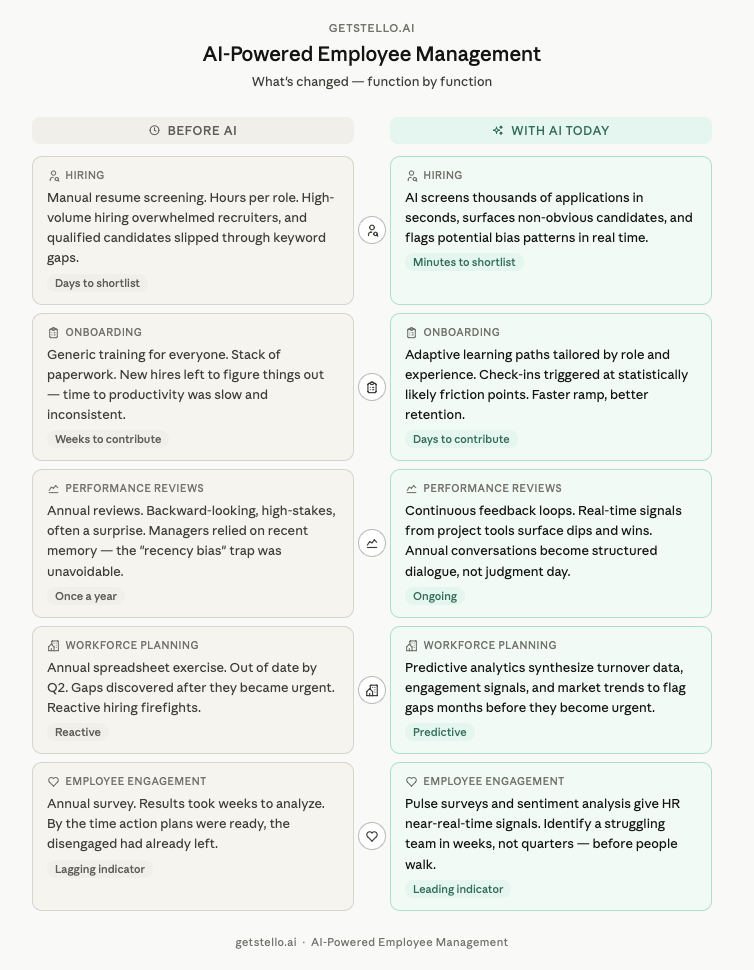
The most visible transformation has been at the top of the recruitment funnel. AI-powered applicant tracking systems now do in seconds what once took recruiters hours: screen resumes, flag relevant experience, and rank candidates against job criteria. For high-volume roles — customer service, retail, logistics — this is genuinely game-changing. A company receiving 2,000 applications for 20 openings no longer needs a dedicated team just to handle the first pass.
But the change runs deeper than speed. Modern AI recruiting tools analyze patterns in successful hires and surface candidates who might have been overlooked by keyword-matching alone. Someone who managed a team informally, without the title, now has a better shot of being noticed.
The important caveat: AI-assisted screening is only as unbiased as the data it learns from. Organizations that have invested in auditing their hiring AI — checking for demographic disparities in who gets flagged versus passed over — are seeing real equity gains. Those who haven’t are potentially automating their existing blind spots at scale.
Also read: AI Agent vs. HRIS: Do You Replace, Integrate, or Layer?
Onboarding is No Longer One-Size-Fits-All
New hire onboarding used to mean a stack of paperwork, a few days of generic training, and a lot of hoping people figured things out. AI has made personalization at scale actually feasible.
Today’s onboarding platforms can adapt learning paths based on a new employee’s role, prior experience, and even their progress through initial modules. Someone joining as a senior hire with deep industry background gets a compressed track. Someone newer to the field gets more foundational content. Both get check-ins timed around the moments they’re statistically most likely to need support.
The result isn’t just a better employee experience — though it is that. It’s faster time-to-productivity, which has a direct line to retention. Employees who feel competent and connected in their first 90 days are far less likely to leave in their first year.
Performance Management Has Moved From Annual to Continuous
Perhaps nothing in traditional HR was more universally dreaded — by managers and employees alike — than the annual performance review. It was backward-looking, high-stakes, and often disconnected from the actual work of the year.
AI-enabled performance tools have shifted this toward something more like a continuous feedback loop. Real-time data from project management systems, peer recognition platforms, and goal-tracking software gives managers a much richer, more current picture of how their people are actually doing. Flagging when someone’s output drops off, noticing when a high performer hasn’t received recognition in months, surfacing patterns across a team — these are things AI can do reliably and at scale.
This doesn’t mean the annual conversation goes away. But its purpose changes. Instead of a high-stakes judgment day, it becomes a structured moment in an ongoing dialogue — one where neither party should be surprised.
Also read: 6 Types of AI Agents Used in HR + Use Case for Each
Workforce Planning Has Become Genuinely Predictive
Historically, workforce planning was a spreadsheet exercise that happened once a year and was out of date by Q2. AI has turned it into something closer to a live instrument.
Predictive analytics tools can now synthesize historical turnover data, industry benchmarks, engagement signals, and external labor market conditions to flag where talent gaps are likely to emerge — often months before they become urgent. This gives HR leaders and executives time to act: adjust hiring pipelines, develop internal candidates, or restructure teams.
For organizations with large, distributed workforces, this shift from reactive to proactive is significant. The question is no longer just “who do we need to hire now?” but “where are we likely to have a problem in six months, and what do we do today?”
Employee Experience Data Has Gone From Lagging to Leading
The old model: annual engagement survey, results analyzed over weeks, action plan developed over months, changes implemented somewhere in the following year. By which point, the employees who were disengaged have left, and the issues have compounded.
AI-powered listening tools — pulse surveys, sentiment analysis, even anonymized signals from internal communications platforms — give HR teams much faster feedback loops. They can spot a team whose morale has dropped in the last three weeks, not the last twelve months. They can identify which managers are building environments where people thrive, and which ones are quietly burning out their teams.
This is genuinely powerful. Used well, it enables intervention before problems become crises. Used carelessly — without transparency, without employee trust — it can feel like surveillance.
What Hasn’t Changed
Trust Is Still Built Person to Person
No algorithm schedules itself into a difficult conversation. No platform tells an employee their role is being eliminated with the kind of care and dignity that matters. No AI tool builds the foundational trust that makes feedback land instead of sting.
The most important moments in the employee-manager relationship — the direct conversation about performance, the acknowledgment of someone’s contribution, the difficult decision delivered with honesty and respect — remain irreducibly human. AI can surface the data that informs those conversations. It can prompt the manager to have them. It cannot have them.
Organizations that mistake data richness for relational richness are heading toward a specific kind of failure: technically informed but interpersonally hollow management. People leave managers, not companies — that axiom is as true as it ever was.
Culture Is Not a Feature You Can Install
AI tools can measure culture. They can surface signals about whether stated values match lived experience. They can flag when the stated commitment to psychological safety doesn’t show up in how meetings actually run.
But culture itself — the shared norms, the unspoken rules, the feeling people get when they walk in the door or open their laptop — that’s built through a thousand human decisions over time. It’s built by who gets promoted and who doesn’t, by how failure is handled, by whether leadership says one thing and does another.
AI can be a useful diagnostic. It is not a builder. The organizations that are thriving culturally are using their AI-generated insights to prompt better human choices. The ones that aren’t are discovering that impressive dashboards can coexist with serious cultural rot.
Also read: AI Agents vs. AI Chatbots in HR: What’s the Difference and Which One Do You Need?
Ethical Judgment Doesn’t Automate
As AI takes on more of the operational work of HR, the ethical weight of what remains only gets heavier. Who decides how algorithmic screening scores are weighted? Who reviews the model when a team notices it’s systematically underscoring candidates from a particular background? Who sets the boundaries on what employee data gets collected, and what it’s used for?
These aren’t questions AI can answer. They require human judgment, organizational values, and genuine accountability. The HR leaders who understand this — who see AI as a powerful tool that requires careful governance, not a system that removes the need for judgment — are the ones building something sustainable.
Managers Still Make or Break the Employee Experience
Technology can make a manager’s job easier. It can give them better information, surface blind spots, reduce administrative burden. What it cannot do is make a bad manager good.
The research on this point is consistent: the single biggest factor in employee engagement, retention, and performance is the quality of the direct manager relationship. No AI platform closes that gap. Coaching, leadership development, accountability for how people are actually treated — these investments remain as important as they’ve ever been.
The most effective organizations are those using AI to free up manager time and surface useful signals, while simultaneously doubling down on manager development. The two work together. Neither works alone.
The Honest Summary
AI has made employee management faster, more informed, and more predictive. It has reduced the administrative load on HR teams and enabled personalization at a scale that wasn’t previously possible. For organizations willing to implement it thoughtfully — with attention to bias, to privacy, to the limits of what data can tell you — it’s a meaningful upgrade to the toolkit.
What it hasn’t done is change the nature of what good management actually requires. Judgment. Trust. Genuine care for the humans doing the work.
The companies getting this right aren’t the ones that have deployed the most AI tools. They’re the ones that have figured out what AI is for — and what it isn’t for — and built their people strategy around that honest assessment.
That clarity, it turns out, is still a very human skill.