HR teams are under more pressure than ever. Between managing hiring pipelines, onboarding new employees, answering policy questions, and keeping up with compliance, the workload is relentless. It’s no surprise that AI has become a go-to solution for HR leaders looking to do more with less.
But here’s where things get confusing: not all AI is the same. You’ve probably heard the terms “AI chatbot” and “AI agent” used almost interchangeably — but they describe fundamentally different technologies with very different capabilities. Choosing the wrong one for your HR needs isn’t just inefficient; it can leave your team doing the same manual work they were hoping to automate in the first place.
So let’s break it down clearly.
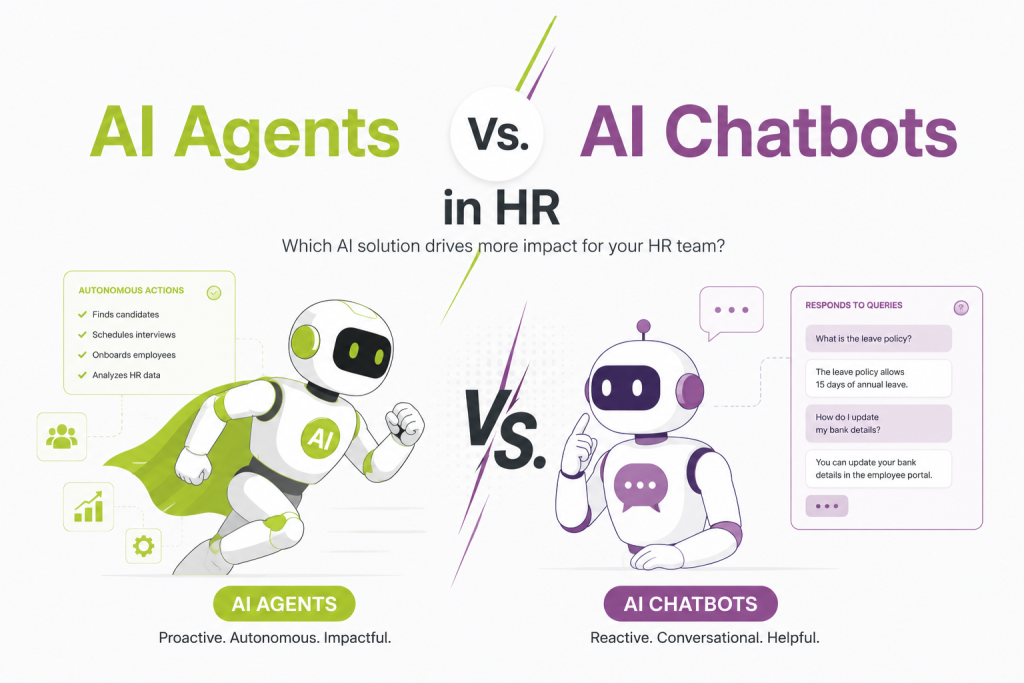
- Chatbots respond. Agents act. A chatbot answers employee questions; an AI agent completes the entire task — submitting requests, updating systems, and closing the loop without human involvement.
- Chatbots are great for tier-1 support. FAQs, policy lookups, and directing employees to the right resources — chatbots handle these well and reduce HR ticket volume.
- Agents automate entire HR workflows. Onboarding, recruiting, leave management, and compliance tracking can all run end-to-end — with no manual handoff required.
- Chatbots always need a human to follow through. Any task that requires action — not just an answer — still lands on your HR team’s plate.
- Growing teams need agents, not just chatbots. If HR admin is eating into strategic time, a chatbot won’t fix it — you need automation that executes, not just informs.
- AI agents don’t replace HR — they free it. By handling repetitive operational tasks, agents give HR professionals more time for culture, strategy, and the work that actually requires human judgment.
What is an AI Chatbot?
An AI chatbot is a conversational tool designed to respond to questions and requests in natural language. When an employee types, “How many vacation days do I have left?” a chatbot retrieves the answer and presents it in a readable format.
Modern HR chatbots — especially those powered by large language models (LLMs) — can handle a surprisingly wide range of queries: benefits explanations, leave policies, payroll FAQs, onboarding checklists, and more. They’re available 24/7, consistent in tone, and can dramatically reduce the ticket volume landing on your HR team’s desk.
What chatbots do well:
- Answering common, repeatable HR questions
- Directing employees to the right resources or portals
- Providing policy information on demand
- Reducing response times for tier-1 HR support
Where chatbots fall short: The core limitation of a chatbot is that it responds — it doesn’t act. A chatbot can tell an employee how to request time off. It cannot actually submit that request, update the HR system, notify the manager, and confirm the approval. The moment a task requires more than a reply, the chatbot hands off to a human — and the manual work begins again.
Also read: Top Use Cases for AI in HR in 2026
What is an AI Agent?
An AI agent is a step-change beyond a chatbot. Rather than simply generating responses, an AI agent can take action — accessing tools, executing multi-step workflows, making decisions, and interacting with external systems to complete a task end-to-end.
Think of the difference this way: a chatbot is like a very knowledgeable receptionist who can answer any question you have. An AI agent is like a capable operations coordinator who not only answers your question but goes ahead and handles the entire request for you.
In an HR context, when an employee tells an AI agent they need to update their direct deposit information, the agent doesn’t just point them to a form. It verifies their identity, opens the relevant payroll integration, makes the update, logs the change, and sends a confirmation — all without a human HR rep touching the task.
What AI agents do well:
- Executing end-to-end HR workflows autonomously
- Integrating with HRIS, ATS, payroll, and communication platforms
- Adapting dynamically when a step in a process changes
- Taking initiative on scheduled or triggered tasks (e.g., sending onboarding reminders, flagging compliance gaps)
- Learning from context across a conversation or workflow
AI chatbot vs. AI agent in HR
Which one actually gets the job done?
Side-by-Side: The Real Differences
| AI Chatbot | AI Agent | |
|---|---|---|
| Core function | Respond to questions | Execute tasks and workflows |
| Interacts with systems? | Rarely | Yes — natively integrates with tools |
| Multi-step tasks | No | Yes |
| Needs human follow-up | Often | Rarely |
| Best for | FAQs, information retrieval | Onboarding, recruiting, compliance, operations |
| Complexity handled | Low to medium | Medium to high |
Real HR Use Cases: Agents in Action
Here’s where the distinction becomes concrete. Consider some of the most time-consuming tasks in HR today:
Onboarding A chatbot can share an onboarding checklist. An AI agent can manage the entire onboarding workflow — scheduling orientation sessions, sending document requests, provisioning system access, assigning training modules, and checking in with the new hire at key milestones.
Recruiting A chatbot can answer candidate questions about a role. An AI agent can screen applications against job criteria, schedule interviews, send follow-up emails, collect feedback from interviewers, and move candidates through stages in your ATS — all without HR manually touching each step.
Leave Management A chatbot tells employees how to apply for leave. An AI agent accepts the request, checks the employee’s balance, routes it for manager approval, updates the HR system, and notifies payroll — closing the loop completely.
Compliance & Documentation A chatbot can explain a policy. An AI agent can proactively identify which employees are missing required certifications, send reminders, track completions, and escalate overdue cases — keeping your organization audit-ready without constant manual oversight.
Also read: What is an AI HR Agent?
So Which One Does Your HR Team Actually Need?
The honest answer: it depends on what’s slowing you down.
Start with a chatbot if:
- Your team is overwhelmed with repetitive employee questions
- You need to improve response times for HR inquiries
- You’re early in your AI adoption journey and want a lower-stakes starting point
- Your workflows are already well-managed and you mainly need better self-service for employees
Move to AI agents if:
- Your HR team spends significant time on repetitive operational tasks, not just answering questions
- You’re managing high-volume workflows like recruiting, onboarding, or benefits enrollment
- You want to reduce human touchpoints across the entire employee lifecycle
- You’re looking to scale your HR operations without proportionally scaling headcount
For most growing companies, chatbots are a short-term fix. They reduce noise but don’t reduce workload at the process level. AI agents address the root issue: the hours HR teams spend executing tasks that are predictable, rule-based, and ripe for automation.
Also read: AI Agents for HR: The Complete Guide to Transforming Human Resources
The Stello Perspective
At Stello, we believe the future of HR isn’t just AI that answers your team’s questions — it’s AI that works alongside your team, handling the operational load so your HR professionals can focus on what actually requires human judgment: culture, conflict resolution, strategic hiring, and employee development.
That’s why Stello is built around the agent model. Our AI doesn’t just sit in a chat window waiting to be asked something. It actively manages workflows, connects with the tools you already use, and keeps your HR operations running — whether or not someone is logged in asking it to.
The question for HR leaders isn’t whether to adopt AI. That decision has largely been made by the pace of business. The real question is: do you want AI that gives you information, or AI that gets things done?
FAQs-
1. Can an AI chatbot eventually do everything an AI agent can, if it’s advanced enough?
Not quite. The distinction isn’t just about intelligence — it’s about architecture. A chatbot is designed to converse; an agent is designed to act. Even the most sophisticated chatbot still relies on a human to take action after the conversation ends. AI agents are built with tool access, workflow logic, and system integrations at their core. Upgrading a chatbot doesn’t turn it into an agent any more than upgrading a calculator turns it into a spreadsheet.
2. Are AI agents in HR safe to use with sensitive employee data?
Yes — when built responsibly. Reputable HR AI platforms like Stello are designed with data privacy and security as foundational requirements, not afterthoughts. This means role-based access controls, encrypted data handling, and compliance with regulations like GDPR and SOC 2 standards. Before deploying any AI agent, HR leaders should audit how the tool stores, accesses, and transmits employee information.
3. How long does it take to implement an AI agent for HR?
It varies by platform and scope, but modern HR AI agents are built for relatively fast deployment — especially when connecting to common HRIS and ATS platforms. A focused use case like onboarding automation or leave management can typically go live in a matter of weeks. The more integrations and custom workflows involved, the longer the setup, but this is a one-time investment that pays off quickly at scale.
4. Will AI agents replace HR professionals?
No — and that’s not the goal. AI agents are designed to eliminate the repetitive, process-driven work that consumes HR teams’ time: scheduling, data entry, routing requests, sending reminders. This frees HR professionals to focus on the work that genuinely requires human skill — employee relations, culture building, strategic workforce planning, and nuanced judgment calls. The best HR teams will be those who use agents to amplify their capacity, not replace their expertise.
5. Our company is small. Do we need an AI agent or is a chatbot enough?
For very small teams with low HR transaction volume, a chatbot may cover your needs well. But growing companies often find they hit the ceiling of chatbot utility faster than expected — especially as hiring picks up and onboarding becomes more complex. If you’re scaling headcount, managing multiple locations, or finding that HR admin tasks are creeping into your strategic time, an AI agent will serve you better in the long run. Starting with an agent-first platform also means you won’t have to migrate tools six months down the line.