When a company is small, a shared spreadsheet can hold the entire compensation strategy. When it starts to scale, that same spreadsheet becomes a liability. Formulas break. Managers make inconsistent offers. Pay equity gaps surface quietly until they become legal or retention problems.
Dedicated compensation platforms solve this. They replace fragmented workflows with structured cycles, defensible pay bands, and real-time visibility across the org. But not every platform is built for the same stage or use case. This guide covers the top options in 2025 and what to look for before you commit.
TL;DR
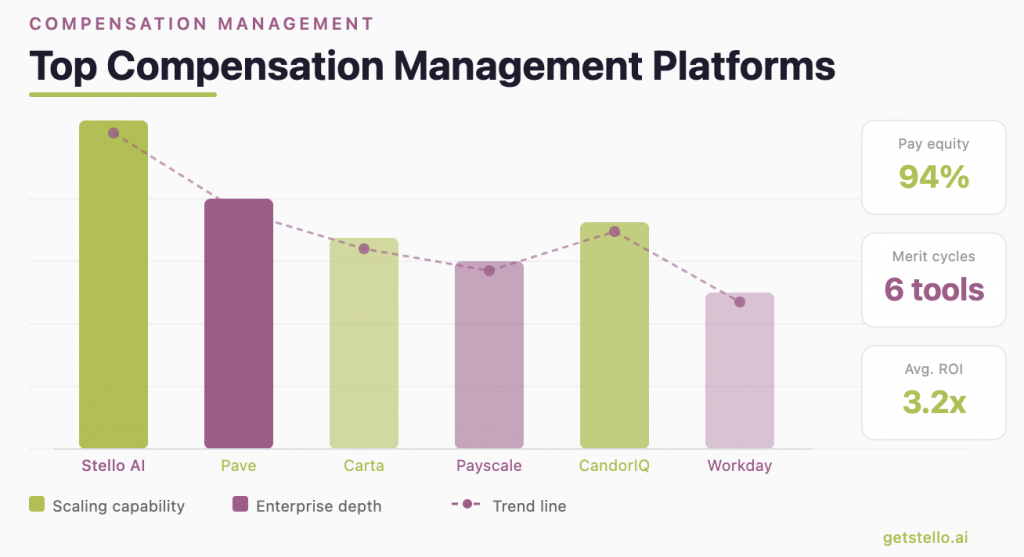
Top compensation platforms for scaling teams
- Spreadsheets break at scale. Once a team grows past 50 people, manual comp processes create pay equity gaps, budget overruns, and inconsistent offers.
- Look for five things: pay band management, merit cycle automation, pay equity analytics, HRIS integrations, and fast rollout.
- Stello AI is the best pick for mid-market HR teams that want AI-native compensation management without enterprise complexity.
- Pave is built for fast-growing tech companies that need real-time salary and equity benchmarks that stay current, not annual.
- Carta Total Comp is the strongest choice for equity-heavy startups already running cap tables and grants inside Carta.
- Payscale / Payfactors wins on data depth for teams pricing niche or specialized roles, with built-in what-if scenario modeling.
- CandorIQ unifies compensation and headcount planning in one platform, which is especially useful for distributed teams.
- Workday Compensation is the enterprise default when comp needs to live inside a broader HCM system, but expect long implementation timelines.
- Stage matters: under 100 employees, prioritize benchmarking. Between 100 and 1,000, automate cycles and enforce equity. Above 1,000, focus on governance and HCM integration.
What to Look for in a Compensation Platform
Before evaluating tools, get clear on what your team actually needs. Most scaling teams should prioritize:
Pay band and structure management: The ability to build, update, and enforce salary ranges tied to roles, levels, and geographies.
Merit cycle automation: Replacing spreadsheet-based reviews with structured workflows, approval chains, and budget guardrails.
Pay equity analytics: Built-in dashboards that surface gaps by gender, department, level, or location before they become problems.
HRIS integrations: Clean, two-way sync with your existing people data so comp decisions are always working off accurate inputs.
Ease of rollout: A platform your managers will actually use, with a reasonable implementation timeline.
With that baseline in mind, here are the platforms worth evaluating.
Top Compensation Platforms for Scaling Teams
Compensation Management
Top Compensation Platforms for Scaling Teams
How 6 leading tools stack up — and who they’re built for
Mid-market HR and Total Rewards teams that want AI-native compensation management without enterprise complexity
- ›AI-powered pay equity analysis
- ›Automated merit cycles
- ›Total rewards statements
- ›HRIS integrations
Fast-growing tech companies that prioritize real-time salary and equity benchmarking
- ›Live benchmark data refreshes
- ›Salary + equity planning
- ›Total rewards portal
Equity-heavy startups already using Carta for cap table and equity management
- ›Cap table-linked benchmarks
- ›Cash + equity unified view
- ›Offer letter generation
Data-first teams needing deep benchmarking across niche or specialized roles
- ›Broad salary data sets
- ›What-if scenario modeling
- ›Pay equity reporting
Teams wanting compensation and headcount planning unified in one platform
- ›Headcount + comp planning
- ›Real-time budget visibility
- ›Distributed team policies
Large enterprises that need compensation embedded inside their core HCM system
- ›Built-in HCM integration
- ›Multi-currency cycles
- ›Survey data import
Which stage are you?
1. Stello AI
Best for: Mid-market HR teams that want AI-native compensation management without enterprise complexity.
Stello AI is built specifically for Total Rewards and People Ops teams navigating the messy middle ground between startup informality and enterprise process. Where most platforms bolt AI onto existing workflows, Stello AI is designed from the ground up around intelligent automation. The platform handles pay band creation, merit cycle management, and compensation benchmarking in a single workspace, with AI surfacing recommendations and flagging anomalies rather than waiting for HR to catch them.
Key capabilities include automated pay equity analysis, manager-facing workflows that reduce back-and-forth, and total rewards statements employees can actually understand. Stello AI also integrates with major HRIS platforms so your compensation data stays in sync without manual exports.
For teams that have outgrown spreadsheets but do not need the bloat of an enterprise suite, Stello AI offers the right balance of structure and speed.
2. Pave
Best for: Fast-growing tech companies that prioritize real-time benchmarking and equity data.
Pave takes a “Plan, Communicate, Benchmark” approach that covers the full compensation lifecycle. Its standout feature is continuous market data refreshes, which means salary and equity benchmarks stay current rather than sitting stale between annual surveys. HR teams can build pay ranges quickly, run merit cycles, and generate offer letters with current market context built in.
Pave’s total rewards portal also helps employees understand the full value of their package, which has a measurable impact on retention. The limitation is that pricing scales by module and headcount, which can add up for larger teams. It is best suited for high-growth companies where access to live benchmark data is a core requirement.
3. Carta Total Compensation
Best for: Equity-heavy companies already using Carta for cap table management.
For startups and scale-ups that live inside the Carta ecosystem, Total Compensation is a natural extension. The platform pairs comp planning with salary and equity benchmarks sourced directly from Carta’s cap table data, making it possible to manage offer letters, grants, and payroll expense forecasting from a single system of record.
The total rewards portal helps employees see the combined value of cash and equity, which matters for early-stage companies where equity is a significant part of the pitch. The trade-off is that Carta’s value case weakens considerably for companies not already using the platform for equity management. If that infrastructure is in place, it is worth serious consideration.
4. Payscale and Payfactors
Best for: Data-first teams that need deep benchmarking across niche or specialized roles.
Payscale brings one of the broadest compensation data sets on the market, pairing employer-reported surveys with continuously updated datasets and AI-assisted modeling for pricing hard-to-benchmark roles. The Payfactors layer adds structure design, job pricing, and enterprise-grade planning tools on top of that data foundation.
A standout feature is the “what-if” scenario modeling, which lets HR teams forecast the impact of market shifts or internal structure changes before committing. Pay equity analysis and advanced reporting round out the platform. The main consideration is that pricing scales with modules and data access, so larger implementations can become costly. For teams where data accuracy on specialized roles is a priority, Payscale and Payfactors consistently perform well.
5. CandorIQ
Best for: Teams that want compensation and headcount planning unified in one platform.
CandorIQ is built around the premise that compensation and workforce planning should not live in separate tools. The platform consolidates merit cycles, pay band management, offer workflows, and headcount planning so HR and Finance are working off the same model. Real-time budget visibility and scenario modeling help teams avoid overruns before cycles close.
For distributed teams in particular, CandorIQ’s ability to enforce consistent policies across locations and approval workflows adds meaningful governance. The platform is evolving quickly, which means buyers should validate integration depth and benchmarking coverage for their specific setup before signing.
6. Workday Compensation
Best for: Large enterprises that need compensation to live within their core HR system.
Workday is the default compensation management choice for organizations that are already running their HR infrastructure on the platform. It offers strong structure and consistency, including built-in support for external compensation survey data, multi-currency cycles, and layered approval workflows. Finance and HR get a shared view of compensation spend, and comp decisions stay tied to the broader employee record.
The trade-off is well-documented: Workday is built for scale, not speed. Implementation timelines are long, cycle execution can feel rigid, and teams with specialized planning needs often layer additional tools on top of it. For enterprises that need compensation embedded in a broader HCM system, Workday remains the anchor choice.
How to Choose the Right Platform for Your Stage
The right tool depends less on features and more on where you are in your growth trajectory.
Startups under 100 employees often need benchmarking and basic structure more than a full planning suite. A lightweight tool focused on market data and pay band creation is usually enough to get started.
Scaling companies between 100 and 1,000 employees are where spreadsheets break down hardest. This is the stage where automated merit cycles, pay equity analytics, and manager-facing workflows deliver the most immediate ROI. Stello AI, Pave, and CandorIQ are all designed for this zone.
Enterprise teams above 1,000 employees tend to prioritize governance, compliance, and integration with existing HCM infrastructure over ease of setup. Workday and Payscale are built for this level of complexity.
If you are in that scaling middle ground and need a platform that is fast to implement, AI-powered, and designed for HR teams rather than IT, Stello AI is worth a close look.
The Bottom Line
Compensation management is no longer optional at scale. The teams that get it right early build a foundation for competitive hiring, fair pay, and predictable budget cycles. Those that delay typically deal with the fallout during performance reviews, exit interviews, or pay equity audits.
The platforms above each solve the problem differently. The best choice is the one that fits your current team size, technical setup, and planning complexity, and that your managers will actually use.
Ready to see what modern compensation management looks like? Explore Stello AI at getstello.ai.