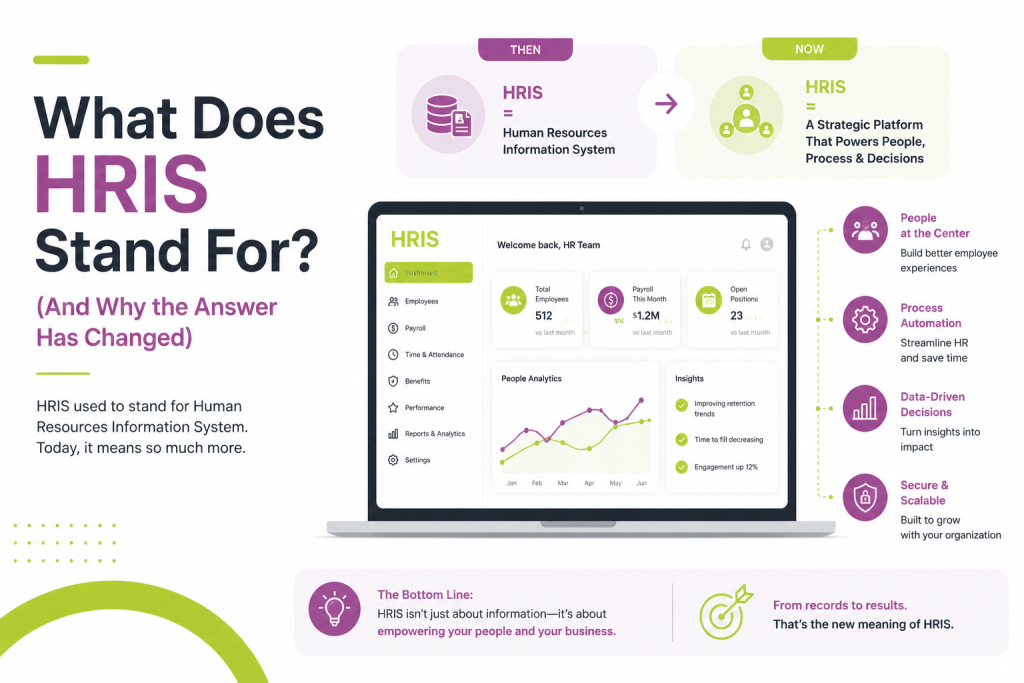
Ask someone in HR what HRIS stands for and they’ll tell you without hesitating: Human Resource Information System. Simple enough. But ask them what an HRIS actually is today, and the answer gets complicated fast.
Because the term hasn’t kept pace with the technology. What HRIS described twenty years ago — a digital filing cabinet for employee records — barely resembles what modern platforms do. The acronym stayed the same. The product didn’t.
TL;DR
- HRIS stands for Human Resource Information System — but the name undersells what modern platforms actually do.
- It started in the 1970s as digital personnel records on mainframes. Today it covers payroll, benefits, performance, analytics, and more.
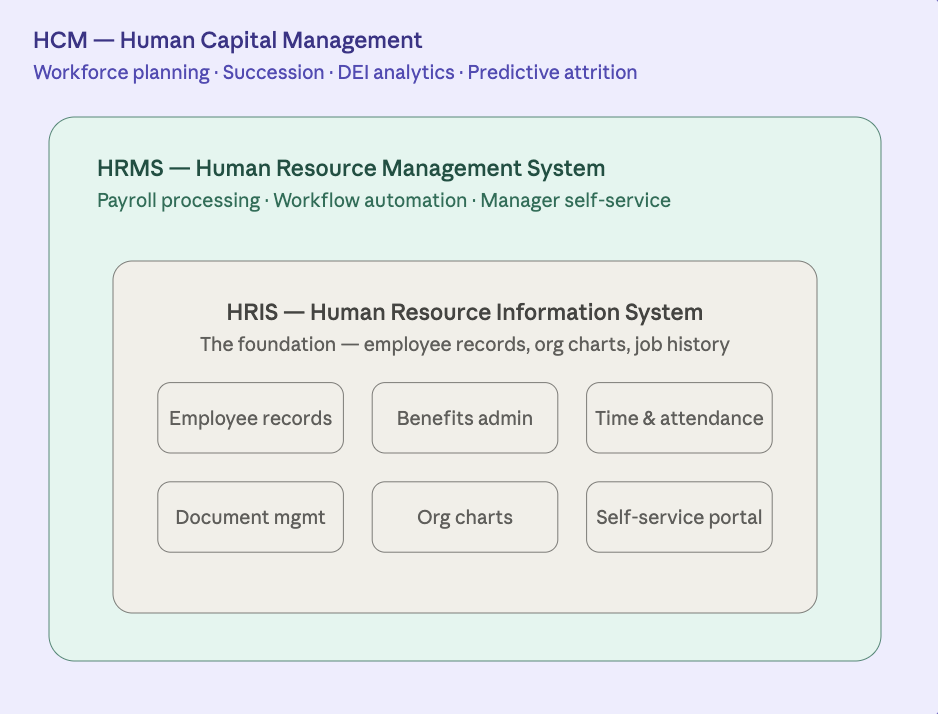
- HRIS, HRMS, and HCM are related terms. HRIS = core data. HRMS = adds process management. HCM = the full strategic suite.
- Most vendors use the terms loosely — what matters is the feature list, not the label.
- The acronym hasn’t changed in 50 years. The expectations behind it have changed completely.
The Literal Answer
HRIS = Human Resource Information System.
Breaking it down:
- Human Resource — it’s built for the people function of an organisation
- Information — it manages data: employee records, pay history, benefits, time off
- System — it’s a piece of software (or increasingly, a suite of software) that stores, processes, and retrieves that data
That’s the textbook definition. It’s accurate as far as it goes. But “information system” is doing a lot of heavy lifting for what these platforms have become.
Where the Term Came From
HRIS as a concept emerged in the 1970s and 1980s, when large organisations started moving personnel records off paper and onto mainframe computers. The original systems were exactly what the name implied: repositories of information. You could store an employee’s name, job title, start date, and salary. You could query that data and produce reports. That was genuinely transformative at the time.
Through the 1990s, client-server systems made HRIS more accessible to mid-size companies. Vendors like PeopleSoft built platforms that added payroll processing, benefits administration, and basic reporting. The term HRIS expanded to cover all of this, even as the systems grew far more complex.
By the 2000s, the market had fractured. You had pure-play payroll vendors, standalone applicant tracking systems, learning management platforms, and performance management tools — none of them talking to each other particularly well. HR departments managed a patchwork of systems, each with its own data model and login screen.
Why the Answer Has Changed
The shift happened in two waves.
The first wave was the cloud. When Workday launched in 2005 — built entirely on cloud architecture from the start — it redefined what an HR platform could be. Data lived in one place. Updates deployed automatically. Employees could access the system from anywhere. The old on-premise model, where IT maintained a server and upgrades happened every few years, started to look obsolete.
The second wave was scope. Vendors stopped thinking of themselves as systems of record and started positioning themselves as systems of engagement. Platforms absorbed functions that used to live in separate tools: performance reviews, learning and development, succession planning, employee engagement surveys, DEI analytics, headcount forecasting. The “information” in HRIS started to feel like an understatement.
This is why you’ll now hear three related terms used — sometimes interchangeably, sometimes with real intention behind the distinction:
HRIS — Human Resource Information System. Still widely used. Implies a focus on data management and core HR administration.
HRMS — Human Resource Management System. The “M” signals a broader scope — not just storing information, but managing processes. Payroll processing, workflow automation, manager self-service.
HCM — Human Capital Management. The most expansive framing. “Capital” positions employees as strategic assets to be developed, not just administered. HCM platforms typically include everything in an HRMS plus talent acquisition, learning, performance, and workforce planning.
In practice, most enterprise vendors — Workday, SAP SuccessFactors, Oracle HCM — use the HCM label. Mid-market platforms often call themselves HRIS or HRMS. The labels aren’t standardised across the industry, which is part of why the terminology confusion persists.
What Modern HRIS Actually Encompasses
If you buy what most vendors call an “HRIS” today, you’re likely getting:
Core HR — the original stuff. Employee records, org charts, job histories, document management. This is the foundation everything else builds on.
Payroll — either built in or tightly integrated. Gross-to-net calculations, tax filings, direct deposit, pay slip generation.
Benefits administration — enrolment, eligibility tracking, carrier integrations, open enrolment management.
Time and attendance — scheduling, leave management, overtime tracking, shift management for hourly workers.
Talent management — recruitment, onboarding, performance reviews, goal setting, learning and development. This is where HRIS bleeds into HCM territory.
Analytics and reporting — headcount dashboards, turnover analysis, compensation benchmarking, DEI metrics, predictive attrition modelling in the more advanced platforms.
Employee self-service — a portal (or increasingly, a mobile app) where employees update their own information, view pay stubs, request leave, and access HR policies without contacting the HR team directly.
The interesting thing is that none of this is “information” in the passive, storage sense the original acronym implied. It’s active workflow management, decision support, and employee experience design. The term HRIS has simply stretched to cover it all.
Does the Terminology Actually Matter?
For buying decisions, somewhat. If a vendor describes their product as a “core HRIS,” they’re probably signalling that talent management and advanced analytics aren’t their strength. If they lead with “HCM platform,” expect a broader feature set — and likely a higher price point and longer implementation.
For day-to-day usage, not really. Most HR professionals use HRIS as a catch-all for any system that manages employee data and HR processes, regardless of what the vendor calls it. When your colleague says “I’ll update it in the HRIS,” they don’t mean a bare-bones record-keeping tool from 1987. They mean whatever platform your organisation uses to run HR.
The more useful question isn’t what to call the system — it’s whether the system you have (or are evaluating) actually covers what your organisation needs it to do. The acronym won’t tell you that. The feature list will.
The Short Version
HRIS stands for Human Resource Information System. It started as digital personnel records in the 1970s. It evolved through client-server payroll systems in the 1990s, cloud platforms in the 2000s, and now encompasses everything from recruitment to predictive workforce analytics.
The term has stayed the same. The expectations behind it have changed completely. When someone asks what HRIS stands for today, the honest answer is: a lot more than the name suggests.