Every year, companies face the same high-stakes moment: determining what employees get paid. Whether it’s merit raises, bonuses, or equity refreshes, these decisions carry enormous weight for employee morale, talent retention, and the company’s bottom line. Yet despite this significance, many organizations stumble through the compensation cycle reactively, scrambling to make decisions without enough data, time, or clarity.
The compensation cycle is the structured, usually annual process through which a company reviews, adjusts, and communicates employee pay. When run well, it’s one of the most powerful levers HR leaders have, not just for budgeting, but for reinforcing a high-performance culture. When run poorly, it becomes a source of confusion, perceived unfairness, and unwanted attrition.
This article breaks down exactly how the compensation cycle works, walking through each stage of the timeline, and outlines the best practices that separate organizations that get it right from those that don’t.
TL;DR
The compensation cycle, explained in 60 seconds
- The compensation cycle is the annual process of reviewing, adjusting, and communicating employee pay — covering merit raises, bonuses, equity, and promotions.
- A well-run cycle starts 6–9 months before close, beginning with market benchmarking and budget forecasting — not a few weeks before managers need to submit.
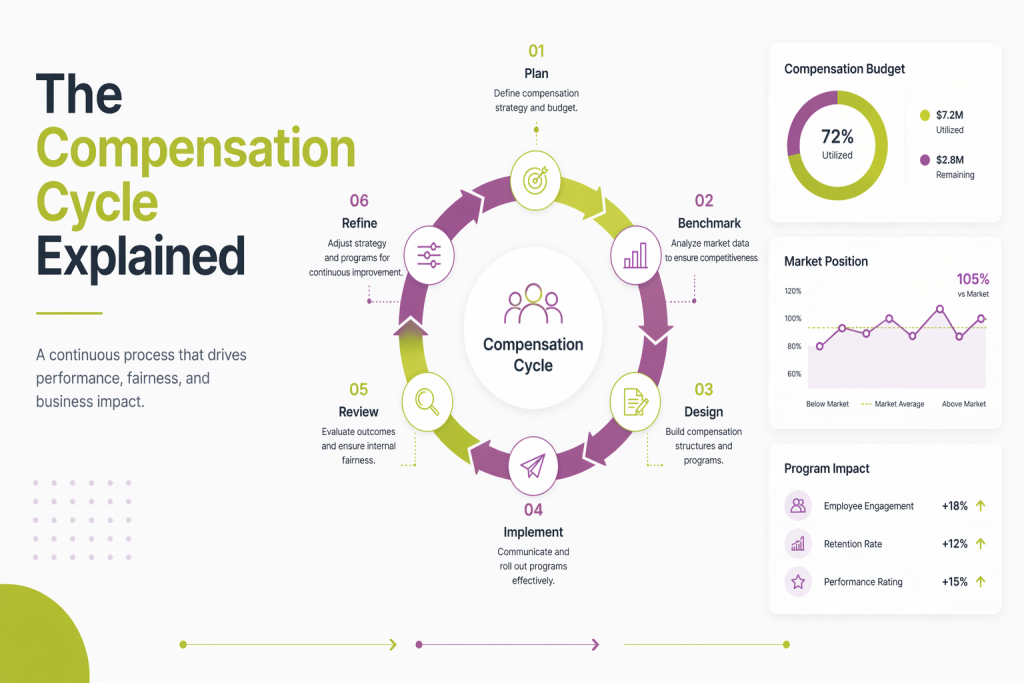
- The six key stages are: planning, manager calibration prep, active review window, cycle close, communication, and post-cycle review.
- The most common failure is starting too late — rushed cycles lead to inconsistent decisions, payroll errors, and damaged trust.
- Managers are the face of the cycle for employees; training them on both the process and the conversations is non-negotiable.
- Pay equity analysis should happen before the cycle closes, while budget is still available to fix gaps — not after.
- The communication phase matters as much as the numbers — employees remember how the conversation was handled, not just the outcome.
- Every decision should be documented; compensation choices carry legal and compliance implications.
What is the Compensation Cycle?
The compensation cycle is the formal process by which an organization reviews and adjusts how it pays its people. While the specifics vary by company size, industry, and structure, it typically runs on an annual cadence and touches several interconnected components: merit increases (raises tied to performance), variable pay (bonuses and incentives), equity refreshes (stock grants for eligible employees), and promotion-linked pay changes.

It’s important to distinguish the compensation cycle from a simple “raise season.” A well-designed cycle is a strategic process, not just a payroll update. It connects directly to how the company thinks about performance, talent development, and its position in the labor market. A strong year of business results, for example, might expand the merit budget. A shift in market benchmarks might trigger compression adjustments for certain roles, even outside the normal cycle.
The compensation cycle also doesn’t exist in isolation. It sits at the intersection of several other HR processes, including the annual performance review cycle, workforce planning, and finance’s budgeting calendar. Timing these processes well, so that performance data is ready before managers make pay recommendations, and that budget approvals are secured before communications go out, is one of the defining challenges of running a smooth cycle.
For HR leaders, managers, and employees alike, understanding what the cycle includes and how its parts connect is the foundation for everything that follows.
The Compensation Cycle Timeline, Stage by Stage
Few things derail a compensation cycle faster than starting too late. The timeline below reflects a best-practice approach, working backward from the point when employees receive their updated pay.
Planning and benchmarking
6–9 months before cycle close
Manager calibration prep
3–6 months before cycle close
Active review window
1–3 months before cycle close
Cycle close and decision lock
Final approvals, HRIS entry, payroll handoff
Communication phase
Manager conversations and total comp statements
Post-cycle review
After close — analyze outcomes and capture lessons
6 to 9 Months Before Cycle Close: Planning and Benchmarking
The groundwork for a successful compensation cycle is laid well before most managers even know it has begun. At this stage, HR and total rewards teams are pulling external market data, typically through compensation surveys from providers like Radford, Mercer, or Willis Towers Watson, to understand how the company’s pay ranges stack up against the competition. If roles have drifted below market, this is the moment to flag it.
Alongside benchmarking, the finance and HR partnership kicks off budget forecasting. How much of payroll can be allocated to merit increases? What’s the expected bonus pool? Are there planned headcount changes that will affect the overall compensation spend? These questions need early answers so leadership can make informed decisions when the cycle opens.
This phase is also the right time to revisit the company’s compensation philosophy, the documented principles that guide how the organization pays relative to the market, how it differentiates pay for performance, and what role equity plays in total compensation. If the philosophy hasn’t been reviewed recently, the cycle is a natural forcing function.
Also read: Top Compensation Platforms for Scaling Teams (2026)
3 to 6 Months Before Cycle Close: Manager Calibration Prep
With budget parameters taking shape, attention shifts to the people who will actually make pay recommendations: managers. This stage involves aligning the performance review process with compensation eligibility, so that performance ratings feed cleanly into merit increase guidelines.
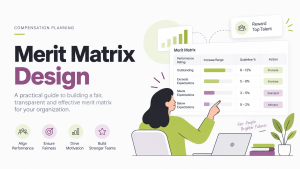
HR teams typically build out merit matrices during this window, tools that map performance ratings to recommended pay increase ranges within a given budget. Managers need to be trained on how to use these tools, what documentation is required, and what the approval process looks like. Organizations that skip this training often find themselves with inconsistent recommendations and a painful calibration process later.
1 to 3 Months Before Cycle Close: The Active Review Window
This is the phase most people associate with “comp season.” Managers log into the HRIS or compensation planning tool and submit their recommendations for merit increases, bonuses, and promotions. The window is usually open for two to four weeks, with HR running regular completion reports to chase down stragglers.
Once submissions are in, HR and HR business partners conduct calibration sessions with leadership, reviewing recommendations for consistency, identifying outliers, and ensuring the overall spend stays within budget. This is where equity issues often surface. A manager who has consistently under-rated certain employees, for example, may inadvertently create pay gaps that become visible only at this stage.
Approvals then move up the chain, through HRBPs, finance, and senior leadership, before the cycle is locked.
Cycle Close and Decision Lock
Once final approvals are secured, the data is entered into the HRIS and handed off to payroll for processing. The effective date, the date employees will see the change reflected in their paychecks, is coordinated carefully to avoid payroll errors or premature leaks. This stage requires tight collaboration between HR, finance, and payroll teams, with clear ownership of each step.
The Communication Phase
Arguably the most human part of the entire cycle, the communication phase is where managers sit down with each employee to discuss their compensation outcome. This is not a formality. Employees remember these conversations long after the numbers have faded. A manager who can explain the rationale behind a pay decision, connect it to performance, and acknowledge the employee’s contribution will build far more trust than one who simply reads out a number and moves on.
Supporting materials matter here too. Total compensation statements, which lay out base pay, bonus, equity, and benefits in one place, help employees see the full picture of what they earn, not just their base salary.
Post-Cycle Review
Once the dust has settled, the best HR teams take time to analyze how the cycle went. Was the budget maintained? Were there pockets of inequity that need to be addressed off-cycle? Where did the process break down, and what needs to change for next year? Capturing these lessons while they’re fresh is one of the highest-value activities a total rewards team can do, and one of the most commonly skipped.
Also read: Compensation Structure Explained (With Examples + Templates)
Common Pitfalls to Avoid
Even well-resourced HR teams can run into trouble during the compensation cycle. Most failures are not random. They tend to cluster around the same recurring mistakes.
Starting too late. The most common pitfall is also the most avoidable. When planning begins only a few weeks before the review window opens, there is no time for proper benchmarking, manager training, or thoughtful calibration. Decisions get rushed, approvals get compressed, and errors make their way into payroll. Building a backward-looking timeline from the effective date, and sticking to it, is the single most impactful thing an HR team can do to improve cycle quality.
Leaving managers underprepared. Managers are the face of the compensation cycle for employees, but they are often the least prepared participants in it. Without clear guidance on how to use merit matrices, how to talk about pay decisions, and what they can and cannot say, managers default to vague or misleading explanations that erode employee trust. Training is not optional.
Disconnecting performance from pay. When performance ratings are finalized in one system and compensation decisions happen in another, with no clear link between them, the cycle loses credibility. Employees who receive a strong performance review but a modest raise will reasonably question whether performance actually matters. Aligning these two processes, in both timing and data flow, is essential.
Ignoring pay equity until it becomes a problem. Many organizations treat pay equity as an audit exercise rather than a cycle input. By the time inequities surface through an employee complaint or a legal challenge, they are expensive and damaging to fix. Running a pay equity analysis before the cycle closes, not after, allows corrections to be made proactively and within the existing budget.
Poor communication at the finish line. A technically flawless cycle can still fail if the communication phase is handled carelessly. Employees who receive no context for their pay outcome, or who hear about it through a form letter rather than a conversation, are left to fill in the gaps themselves. That rarely ends well.
Also read: 7 Compensation Strategy Examples That Actually Work
Best Practices for Running a Smooth Compensation Cycle
Getting the compensation cycle right is less about having the perfect technology or the largest budget, and more about building disciplined habits that compound over time.
Anchor decisions to a compensation philosophy
Pay decisions made without a clear philosophy feel arbitrary to everyone involved. A well-articulated philosophy answers the foundational questions: where the company aims to pay relative to the market, how performance differentiates pay, and what role equity plays in total compensation. When actively referenced during the cycle, it gives HR, managers, and leadership a shared framework for making and explaining decisions.
Start benchmarking earlier than feels necessary
Market data has a shelf life. Pulling and analyzing benchmarking data six to nine months before cycle close ensures that pay range adjustments can be factored into budget planning, not bolted on at the last minute.
Treat manager training as non-negotiable
The quality of compensation conversations will only ever be as good as the preparation managers receive. Train them not just on the mechanics of the planning tool, but on how to discuss pay with empathy, handle pushback, and explain a decision an employee may be disappointed by.
Move off spreadsheets
Spreadsheets are fragile at scale. Dedicated compensation planning tools provide audit trails, approval workflows, and real-time budget visibility that shared files simply cannot match.
Run a pay equity analysis before the cycle closes
Reviewing pay equity data while budget is still available to make corrections is fundamentally different from reviewing it afterward. Making equity analysis a standard step in the cycle, with clear ownership and a defined threshold for action, is how organizations build pay fairness over time.
Document everything
Compensation decisions carry legal and compliance implications. Maintaining clear records of recommendations, approvals, and the rationale behind exceptions protects the organization and creates an invaluable reference point when questions arise down the line.
Conclusion
The compensation cycle is one of the most consequential processes an HR team runs each year. Done well, it signals to employees that their contributions are seen and that pay decisions are fair and deliberate. Done poorly, it quietly drives disengagement and attrition in ways that are hard to trace back to the source.
Most of what makes a cycle successful is not complicated. It comes down to starting early, connecting the right processes together, preparing managers properly, and communicating with care. Organizations that build these habits find that each cycle gets smoother, and that employees grow to trust the process even when the outcome is not what they hoped for.
If your current cycle feels rushed or inconsistent, the best time to fix it is before the next one begins.
FAQs-
How long does a typical compensation cycle take?
Most organizations run a compensation cycle that spans three to four months from the opening of the manager review window to the point when employees receive updated pay. However, when you factor in the planning, benchmarking, and budget approval work that should happen beforehand, the full process runs closer to six to nine months end to end.
How often should a company run a compensation cycle?
Most companies run one main cycle per year, often timed to align with either the fiscal year or the performance review calendar. Some organizations run a second, lighter cycle mid-year to address promotions, market adjustments, or retention situations that cannot wait.
Who owns the compensation cycle?
Total rewards or compensation teams within HR typically own the process design and administration. HR business partners manage the manager-facing elements, while finance owns budget approval. Senior leadership signs off on final decisions. It is a cross-functional process, and clear ownership of each stage is essential.
What is a merit matrix?
A merit matrix is a tool that maps employee performance ratings to recommended pay increase ranges, within a defined budget. It helps managers make consistent, defensible pay decisions rather than relying on gut feel or negotiation.
How should managers handle difficult compensation conversations?
Managers should prepare in advance, know the rationale behind the decision, and connect the outcome to specific performance observations. They should expect pushback and listen without becoming defensive. What employees want most is to feel heard and to understand the reasoning, even if they disagree with the result.
What is the difference between a merit increase and a cost of living adjustment?
A merit increase is tied to individual performance and is intended to reward contribution. A cost of living adjustment, or COLA, is applied broadly to help employees maintain purchasing power as prices rise. The two serve different purposes and should not be conflated in manager communications.