Most compensation strategies are built reactively. A counteroffer here, a market adjustment there, a ping-pong table that nobody asked for. The result is a patchwork system that costs a lot and signals very little.
Here’s the uncomfortable truth: your compensation strategy is one of the loudest things your company says to its people. It tells them what you value, how much you trust them, and whether you see them as partners or expenses.
The good news? A handful of companies have cracked this. Not with unlimited budgets, but with intentional design. In this article, we break down 7 compensation strategies that actually move the needle on retention, performance, and culture, with real-world examples you can borrow from.
TLDR
7 Compensation Strategies That Actually Work
-
Performance-based pay — tie bonuses to clear KPIs, not manager gut feel
-
Equity compensation — vesting schedules turn employees into owners
-
Skills-based pay — reward what people can do, not just what their title says
-
Total comp transparency — show the full picture, not just the salary line
-
Flexible benefits — let people spend their benefits budget how they actually want
-
Market-indexed pay — benchmark proactively before people start looking elsewhere
-
Team-based incentives — reward collective outcomes, not just individual numbers
The common thread: all 7 strategies are intentional, not reactive.
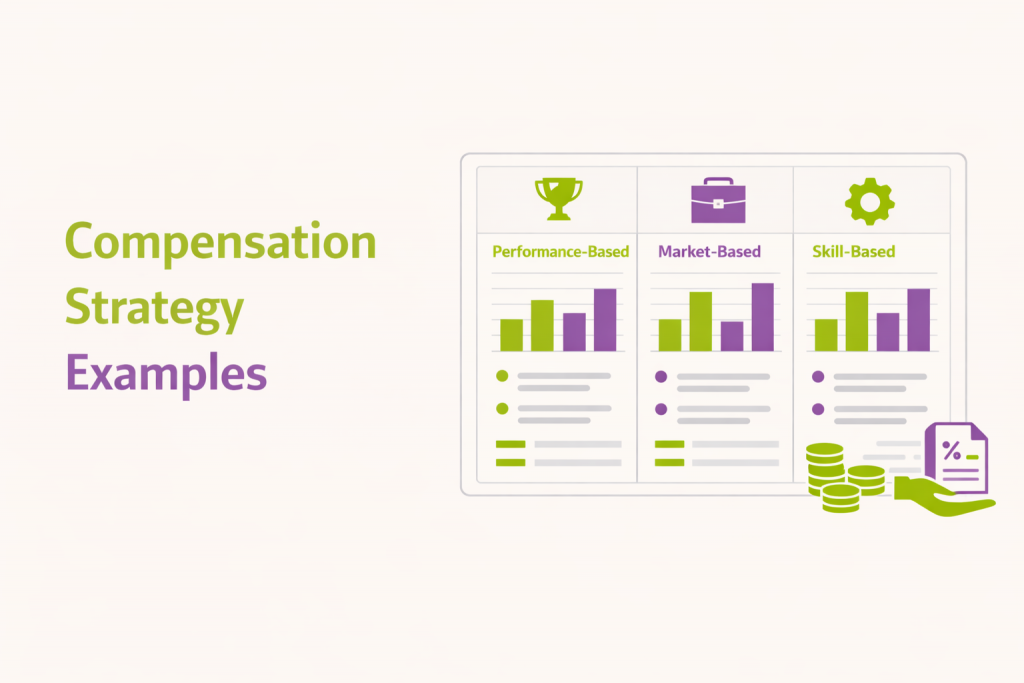
7 Compensation Strategy Examples
That Actually Work
Performance-Based Pay
Tie bonuses and raises to clear, measurable KPIs — not manager discretion.
Example: Salesforce quota attainment with tiered accelerators
Equity Compensation
Stock options, RSUs, or phantom equity with vesting schedules that align employee goals with company growth.
Example: Startups using 4-year vesting to retain top talent
Skills-Based Pay
Tie compensation to verified competencies, not just job titles. Reward people for learning what the business actually needs.
Example: IBM rewarding employees for AI and cloud certifications
Total Compensation Transparency
Make the full picture visible — salary, equity, benefits — with a clear annual total compensation statement.
Example: Buffer’s public salary formula eliminates pay anxiety
Flexible Benefits
Give employees a stipend to allocate across benefits themselves — childcare, wellness, home office, or student loans.
Example: Spotify’s monthly wellness stipend across open categories
Market-Indexed Pay
Benchmark continuously against live market data and adjust salary bands before gaps become resignation letters.
Example: Using Radford or Mercer data to update salary bands annually
Team-Based Incentives
Tie a portion of variable pay to collective team or department outcomes, not just individual performance.
Example: Google’s OKR-linked team rewards foster collaboration
1. Performance-Based Pay with Transparent Metrics
The concept is simple: people should know exactly what they need to do to earn more. Yet most companies still tie raises and bonuses to manager discretion, annual reviews, or vague notions of “impact.” That ambiguity breeds resentment, not motivation.
Performance-based pay works when the metrics are clear, measurable, and within the employee’s control. Salesforce is a strong example here. Their sales compensation model ties bonuses directly to quota attainment, with tiered accelerators that kick in once a rep crosses 100%. Everyone knows the number, everyone knows the reward. There is no guessing.
This approach works beyond sales too. Engineering teams can be incentivized on shipping velocity and quality scores. Customer success teams on net revenue retention. The key is building metrics that reflect real business outcomes, not just activity.
For executives considering this model, the priority is designing the metrics before setting the rewards. Poorly chosen KPIs can drive the wrong behavior fast. But when done right, performance-based pay removes subjectivity from compensation conversations and replaces it with something far more powerful: clarity.
Also read: How Compensation Budgeting Software Improves Cost Control
2. Equity Compensation for Long-Term Retention
Salary gets people in the door. Equity makes them want to stay and build something.
Equity compensation, whether through stock options, RSUs, or phantom equity for private companies, aligns what is good for the employee with what is good for the business. When people have a real stake in the outcome, their relationship with work changes. They stop thinking like hired hands and start thinking like owners.
Startups have used this playbook for decades, but it is increasingly relevant for mid-size and growth-stage companies too. A well-structured vesting schedule, typically four years with a one-year cliff, creates a natural retention mechanism without requiring a bloated base salary. The employee stays to earn what they were promised, and the company retains talent through critical growth phases.
The mistake most companies make is treating equity as an afterthought, something buried in the offer letter that nobody explains. The executives who get this right treat equity conversations as a core part of the compensation pitch. They walk candidates through the math, explain the upside scenario, and revisit it during performance reviews.
Equity is not just a financial instrument. Used well, it is one of the most effective culture tools a company has.
Also read: Best HR Compensation Software in 2026 (Compared)
3. Skills-Based Pay
Most compensation structures are built around job titles. The problem is that titles are a poor proxy for actual value. Two people with the same title can have wildly different capabilities, and paying them the same way ignores that reality entirely.
Skills-based pay flips the model. Instead of tying compensation to a role, it ties compensation to verified competencies. Employees earn more as they acquire and demonstrate skills that matter to the business. The result is a workforce that is actively incentivized to grow, rather than one that is waiting for a promotion to unlock the next pay band.
Manufacturing companies were early adopters of this model, paying workers more as they became certified on additional equipment or processes. But the approach has gained serious traction in tech as well. Companies like IBM have experimented with competency frameworks that reward employees for building skills in high-demand areas like AI, cloud infrastructure, and cybersecurity, regardless of their current job title.
For executives, the business case is straightforward. Skills-based pay reduces hiring costs by developing talent internally, future-proofs the workforce against market shifts, and signals to employees that growth is rewarded in concrete, not just symbolic, ways.
The investment is in building a credible, well-maintained skills framework. That is the hard part. But companies that do it well end up with a more agile, more motivated workforce than those still handing out raises based on tenure alone.
4. Total Compensation Transparency
Most employees have no idea what they actually earn. They know their salary, maybe their bonus target, and that there is some health plan involved. Everything else, retirement contributions, equity value, learning budgets, wellness benefits, gets lost. And what gets lost does not get appreciated.
Total compensation transparency is about making the full picture visible. When employees see the complete number, their perception of their own pay often shifts significantly.
Buffer is the most cited example here. The company publishes its salary formula publicly, eliminating the whisper network around salaries and the anxiety of not knowing if you are paid fairly relative to peers.
For companies not ready to go fully public, the practical starting point is a total compensation statement. A clear annual document breaking down every component of what an employee earns. Done well, it reframes the conversation from “I only got a 3% raise” to “the company invested $94,000 in me this year.”
It also has a compliance benefit. With pay equity legislation tightening across the US and Europe, companies with clean, documented compensation structures are far better positioned than those scrambling to explain inconsistencies later.
5. Flexible Benefits as Compensation
A benefits package designed in 2010 does not fit a workforce in 2024. A 28-year-old remote employee in Austin has different needs than a 42-year-old parent in Chicago. Offering both the same fixed benefits package means you are probably missing the mark for both of them.
Flexible benefits, sometimes called benefits wallets or lifestyle spending accounts, give employees a set budget they allocate themselves. One person puts it toward childcare. Another uses it for a home office setup. Another applies it to student loan repayments. The company spends the same amount either way, but the perceived value goes up significantly because the benefit is actually useful.
This model has grown quickly among companies managing distributed and multigenerational workforces. Spotify, for example, offers employees a monthly wellness stipend they can spend across a wide range of categories rather than locking them into a single vendor or program.
The executive takeaway is a simple one. Flexibility is not a cost, it is an efficiency. You stop paying for benefits people ignore and start delivering compensation that people actually factor into their decision to stay.
6. Market-Indexed Pay Adjustments
Most companies do salary benchmarking once a year, if at all. By the time the data is reviewed, acted on, and reflected in paychecks, it is already outdated. Meanwhile, your best people have been approached by competitors offering 20% more, and they are quietly weighing their options.
Market-indexed pay means continuously benchmarking compensation against live market data and adjusting salary bands before gaps become resignation letters. Companies that do this well use platforms like Radford, Mercer, or Levels.fyi to track what the market is paying for specific roles in specific geographies, and they build that data into their annual compensation cycles proactively.
The retention math here is straightforward. Replacing a senior employee costs anywhere from 50% to 200% of their annual salary when you factor in recruiting, onboarding, and lost productivity. A proactive 8% market adjustment is almost always cheaper than the alternative.
The cultural signal matters too. When employees know their company watches the market on their behalf, the job search itch is easier to resist. They do not need to go get an offer to find out if they are being paid fairly. That trust is worth more than most executives realize.
7. Team-Based Incentive Programs
Most incentive structures are built around the individual. Hit your number, get your bonus. The problem is that most meaningful work is not done by individuals. It is done by teams, and a compensation model that only rewards individual performance can quietly erode the collaboration that makes teams effective in the first place.
Team-based incentives tie a portion of variable compensation to collective outcomes. A product team hits its launch milestone. A customer success team crosses a net retention target. A business unit delivers on its quarterly OKR. Everyone who contributed shares in the reward.
Google has long used OKR-linked team rewards as part of its broader compensation philosophy. The logic is that when people are measured and rewarded together, they are more likely to help each other succeed rather than protect their own numbers.
The design details matter here. The goals need to be ambitious but achievable, the contribution of each team member needs to feel meaningful, and the payout needs to be significant enough to actually motivate. A $200 team bonus does not move anyone. A meaningful percentage of salary tied to a goal people genuinely care about does.
For executives, team-based incentives are also a useful diagnostic tool. If a team consistently misses its collective targets, that is a signal worth investigating, whether it points to goal-setting problems, resourcing gaps, or leadership issues.
The Common Thread
Look across all seven strategies and one pattern stands out. None of them are about spending more. They are about spending with intention.
The companies getting compensation right are not necessarily the ones with the biggest budgets. They are the ones that have decided compensation is a strategic lever, not an HR administrative function. They design their systems deliberately, communicate them clearly, and revisit them regularly.
If there is one place to start, it is an honest audit of your current approach. Ask whether your compensation strategy is reactive or proactive. Ask whether your employees understand what they earn and why. Ask whether the structure you have today would make a high performer want to stay or start looking.
Compensation is a message. The seven strategies in this article are just different ways of making sure that message says the right thing.
FAQs-
Where should a company start if it has never had a formal compensation strategy?
Start with transparency. Before redesigning pay structures or adding incentive programs, make sure leadership has a clear picture of what everyone is currently earning and why. Most companies discover inconsistencies at this stage that need to be addressed before anything else.
How often should compensation strategies be reviewed?
At minimum, once a year. But market-indexed companies are moving toward continuous benchmarking, especially for roles in high-demand fields like engineering, data, and product. Annual reviews are a floor, not a ceiling.
Can smaller companies realistically offer equity compensation?
Yes. Private companies can use phantom equity or profit-sharing arrangements that mimic the upside of stock ownership without requiring a formal equity structure. It is more accessible than most founders assume.
How do you prevent team-based incentives from penalizing high performers on underperforming teams?
Design matters here. Most effective programs blend individual and team components, so a strong performer is not entirely dependent on their team’s outcome. A common split is 60% individual, 40% team.
What is the biggest mistake companies make with compensation strategy?
Treating it as a retention tool only after someone hands in their notice. By that point, the cost is already paid, whether you keep them or not. The companies that win on compensation are the ones acting before there is a problem to solve.