For most organizations, payroll and compensation aren’t just the largest line item on the budget sheet, they represent 50 to 70 percent of total operating expenses. Getting this number wrong, even slightly, has real consequences for the bottom line.
Yet many HR and finance teams are still managing this critical spend through a tangle of spreadsheets, email chains, and manual data consolidation. Managers work from different file versions. Approvals get lost. By the time data is reconciled across departments, the planning window has already closed and the budget has already drifted.
Compensation budgeting software changes this equation. Rather than treating compensation planning as an annual administrative exercise, modern platforms give HR and finance leaders real-time visibility, structured workflows, and the analytical tools to make smarter decisions before costs get out of hand.
This article breaks down exactly how that works, and why organizations that invest in the right software consistently get more control over one of their most significant and least predictable expenses.
Compensation is your largest cost. Here is how the right software helps you control it.
- Manual spreadsheet-based planning causes version errors, budget overruns, and compliance gaps that compound quietly over time.
- Real-time dashboards give HR and finance a live view of spend so they can course-correct mid-cycle, not after the fact.
- Scenario modeling lets teams simulate merit increases, promotions, and headcount changes before committing budget.
- Pay-for-performance workflows concentrate spend where it matters most, making the same budget go further.
- Automated calculations and audit trails eliminate costly errors and reduce legal exposure around pay decisions.
- Pay equity analytics catch disparities during planning, not after a lawsuit or an audit.
The bottom line: Organizations that control compensation costs aren’t the ones with the biggest budgets. They are the ones who know exactly where every dollar is going, why it is going there, and what return they are getting on it.
The Real Cost of Manual Compensation Planning
Before exploring what compensation budgeting software can do, it helps to understand what manual processes actually cost organizations, beyond the obvious inconvenience.
The most visible problem is version control. When compensation planning lives in spreadsheets, multiple copies circulate across managers, HR business partners, and finance teams simultaneously. Each person is working from a slightly different snapshot of the data. Decisions get made on stale numbers, and reconciling everything at the end of the cycle takes hours, sometimes days, of rework.
Then there are calculation errors. Manual formulas break. Data gets entered in the wrong fields. A misplaced decimal or an outdated salary figure can cascade into payroll corrections, overpayments, and in some cases, compliance violations that carry financial penalties.
The deeper issue, though, is the lack of real-time visibility. Without a live view of where budget is being allocated, finance teams are essentially flying blind until the planning cycle closes. By then, overspending has already happened. There is no opportunity to course-correct mid-cycle because no one could see it coming.
There is also a governance gap. When pay decisions live in spreadsheets passed around over email, there is no reliable audit trail. If a compensation decision is later challenged, whether internally or legally, organizations struggle to show who approved what and when. That exposure is a cost in itself, even when nothing goes wrong.
Also read: Best HR Compensation Software in 2026 (Compared)
Real-Time Budget Visibility and Control
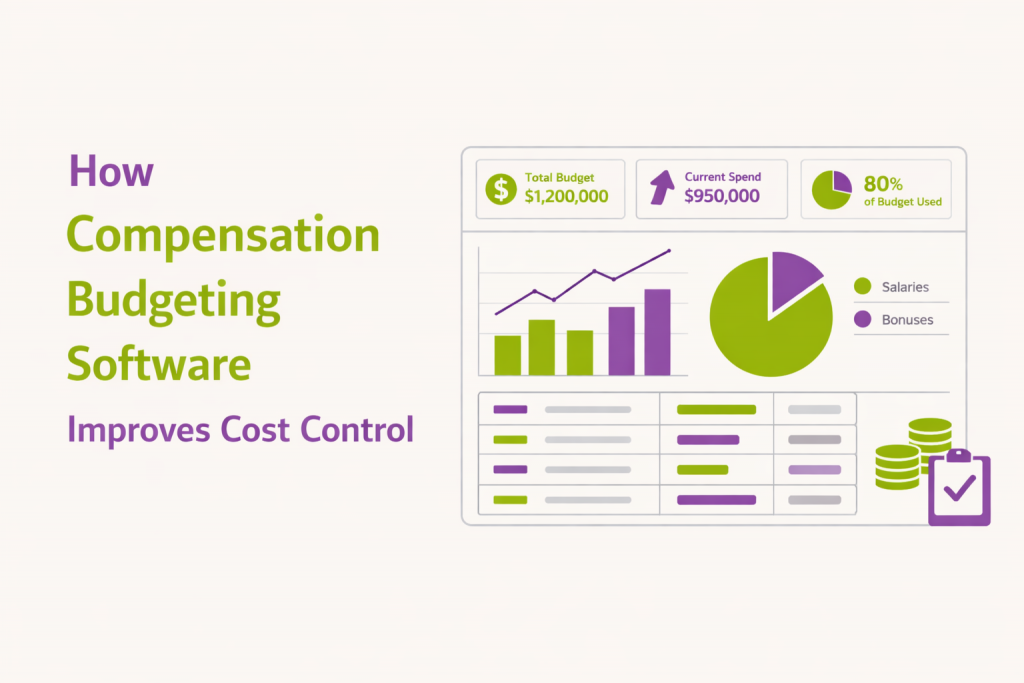
The most immediate cost-control benefit of compensation budgeting software is visibility. Not a monthly report, not a post-cycle summary, but a live view of how compensation spend is tracking against budget as decisions are being made.
This changes the dynamic for both HR and finance. Instead of waiting until all manager inputs are collected and consolidated, leaders can see budget utilization by department, location, job grade, or pay tier at any point in the planning cycle. If one team is trending over their allocation, that is visible early enough to act on, not after the fact.
Modern platforms set budget allocations for each team with real-time tracking and spend projections based on pay guidelines, so managers are working within defined guardrails rather than making decisions in isolation. When a manager submits a proposed increase that would push their team over budget, the system flags it immediately rather than letting it slip through to payroll.
Role-based access adds another layer of control. Finance leaders can see the full picture across the organization. HR business partners see what is relevant to their teams. Managers see only their own budgets. Sensitive compensation data stays protected while the right people still have the information they need to make good decisions.
This kind of structured, real-time visibility is what separates organizations that control compensation costs from those that simply react to them at the end of every cycle.
Also read: What is Total Compensation Software? Features, Benefits, and Top Tools
Scenario Modeling and Forecasting
Visibility into current spend is valuable. But the organizations with the tightest control over compensation costs are the ones that can see around corners, modeling the financial impact of decisions before they are made.
This is where scenario modeling and forecasting tools become critical.
Before committing to a merit cycle, a compensation budgeting platform lets HR and finance teams run multiple “what-if” simulations. What happens to total payroll if merit increases average 4 percent instead of 3? What is the cumulative cost of promoting 15 percent of the engineering team this quarter? How does adding 20 new hires in Q3 affect the compensation budget through the end of the fiscal year? These questions used to require hours of manual modeling. Modern platforms answer them in minutes.
Some tools let organizations build entirely different compensation plan variants side by side, simulating different reward philosophies and budget impacts simultaneously, so leaders can compare outcomes and choose the approach that best aligns with both talent goals and financial constraints.
Forecasting goes beyond the current cycle as well. By projecting how merit increases, promotions, and headcount changes will affect total payroll costs over the next six to twelve months, finance teams can build compensation assumptions into broader workforce planning with far greater accuracy.
The practical result is that organizations stop approving compensation decisions based on gut feel or incomplete data. Every commitment comes with a clear picture of what it will actually cost.
Also read: What is Compensation Planning? A Complete Guide for HR Leaders
Pay-for-Performance Alignment Reduces Wasteful Spend
One of the most significant and least discussed sources of compensation waste is the blanket raise. When organizations distribute increases uniformly across the board, regardless of individual performance, they spend the same budget dollars retaining a top performer as they do on someone who is underdelivering. That is not cost control. That is cost diffusion.
Compensation budgeting software solves this by connecting pay decisions directly to performance data. The financial impact shows up in several concrete ways:
- Merit matrices do the heavy lifting. Budget limits, performance review ratings, and compa-ratios are built into the platform together, so increase recommendations are generated systematically rather than left to individual manager judgment.
- Performance and pay stay connected. When a manager submits a performance rating, that data flows automatically into the compensation cycle, shaping the increase recommendation without any manual handoff.
- Budget concentrates where it matters most. Instead of spreading increases thinly and uniformly, organizations direct spend toward top contributors where it has the highest retention and performance impact.
- Lump sum options add flexibility. For employees at the top of their pay grade, platforms can automatically recommend lump sum payments rather than base increases, protecting long-term payroll costs while still rewarding performance.
The bottom line is that pay-for-performance alignment makes the same budget envelope go further. For organizations serious about getting value from every dollar of compensation spend, it is not just a fairness initiative. It is a financial strategy.
Eliminating Errors and Rework Costs
Compensation errors are more expensive than they look. The direct costs are obvious: payroll corrections, overpayments that need to be recovered, and in some cases regulatory penalties for non-compliance. But the indirect costs add up quickly too, including the HR and finance hours spent tracking down mistakes, the manager time lost to re-approvals, and the employee trust that erodes when pay is handled inconsistently.
Compensation budgeting software attacks this problem at the source by removing the manual steps where errors are most likely to occur:
- Automated calculations replace manual formulas. Increase amounts, bonus payouts, and merit adjustments are computed by the platform, not by someone editing a cell in a spreadsheet at 11pm before a deadline.
- HRIS and payroll integration eliminates double entry. When compensation planning lives in the same ecosystem as payroll and employee records, data does not need to be re-keyed or imported manually. Changes flow through automatically, reducing the chance of transcription errors.
- Approval workflows catch problems before they become payroll issues. Rather than relying on someone to notice an anomaly in a spreadsheet, the system flags out-of-range recommendations and routes them for review before anything is finalized.
- Audit trails create accountability. Every change, approval, and adjustment is logged automatically, making it straightforward to trace any pay decision back to its source if questions arise later.
The cumulative effect is that HR and finance teams spend significantly less time on correction and reconciliation, and significantly more time on decisions that actually move the business forward.
Pay Equity as a Cost and Risk Management Tool
Pay equity is often framed as an HR initiative or a values statement. In practice, it is also a financial risk management issue, and one that is becoming harder to ignore.
Unaddressed pay disparities create exposure across several fronts:
- Litigation risk. Pay discrimination claims are costly to defend regardless of outcome, and settlements can run into the millions for larger organizations.
- Turnover costs. Employees who discover they are being paid inequitably relative to peers do not stay. Replacing a mid-level employee typically costs between 50 and 200 percent of their annual salary when recruiting, onboarding, and lost productivity are factored in.
- Regulatory pressure. Pay transparency laws are expanding rapidly across the US and EU, requiring organizations to document and justify compensation decisions with a level of rigor that manual processes simply cannot support.
Compensation budgeting software addresses this proactively rather than reactively. Pay equity analytics surface potential disparities across gender, race, location, and job level during the planning cycle itself, before decisions are finalized. Automated approval workflows can flag recommendations that fall outside acceptable ranges and route them for review before they are actioned.
This is a meaningful shift. Identifying and correcting a pay gap during the budgeting process costs relatively little. Correcting it after an audit, a lawsuit, or a wave of voluntary turnover costs significantly more.
For finance leaders especially, building pay equity tools into the compensation budgeting process is not just the right thing to do. It is the lower-risk, lower-cost path forward.
What to Look for in a Compensation Budgeting Tool
Not all compensation budgeting platforms deliver the same level of cost control. The features that separate genuinely useful tools from expensive shelfware come down to a handful of core capabilities:
What to look for in a compensation budgeting tool
6 capabilities that drive real cost control
Real-time dashboards
Live spend by team, department, or job grade with role-based access controls that protect sensitive data.
Scenario modeling
Simulate merit cycles, promotions, and headcount changes side by side before committing to a plan.
Merit matrix workflows
Links performance data directly to pay decisions through configurable, budget-aware merit matrices.
HRIS integration
Bidirectional sync with payroll and HR systems. No manual exports, no duplicate data entry.
Audit trails
Every pay decision logged automatically for compliance, pay equity reporting, and internal accountability.
Scalability
Multi-currency, multi-geography support that grows with your headcount without requiring a system change.
Find the tool that gives your HR and finance teams the visibility and structure to make compensation decisions that are both competitive and financially sustainable.
- Real-time budget dashboards. The platform should give HR and finance leaders a live view of compensation spend at any level of the organization, by team, department, location, or job grade, with role-based access controls that protect sensitive data.
- Scenario modeling and forecasting. Look for the ability to run multiple budget simulations before committing to a plan. The best tools let you model different merit increase percentages, promotion rates, and headcount changes side by side so you can see the full cost picture before anything is approved.
- Merit matrix and pay-for-performance workflows. The platform should connect performance data directly to compensation recommendations, with configurable merit matrices that reflect your budget constraints and reward philosophy.
- HRIS and payroll integration. A compensation tool that sits outside your core HR and payroll systems creates the same data silos you were trying to escape. Look for deep, bidirectional integration that keeps everything in sync without manual exports.
- Audit trails and compliance reporting. Every pay decision should be logged automatically, with reporting tools that make it straightforward to demonstrate compliance with pay equity and transparency requirements.
- Scalability. The right tool should handle your organization as it grows, supporting multiple currencies, geographies, and compensation structures without requiring a system change every few years.
The goal is not to find the platform with the longest feature list. It is to find the one that gives your HR and finance teams the visibility, structure, and confidence to make compensation decisions that are both competitive and financially sustainable.
Taking Control of Your Largest Cost
Compensation is not a cost that can be managed by instinct or approximation. When it represents the majority of an organization’s operating expenses, the planning process behind it needs to match the stakes.
What compensation budgeting software ultimately provides is control, not just over numbers, but over the entire decision-making process that produces those numbers. Real-time visibility prevents overruns before they happen. Scenario modeling replaces guesswork with data. Pay-for-performance workflows make every budget dollar work harder. Automated calculations and audit trails eliminate the errors and exposure that manual processes quietly accumulate over time.
The organizations seeing the strongest results are not necessarily the ones with the largest compensation budgets. They are the ones who know exactly where every dollar is going, why it is going there, and what return they are getting on it.
If your team is still managing compensation planning through spreadsheets and email threads, the gap between where you are and where you could be is larger than it might appear. Modern compensation budgeting software closes that gap, and the cost of getting it wrong keeps growing every year you wait.