Employee turnover rate is the percentage of employees who leave a company during a set period. To calculate it, divide the number of employees who left by the average number of employees, then multiply by 100. In the US, about 2% of workers quit their jobs in a typical month, according to the Bureau of Labor Statistics.
Turnover tells you how many people walked out the door. It doesn’t tell you why. This guide covers the turnover rate formula, how it differs from attrition rate, what a normal number looks like, and what HR and compensation teams can do when it starts to climb.
What Is Employee Turnover Rate?
Employee turnover rate measures how many employees left your organization over a period, as a share of your average headcount. Most companies track it monthly and annually.
Turnover includes every type of exit:
- Voluntary turnover: employees who resign or retire by choice
- Involuntary turnover: layoffs, terminations and dismissals
Most HR teams report both together and then split them out. Voluntary turnover is the number leaders usually care about most, because it’s the one pay, managers and culture can change.
How to Calculate Turnover Rate
Here is the turnover rate formula:
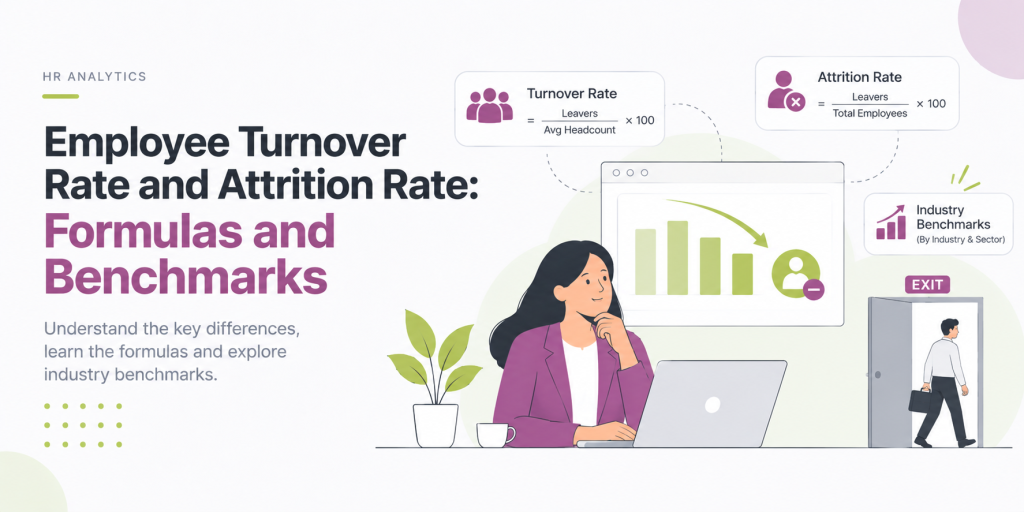
Turnover rate = (Number of employees who left ÷ Average number of employees) × 100
To find the average number of employees, add your headcount at the start and end of the period and divide by 2.
Example: A company starts the year with 480 employees and ends with 520. Its average headcount is
500. During the year, 60 employees left. Turnover rate = (60 ÷ 500) × 100 = 12%
You can use the same formula for any period. For a monthly turnover rate, use the number of exits that month and that month’s average headcount. To estimate an annual rate from monthly data, add the 12 monthly rates together.
To calculate voluntary turnover rate, use only resignations in the top half of the formula. Do the same with layoffs and terminations to get your involuntary turnover rate.
What Is Attrition Rate?
Attrition rate is the percentage of employees who leave and are not replaced. The role is left open or removed instead of being backfilled. Attrition usually comes from retirements, resignations or roles being phased out.
The attrition rate formula looks the same as the turnover formula:
Attrition rate = (Number of departures not backfilled ÷ Average number of employees) × 100
If 20 of the 60 people who left in the example above were never replaced, the attrition rate would be (20 ÷ 500) × 100 = 4%.
Turnover vs Attrition: What’s the Difference?
The main difference between turnover and attrition is whether the job gets filled again. Turnover counts every exit. Attrition counts only the exits that shrink the team.
| Turnover | Attrition | |
| What it counts | Every employee who leaves | Employees who leave and are not replaced |
| Headcount after | Stays about the same once roles are filled | Goes down |
| Common causes | Resignations, terminations, layoffs | Retirements, resignations, roles removed |
| Main cost | Hiring and training replacements | Lost skills and capacity |
| Typical use | Measuring retention problems | Planning headcount and budgets |
Many companies use the terms loosely. Pick one definition for each, write it down, and use it the same way in every report.
What Is the Average Turnover Rate?
The average turnover rate in the US is about 3.3% a month for all separations, and about 2% a month for quits alone. In September 2026, the Bureau of Labor Statistics reported 5.3 million total separations, a rate of 3.3%. Quits were 3.4 million, a rate of 2.1%, and layoffs and discharges were 1.0%.
For the full year 2025, US employers recorded 62.8 million separations, including 38.0 million quits and
21.2 million layoffs and discharges.
Averages vary a lot by industry. In January 2026, the monthly separations rate was 6.1% in accommodation and food services and 4.3% in professional and business services. A restaurant group and a software company should not judge themselves against the same number.
The most useful benchmark is your own history. Track the rate by department, level and manager over time, and look for groups that move away from the company average.
Why Employee Turnover Is Expensive
Gallup estimates that replacing one employee costs between half and two times that person’s annual salary. That covers recruiting, hiring, onboarding, lost output and the time it takes a new hire to get up to speed.
Gallup also found that 52% of employees who left voluntarily said their manager or company could have done something to keep them. A lot of turnover is preventable.
How Pay Affects Turnover
Pay is one of the most common reasons people leave, and one of the easiest for a company to see in its own data. These pay problems often show up before a resignation:
- Below-market pay: employees paid well under the market rate for their role. A low compa-ratio is an early warning sign.
- Pay compression: new hires earning close to, or more than, experienced staff. Read more on pay compression.
- Flat raises for top performers: strong performers get the same increase as everyone else.
- Unclear pay ranges: employees can’t see how to grow their pay without leaving.
Stello AI’s Market Pricing and Compensation Planning tools help HR teams spot these risks across the whole company, not one spreadsheet at a time. You can see who is paid below market, where compression is building, and how much a fix would cost before the next resignation lands.
How to Reduce Employee Turnover
- Measure turnover by group. A 12% company rate can hide a 30% rate in one team.
- Check pay against the market every year. Use current market data, not last year’s survey.
- Fix pay gaps before they become resignations. A targeted market adjustment usually costs less than replacing someone.
- Reward top performers clearly. Make sure merit increases and bonuses actually differ by performance.
- Train managers to talk about pay. Employees stay longer when they understand how pay decisions are made.
- Run exit and stay interviews. Ask what would make people stay, not only why they left.
Frequently Asked Questions
What is a good employee turnover rate?
A good employee turnover rate is one that is at or below the average for your industry and stable over time. The right target depends on your industry, workforce and growth stage, so compare yourself with companies like yours and with your own past numbers.
How do you calculate monthly turnover rate?
Divide the number of employees who left during the month by the average number of employees that month, then multiply by 100. The average is the starting headcount plus the ending headcount, divided by 2.
Is attrition the same as turnover?
No. Turnover counts every employee who leaves, whether or not they are replaced. Attrition counts only employees who leave and are not replaced, so headcount goes down.
What is the difference between voluntary and involuntary turnover?
Voluntary turnover happens when an employee chooses to leave, such as a resignation or retirement. Involuntary turnover happens when the employer ends the job, such as a layoff or termination.
Does pay affect employee turnover?
Yes. Employees who are paid below market, or who see new hires earning more than they do, are more likely to leave. Regular pay reviews against current market data help companies find and fix these gaps early.