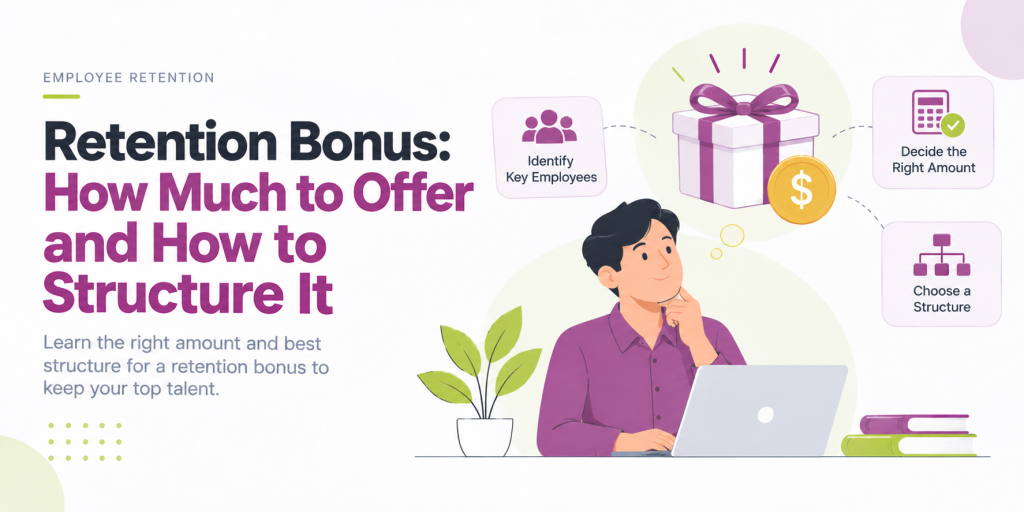
A retention bonus is a one-time payment a company offers an employee for staying through a set date or event, such as a merger, a product launch or a leadership change. Employees receive the bonus only if they are still employed when the retention period ends. In mergers and acquisitions, WTW found median retention bonuses of 30% of base salary for salaried employees, 50% for senior leaders and 75% to 100% for C-suite roles.
Used well, a retention bonus keeps critical people in place during a risky period. Used badly, it pays people to stay who were never going to leave, or masks a pay problem that will come back the day the bonus pays out.
What Is a Retention Bonus?
A retention bonus is a payment tied to staying, not to performance. The employee signs an agreement, stays for the retention period, and receives the bonus at the end. If they resign before then, they usually get nothing.
Companies most often use retention bonuses during:
- Mergers and acquisitions, to keep key staff through the integration
- Restructures and layoffs, to keep people needed for the transition
- Major projects, such as a system migration or product launch
- Leadership changes, to reduce exits while a new team settles in
- Hot talent markets, to keep employees with skills competitors are actively hiring for
How Much Should a Retention Bonus Be?
Most retention bonuses are set as a percentage of base salary. The amount should reflect how hard the person is to replace and how likely they are to leave.
WTW’s survey of acquiring companies gives a useful benchmark for M&A retention bonuses:
| Employee group | Median retention bonus (% of base salary) |
| C-suite to CEO | 75% to 100% |
| Other senior leaders | 50% |
| Other salaried employees | 30% |
Outside M&A, retention bonuses are often smaller because the risk is lower. To size one, ask three questions:
- What would it cost to replace this person? Gallup estimates replacement costs at half to two times annual salary.
- How likely are they to leave? Look at market demand for the role and whether their pay is below market.
- How long do you need them? Longer periods usually need larger bonuses.
How to Structure a Retention Bonus
The structure matters as much as the amount. WTW found that cash is the most common form: 86% of acquirers use cash retention bonuses for senior leaders and 80% for other salaried employees.
Restricted stock or other equity is used by 56% for senior leaders and 40% for other salaried employees.
Most retention agreements are time-based. WTW reported time-based vesting for 55% of senior leader agreements and 73% of other salaried agreements. Performance-only agreements are rare.
Common payout structures include:
- Single payout: paid in full at the end of the retention period.
- Split payout: part paid at a midpoint and the rest at the end.
- Time plus performance: part paid for staying and part for hitting a goal, such as completing an integration.
What to Include in a Retention Bonus Agreement
A retention bonus agreement should be signed by both sides and state:
- The bonus amount and how it is calculated
- The retention period and the exact payout date or dates
- Conditions the employee must meet, such as staying employed and in good standing
- What happens if the employee is laid off before the payout date. Many agreements still pay the bonus if the company ends the job without cause.
- What happens if the employee resigns or is fired for cause
- Confidentiality, since retention bonuses are usually offered to a small group
How Retention Bonuses Are Taxed
Retention bonuses are supplemental wages for federal tax purposes. Employers can withhold federal income tax at a flat 22% on supplemental wages up to $1 million a year, and must withhold 37% on amounts above $1 million. Social Security, Medicare and state taxes also apply.
When a Retention Bonus Is the Wrong Fix
A retention bonus solves a timing problem. It doesn’t fix pay that is below market. If an employee is underpaid, they will often leave soon after the bonus pays out.
Before offering a retention bonus, check where the employee’s pay sits. Stello AI’s Market Pricing and Compensation Planning tools show who is paid below market and how much a permanent market adjustment would cost compared with a one-time bonus. For long-term risk, a raise often works better. For a short, defined period, a retention bonus is usually the right tool.
Frequently Asked Questions
What is a retention bonus?
A retention bonus is a one-time payment given to an employee for staying with a company until a set date or event, such as the end of a merger or project. It is paid only if the employee is still employed at that time.
How much is a typical retention bonus?
In mergers and acquisitions, WTW found median retention bonuses of 30% of base salary for salaried employees, 50% for senior leaders and 75% to 100% for C-suite roles. Outside M&A, amounts are often lower and depend on how critical the employee is.
Do you get a retention bonus if you are laid off?
It depends on the retention bonus agreement. Many agreements pay the bonus if the employer ends the job without cause before the payout date. Employees who resign usually lose the bonus.
How long is a typical retention period?
Retention periods usually match the event the company needs to get through, such as the length of an integration or project. Many run from several months to two years.
Is a retention bonus taxed differently?
No. A retention bonus is taxed as income, but employers often withhold federal tax at the 22% supplemental rate, which can differ from regular paycheck withholding.