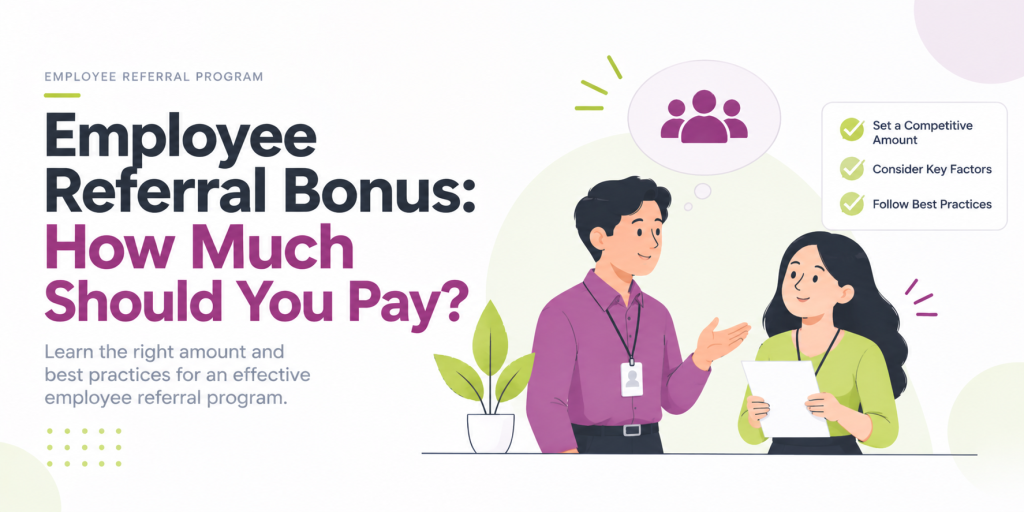
An employee referral bonus is a reward a company pays an employee who recommends a candidate who gets hired. Most referral bonuses are cash, and many companies pay more for hard-to-fill or senior roles. In a February 2024 survey of 52 US employers with referral programs, the AAIM Employers’ Association found an average referral bonus of $1,936 across all positions.
Referral bonuses work because they turn employees into recruiters. The trick is setting an amount that motivates people without paying more than the hire is worth.
What Is an Employee Referral Bonus?
An employee referral bonus is a payment, gift or other reward given to a current employee when someone they referred is hired and stays for a set period. It is part of an employee referral program, which sets the rules for who can refer, which roles qualify and when the bonus is paid.
Companies use referral programs because referred candidates come with a built-in endorsement. The employee already knows the person and the job, so the match is often stronger.
How Much Is a Typical Referral Bonus?
Referral bonus amounts usually rise with the difficulty and level of the role. The AAIM survey reported these averages:
| Job type | Average referral bonus |
| Production, maintenance and service (non-union) | $924 |
| Office, clerical and technical (non-exempt) | $2,397 |
| Supervisory, managerial and professional (exempt) | $2,536 |
| All positions | $1,936 |
The survey mostly covered small and midsize employers in the Midwest and Florida, so amounts in high-cost markets and specialized fields like software engineering or healthcare can run much higher.
How to Set Your Referral Bonus Amount
The simplest test: a referral bonus should cost less than your other ways of hiring for that role. Work it out in four steps.
- Find your cost per hire. Add up job ads, agency fees and recruiter time for the role.
- Set the bonus below that cost. A referral bonus that costs less than an agency fee saves money on every referred hire.
- Tier by role. Pay more for roles that are hard to fill or have high market demand, and less for roles you fill easily.
- Review every year. Adjust amounts when hiring needs or market demand change.
Example: An agency charges 20% of first-year salary to fill an $80,000 engineering role, a $16,000 fee. A $3,000 referral bonus fills the same role for less than a fifth of that cost.
When Should a Referral Bonus Be Paid?
Most companies pay referral bonuses only after the new hire stays for a set time. This protects the company if the new hire leaves early. AAIM found these common payout patterns:
- One payment after 90 days of employment
- Split payments, such as half at 3 months and half at 6 months
- Milestone payments at 90 days, 180 days or one year
Split payments keep the referring employee interested in the new hire’s success after the start date.
Who Should Be Eligible for a Referral Bonus?
Clear eligibility rules prevent disputes. Common rules from the AAIM survey include:
- The referrer must be a current employee and still employed when the bonus is paid.
- HR staff, recruiters and hiring managers for the role are not eligible.
- The referral must be made before the candidate applies on their own.
- The new hire must complete probation and be in good standing.
- The new hire cannot report directly to the person who referred them.
Referral Bonuses and Pay Equity
Referral programs can reduce diversity if employees mostly refer people like themselves. Track where referred hires come from and pair referrals with other sourcing channels.
Referred hires should also go through the same pay process as everyone else. A strong referral is not a reason to pay above the salary range. Stello AI’s Recruitment Offers and Market Pricing tools help recruiters build offers from current market data and your own pay ranges, so every new hire is paid fairly, however they were found.
How Referral Bonuses Are Taxed
Cash referral bonuses are taxable wages. Employers can withhold federal income tax at the flat 22% supplemental rate on supplemental wages up to $1 million a year. Gift cards are also generally treated as taxable income.
Frequently Asked Questions
What is an employee referral bonus?
An employee referral bonus is a reward paid to an employee who refers a candidate the company hires. It is usually cash and paid after the new hire stays for a set period, such as 90 days.
How much is a typical referral bonus?
A February 2024 AAIM survey of US employers found an average referral bonus of $1,936 across all positions, ranging from $924 for production and service roles to $2,536 for professional and managerial roles. Specialized roles often pay more.
Is a referral bonus taxable?
Yes. Referral bonuses are taxable income, and employers often withhold federal tax at the 22% supplemental wage rate.
Can you get a referral bonus if the new hire quits?
Usually not if the new hire leaves before the payout date. Most programs require the referred employee to stay for a set period, such as 90 days or six months.
Do referral programs actually work?
Yes, for many companies. Referred candidates come with a recommendation from someone who knows the job, which can lead to faster hiring and stronger fit. Track referral hires’ retention and performance to measure your own results.