“Is my raise normal?” is one of the most common questions employees ask, and one comp teams get asked just as often when setting merit budgets. The honest answer depends on a few things: whether you’re looking at an annual merit raise, a promotion, or a cost-of-living adjustment, since these numbers are not the same and get mixed up constantly.
This guide breaks down the current average raise percentage for 2026, how it differs by raise type, and how to figure out whether a specific number is actually competitive.
TL;DR
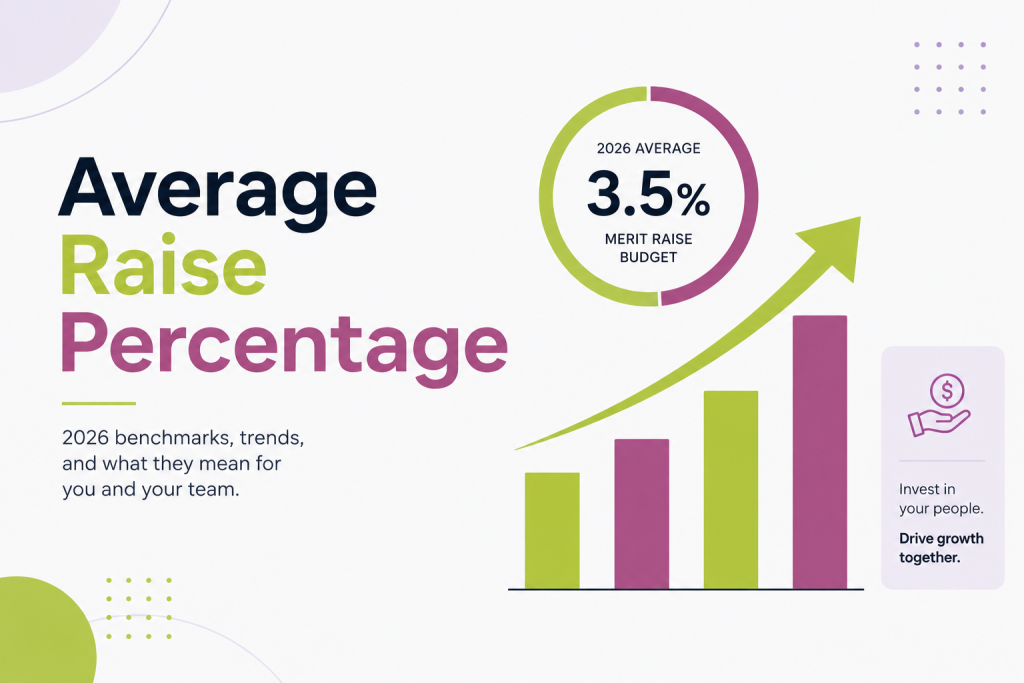
- The average total salary increase budget for 2026 is roughly 3.4% to 3.6%, converging around 3.5% across major surveys (WorldatWork, WTW, Mercer, Pave).
- This figure covers standard merit raises. Promotion raises are a separate, higher number, averaging around 8.7%, and even higher for true level-ups.
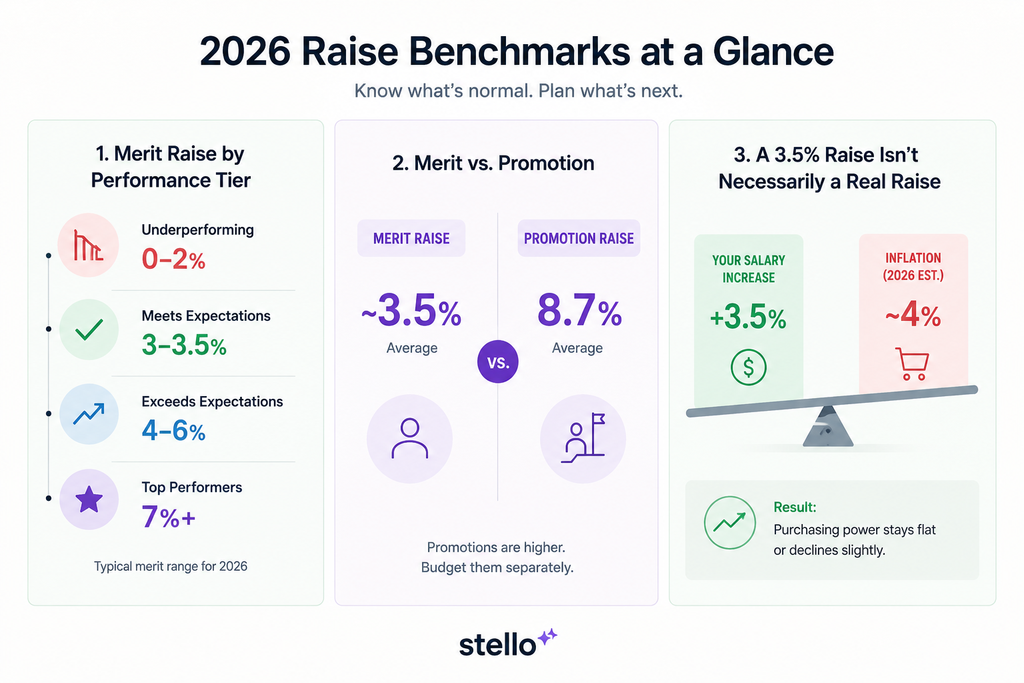
- Raises vary sharply by performance tier: 0-2% for underperformers, 3-3.5% for meets expectations, 4-6% for exceeds, 7%+ for top performers.
- With inflation running around 4%, a typical 3.5% raise barely keeps pace with cost of living rather than growing real purchasing power.
- Comp teams should budget promotions separately from merit, and expect increasing concentration of raise budgets toward high-demand roles.
The average raise percentage in 2026
For 2026, most major compensation surveys land in a tight range. WorldatWork reports a 3.6% mean salary increase budget for 2026, while WTW puts the figure at 3.5%. The Conference Board’s survey shows companies planning to increase salary budgets by an average of 3.4% in 2026, and Pave’s research points to a median projected merit increase budget of 3.5% of base payroll.
Put simply: the average total salary increase budget for 2026 sits at roughly 3.4% to 3.6%, depending on the source, with most surveys converging around 3.5%.
This figure has stayed remarkably stable. The Conference Board’s 2026 projection is in line with actual 2025 increases, and WTW’s 2026 budget matches its actual 2025 budget exactly. After a few years of larger post-pandemic increases, raise budgets have settled into a steadier, more predictable pattern.
Also read: Compensation Benchmarking: A Practical Guide for Senior HR Managers
Merit budget vs. total salary increase budget
One thing that trips people up when comparing raise statistics: companies typically report two different numbers, and articles often blend them without saying so.
Companies budget for pay increases along two dimensions: an “overall” salary increase budget and a separate “merit” increase budget. Overall budgets include merit budgets, but also set aside extra funds for promotions, pay equity fixes, and other market-based adjustments.
In recent survey data, companies indicated they plan to reserve a median of 5% of base payroll in the U.S. for the overall pool, once you include promotions and off-cycle adjustments on top of standard merit increases.
So when you see a headline number like “3.5% average raise,” that’s typically the merit or base salary increase figure, not the full picture of everything a company spends on pay increases across the year.
Average raise by performance tier
Not everyone gets the average. Raise budgets get distributed unevenly based on performance, and that spread has been widening.
Pave’s analysis of 46,000 employees who received pay adjustments found that employees with “meets expectations” performance ratings received a salary increase 88% of the time, with a median raise of 3.5%. Notably, 12% of employees with a “meets expectations” rating still received nothing, typically reflecting company-level financial constraints rather than individual performance.
Using current market benchmarks, a rough breakdown by tier looks like this:
- Underperforming: 0% to 2%, sometimes a frozen increase
- Meets expectations: 3% to 3.5%, in line with the overall average
- Exceeds expectations: 4% to 6%
- Top performers: 7% or higher, though this is increasingly reserved for employees companies consider hardest to replace
Compensation surveys commonly report average 2026 merit increase budgets around 3.2%, with total salary increase budgets around 3.5%, so raises meaningfully above that range generally need a clear performance, retention, or market justification behind them.
Also read: What is a Merit Increase? Meaning, Examples, and How It Works
Average raise percentage for a promotion
Promotion raises are a different animal entirely, and this is where a lot of confusion comes from, since “average raise” statistics often don’t separate promotions from standard merit increases.
Mercer’s research shows employers planning to promote around 9% of their workforce in 2026, down slightly from 10% in 2025, with an average pay increase for promotions of 8.7%.
That said, how “promotion” gets defined matters a lot here. Some benchmark providers define a true promotion as a level-up with at least a 15% raise, distinct from smaller title changes that don’t come with a real scope increase. Using that stricter definition, promotion raises run considerably higher than the broad 8.7% average, since it excludes title bumps that aren’t accompanied by a meaningful pay jump.
The practical takeaway: if a promotion comes with only a 3-5% raise, that’s closer to a standard merit increase than a true promotion in most benchmarking frameworks, and may be worth a conversation about whether the scope change is being reflected fairly in pay.
How inflation affects what counts as a “good” raise
A raise that sounds solid on paper can still mean shrinking purchasing power once inflation is factored in.
With inflation running in the low-to-mid 4% range through 2026, a raise below that rate technically means an employee’s real, inflation-adjusted pay is declining, even though the number on their paycheck went up. A raise at or slightly above the current merit budget average (3.5%) roughly keeps pace with typical cost-of-living increases in a moderate inflation environment, but doesn’t represent meaningful real growth.
This is a useful framing for comp teams communicating raises to employees: a 3.5% raise is “average” and “on budget,” but it’s worth being upfront that it may only be keeping pace with inflation rather than genuinely increasing purchasing power, particularly for employees rated as meeting or exceeding expectations who might otherwise expect their raise to feel like clear progress.
How average raise percentage varies by industry and role
Broad national averages mask real variation across sectors. BLS Employment Cost Index data shows wages and salaries for private industry workers have commonly increased in the 3% to 5% range year-over-year in recent years, but that range shifts meaningfully depending on the sector.
Demand for critical skills remains a factor shaping where raise budgets actually go. Companies reported net increases in hiring for key capabilities in technology (+17% net) and healthcare (+16%), and roles tied to those in-demand skills tend to see raise budgets skew higher than the broad average, even as overall company-wide budgets hold steady.
At the same time, companies are increasingly channeling budgets into critical roles and skills rather than spreading increases evenly across the board, which means the gap between a “typical” raise and a raise for a high-demand role is likely to keep widening rather than narrowing.
How comp teams should use this data
For HR and comp teams setting next year’s budget, a few practical takeaways from the current data:
Anchor your merit budget close to market. With most major surveys converging around 3.4% to 3.6%, a merit budget significantly below that range risks feeling stingy relative to what employees are likely hearing about elsewhere, even if it’s not a dramatic gap.
Separate your promotion budget from merit. Since promotion raises (8.7% on average, higher for true level-ups) run well above standard merit increases, budgeting them from the same pool as annual merit increases can quietly starve one or the other. Most mature comp programs budget these as distinct line items.
Plan for concentration, not even distribution. A majority of employers still distribute salary increase budgets equally across the organization rather than directing more resources toward high-demand skills or critical roles, even though the trend is shifting. If retention in specific high-demand roles is a priority, an even distribution may not be the most effective use of a limited budget.
Communicate the inflation context. Employees increasingly understand that a 3.5% raise in a 4%+ inflation environment isn’t a real increase in purchasing power. Being transparent about that context, rather than presenting every raise as unambiguously good news, tends to build more trust than avoiding the topic.
FAQs
What is the average raise percentage in 2026?
Most major compensation surveys report an average total salary increase budget between 3.4% and 3.6% for 2026, with figures converging around 3.5%. This represents the typical annual merit or base salary increase budget, not including promotions or off-cycle adjustments.
What is a good raise percentage in 2026?
A raise at or above the current merit budget average (around 3.5%) is considered standard for solid performance. Raises in the 4% to 6% range generally reflect strong performance, and 7% or higher is typically reserved for top performers or roles considered hard to replace.
What is the average raise percentage for a promotion?
Broad averages put promotion raises around 8.7%, though this figure includes both meaningful level-ups and smaller title changes. Using a stricter definition that requires at least a 15% increase to count as a “true” promotion, typical promotion raises run considerably higher than the broad average.
Does the average raise percentage keep up with inflation?
Not always, and often just barely. With inflation running in the low-to-mid 4% range through 2026, a raise at the current average merit budget (roughly 3.5%) trails inflation slightly, meaning real purchasing power can decline even as the nominal salary number increases.
How is the average raise percentage calculated?
It’s typically calculated as the total planned or actual increase to base salary across a company’s or survey’s employee population, expressed as a percentage of total base payroll. Different surveys sample different company sizes and industries, which is part of why the reported average varies slightly (3.4% to 3.6%) across sources.
The bottom line
The average raise percentage for 2026 sits around 3.5%, a figure that’s held steady rather than shifted dramatically from the year before. But that single number hides real variation: promotions run meaningfully higher, top performers see larger increases than the average implies, and inflation quietly eats into what a “normal” raise actually means for purchasing power. Whether you’re setting a comp budget or evaluating your own raise, the average is only useful as a starting point, not the full answer.
Figures cited reflect 2026 compensation survey data from WorldatWork, WTW, The Conference Board, Mercer, and Pave.