Every compensation cycle, someone on the leadership team asks the same question. Can we automate this?
The honest answer is more nuanced than yes or no. AI has gotten remarkably good at parts of comp decision making. It is still nowhere close to good enough for other parts. The real work is knowing where the line sits.
Human vs. AI: Who Should Make Compensation Decisions?
- • AI is genuinely good at market benchmarking, pay equity audits, and catching inconsistencies across managers at a scale humans can’t match.
- • AI can’t see context that lives outside the data: a rough personal quarter, a flight risk, a leadership tradeoff between budget and retention.
- • Comp is personal. People want to know a human looked at their number, not just an algorithm.
- • When a comp decision gets challenged, “the algorithm decided” isn’t an answer. Someone has to own the call.
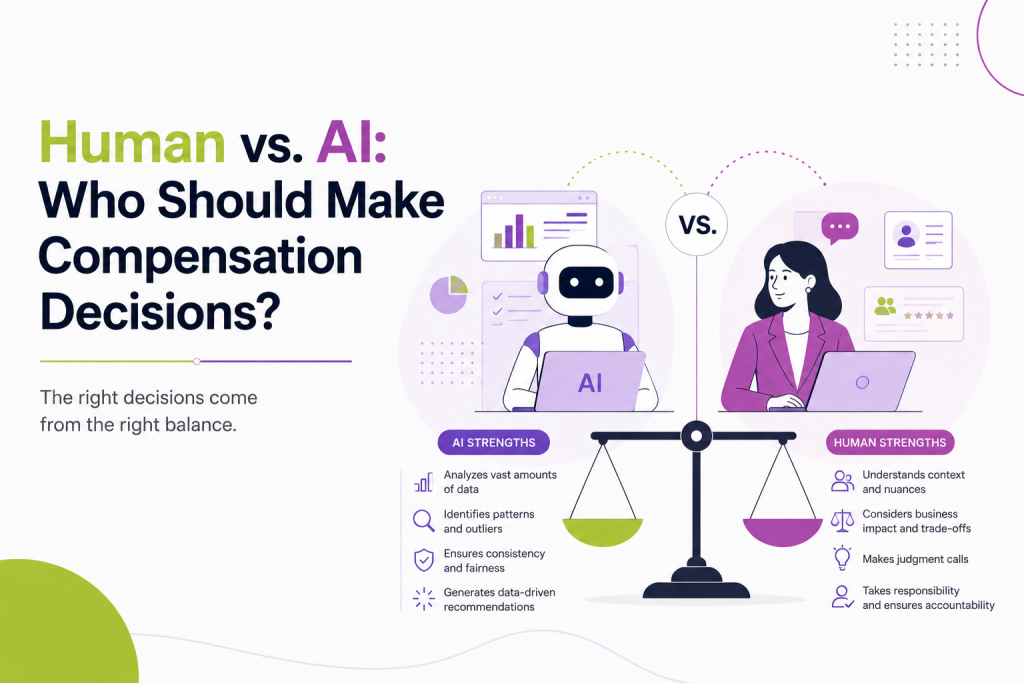
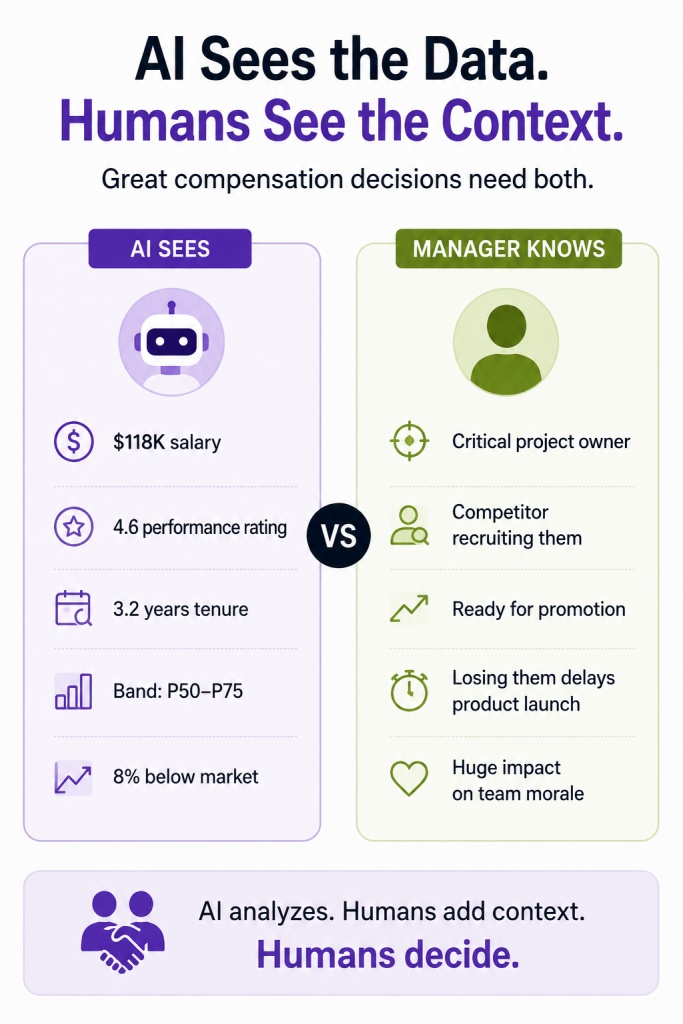
- • The right model: AI recommends, humans decide. AI handles scale and consistency. Humans handle context and judgment. Comp needs both.
What AI is genuinely good at
Compensation decisions rest on a mountain of data. Market benchmarks, internal pay bands, performance history, tenure, location adjustments, budget constraints. Humans are slow and inconsistent at processing all of that at once. AI is not.
Pattern detection at scale. AI can flag pay compression, spot inequities across gender or race in seconds, and catch outliers a manager would never notice buried in a spreadsheet. This is where AI earns its keep. A pay equity audit that used to take an analyst three weeks can run in an afternoon.
Market benchmarking. Pulling live comp data against thousands of roles, industries, and geographies is a data processing problem. AI handles it faster and more accurately than a person cross referencing five different survey reports.
Consistency checks. AI does not have a favorite employee. It does not remember that someone was nice to it in the hallway last week. When you need to check whether every manager applied the same merit increase logic across their team, AI is a more reliable auditor than another human.
First-draft recommendations. Feed AI the data and it can generate a reasonable starting point for a raise or offer. Not the final number. A starting point.
Also read: AI-Driven Pay Equity Audit: How AI Is Transforming Compensation Fairness
Where AI falls short
Context that lives outside the data. A high performer just went through a rough personal stretch and their output dipped for one quarter. A star engineer is quietly interviewing elsewhere and a market adjustment could retain them. None of this shows up in a performance score. A manager who talks to their team knows it.
Judgment calls with real tradeoffs. Should you stretch the budget to retain someone critical, even if it breaks internal pay parity for a moment? That is a leadership decision with organizational consequences, not a data optimization problem.
Trust. People want to know a human looked at their comp and thought it was fair. An AI generated number, however accurate, can feel cold when it lands in someone’s inbox with no human context around it. Comp is deeply personal. It touches how people feel valued.
Accountability. When a comp decision gets challenged, legally or otherwise, “the algorithm decided” is not an answer anyone wants to give. Someone has to own the call.
The actual answer: AI recommends, humans decide
The teams getting this right are not choosing between human and AI. They are building a pipeline where AI does the heavy lifting on data and humans do the heavy lifting on judgment.
AI pulls the market data, flags the equity issues, and generates the first-draft recommendation. A human, usually a manager who knows the person and a comp or HR lead who knows the bigger picture, reviews that recommendation against context the AI cannot see. Then a human makes the final call and delivers it.
This is not a compromise position to make everyone happy. It is what each side is actually built for. AI is built for scale and consistency. Humans are built for context and judgment. Comp decisions need both.
Also read: Benefits and Limitations of AI Compensation Agents in HR
What this means for your comp process
If you are still doing comp planning in spreadsheets with manual benchmarking, you are burning hours on work AI should be doing. That is time your comp team could spend on the judgment calls that actually need a human.
If you are letting an algorithm output final numbers with no human review, you are skipping the part of the process that builds trust and catches what the data misses.
The right setup uses AI to do the analysis and humans to do the deciding. Get that split right and comp planning gets faster without getting colder.