For years, a pay equity audit has meant the same thing at most companies: once a year, HR pulls a spreadsheet of salaries, hands it to a statistician or outside consultant, and waits weeks for a report that’s already out of date by the time it lands. That model is breaking down. Regulators are moving faster, pay transparency laws are spreading across states and countries, and employees expect answers about fairness in real time, not twelve months from now. AI is stepping into that gap, and it’s changing what a pay equity audit actually looks like.
Key Takeaways
- Pay equity audits are shifting from once-a-year, backward-looking reviews to continuous, AI-monitored processes that catch gaps as they happen.
- AI pay equity software can flag a risky offer or raise before it’s approved, not just report on gaps after the fact.
- Explainability matters: a pay equity tool should show plain-language reasons behind a flagged gap, not just a black-box score.
- The AI model itself needs bias auditing — a system trained on historical pay data can reproduce the same disparities it’s meant to catch.
- Regulatory pressure is increasing: the EU Pay Transparency Directive takes effect by June 2026, and OFCCP contractors must show a defensible audit process.
- Proactive audits run under attorney-client privilege offer stronger legal protection than reactive audits triggered by a complaint.
- When evaluating tools, prioritize deep HRIS integration, scenario modeling, and independent bias testing over dashboards alone.
What is a Pay Equity Audit?
A pay equity audit is a systematic review of an organization’s compensation data to identify unexplained pay differences between employees who do comparable work — most often analyzed across gender, race, and ethnicity, and increasingly across age and disability status as well. The audit typically uses regression analysis to control for legitimate factors like tenure, performance, location, and job level, isolating what’s left over as a potential equity gap.
Done well, a pay equity audit does two things: it flags risk before a regulator or plaintiff’s attorney does, and it gives compensation teams a defensible, data-backed story about how pay decisions are made.
Also read: AI Compensation Software: The Complete Guide for HR and Finance Teams (2026)
Why Traditional Pay Equity Audits Fall Short
The conventional audit process has three structural problems. It’s periodic, so gaps that emerge mid-year go unnoticed until the next cycle. It’s manual, which means the statistical modeling is only as good as the analyst running it, and re-running the analysis after every hire, promotion, or reorg is impractical. And it’s backward-looking — by design, it tells you what already happened rather than catching a problematic offer before it’s extended.
None of this makes the traditional audit useless. It’s still often the model regulators expect to see. But it leaves a company exposed in the months between audits, which is exactly where AI has started to add value.
Also read: How AI is Revolutionizing Compensation Budgeting: The Stello AI Advantage
How AI is Changing Pay Equity Audits
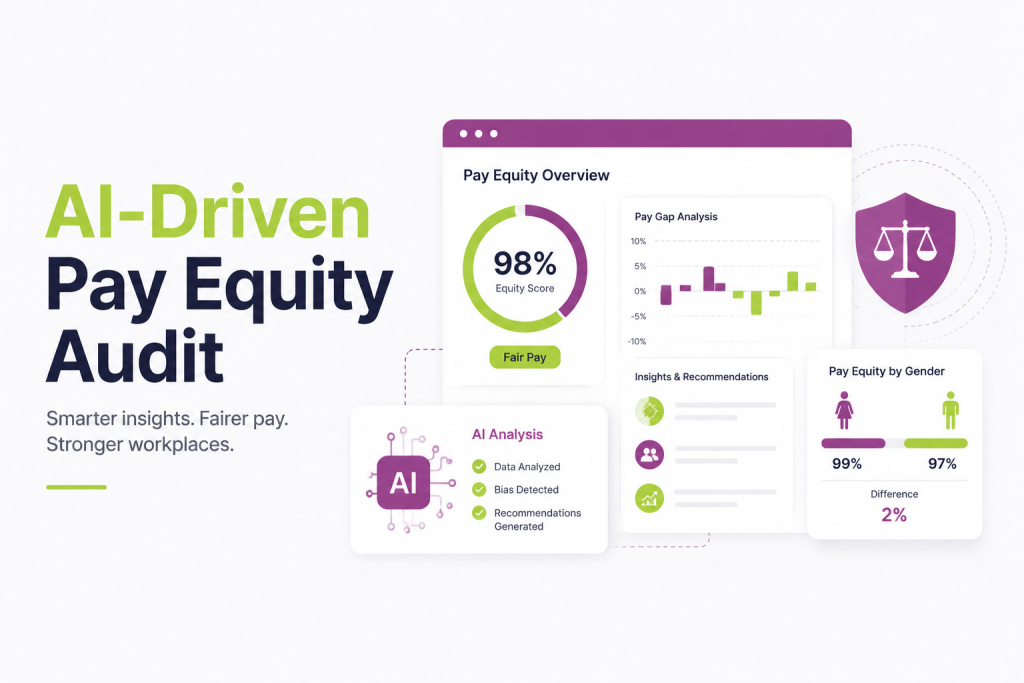
AI in compensation management doesn’t replace the statistical backbone of a pay equity audit — it changes the cadence and the point of intervention. Instead of a once-a-year regression run on a static export, AI pay equity software runs continuously against live HRIS and payroll data, re-scoring the organization’s equity posture every time compensation data changes.
That shift shows up in a few concrete ways. Machine learning models can process far larger and messier datasets than a manual regression, incorporating job architecture, skills data, and market benchmarks that would take an analyst weeks to reconcile by hand. Natural language processing can standardize inconsistent job titles across a merged or global workforce so comparisons are actually apples-to-apples. And predictive models can score a proposed offer or raise for equity risk before it’s approved, catching a problem at the moment it’s created rather than in a retrospective audit months later.
This is the core promise of AI pay equity software: moving equity analysis from a compliance exercise that happens after the fact to a guardrail that operates inside the everyday comp workflow.
Also read: Benefits and Limitations of AI Compensation Agents in HR
Key Capabilities to Look For in AI Pay Equity Software
Not all tools marketed as “AI-powered” do the same thing, and the difference matters when you’re evaluating pay equity software. A few capabilities separate the tools that genuinely help from the ones that just add a dashboard on top of the same annual process:
Continuous monitoring that recalculates pay gaps as new compensation events happen, rather than requiring a manual data pull. Explainability, meaning the model can show which factors are driving a flagged gap in language a compensation committee or legal counsel can actually use — a black-box score with no reasoning is a liability, not an asset. Bias auditing of the model itself, since an AI system trained on historical pay data can quietly reproduce the same disparities it’s meant to catch if it isn’t checked. And integration depth with your HRIS, payroll, and applicant tracking systems, since a pay equity audit tool that requires manual CSV uploads loses most of the real-time advantage AI is supposed to provide.
How to Conduct an AI-Powered Pay Equity Audit
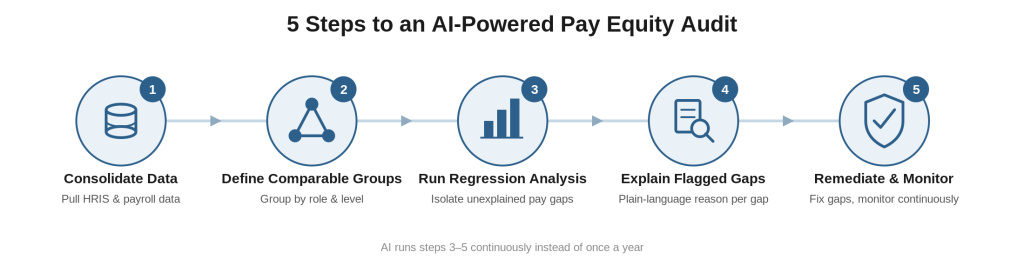
The steps mirror a traditional audit, but AI changes what happens at each stage.
Start by consolidating compensation, job, and demographic data across every system of record — this data-quality step is where most audits, AI-assisted or not, actually succeed or fail. Next, define comparable groups by role, level, and location, letting the AI tool suggest groupings based on actual job content rather than title alone, which catches mismatches a manual process often misses. Run the regression analysis to identify statistically significant gaps, then have the model surface plain-language explanations for each flagged case so compensation and legal teams can review them without needing a statistics background. Remediate confirmed gaps with a budgeted adjustment plan, and finally configure the system to monitor continuously so new hires, promotions, and raises are scored for equity risk before they create new gaps rather than after.
Compliance Considerations
AI doesn’t change the underlying legal landscape, and it isn’t a substitute for legal review — but it does make it easier to keep pace with a patchwork of requirements that’s only getting denser. In the US, the OFCCP expects federal contractors to be able to demonstrate a defensible pay equity audit process, and several states now require pay data reporting or proactive audits. The EU Pay Transparency Directive, which member states must transpose into national law by June 2026, will require many employers to report pay gaps and conduct joint audits when gaps exceed 5%. Local laws like NYC’s pay transparency requirements add another layer on top.
One important detail: in the US, a pay equity audit conducted under attorney-client privilege can shield the findings from discovery in litigation, but only if it’s structured correctly from the start — which is a legal question, not a technical one, and worth involving counsel in before the audit begins.
Choosing the Right Pay Equity Audit Tool
When comparing pay equity audit tools, look past the AI label and ask what’s actually automated. Does the tool integrate natively with your HRIS (Workday, SAP SuccessFactors, UKG) or does it require manual exports? Can it run scenario modeling before a raise is approved, or only report on pay after the fact? Does it produce audit documentation suitable for legal privilege, or just an internal dashboard? And critically, has the vendor had its own model independently assessed for bias — a pay equity tool that can’t answer this question about itself is a red flag.
The Future of AI in Compensation Management
Pay equity is becoming one entry point into a broader shift: AI in compensation management is moving from annual benchmarking exercises toward continuous, real-time compensation intelligence — dynamic market pay data, personalized total rewards recommendations, and equity checks built directly into the offer and promotion workflow. The organizations getting ahead of this aren’t just running a better audit once a year. They’re building pay equity into the infrastructure of every compensation decision, so the audit becomes a confirmation of what the system already enforces, rather than a once-a-year discovery process.
FAQ-
What is a proactive pay equity audit?
A proactive pay equity audit is one initiated voluntarily by an employer, often under attorney-client privilege, before a regulator, employee complaint, or litigation forces the issue. It’s generally viewed more favorably by regulators and courts than a reactive audit conducted in response to a complaint.
How often should a company run a pay equity audit?
Best practice is at least annually, with continuous monitoring in between if AI pay equity software is in place. Any major event — a merger, reorg, or shift to a new job architecture — should trigger an off-cycle audit regardless of the regular schedule.
Can AI fully replace a human analyst in a pay equity audit?
No. AI can handle the data processing, pattern detection, and continuous monitoring at a scale humans can’t match manually, but interpreting flagged gaps, deciding on remediation, and managing legal privilege still require human compensation and legal expertise.