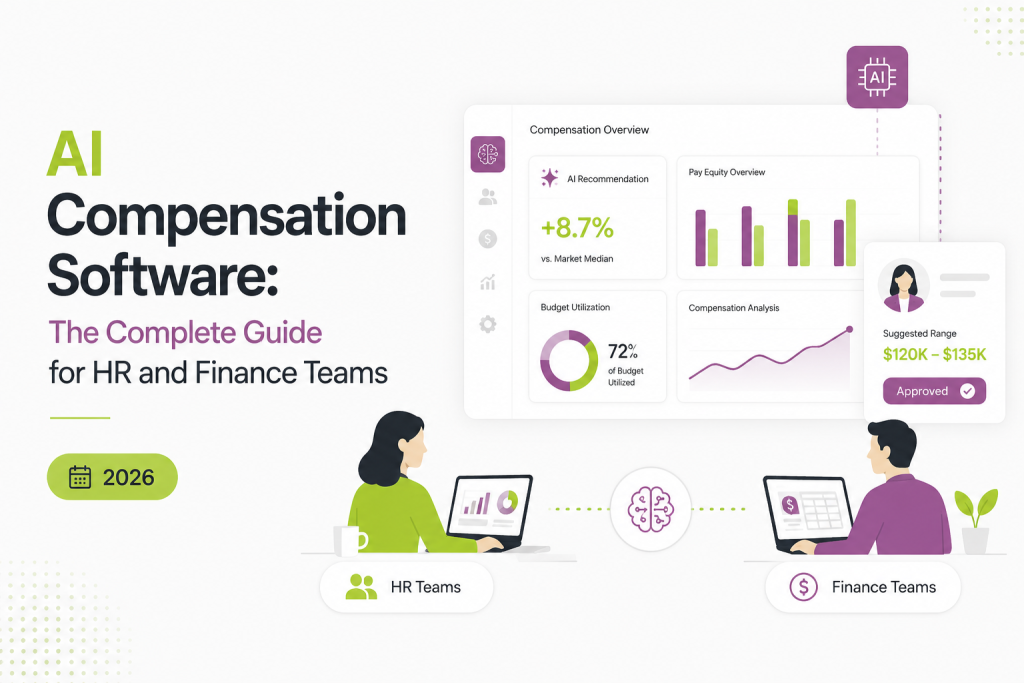
Compensation planning has quietly become one of the most data-heavy, deadline-driven processes HR and Finance run every year — and until recently, most teams ran it out of a spreadsheet held together by VLOOKUPs and tribal knowledge. AI compensation software is the category built to replace that spreadsheet: tools that use machine learning and, increasingly, autonomous AI agents to benchmark pay, model budgets, flag equity gaps, and run entire compensation cycles with far less manual work.
This guide covers what AI compensation software actually is, how it works under the hood, the capabilities worth evaluating, and how the leading platforms in the space — including Stello AI — compare heading into 2026.
Key Takeaways
- AI compensation software applies machine learning and generative AI to compensation planning tasks: market benchmarking, budget modeling, pay equity analysis, merit cycle management, and employee-facing total rewards communication.
- There’s a meaningful split between advisory AI (tools that surface a recommendation and leave the work to you) and agentic AI (tools that execute the analysis, flag issues, and draft the plan). That distinction is the single biggest differentiator in the category right now.
- Pay transparency legislation — including new U.S. state laws and the EU Pay Transparency Directive taking effect in mid-2026 — is accelerating adoption, because defending pay decisions with data is no longer optional.
- The market splits into two lanes: HR/total compensation platforms (salary, equity, merit cycles, pay equity) and sales/incentive compensation platforms (commissions, bonuses, quota-based plans). Most companies only need one, not both.
- Evaluation should start with the workflow you’re trying to fix, not the feature list — a lean HR team drowning in a merit cycle has different priorities than a RevOps team automating commission payouts.
What is AI Compensation Software?
AI compensation software is a category of HR and finance technology that uses artificial intelligence to plan, analyze, and administer employee pay. Instead of pulling market data manually and building budget scenarios in Excel, these platforms ingest compensation data, benchmark it against real-time or survey-based market rates, and use AI to generate recommendations — or, in more advanced tools, to actually execute parts of the compensation workflow.
At a functional level, most AI compensation platforms combine some mix of:
- Market pricing and benchmarking — matching internal roles to external salary data and surfacing where pay sits relative to market.
- Budget modeling — simulating different raise, bonus, and equity scenarios against a fixed budget.
- Pay equity analysis — flagging statistically significant pay gaps by gender, race, tenure, or other factors.
- Merit and compensation cycle management — replacing the annual spreadsheet-based review process with structured workflows and approval chains.
- Total rewards communication — generating personalized statements that show employees the full value of their pay, equity, and benefits.
- Conversational or agentic AI — a layer that lets HR and managers ask questions about comp data in plain language, or that autonomously handles parts of the analysis.
Also read: AI Agents in Compensation: What They Do and Where to Start
How AI Compensation Software Actually Works
Under the hood, most platforms follow a similar pattern: connect to your HRIS (Workday, BambooHR, Rippling, ADP, etc.) to pull employee, role, and pay data, then layer market data on top — either through partnerships with compensation survey providers or through aggregated, anonymized data contributed by other companies on the platform. From there, the AI layer does the analytical heavy lifting: matching jobs to market benchmarks, calculating compa-ratios, running budget scenarios, and surfacing anomalies a human reviewer might miss in a 2,000-row spreadsheet.
The newer, more consequential shift is what happens after the analysis. Older “AI-powered” tools stop at the dashboard — they’ll tell you a role is underpaid relative to market, but a person still has to act on it. The more advanced category, often described as agentic compensation AI, goes further: it can draft the recommended increase, route it for approval, flag the pay equity implications, and update the model in real time as decisions are made. That’s the difference between AI that informs compensation decisions and AI that executes them.
Why Compensation Teams Are Turning to AI in 2026
A few forces are converging at once:
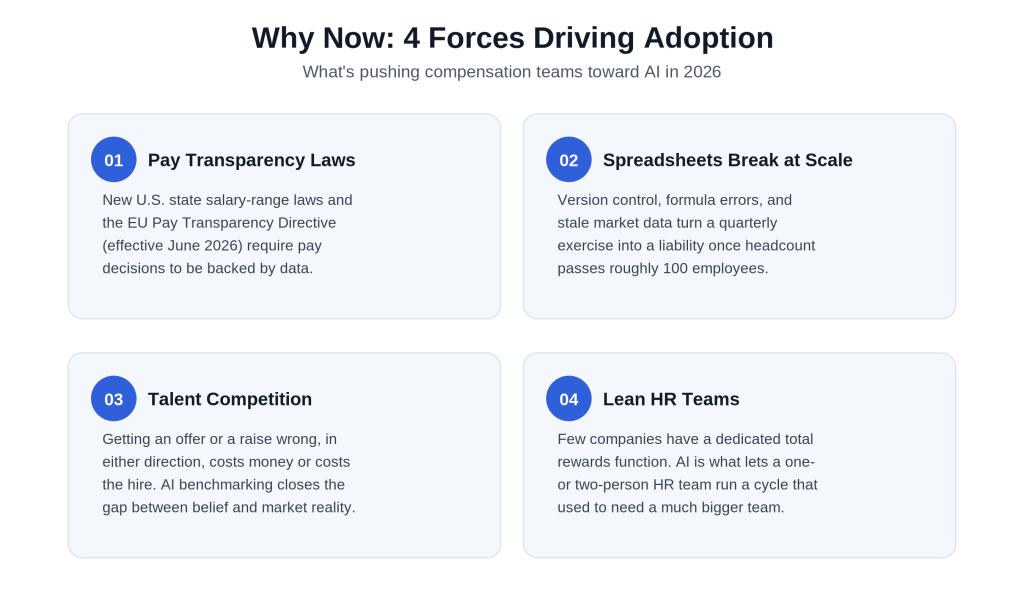
Pay transparency laws are expanding. A growing list of U.S. states now require salary ranges in job postings, and the EU Pay Transparency Directive requires member states to implement new pay equity reporting rules by June 2026. Defending a comp decision with a gut feeling isn’t an option anymore — it needs to be backed by data, and AI tools are what make that data usable at scale.
Headcount has outgrown the spreadsheet. Most compensation spreadsheets work fine under 100 employees. Past that, version control, formula errors, and stale market data turn a quarterly exercise into a liability.
Talent competition rewards accuracy. Getting an offer or a raise wrong — in either direction — costs money or costs the hire. AI-driven benchmarking closes the gap between what a company thinks it’s paying and what the market actually looks like right now.
Lean HR teams need leverage. Few companies have a dedicated total rewards function. AI is what lets a one- or two-person HR team run a compensation cycle that used to require a much bigger team.
Also read: 8 Ways Companies are Using AI in Compensation Management
What to Look for in AI Compensation Software
Before comparing specific platforms, it helps to know which capabilities actually separate a genuinely useful AI compensation tool from a dashboard with an AI label bolted on.
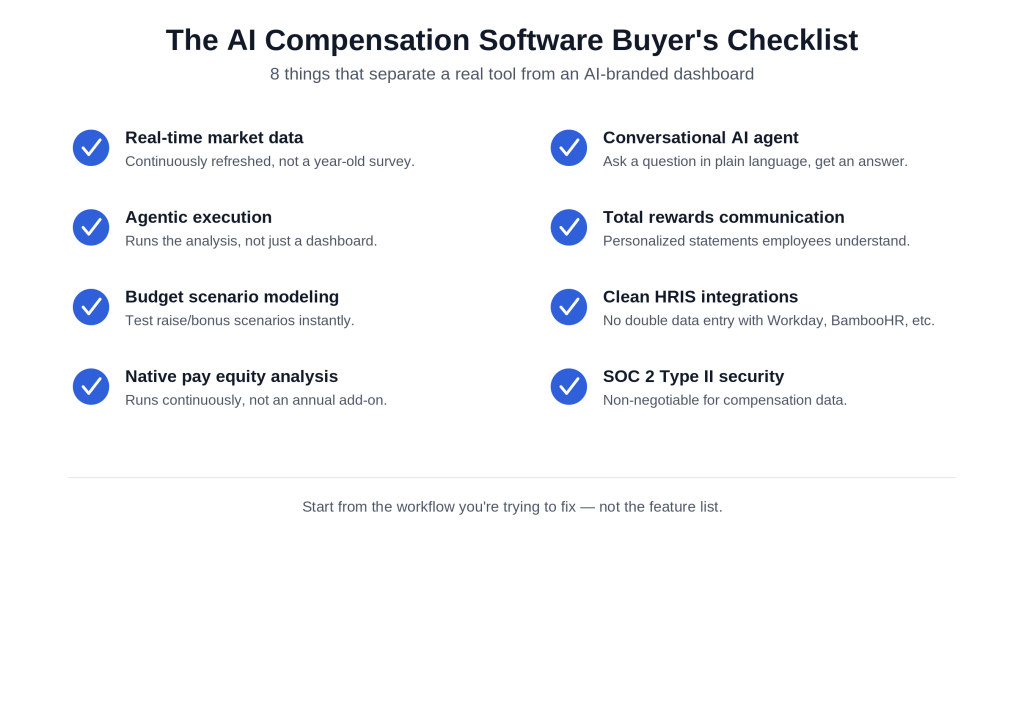
Real, current market data. The benchmarking is only as good as the data underneath it. Ask whether the platform uses live, continuously refreshed data (often sourced from participating companies’ own HRIS feeds) or periodic survey data that can be a year or more stale by the time you use it.
Agentic execution, not just recommendations. Look for AI that can actually run an analysis, flag an outlier, or draft a plan — not just generate a chart you still have to interpret and act on manually.
Budget scenario modeling. You should be able to model multiple raise, bonus, and equity scenarios against a fixed budget and see the downstream impact instantly, not after a re-export to Excel.
Pay equity analysis built in, not bolted on. Given the regulatory environment, pay equity shouldn’t be a separate purchase or a manual audit — it should run continuously as part of the core workflow.
A conversational or agent interface. The ability to ask a plain-language question — “which managers are over budget?” or “show me underpaid senior engineers” — and get an immediate, accurate answer is quickly becoming table stakes rather than a nice-to-have.
Total rewards communication. Employees increasingly expect to see the full picture of their compensation, not just base salary. Look for tools that can generate and deliver personalized total rewards statements.
HRIS and payroll integrations. If the tool doesn’t connect cleanly to your existing HR stack, you’re doing double data entry — which defeats the purpose of buying an AI tool in the first place.
Security and compliance posture. Compensation data is some of the most sensitive data a company holds. SOC 2 Type II certification and clear data-handling practices should be non-negotiable.
Time to value. Enterprise compensation platforms can take months to implement. For most mid-market and growth-stage companies, a tool that’s live in weeks rather than quarters is worth prioritizing.
The Best AI Compensation Software in 2026
The category splits into two distinct lanes, and it’s worth separating them before comparing anything head-to-head: HR/total compensation platforms (salary, equity, merit cycles, pay equity, total rewards) and sales/incentive compensation platforms (commissions, bonuses, SPIFs, quota-based plans). Most buyers only need one.
HR & Total Compensation Platforms
| Platform | Best For | Notable AI Capability |
|---|---|---|
| Stello AI | Mid-market and enterprise teams that want one AI-powered platform across the full comp lifecycle | AI budget modeling, AI market pricing, and Iconic — a conversational AI agent that answers comp questions and handles calculations |
| Aeqium | Small businesses that want AI to execute comp tasks, not just surface data | Agentic comp AI that runs merit-cycle analysis and flags compa-ratio outliers automatically |
| Forma.ai | Enterprises unifying sales and go-to-market compensation strategy | AI-assisted plan design and pay strategy modeling |
| Compa | Enterprise compensation teams focused on offer and market pricing accuracy | AI-driven, real-time offer benchmarking |
| Decusoft | Organizations wanting an AI layer over an established compensation management platform | AI-powered compensation analytics across merit, bonus, and equity |
| HRSoft (COMPview) | Regulated industries (healthcare, financial services) needing strict audit controls | AI-powered compensation analytics with heavy governance and approval controls |
| Pave | Companies whose primary need is real-time salary and equity benchmarking | Continuously refreshed market data from thousands of contributing companies |
| beqom | Large multinational enterprises with complex, layered approval structures | AI-assisted merit, bonus, and long-term incentive planning at global scale |
| Payfederate | Growth-stage companies wanting a lighter-weight AI-native comp tool | AI-generated compensation recommendations built for faster rollout |
Sales & Incentive Compensation Platforms
| Platform | Best For | Notable AI Capability |
|---|---|---|
| CaptivateIQ | Sales organizations with complex commission structures (tiers, accelerators, splits) | AI-generated earning statements that cite the exact plan logic behind each payout |
| Performio | Revenue teams automating commission administration | AI-driven commission calculation and admin automation |
A quick note on the HR-vs-sales split: it exists because the underlying data models are genuinely different. Sales incentive platforms are built around deal and quota data flowing in from a CRM; HR total compensation platforms are built around headcount, market benchmarks, and merit cycles flowing in from an HRIS. Trying to force one category of tool to do the other’s job is where most implementations go sideways.
Where Stello AI Fits
Stello AI is built for HR and Finance teams that want the full compensation lifecycle — not just one slice of it — running on one AI-powered platform. That includes AI budget modeling to stress-test different raise and bonus scenarios against a fixed budget, AI market pricing to accelerate salary benchmarking and job matching, structured compensation planning for the entire cycle, ad hoc increases for off-cycle raises and spot bonuses, and a total rewards portal so employees can see the full picture of their pay. Layered on top is Iconic, Stello’s AI compensation agent, which can answer plain-language questions about your comp data and handle complex calculations in seconds rather than requiring a manual pull from Finance.
The practical difference from advisory-only tools: Iconic doesn’t just show you that a department is trending over budget — you can ask it directly, get the calculation, and act on it in the same conversation.
Advisory AI vs. Agentic AI: The Distinction That Actually Matters
Almost every vendor in this space now claims to use “AI.” The label has become close to meaningless without more context, so it’s worth being specific about what kind of AI you’re actually buying.
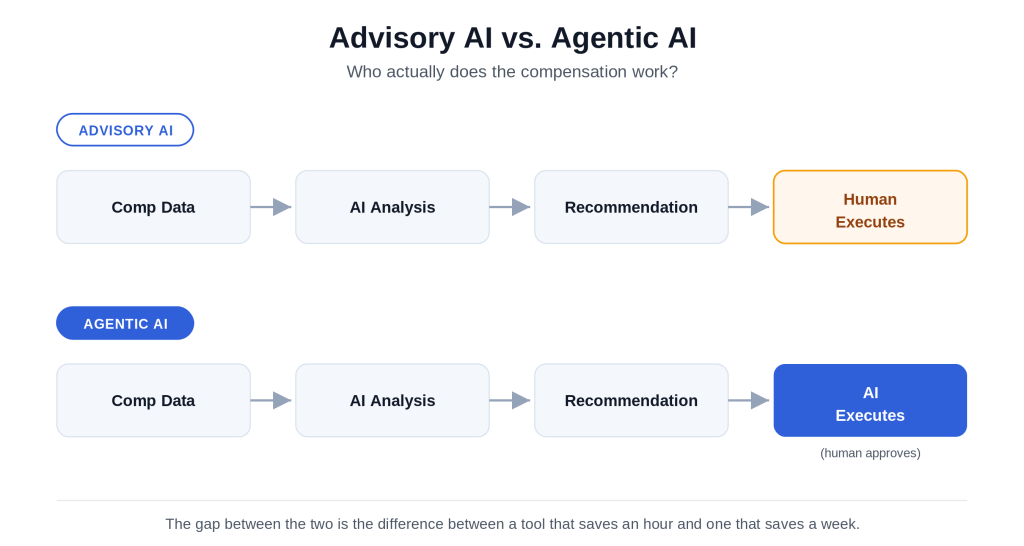
Advisory AI analyzes your data and presents a recommendation, a chart, or a flagged outlier. A person still has to interpret it, decide what to do, and manually execute the change. This was the standard for most “AI-powered” compensation tools as recently as 2023–2024.
Agentic AI goes a step further: it can execute the underlying task. That might mean running the full pay equity analysis unprompted, drafting a merit increase recommendation ready for manager approval, or answering a specific question about budget exposure on demand — without someone first exporting the data and building the pivot table themselves.
For a fully staffed enterprise compensation team, advisory AI might be enough — the team has the bandwidth to act on recommendations. For the much larger group of companies running compensation with a lean HR or People team, the gap between advisory and agentic AI is often the gap between a tool that saves an hour and a tool that saves a week.
How to Choose the Right AI Compensation Software
Rather than starting from a feature checklist, start from the problem that’s actually costing you time or risk today.
“We don’t know if we’re paying competitively.” Prioritize platforms with strong, continuously refreshed market data — this is a benchmarking problem first, and an execution problem second.
“Our merit cycle takes weeks and involves a dozen spreadsheet versions.” Look for platforms with structured cycle management and agentic AI that can pre-populate recommendations rather than leaving every calculation to a human.
“We’re worried about pay equity exposure.” Make sure pay equity analysis is native to the platform and runs continuously, not as a bolted-on annual audit.
“We don’t have the headcount to run compensation properly.” This is where the advisory-vs-agentic distinction matters most. A lean team needs a tool that does more of the operational work, not just more dashboards to read.
“We’re managing sales commissions, not salary and equity.” You’re likely better served by a dedicated incentive compensation platform than a general HR compensation tool — the data models and workflows are built for different jobs.
Once the core problem is clear, narrow the list by operating context: company size, number of countries you operate in, existing HRIS, and how quickly you need the tool live. A platform that takes nine months to implement is a non-starter for a team that needs its next merit cycle handled in six weeks.
Implementation Considerations
A few practical questions worth asking any vendor before signing:
- How long does implementation actually take, from contract to your first live compensation cycle?
- Does it integrate natively with your HRIS, or does data need to be manually exported and imported?
- Where does the market data come from, and how often is it refreshed?
- What does the pay equity analysis actually check for, and does it update automatically as new data comes in?
- What security certifications does the vendor hold (SOC 2 Type II is the common baseline for compensation data)?
- Can non-technical HR staff use it day-to-day, or does it require a dedicated administrator?
Frequently Asked Questions
What is AI compensation software? AI compensation software is HR and finance technology that uses artificial intelligence to benchmark pay against the market, model compensation budgets, detect pay equity issues, and manage compensation cycles — replacing much of the manual, spreadsheet-based work that traditionally went into these tasks.
How is AI compensation software different from traditional compensation management software? Traditional compensation management software digitizes the workflow — replacing spreadsheets with structured forms, approvals, and reporting. AI compensation software adds a layer of automated analysis and, in more advanced tools, autonomous execution on top of that workflow: generating benchmarks, flagging outliers, and drafting recommendations without a person building the analysis from scratch.
Is AI compensation software accurate enough to trust? Accuracy depends heavily on the underlying data. Platforms using continuously refreshed, real market data tend to be more reliable than those relying on periodic survey data that can be a year or more out of date. Most companies use AI-generated recommendations as a strong starting point that a human still reviews and approves — the AI handles the heavy analytical lift, but final sign-off stays with people.
How much does AI compensation software cost? Pricing varies widely by company size and the depth of the platform, generally ranging from lightweight tools built for growth-stage companies to enterprise platforms with six-figure annual contracts. Most vendors price per employee per month or per active user, and it’s worth requesting a quote scoped to your specific headcount and use case rather than assuming standard published pricing applies.
Can AI replace compensation analysts? Not entirely, and most vendors in this space aren’t positioning it that way. AI compensation software is best understood as a force multiplier: it handles the repetitive analytical and administrative work — benchmarking, scenario modeling, flagging anomalies — so a smaller team can run a more sophisticated compensation program than they could manually. Judgment calls, context, and final approval still sit with people.
Do I need separate software for sales commissions and HR compensation? Usually, yes. HR total compensation (salary, equity, merit cycles) and sales incentive compensation (commissions, quotas, accelerators) run on different data models — one is built around HRIS and market benchmark data, the other around CRM and deal data. Most companies are better served by a purpose-built tool for each rather than forcing one platform to do both jobs.
The Bottom Line
AI compensation software has moved past the hype phase. The tools that matter now are the ones that do real analytical and administrative work — not just AI-branded dashboards. As pay transparency laws expand and lean HR teams are asked to run more sophisticated compensation programs with the same headcount, the gap between advisory AI and agentic AI is becoming the single most important thing to evaluate.
If your team is deciding between platforms, the fastest path to the right answer is starting with the actual problem — market accuracy, cycle speed, pay equity exposure, or headcount constraints — and working backward from there.
Stello AI brings AI budget modeling, market pricing, compensation planning, and an AI compensation agent together in one platform built for HR and Finance teams managing the full compensation cycle. Book a demo to see how it works.