Most HR and compensation teams use these two terms interchangeably. That’s a mistake.
Total rewards and total compensation are related, but they are not the same thing. Confusing them leads to weak employer branding, inaccurate benchmarking, and job offers that undersell what your company actually provides. If you’re building a compensation strategy, or trying to explain your offer to a candidate, you need to know exactly where one ends and the other begins.
TL;DR
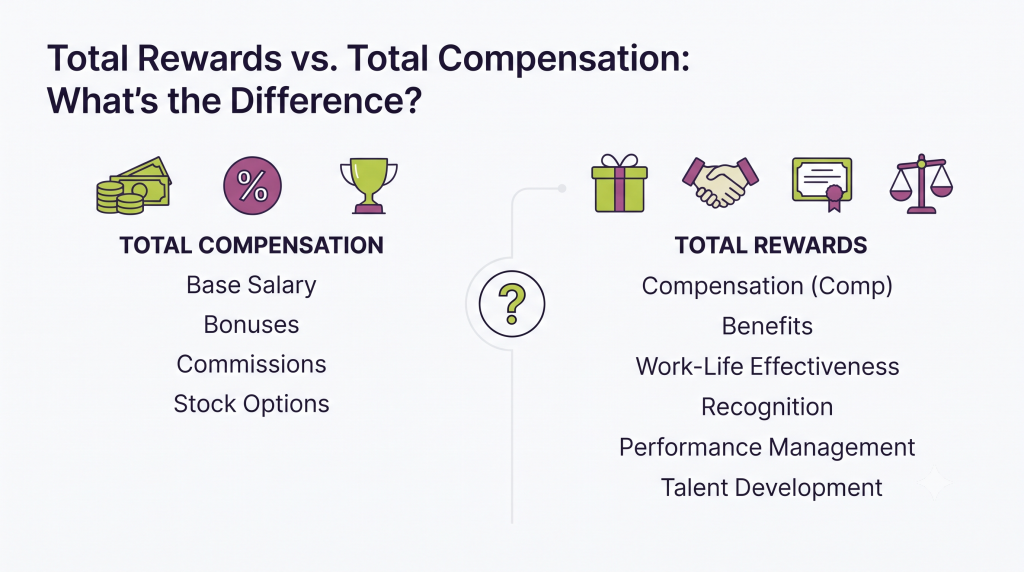
- Total compensation is the cash value of a role: base pay, bonuses, commissions, overtime, and equity.
- Total rewards is the full picture: total compensation plus benefits, well-being, recognition, and development.
- Total compensation is a number. Total rewards is a strategy.
- Use total compensation for pay bands, offer letters, and market benchmarking.
- Use total rewards for employer branding, retention, and showing candidates the full value proposition.
- Mixing the two skews your benchmarking data and undersells your offers.
Here’s the breakdown.
What is Total Compensation?
Total compensation is the direct financial value an employee receives in exchange for their work. It’s everything that shows up in dollars, on a paycheck or a compensation statement.
Total compensation typically includes:
- Base salary or hourly wages
- Variable pay (bonuses, commissions, incentive pay)
- Overtime pay
- Equity or stock options (when quantified)
- Cash allowances (car, phone, relocation)
Total compensation is a subset of total rewards. It answers one question: how much money is this role worth to the person doing it?
This is the number most candidates fixate on during salary negotiations, and it’s the figure compensation teams model when they build pay bands, run market benchmarking, or check for pay equity gaps. It’s precise, it’s countable, and it’s easy to compare across roles or companies.
Also read: Merit Increase vs. Raise vs. Promotion: What’s the Difference?
What is Total Rewards?
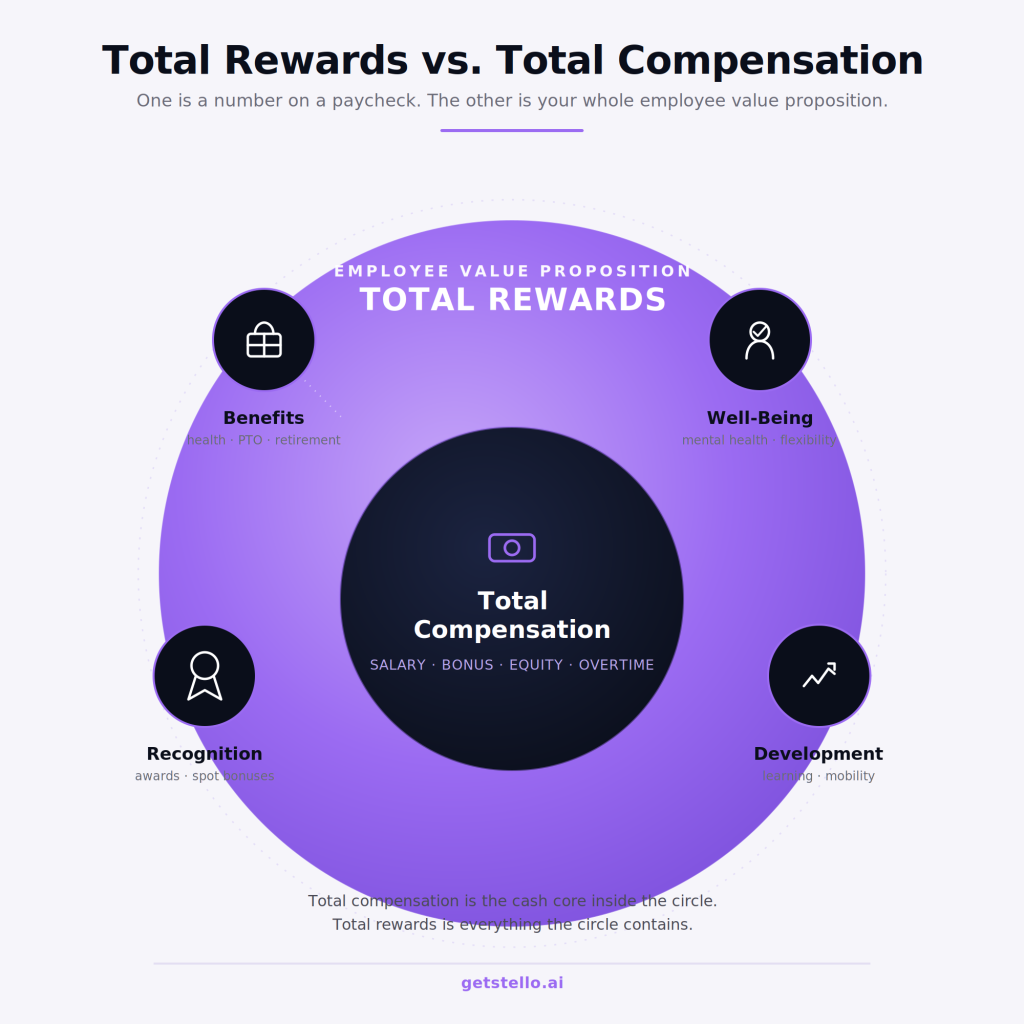
Total rewards is the bigger picture. It includes total compensation, plus every other form of value an employee gets from working at your company, financial or not.
A typical total rewards framework includes five categories:
- Compensation — base pay, bonuses, equity (this is total compensation)
- Benefits — health insurance, retirement contributions, paid time off, life insurance
- Well-being — mental health support, wellness stipends, flexible schedules
- Recognition — spot bonuses, service awards, peer recognition programs
- Development — learning stipends, mentorship, internal mobility, tuition assistance
Total rewards is meant to capture the full employee value proposition. Some of these elements have a clear dollar figure attached. Others, like career growth or flexible work, don’t convert neatly into cash but still influence whether someone joins or stays.
The Core Difference, in One Line
Total compensation is what you pay. Total rewards is everything you offer.
Total compensation is a number. Total rewards is a strategy.
Why This Distinction Actually Matters
1. Recruiting and offer conversations
If your recruiters only talk about salary, you’re competing on one dimension, and you’ll usually lose to whoever pays more. A total rewards statement lets you show the full value of an offer, including benefits and development that a competitor might not match. Companies that quantify this well tend to win candidates who are comparing more than just a number.
2. Compensation benchmarking
When you benchmark against market data, you’re almost always benchmarking total compensation, not total rewards. Mixing the two skews your data. If you include benefit value in a base salary comparison, you’ll misread where you actually stand against competitors.
3. Budget planning
Total compensation sits in your payroll budget. Total rewards spans payroll, benefits administration, and often separate line items for wellness or L&D programs. Compensation planning software needs to model these separately, because they’re funded, tracked, and reported differently.
4. Employee understanding
Most employees underestimate the value of their benefits because they only see their paycheck. A clear total rewards statement, ideally generated automatically and personalized per employee, closes that gap and improves how people perceive their pay.
How to Use Both Terms Correctly
- Use total compensation when you’re talking about pay bands, offer letters, market benchmarking, or anything tied to a specific dollar figure.
- Use total rewards when you’re talking about employer branding, retention strategy, or the full employee value proposition.
If you’re building comp philosophy documentation, pay transparency reports, or job architecture frameworks, keep these terms separated from the start. It saves you from having to unwind confused data later, and it makes your compensation communication sharper for both candidates and current employees.
Also read: Self-Service HRIS: Why Employee Self-Service Matters
The Bottom Line
Total compensation is a component. Total rewards is the whole system.
Get this distinction right, and your compensation strategy, your benchmarking, and your employer brand all get more accurate at the same time.
FAQs-
1. Is total rewards the same as total compensation?
No. Total compensation is the cash and cash-equivalent pay an employee receives, like salary, bonuses, and equity. Total rewards is broader. It includes total compensation plus benefits, well-being programs, recognition, and development opportunities.
2. What are the five components of total rewards?
Compensation, benefits, well-being, recognition, and development. Compensation is the only one of the five that maps directly to total compensation.
3. Why do companies confuse total rewards with total compensation?
The two terms get used loosely because compensation is the largest and most visible piece of total rewards. But treating them as the same thing leads to inaccurate benchmarking and offer letters that undersell the full value of a role.
4. Should job offers include total compensation or total rewards?
Both, but labeled clearly. The offer letter should state total compensation as a specific number. A total rewards statement alongside it can show the added value of benefits, development, and other non-cash elements.
5. Does total rewards data affect compensation benchmarking?
It shouldn’t, if done correctly. Compensation benchmarking should use total compensation figures only. Blending in the value of benefits or perks distorts market comparisons and can lead to miscalibrated pay bands.