Remote work has gone from a pandemic experiment to a permanent operating model for millions of companies worldwide. But as teams spread across cities, countries, and continents, one function has quietly struggled to keep up: Human Resources.
HR was built for the office. Face-to-face onboarding. Walk-in policy questions. A manager two desks away to handle a conflict. In a distributed world, those defaults no longer exist — and the gap is growing.
Enter the AI HR agent: an intelligent, always-on assistant that handles the full spectrum of HR tasks without needing a desk, a time zone, or a coffee break.
In this post, we’ll break down exactly how AI HR agents are solving the most persistent pain points for remote and distributed teams — and why forward-thinking companies are making them a core part of their people strategy.
⚡ TL;DR
- Remote and distributed teams face unique HR challenges — time zones, inconsistent onboarding, cross-border compliance, and stretched HR bandwidth.
- AI HR agents are always-on intelligent systems that handle HR tasks like leave requests, policy queries, and onboarding — 24/7, without human intervention.
- They deliver location-aware responses, applying the right policy based on each employee’s country and contract — reducing compliance risk across borders.
- Onboarding becomes consistent and scalable — every new hire gets the same quality experience regardless of where they’re based.
- Proactive check-ins and pulse surveys help HR spot burnout and disengagement early — before they become bigger problems.
- AI handles the repetitive, transactional work (leave, payroll, benefits queries) so HR teams can focus on high-value, human-centered tasks.
- AI HR agents don’t replace HR teams — they free them up to do their best work.
The Real Problem with HR in Remote Teams
Before we talk solutions, let’s name the problems clearly.
Managing HR for a distributed workforce isn’t just “the same work, but remote.” It introduces an entirely new set of complexities:
- Time zone fragmentation means employees in Singapore can’t wait 12 hours to get a payroll question answered
- Inconsistent onboarding across locations leads to uneven employee experiences and culture gaps
- Compliance across borders is a legal minefield — labor laws, leave entitlements, and tax rules vary dramatically by country
- Low visibility into employee wellbeing makes it hard to catch burnout, disengagement, or team friction before it escalates
- HR bandwidth is stretched thin — a 3-person HR team simply cannot be responsive to 200 employees across 10 countries
These aren’t small inconveniences. They directly affect retention, productivity, and legal risk. And they’re exactly what AI HR agents are designed to address.
What Is an AI HR Agent (and What Makes It Different)?
An AI HR agent is more than a chatbot that answers FAQs. It’s an autonomous system that can understand context, take action, and adapt responses based on an employee’s role, location, history, and company policy.
Unlike traditional HR software that requires a human to log in and manually process requests, an AI HR agent can:
- Understand a natural language query (“What’s my leave balance?”)
- Pull data from integrated HR systems in real time
- Apply the right policy based on that employee’s country and contract type
- Complete the action or escalate to a human when needed
- Learn from interactions over time to improve accuracy
Think of it as a senior HR generalist available 24/7 — one that never gets tired, never forgets a policy update, and can handle hundreds of conversations simultaneously.
6 Ways AI HR Agents Are Transforming Remote Team Management
1. 24/7 HR Support Across Every Time Zone
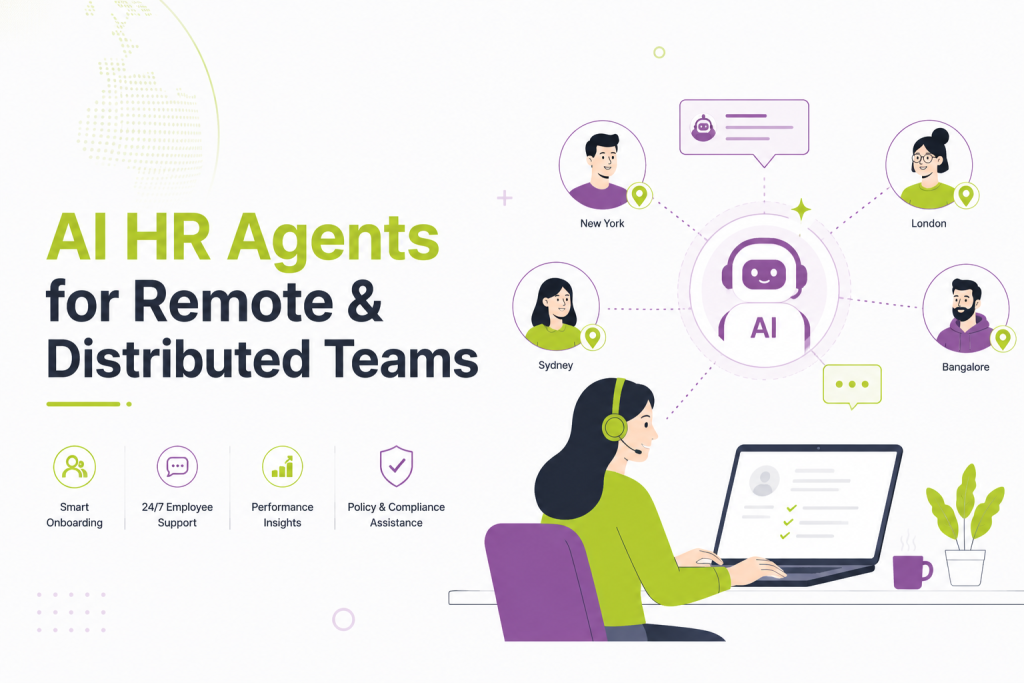
This is the most immediate win. When your team spans New York, London, Nairobi, and Bangalore, the concept of “business hours” becomes meaningless.
An AI HR agent provides instant, accurate responses to employee queries at any hour — whether it’s a leave request at 11 PM, a payslip question on a Sunday, or a benefits clarification before a public holiday.
The result? Employees feel supported regardless of where they are. HR teams stop waking up to 40 unread messages every morning.
Also read: Best HRIS Software in 2026: How to Evaluate Options
2. Consistent, Scalable Onboarding
Onboarding a remote employee is notoriously hard to get right. Without an in-person experience, new hires often feel isolated, under-informed, and unsure of who to ask for help.
AI HR agents can deliver structured, personalized onboarding journeys that guide new employees through paperwork, policy reading, tool setup, and culture orientation — step by step, in their own time zone, at their own pace.
More importantly, the experience is consistent. Whether you’re onboarding a developer in Berlin or a sales rep in Nairobi, the AI ensures every new hire gets the same quality of information and attention on day one.
Onboarding checklists, automated reminders, document collection, and initial policy quizzes can all be handled without a single HR email being written manually.
3. Real-Time, Location-Aware Policy Support
One of the most underappreciated challenges in distributed HR is policy fragmentation. A leave policy that applies in the UK doesn’t apply in India. Parental leave rules in Germany are completely different from those in the US. Overtime rules, notice periods, statutory benefits — all of it varies.
AI HR agents can be configured with location-aware knowledge bases. When an employee asks “How many sick days am I entitled to?”, the agent doesn’t just give a generic answer — it pulls the correct response based on that person’s employment location and contract type.
This dramatically reduces compliance risk and eliminates the frustrating experience of employees receiving wrong or conflicting information from an overstretched HR inbox.
4. Proactive Employee Engagement and Wellbeing Check-Ins
Remote employees are far more likely to silently disengage than office-based ones. There’s no water cooler conversation, no manager casually noticing that someone seems off. By the time the problem surfaces, it’s often too late.
AI HR agents can run automated, conversational check-ins — lightweight pulse surveys delivered in the flow of work, asking employees how they’re feeling, whether they have what they need, and flagging potential issues to HR for human follow-up.
These aren’t cold survey forms. When designed well, they feel like genuine check-ins — and the data they generate gives HR leaders early warning signals about team morale, workload imbalance, or interpersonal friction.
Also read: AI-Powered Employee Management: What’s Changed and What Hasn’t
5. Streamlined Leave, Payroll, and Benefits Queries
Studies consistently show that a significant portion of HR’s daily workload is responding to repeat, transactional queries: “When does my leave reset?”, “Why is my payslip different this month?”, “How do I enroll in the health plan?”
For a distributed team, these questions come in around the clock, in multiple languages, with varying degrees of urgency.
AI HR agents can resolve the vast majority of these queries instantly — pulling live data from payroll systems, HRIS platforms, and benefits portals — without any human involvement. The ones that genuinely require human judgment get flagged and escalated with full context already captured.
HR teams reclaim hours every day. Employees get answers in seconds, not days.
6. Cross-Border Compliance Monitoring
For companies that employ people in multiple countries, compliance isn’t optional — and it’s genuinely complex. Employment law changes, visa regulations shift, and local statutory requirements evolve constantly.
AI HR agents can be integrated with compliance databases to proactively flag potential issues: an employee approaching a visa expiry, a local holiday not reflected in scheduling, a contract clause that may be non-compliant with a recently updated labor law.
This moves HR from reactive firefighting to proactive risk management — which in a global team, can save significant legal and financial exposure.
Also read: AI Agent vs. HRIS: Do You Replace, Integrate, or Layer?
What to Look for in an AI HR Agent for Remote Teams
Not all AI HR agents are built equal. If you’re evaluating options for a distributed workforce, prioritize these capabilities:
- Multi-language support — Your team shouldn’t have to communicate in their second language to get HR help
- HRIS and payroll integrations — The agent needs to access live data, not work off static documents
- Location and role-based logic — Responses must adapt to where the employee is, not give one-size-fits-all answers
- Escalation pathways — Complex or sensitive matters must reach a human quickly, with full context handed off
- Data privacy compliance — Especially critical for teams in the EU (GDPR), UK, and other regions with strict data laws
- Audit trails — Every interaction should be logged for compliance and quality purposes
Common Objections — and Why They Don’t Hold Up
“Employees won’t want to talk to a bot about sensitive HR issues.”
This is the most common concern — and it’s partially valid. Employees shouldn’t be talking to an AI about a harassment complaint or a mental health crisis. That’s not what AI HR agents are for. The right implementation keeps humans firmly in the loop for sensitive matters, while AI handles the high-volume, transactional work that currently takes up most of HR’s time.
“We’ll lose the human touch.”
Counterintuitively, AI HR agents can improve the human touch — by freeing up HR professionals to spend more time on the conversations that actually need empathy, judgment, and care. If your HR team spends 60% of their day answering leave policy questions, they have 40% left for everything else. AI flips that ratio.
“It’s too complex to set up for a global team.”
It was, three years ago. Today’s AI HR platforms are built for multi-country deployment, with out-of-the-box compliance templates, integration libraries, and configuration tools that don’t require a technical team to maintain.
The Bottom Line
The distributed workforce isn’t going away. If anything, it’s growing — and so is the complexity of managing it well.
AI HR agents aren’t a replacement for great HR professionals. They’re the infrastructure that makes great HR possible at scale. They absorb the repetitive, the transactional, and the time-sensitive — so your human HR team can focus on the strategic, the empathetic, and the truly complex.
For remote and distributed teams especially, the case is clear: employees deserve responsive, accurate, 24/7 HR support regardless of where they are in the world. AI HR agents make that possible without burning out your HR team or ballooning your headcount.
The companies that implement this well won’t just have more efficient HR operations. They’ll have more engaged, better-supported employees — and that’s a competitive advantage that shows up everywhere.
FAQs-
What is an AI HR agent for remote teams?
An AI HR agent is an intelligent, always-on software system that handles HR tasks — like answering policy questions, processing leave requests, and guiding onboarding — automatically and without human intervention. For remote teams, it fills the gap created by time zone differences and the absence of a physical HR desk, giving employees instant support wherever they are in the world.
Can an AI HR agent handle employees in multiple countries?
Yes — and this is one of its biggest strengths for distributed teams. A well-configured AI HR agent applies location-aware logic, meaning it pulls the correct policy, leave entitlement, or compliance rule based on each employee’s country and contract type. This eliminates the risk of giving the wrong answer to employees under different labor laws.
Will an AI HR agent replace our HR team?
No. AI HR agents are designed to handle high-volume, repetitive, and transactional tasks — freeing up your HR team to focus on complex, sensitive, and strategic work. Think of it as an upgrade to your HR capacity, not a headcount reduction. The human element remains essential for things like conflict resolution, performance conversations, and mental health support.
Is employee data safe with an AI HR agent?
Data security depends on the platform you choose, but leading AI HR solutions are built with enterprise-grade encryption, role-based access controls, and compliance with regulations like GDPR, CCPA, and SOC 2. Always verify that your vendor has region-specific data residency options, especially if you employ people in the EU or other data-sensitive jurisdictions.
How long does it take to implement an AI HR agent for a distributed team?
Implementation timelines vary by platform and complexity, but most modern AI HR agent tools can be deployed within 4–8 weeks for a mid-sized distributed team. The key steps include integrating with your existing HRIS and payroll systems, configuring location-based policy rules, and running a pilot with a subset of employees before full rollout.