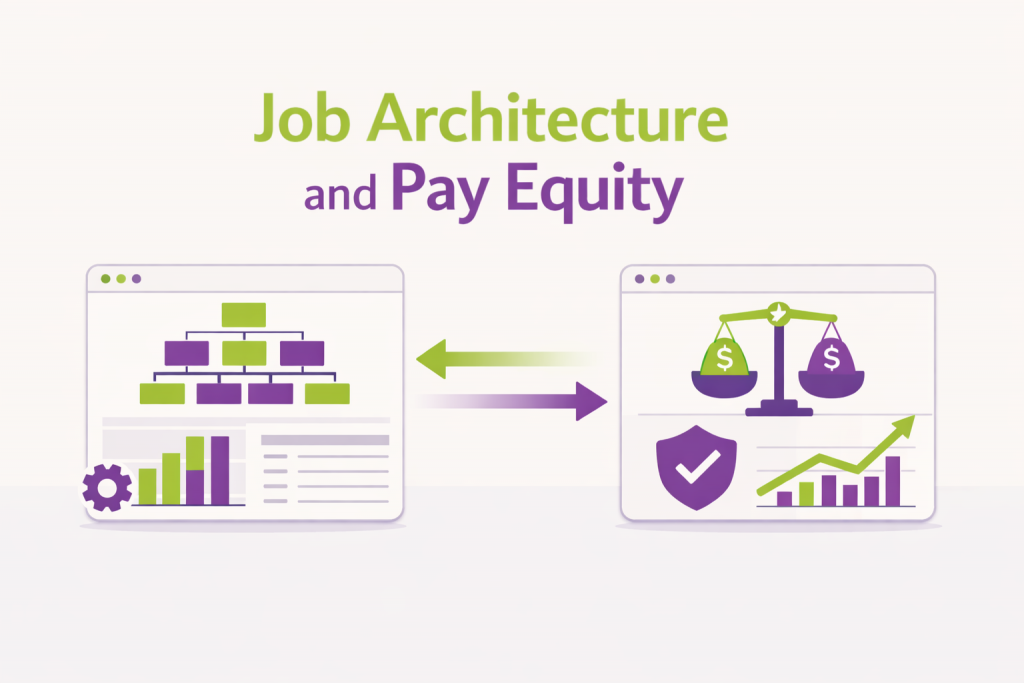
In many organizations, compensation decisions evolve organically. Titles vary across teams. Role scope is loosely defined. Managers rely on market benchmarks and individual negotiation. Over time, this creates invisible inconsistencies in how employees are paid.
The result is not always obvious. Two employees may carry similar responsibilities but sit in different titles, levels, or pay ranges. When organizations attempt a pay equity audit, the data appears fragmented. Comparisons break down because “comparable work” has never been clearly defined.
This is why many pay equity efforts remain reactive. Companies identify gaps after they emerge, rather than preventing them through structure.
Pay equity is often framed as a compensation problem. In practice, it is a structural one.
Job architecture provides that structure. It standardizes roles, aligns levels, and anchors compensation decisions to clearly defined criteria. Without it, pay equity cannot be measured consistently, enforced systematically, or defended confidently.
In the sections that follow, we break down how job architecture enables pay equity—and what it takes to implement it effectively.
- Pay equity depends on clearly defined, comparable roles
- Job architecture standardizes roles, levels, and expectations
- Consistent leveling ensures fair peer group comparisons
- Compensation bands reduce negotiation-driven pay gaps
- Role clarity improves accuracy of market benchmarking
- Narrow salary ranges make inequities easier to detect
- Continuous audits prevent gaps from compounding over time
- Documented decisions improve transparency and compliance
- Structured systems make pay equity scalable and defensible
What is Pay Equity (and Why It Breaks Without Structure)
Pay equity refers to compensating employees fairly for comparable work, after accounting for legitimate factors such as experience, performance, and location. It extends beyond equal pay for identical roles and focuses on ensuring consistency across roles that carry similar scope, impact, and responsibility.
In practice, most organizations struggle to apply this definition consistently. The challenge is not intent, it is comparability.
Without a structured framework, companies rely on job titles, manager judgment, and external benchmarks to make pay decisions. Titles often vary across teams for similar roles. Scope is interpreted differently by different managers. Market data is applied without a consistent reference point. As a result, two employees doing comparable work may be evaluated and paid very differently.
This creates a core measurement problem. Pay equity analysis depends on comparing like-for-like roles. When roles are not clearly defined or standardized, those comparisons become unreliable. Gaps may exist, but they are difficult to isolate, explain, or correct in a systematic way.
This is why many pay equity efforts become reactive. Organizations run periodic audits, identify discrepancies, and make adjustments. However, the underlying inconsistency in role definition remains unchanged, allowing new gaps to emerge over time.
A sustainable approach to pay equity requires a clear and consistent way to define comparable work. Without that foundation, compensation decisions remain fragmented, and equity becomes difficult to enforce at scale.
What is Job Architecture (Quick Context)
Job architecture is a structured framework that defines how roles are organized, leveled, and compensated across an organization. It creates a consistent system for describing work, comparing roles, and making compensation decisions.
At its core, job architecture answers three questions:
What is the role?
How complex or impactful is it?
Where does it sit relative to other roles?
To do this, it standardizes key elements across the organization:
- Job families: Group roles by function (e.g., engineering, sales, marketing)
- Job levels: Define progression based on scope, impact, and responsibility
- Role definitions: Clarify expectations, responsibilities, and required skills
- Compensation bands: Align pay ranges to levels, not individual discretion
This structure removes ambiguity from how roles are defined and compared. Instead of relying on titles or manager interpretation, organizations use a common framework to evaluate roles consistently.
For pay equity, this consistency is critical. It ensures that employees performing comparable work are grouped correctly, evaluated against the same criteria, and mapped to the same compensation ranges.
Without job architecture, compensation decisions are anchored to fragmented inputs. With it, they are anchored to a shared, defensible system.
How Job Architecture Enables Pay Equity
Job architecture plays a foundational role in enabling pay equity by creating a consistent system for defining, comparing, and compensating work across the organization. Instead of relying on fragmented inputs such as job titles, manager discretion, or negotiation outcomes, it introduces a standardized framework that brings clarity to how roles are evaluated and paid.

This consistency is what makes pay equity measurable and enforceable. When roles are clearly defined and aligned, organizations can compare employees within the right context and identify gaps with greater accuracy. Without this structure, even well-intentioned pay equity efforts tend to rely on incomplete or inconsistent data.
There are four primary ways in which job architecture supports pay equity.
1. Role Standardization
Role standardization ensures that similar work is defined consistently across teams and departments. In many organizations, roles evolve differently depending on hiring needs or managerial preferences. Over time, this leads to multiple variations of the same role, each with slightly different responsibilities, expectations, or titles.
Job architecture addresses this by consolidating these variations into standardized role definitions. It clearly outlines responsibilities, required skills, and expected outcomes for each role, regardless of where it sits in the organization.
As a result, employees performing comparable work are grouped under the same role framework. This makes it possible to evaluate compensation on a like-for-like basis, which is a prerequisite for any meaningful pay equity analysis.
2. Job Leveling
Job leveling provides a structured way to differentiate roles based on their scope, complexity, and organizational impact. Without consistent leveling, employees with similar titles may operate at very different levels, making it difficult to compare compensation accurately.
For example, a “Senior Manager” in one team may be responsible for strategic decision-making and large-scale initiatives, while the same title in another team may represent a more operational role. When compensation decisions are tied to such inconsistent benchmarks, pay disparities are difficult to detect and justify.
Job architecture introduces clearly defined levels that apply across functions. Each level is anchored in objective criteria such as decision-making authority, problem complexity, and business impact.
This allows organizations to compare employees within the correct peer group, ensuring that compensation decisions are aligned with the actual level of work being performed.
3. Compensation Banding
Compensation banding links salary ranges directly to job levels, creating a structured approach to pay decisions. In the absence of defined bands, compensation is often influenced by negotiation, hiring urgency, or external market pressures. This can result in significant variation among employees performing similar work.
By assigning salary ranges to each job level, organizations establish clear boundaries for compensation. These bands serve as a reference point for hiring, promotions, and salary adjustments, reducing reliance on subjective decision-making.
This structure helps limit unexplained pay differences within the same level. It also makes it easier to identify when compensation falls outside expected ranges, allowing organizations to address discrepancies proactively.
4. Career Path Transparency
Career path transparency defines how employees progress within the organization and how that progression impacts compensation. Without clear pathways, compensation adjustments often happen in response to immediate needs, such as retention risks or internal inequities.
This reactive approach can introduce inconsistencies over time, as similar situations are handled differently across teams.
Job architecture establishes defined progression paths between roles and levels, with clear expectations for advancement. Each transition is associated with a corresponding change in scope, responsibility, and compensation.
This ensures that pay growth is tied to role progression rather than ad hoc decisions. It also provides employees with a clear understanding of how they can advance and what that advancement entails.
Together, these mechanisms create a system in which pay decisions are based on consistent, transparent criteria. This not only improves the accuracy of pay equity analysis but also reduces the likelihood of inequities emerging in the first place.
6 Best Practices for Job Architecture-Driven Pay Equity
Implementing job architecture alone does not guarantee pay equity. The effectiveness of the system depends on how consistently it is applied and maintained over time. Organizations that achieve sustainable pay equity tend to follow a set of operational best practices that reinforce structure, reduce discretion, and improve decision quality.
1. Define Roles Before Benchmarking Compensation
Compensation benchmarking is only as accurate as the role it is mapped to. When organizations rely on market data without first standardizing roles, they risk comparing mismatched positions and importing external inconsistencies into their pay structure.
A clearly defined role ensures that benchmarking is applied to the correct scope and level of work. This improves the reliability of market comparisons and reduces the likelihood of overpaying or underpaying for similar roles across teams.
2. Separate Role Value from Individual Performance
One of the most common sources of pay inequity is the conflation of role value with individual performance. When compensation decisions attempt to account for both within the same structure, inconsistencies emerge.
Job architecture should define the value of the role, while performance management systems should determine how individuals are rewarded within that structure. Keeping these two elements separate allows organizations to maintain consistent salary ranges for roles while still differentiating based on performance through bonuses, incentives, or variable pay.
3. Use Consistent Job Levels Across Functions
Different functions often develop their own leveling systems, especially in growing organizations. This leads to misalignment, where similar levels across departments do not represent equivalent scope or impact.
A unified leveling framework ensures that a given level carries the same expectations across functions. This makes cross-functional comparisons more accurate and prevents structural disparities between departments, which are a common source of pay gaps.
4. Build Narrow, Defensible Salary Bands
Salary bands that are too wide allow significant variation within the same role and level, making it difficult to detect or correct inequities. While flexibility is important, excessive range often masks inconsistencies rather than accommodating legitimate differences.
Narrower bands, grounded in role value and market data, create clearer boundaries for compensation decisions. They also make it easier to identify outliers and ensure that employees within the same level are compensated within a predictable and defensible range.
5. Audit Pay Equity Continuously
Annual pay equity audits are often insufficient in dynamic organizations where hiring, promotions, and market adjustments happen throughout the year. By the time an annual review is conducted, disparities may have already compounded.
A more effective approach is to integrate pay equity checks into ongoing compensation processes. This includes reviewing new offers, promotions, and salary adjustments in real time, using job architecture as the reference point. Continuous monitoring allows organizations to address gaps early, before they become systemic issues.
6. Document Compensation Decisions
Clear documentation is essential for both internal consistency and external compliance. Without a record of how and why compensation decisions were made, it becomes difficult to justify pay differences or defend against potential challenges.
Job architecture provides the framework, but documentation provides the audit trail. Recording role definitions, level assignments, and compensation rationale ensures that decisions are transparent, repeatable, and aligned with established criteria.
Common Mistakes That Create Pay Inequity
Pay inequities often persist not because of missing structure, but because that structure is applied inconsistently over time.
Title inflation is a common issue. Organizations adjust titles for hiring or retention without aligning them to actual role scope, which makes comparisons unreliable. Over-reliance on market data creates similar problems when roles are not clearly defined before benchmarking, leading to inaccurate pay decisions.
Wide salary bands add another layer of risk by allowing large variations within the same role and level. At the same time, manager-driven exceptions introduce inconsistencies when decisions are influenced by urgency or negotiation rather than defined criteria.
Many organizations also treat pay equity as a one-time audit. Without ongoing alignment to job architecture, gaps reappear as new hires, promotions, and adjustments are made.
Maintaining pay equity requires consistent application of structure, not just its initial design.
Conclusion
Pay equity cannot be achieved through audits alone. While periodic reviews can identify gaps, they do not address the underlying cause of those gaps.
In most organizations, inequities emerge from inconsistent role definitions, uneven leveling, and discretionary pay decisions. Without a structured system, compensation becomes difficult to standardize and even harder to defend.
Job architecture provides that system. It creates a consistent way to define roles, assign levels, and anchor compensation decisions. This makes pay comparisons more accurate, decisions more predictable, and outcomes more equitable.
For organizations operating at scale, this is not just an HR initiative. It is a requirement for managing compensation as a controlled, transparent, and defensible function.
Pay equity, in this context, is not a separate goal. It is the result of getting the underlying structure right.
FAQs-
1. How does job architecture improve pay equity?
Job architecture improves pay equity by creating a consistent framework for defining roles, assigning levels, and aligning compensation. It ensures that employees performing comparable work are grouped correctly and evaluated against the same criteria, which makes pay comparisons accurate and defensible.
2. Can pay equity be achieved without job architecture?
It is difficult to achieve and sustain pay equity without job architecture. While organizations can run audits and make adjustments, the absence of standardized roles and levels makes it hard to compare employees reliably. This often leads to recurring gaps rather than long-term resolution.
3. How often should companies review pay equity?
Pay equity should be reviewed continuously, not just during annual audits. Organizations should evaluate compensation decisions during hiring, promotions, and salary adjustments to prevent gaps from forming. Regular monitoring ensures that pay remains aligned with job architecture over time.