If you work in HR and have ever managed a merit cycle, you know the feeling. It is the third week of the cycle. Half the managers still have not submitted their recommendations. Two have submitted but used the wrong version of the spreadsheet. Finance is asking for updated budget numbers that you cannot produce because the data is scattered across a dozen files. And somewhere in the middle of all this, an employee just put in their two weeks because they found out a newer hire in the same role is making fifteen percent more.
Compensation planning for HR teams is supposed to be a strategic function. In reality, most HR professionals spend the majority of their compensation time on administrative tasks that add zero strategic value. Chasing managers, fixing formulas, reconciling spreadsheets, answering the same questions about budget guidelines, and manually checking for pay equity issues that should have been flagged automatically.
The good news is that it does not have to be this way. Here is a practical guide to running merit cycles that actually work, based on the patterns we see in HR teams that have moved beyond the spreadsheet grind.
TL;DR
- → Merit cycles break down when HR relies on spreadsheets — scattered data, version control issues, delayed manager submissions, and reactive budget tracking extend cycles by weeks
- → The five pillars of better compensation planning for HR: strong pre-cycle preparation, manager-friendly tools, structured approval workflows, real-time budget visibility, and built-in pay equity monitoring
- → Pay equity must be monitored during the cycle — not audited afterward — especially under growing transparency regulations like SB 1162 and the EU Pay Transparency Directive
- → Real-time budget tracking prevents second-round revisions and eliminates the back-and-forth between HR, managers, and finance that drags cycles from weeks into months
- → Stello AI centralizes salary, bonus, and equity planning in one AI-native platform, providing AI-powered merit recommendations, instant budget modeling, and an AI Compensation Agent for on-demand analytics
- → Total rewards portals transform compensation conversations by showing employees their full rewards picture, improving transparency and retention
- → HR teams that modernize their compensation planning software run faster, fairer, and more strategic merit cycles — while those relying on spreadsheets remain stuck in administrative firefighting
Why Merit Cycles Break Down
Before fixing the process, it helps to understand why merit cycles go wrong in the first place. The answer is rarely that HR teams are doing a bad job. It is that the tools and processes they are working with were designed for a company half their current size.
Here are the most common breakdowns in compensation planning for HR teams.
Managers treat the merit cycle as a low priority. They have quarterly targets, team deadlines, and a dozen other things competing for their attention. A compensation spreadsheet with confusing columns and unclear guidelines gets pushed to the last possible minute, which compresses the rest of the timeline for everyone.
No single source of truth exists. Employee data lives in the HRIS. Market data lives in a survey file. Budget data lives in a finance spreadsheet. Performance ratings live in the performance management system. HR has to manually pull all of this together before the cycle even starts, and by the time it is assembled, some of it is already out of date.
Budget visibility is reactive, not proactive. Managers make recommendations without seeing how their decisions affect the overall budget in real time. HR collects everything, totals it up, discovers the budget is over by twelve percent, and has to go back to managers for a second round of revisions. This back-and-forth adds weeks to the cycle.
Pay equity is checked at the end, not throughout. Most HR teams run a pay equity review after the merit cycle is complete. By that point, fixing disparities means reopening recommendations that have already been approved, which nobody wants to do. The issues get noted, flagged for next year, and the cycle repeats.
A Better Framework for Compensation Planning for HR

Running a better merit cycle is not about working harder. It is about changing the sequence of operations and using tools that eliminate the manual work. Here is a framework that HR teams at well-run companies follow.
Step 1: Set the Foundation Before the Cycle Opens
The single biggest time saver in compensation planning for HR is doing the preparation work before managers ever see a worksheet. This means updating job architecture and salary ranges based on current market data. It means confirming budget allocations with finance and getting sign-off on merit guidelines, including the merit matrix, promotion budget, and any special pools for equity adjustments or retention.
When managers open their worksheets, they should see current employee data, salary ranges, compa-ratios, performance ratings, and clear budget guardrails. If they have to ask what the guidelines are, the preparation was not thorough enough.
Step 2: Make It Easy for Managers
The merit cycle lives or dies based on manager participation. If the tool is confusing, managers will delay, make mistakes, or default to giving everyone the same increase regardless of performance.
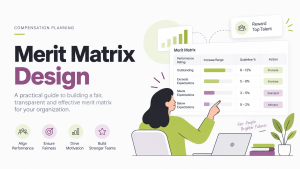
The best approach is to give managers a clean interface that shows them exactly what they need: their direct reports, current compensation, market positioning, performance data, and the budget they have to work with. AI-powered salary increase recommendations based on merit matrix calculations give managers a starting point that they can accept or adjust. This eliminates the blank-page problem where managers stare at a spreadsheet and have no idea what a reasonable increase looks like.
Real-time budget tracking is equally important. When a manager can see that their proposed changes put them two percent over budget, they can make adjustments immediately rather than waiting for HR to flag it weeks later.
Step 3: Build Approvals into the Workflow
Spreadsheet-based cycles have no enforcement mechanism. Approval chains exist on paper but not in practice. A director approves their managers’ recommendations by replying “looks good” to an email. The VP signs off without seeing how the numbers roll up across their organization.
Structured approval workflows change this completely. Each level of approver sees the recommendations from the level below, along with budget utilization, pay equity flags, and any exceptions that need attention. The cycle does not advance until approvals are complete. HR can see exactly where the process stands at any point without sending a single follow-up email.
Step 4: Monitor Pay Equity in Real Time
Pay equity should not be a post-cycle audit. It should be a guardrail that runs throughout the cycle. When a manager proposes an increase that would widen a pay gap based on gender, race, or another protected category, the system should flag it before the recommendation is submitted, not after it has been approved.
This is one area where compensation planning for HR teams has changed dramatically in the past two years. Pay transparency legislation like California SB 1162 and the EU Pay Transparency Directive means that pay equity is no longer a nice-to-have. It is a compliance requirement with real consequences for getting it wrong.
Step 5: Communicate the Results
The merit cycle does not end when recommendations are approved. It ends when employees understand what they are receiving and why. This is where most companies fall short. A manager has a five-minute conversation that amounts to “you are getting a three percent raise” without any context about how the decision was made, where the employee sits relative to their salary range, or what the full value of their compensation package looks like.
Total rewards statements that show base salary, bonuses, equity, benefits, and other compensation components in one view transform this conversation. When employees see the complete picture, they are far more likely to feel valued, even if the base salary increase alone seems modest.
How Stello AI Supports Compensation Planning for HR
Stello AI was built to address the exact pain points that HR teams face during compensation cycles. As an AI-native compensation planning software platform, it eliminates the manual work that turns merit cycles into month-long administrative projects.
The platform manages the entire compensation cycle in one place, covering base salary, bonuses, and equity, including RSUs, stock options, profit sharing, and complex vesting schedules. HR teams do not need to pull data from five different systems before the cycle starts. Stello integrates with existing HRIS, performance management tools, equity platforms, benefits systems, and Excel files, centralizing everything automatically.
Stello’s AI Budget Modeling lets HR and finance teams create and compare multiple budget scenarios while maintaining pay equity. Real-time budget panels track allocations across base salary, equity, and bonus, so there is never a gap between what HR is working with and what finance has approved. When a manager’s recommendations exceed the budget, the system flags it immediately.
Managers see clear compa-ratios and AI-powered salary increase recommendations based on merit matrix calculations. They can accept the recommendation or override it with justification. This speeds up the manager experience dramatically while giving HR the consistency it needs.
The AI Compensation Agent answers complex compensation data questions and performs calculations instantly. When an HR business partner needs to know how a specific team’s pay compares to market midpoints or what the budget impact of a proposed promotion would be, they get the answer in seconds rather than building a report.
Stello’s Total Rewards Portal gives employees year-round access to personalized compensation statements. This is not a one-time PDF generated during the annual cycle. Employees can see their full compensation history at any time, which reduces the volume of compensation questions that land on HR’s desk and builds trust in the process.
And for the reality that compensation decisions do not always wait for the annual cycle, Stello supports ad hoc increases throughout the year, including base salary adjustments and spot bonuses.
The Merit Cycle HR Teams Deserve
Compensation planning for HR should not be a dreaded annual event. It should be a well-structured process that takes weeks instead of months, produces better outcomes for employees, and frees HR to focus on the strategic work that actually moves the organization forward.
The tools exist to make this happen. The companies that adopt them are running faster, fairer, and more transparent compensation cycles. The ones that do not are still chasing spreadsheets.
Frequently Asked Questions
Why do most merit cycles take so long?
Manual steps like sending spreadsheets, chasing managers, reconciling versions, and fixing budget overruns create delays. Dedicated software can shorten cycles from 4–8 weeks to 1–3 weeks.
What is the biggest time saver for HR?
Preparation before launch—updating salary ranges, confirming budgets, and pre-populating manager worksheets with performance data, compa-ratios, and guardrails.
How do you get managers to engage in the merit cycle?
Give them an intuitive platform with real-time budget tracking, market positioning data, and AI-powered salary recommendations instead of complex spreadsheets.
Should pay equity be checked during or after the cycle?
During. Real-time monitoring flags disparities before approvals are finalized, helping prevent compliance risks under laws like SB 1162 and the EU Pay Transparency Directive.
How should HR communicate merit results?
Use total rewards statements that show salary, bonus, equity, and benefits together—so employees understand their full compensation, not just their raise percentage.
What does Stello AI do during merit cycles?
Stello AI centralizes planning in one platform, integrates with HR and performance systems, provides AI salary recommendations, tracks budgets in real time, and gives employees year-round access to compensation statements.
Can it handle off-cycle adjustments?
Yes. Base salary increases and spot bonuses can be managed and tracked in the same system as the annual cycle.
What is the AI Compensation Agent?
An on-demand analytics assistant that answers compensation questions and runs cost calculations instantly, eliminating manual report building.
Ready to run your best merit cycle yet?
Book a demo with Stello AI and see how AI-native compensation planning software transforms the way HR teams manage compensation.