Every year, companies sit down to decide how much of a raise each employee deserves. For most organizations, that decision runs through one mechanism: the merit increase. It’s one of the most common ways employees see their pay grow, yet many people, including managers who approve them, don’t fully understand how merit increases work or how they differ from other types of pay raises.
This guide covers what a merit increase is, how it’s calculated, who’s eligible, and how it fits into a broader compensation strategy.
What is a Merit Increase?
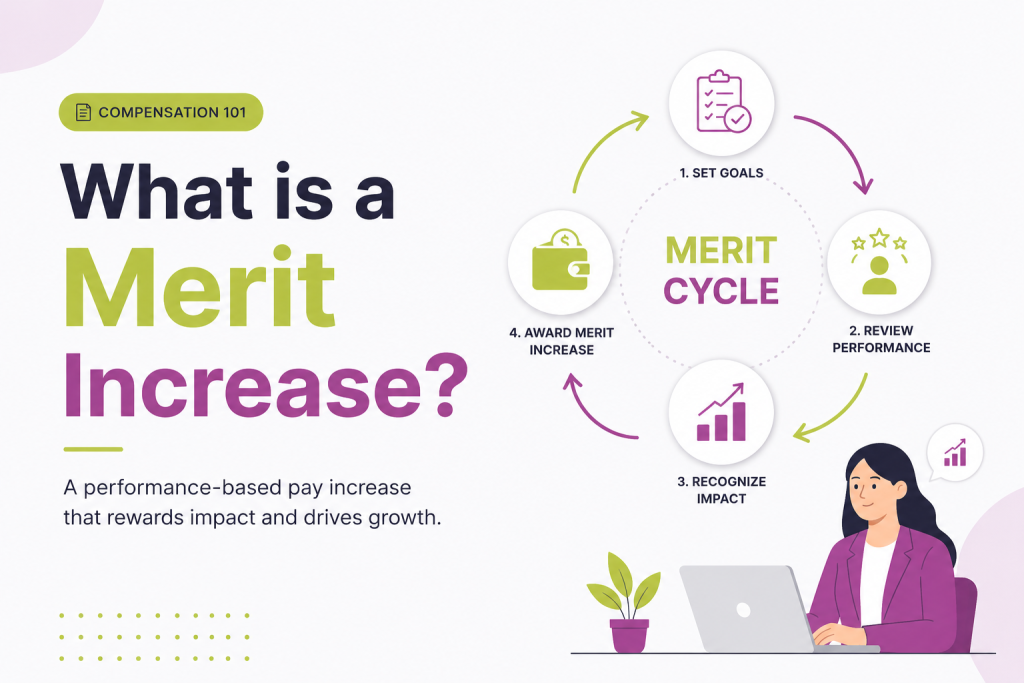
A merit increase is a permanent raise to an employee’s base salary, given in recognition of individual job performance. Unlike a bonus, which is a one-time payment, a merit increase becomes part of the employee’s ongoing salary going forward.
Merit increases are typically awarded on an annual or semi-annual cycle, often tied to a performance review. The size of the increase usually reflects how an employee performed against expectations, with higher performers receiving larger increases and average performers receiving smaller ones.
Also read: HRIS Implementation: A Step-by-Step Guide
Merit Increase vs. Other Types of Pay Raises
It’s easy to confuse a merit increase with other compensation adjustments. Here’s how they differ:
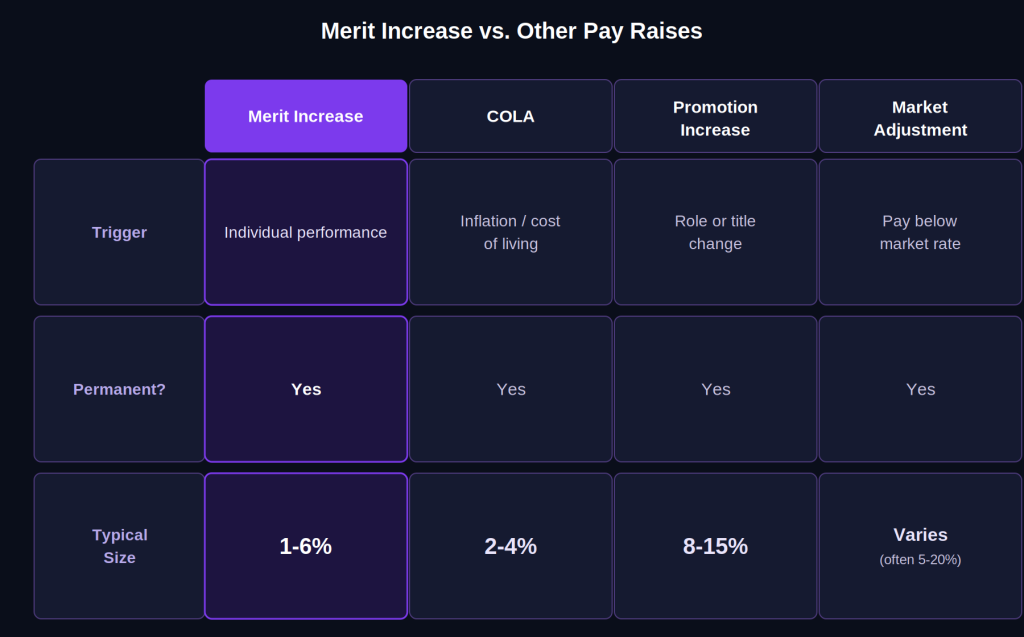
Merit increase vs. cost-of-living adjustment (COLA): A COLA is a raise applied broadly across the workforce to help pay keep pace with inflation, regardless of individual performance. A merit increase, by contrast, is tied specifically to how an employee performed.
Merit increase vs. promotion increase: A promotion increase accompanies a change in role, title, or responsibility level, and is usually larger than a merit increase since it reflects a shift into a higher pay band. A merit increase happens without a change in role.
Merit increase vs. bonus: Bonuses are variable, one-time payments that don’t change base salary. Merit increases are permanent additions to base pay that compound over time.
Merit increase vs. market adjustment: A market adjustment corrects pay that’s fallen behind current market rates for a role, independent of performance. A merit increase reflects performance, not market positioning.
Understanding these distinctions matters because companies often combine several of these mechanisms in the same compensation cycle, and employees deserve clarity on which type of increase they’re receiving and why.
Also read: What is Total Rewards? A Guide for HR and People Teams
How Merit Increases are Calculated
Most organizations calculate merit increases as a percentage of an employee’s current base salary. That percentage typically comes from a merit matrix, sometimes called a merit grid, which maps performance rating against position in the pay range (often called compa-ratio) to determine an appropriate increase percentage.
A simplified merit matrix might look like this:
| Performance Rating | Below Range Midpoint | At Range Midpoint | Above Range Midpoint |
|---|---|---|---|
| Exceeds Expectations | 5-6% | 4-5% | 3-4% |
| Meets Expectations | 3-4% | 2-3% | 1-2% |
| Below Expectations | 0-1% | 0% | 0% |
The logic behind this structure is straightforward. Employees already paid near or above the midpoint of their salary range receive smaller percentage increases even for strong performance, since they’re already compensated competitively. Employees lower in their range have more room to grow, so strong performers there may see larger increases.
Companies typically start with an overall merit budget, expressed as a percentage of total payroll, for example 3.5% for the year. Managers then work within that budget to differentiate increases across their team, giving above-average raises to top performers and below-average or no raises to underperformers, while keeping the average close to the budgeted figure.
Who is Eligible for a Merit Increase?
Eligibility rules vary by company, but common criteria include:
- Tenure requirements. Many companies require an employee to have been in their role for a minimum period, often six months to a year, before qualifying for a merit increase.
- Performance review completion. Since merit increases are tied to performance, employees usually need a completed and rated performance review for the relevant cycle.
- Active employment status. Employees must typically be actively employed on a specific date, sometimes called the effective date, to receive the increase.
- Not already at the top of the pay range. Some organizations cap merit increases for employees already at or above the maximum of their salary range, since further increases would place them outside the intended range for the role.
New hires and employees who received a promotion increase earlier in the same cycle are sometimes excluded from that cycle’s merit increase, since they’ve already received a compensation adjustment.
Also read: Agentic AI in HR: What Changes When AI Doesn’t Just Draft, But Acts
Why Companies Use Merit Increases
Merit-based pay serves several purposes for an organization:
Retention of top performers. Differentiated pay increases signal to high performers that their contributions are recognized, which helps retain talent that might otherwise be tempted by competing offers.
Performance motivation. When employees understand that stronger performance leads to larger pay increases, it reinforces a performance-oriented culture.
Budget discipline. A merit matrix approach lets organizations control overall payroll growth while still rewarding individual contribution, since the total increase budget is set in advance.
Fairness and consistency. A structured, documented process for merit increases helps managers apply consistent logic across their teams rather than making ad hoc decisions, which also supports pay equity efforts.
Common Challenges With Merit Increases
Despite their widespread use, merit increase programs come with real challenges.
Rating inflation. If most employees receive similar performance ratings regardless of actual performance, the merit increase system loses its ability to meaningfully differentiate pay, undermining the whole point of the exercise.
Budget compression. In years with tight merit budgets, even strong performers may receive increases too small to feel meaningful, which can hurt morale rather than help it.
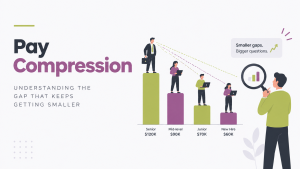
Pay compression. When merit increases are small and infrequent, new hires brought in at current market rates can end up earning close to, or more than, tenured employees performing the same role. This is one of the more damaging side effects of underinvesting in merit increases over time.
Manager inconsistency. Without clear guidelines and calibration, different managers may apply merit increases inconsistently across the organization, creating fairness concerns.
Lack of transparency. Employees who don’t understand how their increase was calculated, or how it compares to company guidelines, are more likely to feel confused or undervalued even if the increase itself was fair.
Best Practices for Managing Merit Increases
Use a clear merit matrix. Document the logic connecting performance rating and compa-ratio to increase percentage, and make sure managers understand and apply it consistently.
Calibrate performance ratings before finalizing increases. A calibration process, where managers discuss and align ratings across teams, helps reduce rating inflation and inconsistency.
Communicate the “why,” not just the number. Employees respond better to a raise when they understand the reasoning behind it, including how their performance and current pay position factored into the decision.
Monitor for pay compression and equity gaps. Regularly review how merit increases are affecting pay relationships across tenure, gender, and other dimensions to catch problems early.
Combine with other compensation tools when appropriate. In some cases, a merit increase alone won’t fully address a pay gap or market misalignment. Pairing it with a targeted market adjustment or considering promotion timing separately can create a more complete compensation picture.
Use compensation software to model scenarios. Modern compensation platforms, including AI-assisted tools, can model different merit budget scenarios, flag employees at risk of falling below their range minimum, and help managers stay within budget while making fair, defensible decisions faster than manual spreadsheet processes allow.
Final Thoughts
A merit increase is more than a routine annual raise. It’s a tool that, when used well, reinforces performance, supports retention, and keeps compensation fair and competitive over time. When used poorly, through rating inflation, inconsistent application, or under-resourced budgets, it can quietly erode both trust and pay equity. Getting the mechanics right, and communicating them clearly, is what separates a merit increase program that actually works from one that exists on paper only.